Market Summary
Executive Summary and Global Market Analysis
Meat processing equipment comprises engineered systems that cut, grind, blend, fill, tenderize, smoke, and cook animal protein under controlled production conditions. These machines support throughput consistency, hygiene control, and recipe precision across primary and secondary processing lines. Their role extends beyond mechanical handling, as processors rely on them to maintain texture, portion uniformity, and thermal performance across high-volume operations.
Market momentum reflects the need for efficient protein handling, tighter food safety execution, and greater line reliability in labor-constrained environments. Processors are modernizing plant layouts to reduce manual intervention, standardize yields, and improve sanitation outcomes. As product portfolios widen across chilled, cooked, marinated, and value-added formats, equipment selection increasingly centers on flexibility, uptime, and process control.
Segment positioning highlights broad demand across product type, automation level, meat type, and end-user environments. Cutting and grinding systems remain foundational because they shape upstream material preparation for downstream forming and cooking stages. Automatic configurations attract large processors seeking repeatable performance, while semi-automatic and manual formats remain relevant where batch diversity, plant scale, or capital priorities differ.
Technology development is shifting equipment design toward integrated controls, washdown-ready construction, and smarter monitoring across critical processing stages. Manufacturers are refining servo-driven filling, programmable mixing, and thermal systems that support recipe accuracy with reduced giveaway. This evolution is improving changeover efficiency and reinforcing traceable production workflows in facilities balancing output targets with compliance requirements.
Competitive conditions remain centered on equipment breadth, application expertise, aftermarket support, and system integration capabilities. Vendors are differentiating through modular line design, processor-specific engineering, and lifecycle services that help customers sustain utilization. The market therefore reflects not only machinery demand, but also the strategic importance of adaptable platforms aligned with evolving processing requirements.
Segment Analysis
Meat Processing Equipment Market Segmentation
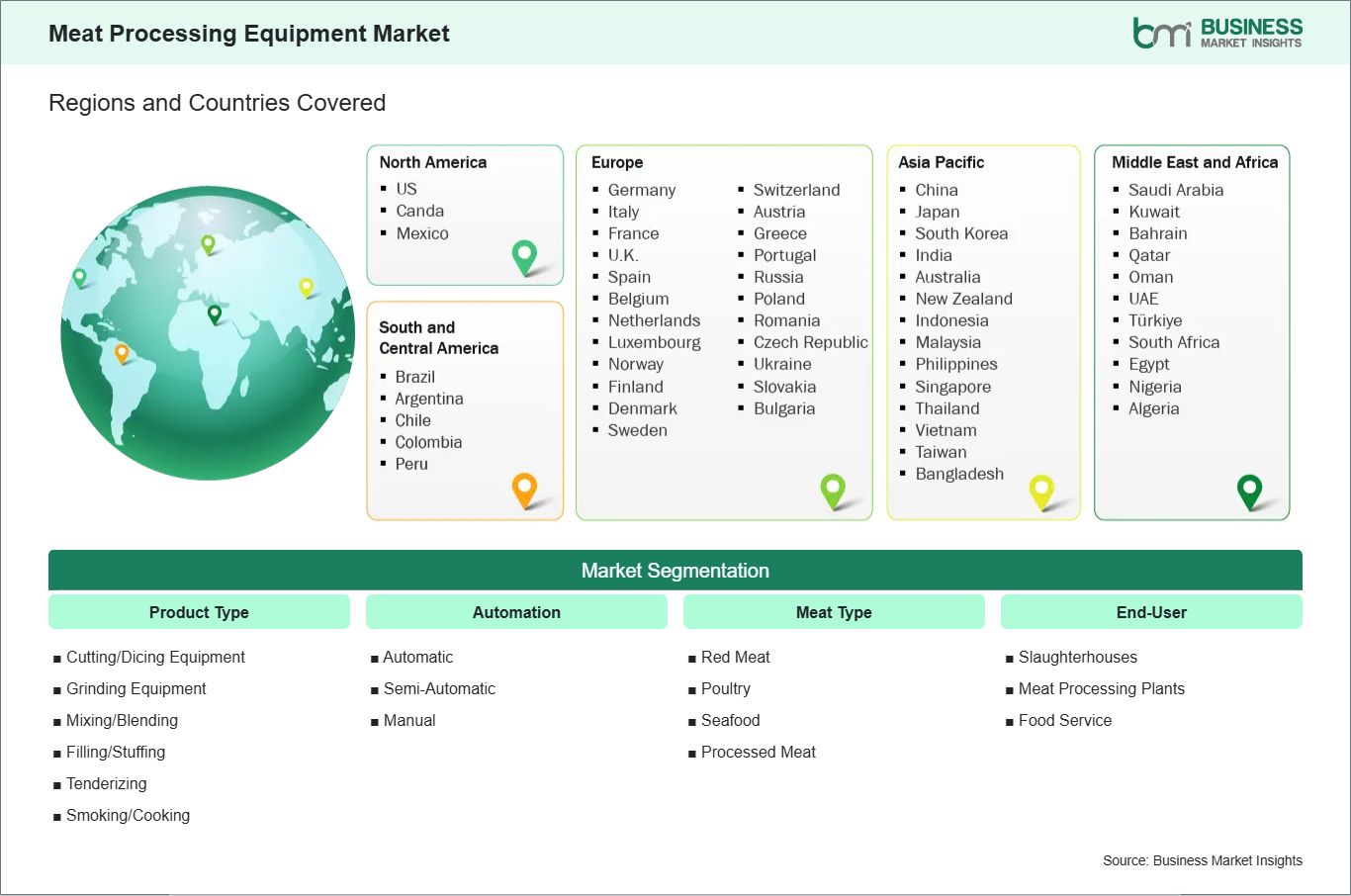
The Meat Processing Equipment market is segmented by product type, automation, meat type, and end-user, reflecting plant configuration needs and processing complexity across operating environments.
By Product Type
- Cutting/Dicing Equipment: Shapes portion size and improves downstream uniformity.
- Grinding Equipment: Supports texture control for minced and formed products.
- Mixing/Blending: Enables even ingredient distribution across batch formulations.
- Filling/Stuffing: Advances portion accuracy for sausages and prepared items.
- Tenderizing: Enhances bite consistency in structured muscle products.
- Smoking/Cooking: Delivers thermal treatment and flavor development in one stage.
By Automation
- Automatic: Prioritizes throughput stability and repeatable line performance.
- Semi-Automatic: Balances operator control with process efficiency.
- Manual: Fits smaller facilities with flexible batch handling needs.
By Meat Type
- Red Meat: Requires robust systems for dense muscle processing tasks.
- Poultry: Favors hygienic, high-speed equipment for volume-oriented lines.
- Seafood: Demands gentle handling and corrosion-conscious equipment design.
- Processed Meat: Relies on integrated steps for mixing, filling, and cooking.
By End-User
- Slaughterhouses: Use heavy-duty equipment for initial preparation and conversion.
- Meat Processing Plants: Operate integrated lines for scaled product transformation.
- Food Service: Prefers compact systems for controlled batch preparation.
Market Forces
Meat Processing Equipment Market Drivers and Opportunities
Automation Upgrades Across Protein Processing Facilities
Processors are reconfiguring production lines to handle tighter hygiene demands, higher throughput expectations, and more standardized product specifications. That shift creates a clear need for equipment that reduces manual contact, improves cut precision, and stabilizes batch execution. As facilities pursue greater operational discipline, investment is moving toward automated cutting, grinding, mixing, and thermal systems that align daily output with quality targets.
The effect is visible in plant modernization programs focused on sanitation efficiency, yield management, and consistent finished-product attributes. In this context, advanced machinery becomes relevant not only for speed, but also for repeatable process control across demanding production schedules. The market benefits as processors prioritize equipment platforms that support reliable execution in multi-shift environments and increasingly complex product mixes.
Smart Processing Systems for Flexible Product Portfolios
A notable opportunity is emerging from the shift toward flexible production architectures that can accommodate diverse protein formats and recipe changes. Equipment suppliers are introducing smarter controls, modular assemblies, and programmable functions that simplify transitions between product runs. These innovations are particularly useful in filling, blending, and cooking operations where formulation integrity and process timing directly influence product consistency.
Future scope extends across processors seeking adaptable lines that can support premium, convenience-oriented, and prepared meat categories without prolonged changeovers. This creates room for broader deployment of digitally assisted equipment in both established plants and expanding processing networks. As operational flexibility becomes a stronger purchasing criterion, suppliers with scalable and application-specific solutions can strengthen their position across this sector.
Size and Share Analysis
Meat Processing Equipment Market Size and Share Analysis
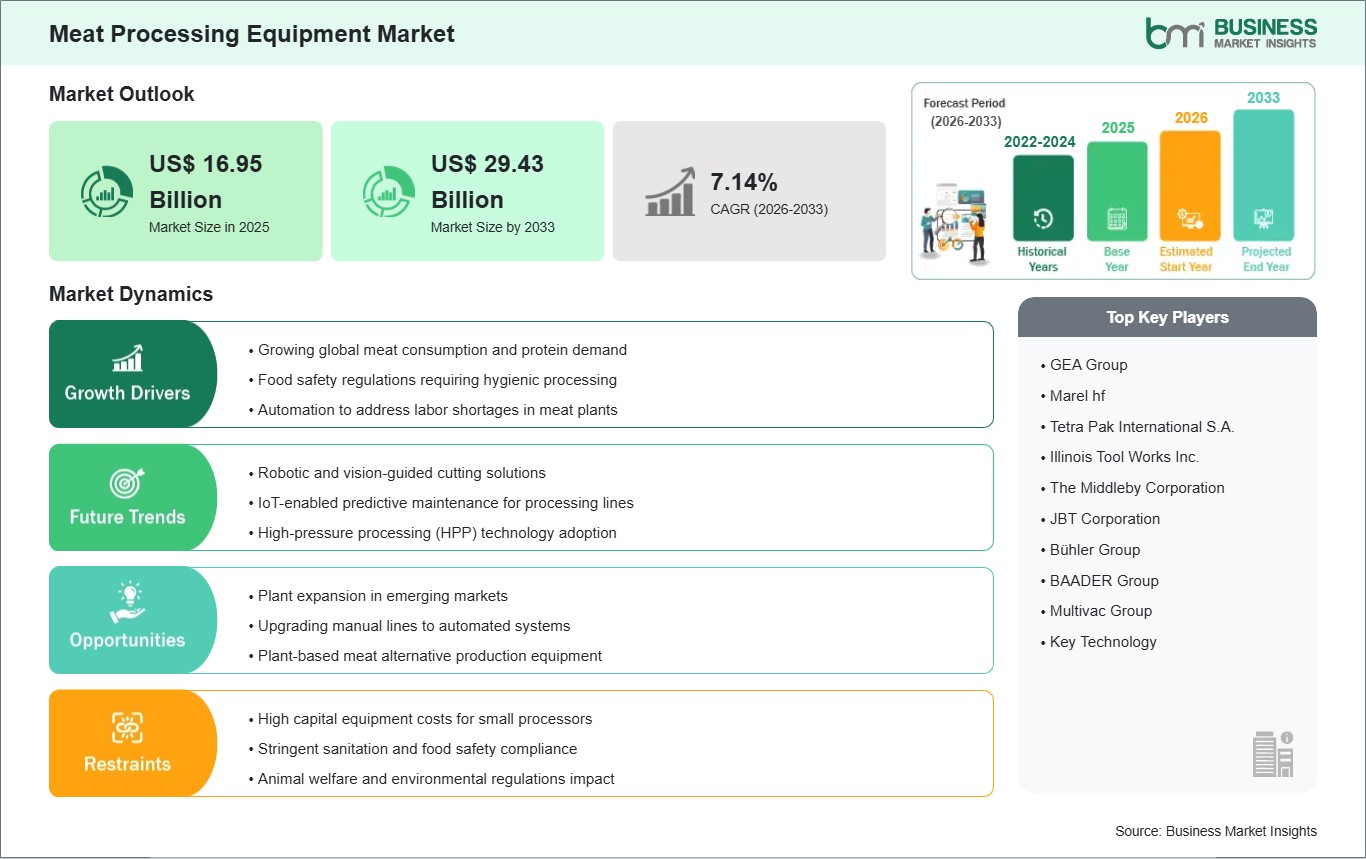
The Meat Processing Equipment market size is expected to reach US$ 29.43 Billion by 2033 from US$ 16.95 Billion in 2025. The market is estimated to record a CAGR of 7.14% from 2026 to 2033. This trajectory reflects steady capital allocation toward line modernization, sanitation-focused design, and higher process consistency across protein handling operations.
By product type, cutting/dicing equipment and grinding equipment hold a central position because they anchor upstream material preparation and influence downstream efficiency. Automatic systems command stronger interest among larger processors due to their repeatable performance, while semi-automatic and manual formats remain relevant where production scale and workflow flexibility shape equipment choices.
By application context, meat processing plants represent the dominant end-user environment as they require integrated equipment across multiple transformation stages. Demand is also sustained in slaughterhouses for primary conversion tasks, while food service settings support more compact equipment needs tied to controlled-volume preparation and menu standardization.
Report Coverage
Meat Processing Equipment Market Report Coverage and Deliverables
The "Meat Processing Equipment Market Size and Forecast (2022-2033)" report provides a detailed analysis of the market covering the areas below:
- Market size and forecast at global, regional, and country levels for all the key market segments covered under the scope
- Market trends, as well as market dynamics such as drivers, restraints, and key opportunities
- Market analysis covering key market trends, global and regional framework, major players, regulations, and recent market developments
- Industry landscape and competition analysis covering market concentration, heat map analysis, prominent players, and recent developments for the market
- Detailed company profiles, including SWOT analysis
Geographic Insights
Meat Processing Equipment Market Geographic Insights
The Meat Processing Equipment market shows diverse regional adoption patterns influenced by protein consumption structures, plant modernization priorities, regulatory expectations, and processing intensity across supply chains. Global demand reflects the need for equipment that can improve hygiene execution, yield consistency, and throughput across both established processors and expanding production networks.
North America maintains a mature procurement environment supported by large-scale processing infrastructure, replacement demand, and a strong focus on labor efficiency. Equipment selection in the region increasingly emphasizes automation depth, sanitation-oriented engineering, and dependable aftermarket support. Processors are attentive to line resilience, especially where product uniformity and uptime influence operating economics.
Asia Pacific presents a different growth profile, shaped by expanding processing capacity, shifting food distribution models, and the formalization of protein value chains. Manufacturers and processors across the region are increasing equipment deployment to improve handling efficiency and support broader product portfolios. Demand is particularly aligned with scalable systems that can serve both volume expansion and operational standardization.
Europe continues to emphasize precision engineering, process reliability, and compliance-led equipment design, which sustains demand for advanced integrated systems. Emerging markets in the Middle East, Africa, and South and Central America are progressing through selective investments tied to cold-chain development, domestic processing expansion, and food service supply needs. Together, these regions broaden the market’s long-term equipment replacement and installation base.
Industry Activity
Recent Developments
The Meat Processing Equipment Market is evaluated by gathering qualitative and quantitative data post primary and secondary research, which includes important corporate publications, association data, and databases. Recent developments and news in the market include:
- In January 2026, Henco Machinery manufacturer announced the launch of its newly developed Meat Equal-Weight Cutting Line. This cutting-edge solution is set to redefine efficiency, precision, and safety standards in the meat processing sector, addressing the industry's pressing needs for cost optimization, waste reduction, and consistent product quality.
- In April 2024, JBT Corporation (NYSE: JBT), a leading global technology solutions provider to high-value segments of the food & beverage industry, announced that JBT and Marel hf. (ICL: Marel) have executed a definitive transaction agreement related to JBT’s previously announced intention to make a voluntary takeover offer for all of the issued and outstanding shares of Marel. The transaction agreement includes the terms of the offer and other important governance, social, and operating items relating to the proposed business combination of JBT and Marel. The transaction agreement was approved by the Boards of Directors of both companies.
Trust & Transparency
Research Methodology
The market analysis combines proprietary research with secondary data from government agencies, company disclosures, regulatory filings, industry databases and expert interviews. Market estimates are validated through data triangulation, cross-market benchmarking and analyst
review.
View Full Research Methodology
Key Sources Referred:
World Bank: Global Trade IndicatorsWorld Trade Organization (WTO)International Monetary Fund (IMF)International Trade Administration (ITA)Company WebsitesCompany Annual ReportsCompany Investor Presentations