
Food Processing and Handling Equipment Market Outlook: Size, Share, Trends, Growth Analysis, Competitive Landscape & Forecast, 2026-2033

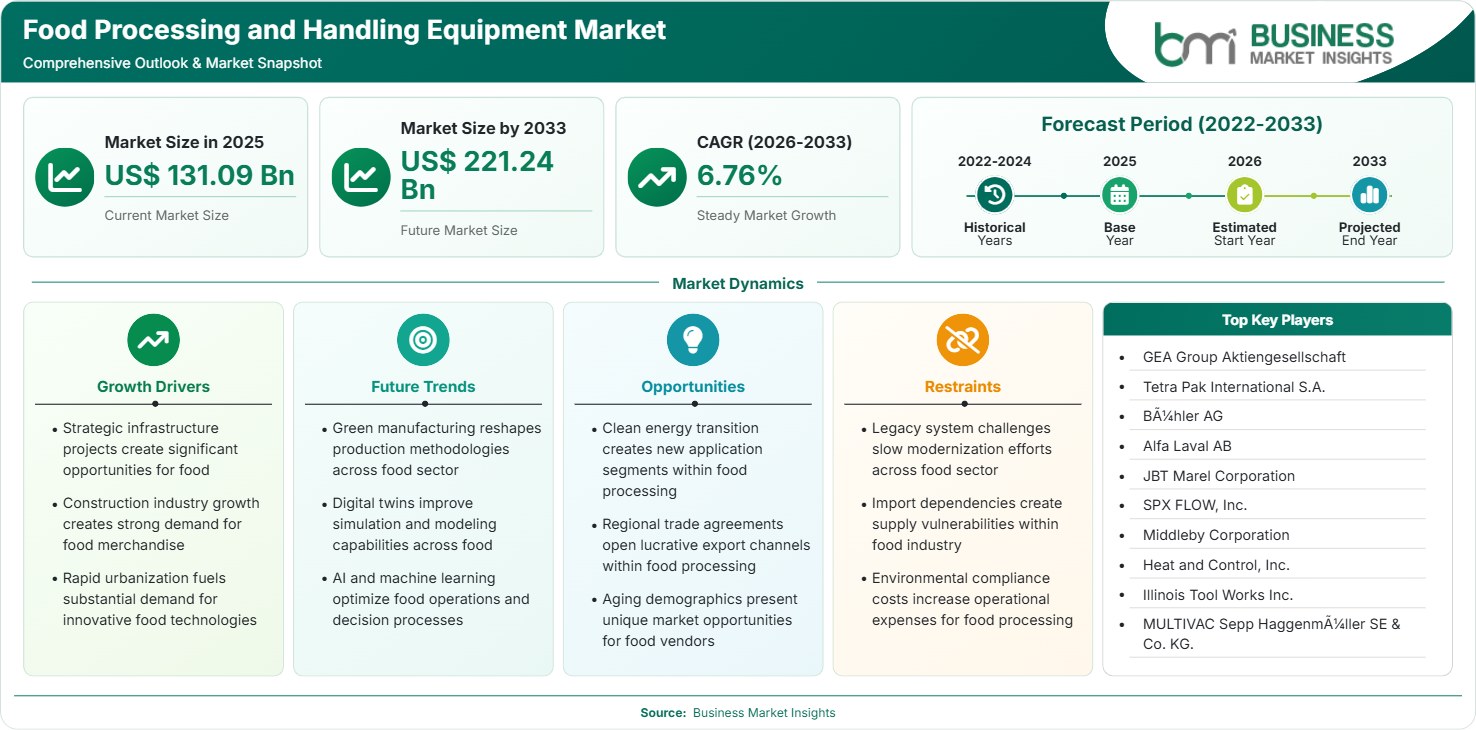
The Food Processing and Handling Equipment Market size was valued at US$ 131.09 Billion in 2025 and is projected to reach US$ 221.24 Billion by 2033, growing at a CAGR of 6.76% during 2026–2033. Demand for automation, food safety compliance, energy-efficient systems, smart factories, and value-added packaged foods continues to create strong expansion opportunities across processing and packaging operations.

Report Coverage
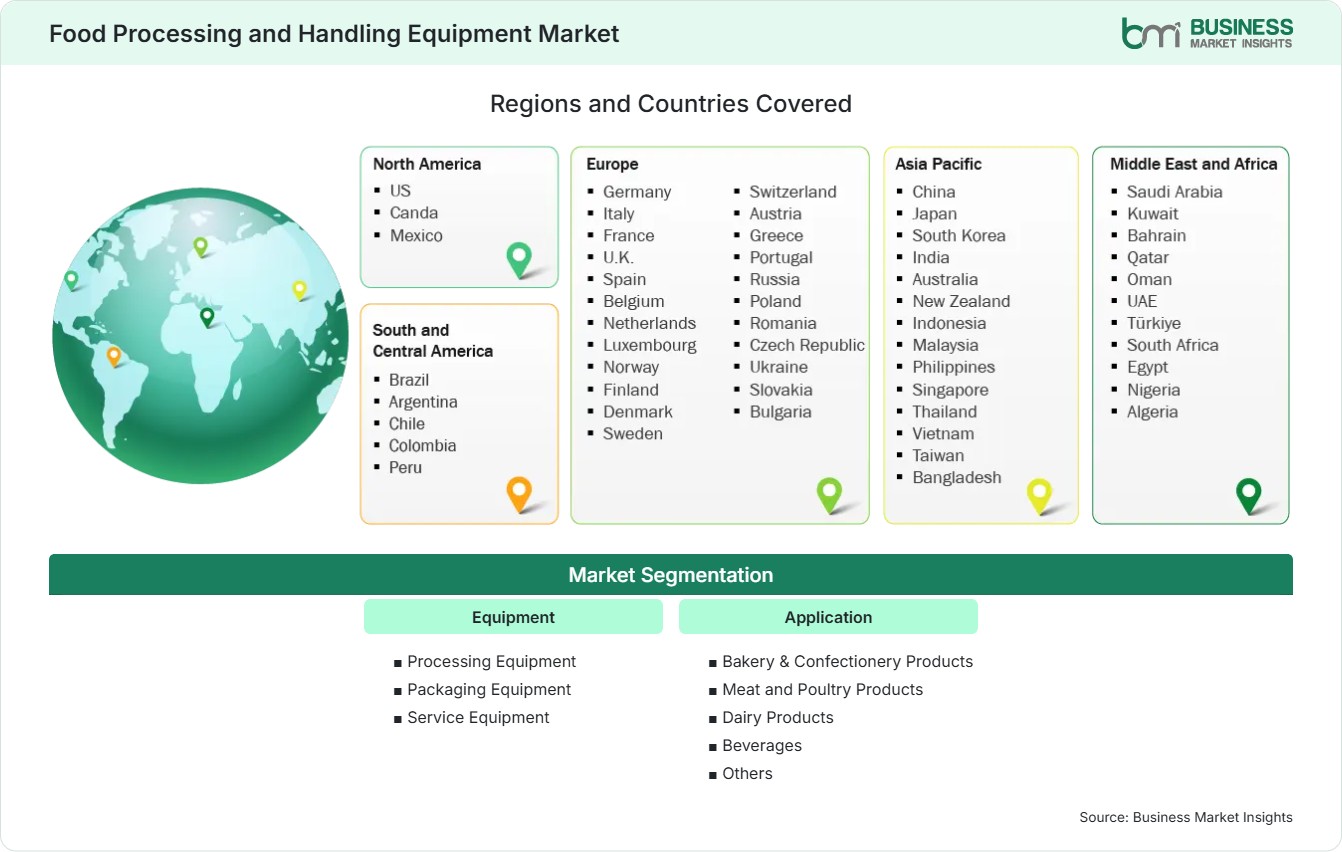
  • Equipment: Processing Equipment, Packaging Equipment, Service Equipment
  • Application: Bakery & Confectionery Products, Meat and Poultry Products, Dairy Products, Beverages, Others
US$ 131.09 Bn Market size in 2025
US$ 221.24 Bn Market Size by 2033
6.76% CAGR, 2026 - 2033
2026-2033 Forecast Period

AI Overview

Food Processing and Handling Equipment Market Summary

  • North America Region: North America holds a market share of 34%–37% in 2025, growing at a CAGR of 5.8%–6.4% during 2026–2033. Growth is supported by automation upgrades, labor shortages, traceability requirements, sustainable packaging investments, robotics deployment, ready-to-eat food demand, predictive maintenance adoption, and modernization across processing facilities. U.S. demand remains strong due to large-scale food manufacturing, digitalization initiatives, and replacement investments, advancing at approximately 5.9%–6.5% CAGR.
  • Fastest Growing Region: Asia Pacific accounts for 27%–30% share in 2025 and expands at 7.9%–8.6% CAGR. Rising disposable incomes, rapid food industrialization, cold-chain expansion, export-oriented processing investments, urban consumption patterns, and government support are strengthening equipment demand.
  • Leading Segment: Processing Equipment captures 52%–56% share in 2025 and advances at 6.3%–6.9% CAGR. Adoption benefits from productivity improvements, hygienic processing requirements, energy optimization initiatives, automation integration, throughput enhancement efforts, food safety compliance, and continuous production modernization.
  • High Growth Segment: Beverages represents 18%–22% share in 2025 and records 7.5%–8.2% CAGR. Premium drinks, plant-based beverages, functional nutrition products, automation investments, aseptic technologies, sustainable production goals, packaging innovation, and export demand support expansion.
  • Key Market Opportunity: Growth potential is emerging from AI-enabled production monitoring, smart processing lines, digital twins, robotics integration, remote diagnostics, energy management solutions, and sustainability-focused retrofits across food manufacturing facilities worldwide.
  • Major Market Players: GEA Group Aktiengesellschaft, Tetra Pak International S.A., Bühler AG, Alfa Laval AB, JBT Marel Corporation, SPX FLOW, Inc., Middleby Corporation, Heat and Control, Inc., Illinois Tool Works Inc., and MULTIVAC Sepp Haggenmüller SE & Co. KG.
Strategic Insights

Food Processing and Handling Equipment Market: Strategic Insights

Food Processing and Handling Equipment Market Strategic Framework
FREE PDF
Request your free sample
Request free sample
Stakeholder View

Key Takeaways

  • Supply chains are increasingly integrated, with equipment vendors providing processing, packaging, software, maintenance, and analytics within unified operational ecosystems.
  • Beverage, dairy, and value-added protein production present attractive expansion opportunities due to rising consumer demand and stricter quality requirements.
  • Artificial intelligence, machine vision, and predictive maintenance technologies are reshaping manufacturing performance metrics and operational decision-making.
  • Asia Pacific offers the strongest medium-term investment case due to urbanization, food industry expansion, and manufacturing localization initiatives.
  • Industry consolidation continues as vendors acquire automation, software, and specialty processing technology providers to broaden capabilities.
  • Sustainability-driven retrofits involving energy recovery, water optimization, and waste reduction are creating recurring aftermarket revenue opportunities.
Geographic Outlook

Food Processing and Handling Equipment Market Regional Highlights

North America Food Processing and Handling Equipment Market

North America accounted for a 34%–37% share in 2025 and is expected to grow at 5.8%–6.4% CAGR through 2033. Strong packaged food consumption, automation investments, and regulatory compliance spending support demand. The region records the largest Food Processing and Handling Equipment Market share due to its mature processing infrastructure and continuous modernization activities.

  • Labor shortages accelerate robotics and automated handling system deployment.
  • Sustainability targets drive investment in energy-efficient processing technologies.
  • High adoption of digital monitoring improves operating performance.
  • Food safety regulations encourage replacement of aging equipment.
  • Strong aftermarket service demand supports recurring revenues.

US Food Processing and Handling Equipment Market

The United States represents 76%–80% of North American demand and advances at approximately 5.9%–6.5% CAGR. Investments in protein processing, beverages, automation, and smart manufacturing continue to influence purchasing decisions. Capital expenditure remains focused on productivity enhancement and food safety compliance.

  • Robotics adoption improves throughput while reducing labor dependency.
  • Traceability and inspection systems gain importance across production lines.
  • Sustainable packaging initiatives support packaging equipment investments.
  • Digital factory technologies improve asset utilization and maintenance planning.

Europe Food Processing and Handling Equipment Market

Europe has a 26%-29% market share and is growing at a 5.7%-6.3% CAGR. Germany is leading regional demand, and Eastern European markets are driving growth. Energy efficiency, sustainability, and advanced food manufacturing contribute to market growth.

  • Germany remains the leading market through strong industrial food production.
  • Poland and Romania demonstrate faster growth from capacity investments.
  • Circular economy initiatives support process modernization projects.
  • Automation adoption reduces operational costs and waste generation.
  • Premium food exports sustain technology upgrades.

Asia Pacific Food Processing and Handling Equipment Market

Asia Pacific region holds a 27%–30% market share in 2025 and experiences the fastest growth at 7.9%–8.6%. China is the largest market in the region, and other fast-growing markets include India and Vietnam. Growth is driven by the expanding food packaging industry and rising consumer spending, which drives equipment purchases.

  • Food industrialization expands processing capacity across major economies.
  • Cold-chain investments encourage modernization of production facilities.
  • Export-oriented manufacturing supports advanced processing technologies.
  • Government programs encourage food safety and automation adoption.
  • Urbanization boosts demand for packaged and convenience foods.

Rest of World Food Processing and Handling Equipment Market

Rest of World accounts for 10%–13% share and advances at 6.8%–7.5% CAGR. South & Central America benefit from meat and agricultural processing expansion, while the Middle East and Africa gain momentum through food security initiatives and manufacturing investments.

  • Brazil leads regional demand through large-scale food exports.
  • Saudi Arabia shows strong growth supported by industrial diversification.
  • Processing localization investments increase equipment purchases.
  • Modern retail expansion supports packaged food manufacturing.
  • Capacity additions strengthen regional food self-sufficiency objectives.
Global Market Geography
FREE PDF
Request your free sample
Request free sample
Segment Analysis

Food Processing and Handling Equipment Market Segmentation

Equipment

Equipment is the largest sector, with a share of around 62%-66% in 2025 and a CAGR of 6.4%-7.0%. The scope of the Food Processing and Handling Equipment Market in this category continues to broaden as processors pursue efficiency, automation, and hygiene improvements across production facilities.

  • Processing Equipment: Widely adopted for mixing, cooking, slicing, separation, and thermal operations, supported by productivity enhancement initiatives, regulatory compliance requirements, and growing processed food output.
  • Packaging Equipment: Demand rises from sustainability requirements, product protection needs, traceability expectations, and increasing consumption of packaged food products across global markets.
  • Service Equipment: Includes cleaning, inspection, conveying, and support systems that improve operational reliability, food safety performance, and overall production efficiency.

Application

Application demand is driven by changing dietary preferences, convenience food consumption, product innovation, and modernization investments. The Food Processing and Handling Equipment Market trends indicate growing adoption across diversified food manufacturing industries with an estimated 34%–38% share and 6.8%–7.4% CAGR.

  • Bakery & Confectionery Products: Equipment demand benefits from product diversification, premium offerings, packaging innovation, and growing convenience consumption patterns.
  • Meat and Poultry Products: Automation requirements, hygiene standards, and labor optimization initiatives support steady technology investments and capacity expansion.
  • Dairy Products: Processing modernization enhances efficiency, product consistency, and food safety performance across milk and value-added dairy applications.
  • Beverages: Strong investments in aseptic processing, functional beverages, plant-based drinks, and packaging systems sustain above-average growth prospects.
Market Forces

Food Processing and Handling Equipment Market Dynamics

Key Market Drivers

Automation and Smart Manufacturing Adoption

The use of robotics, machine vision technologies, industrial IoT solutions, and predictive maintenance tools is becoming more prevalent in food production companies. Higher labor costs and labor shortages incentivize food producers to invest in automated handling and processing equipment. Modern equipment helps minimize downtime and increase efficiency. Food manufacturers prefer connected equipment that can be monitored and optimized in real time. These factors are strengthening long-term industry competitiveness and accelerating technology upgrades across processing facilities worldwide.

Stringent Food Safety Regulations

The international standards for food safety still require investment in hygiene, protection against contamination, inspection procedures, and traceability systems. Meeting the requirements of regulatory agencies such as the FDA and EFSA drives demand for equipment that meets sanitary standards. Modern production technologies enable compliance with standards and minimize risks. Food producers update their equipment with more sophisticated systems that ensure high quality.

Growth in Processed and Convenience Foods

The urban lifestyle, rising income levels, and changes in consumption habits drive demand for packaged foods. An increase in production volume requires higher-capacity machines and packaging technologies. The demand exists in areas like bakery products, dairy products, beverages, meats, and ready-to-eat products. Growth in retail sales through online channels also aids the modernization of the food processing industry.

Key Market Opportunities

AI-Enabled Production Optimization

Artificial intelligence is revolutionizing production optimization through improved process monitoring, quality control, predictive maintenance, and energy management. By using AI-based analytics, manufacturers can identify inefficiencies and optimize operations to increase production while reducing waste, maintenance time, and operational costs. Predictive maintenance techniques can help detect equipment problems before they arise, minimizing downtime and equipment wastage. Equipment providers who use advanced software platforms alongside processing technologies can build stronger relationships with their customers, earn recurring income streams, and add more value.

Expansion in Emerging Food Manufacturing Hubs

Emerging food manufacturing clusters in Southeast Asia, India, the Middle East, and certain African countries are seeing large investments in domestic food manufacturing capacity. The authorities, as well as the business community, are establishing state-of-the-art food processing plants to improve food security, reduce dependence on imports, and meet growing consumer demand. New food processing plants need high-tech equipment right from the start, creating significant opportunities for suppliers of efficient, dependable equipment. The Food Processing and Handling Equipment market forecasts bode well for continued investments and capital spending.

Sustainability-Oriented Equipment Retrofits

The increasing emphasis on sustainable projects by manufacturers through energy efficiency, water savings, and waste minimization is evident. The installation of modern equipment in the existing plant is an economical way to achieve these goals without incurring the additional costs of constructing a new plant. The modified machines would save resources, reduce operational expenses, and improve the company's environmental performance. In addition, they would help the company comply with environmental standards and practice sustainable development. As the number of companies pursuing sustainable development increases, the need for retrofitted equipment would increase. As organizations' commitment to sustainable operations and reduced carbon emissions increases, there will be an increased demand for equipment retrofits.

Market Restraints and Challenges

High Capital Investment and Extended Payback Challenges

Factor: Modern processing and handling systems require substantial upfront capital investment, including equipment acquisition, installation, customization, and integration expenses. Economic uncertainty, budget constraints, and limited access to financing further increase the financial burden associated with modernization initiatives. Impact: High investment requirements often discourage small and medium-sized processors from replacing aging equipment despite the potential operational and productivity benefits. Organizations operating in cost-sensitive markets frequently postpone procurement decisions due to concerns over return on investment and extended payback periods. As a result, capital expenditure plans may be delayed, slowing the adoption of advanced processing and handling technologies across the industry.

Integration Complexity and Skilled Workforce Limitations

Factor: The deployment of advanced automated processing and handling systems requires specialized engineering expertise, technical training, and seamless integration with existing operational infrastructure. Many facilities continue to rely on legacy systems that present compatibility challenges during modernization projects. Impact: Integration complexities can extend implementation timelines and increase operational costs during transition phases. Organizations may experience difficulties optimizing system performance due to workforce skill gaps and limited technical expertise, particularly in developing regions. These challenges can reduce deployment efficiency, delay expected productivity gains, and ultimately constrain the adoption of sophisticated automation solutions within the market.

Company Analysis

Competitive Landscape

The Food Processing and Handling Equipment Market analysis indicates competition centered on automation, hygienic design, digital services, energy efficiency, and integrated processing capabilities.

Company Name

Overview

Products and Services relevant to this market

GEA Group Aktiengesellschaft

Global processing technology provider serving food, beverage, dairy, and industrial customers.

Processing systems, separators, packaging solutions, automation, service and maintenance.

Tetra Pak International S.A.

Major food and beverage processing and packaging technology company.

Processing equipment, filling systems, packaging technologies, plant integration services.

Bühler AG

Swiss engineering company active across food processing value chains.

Milling, mixing, extrusion, sorting, automation and digital solutions.

Alfa Laval AB

Specializes in heat transfer and fluid handling technologies.

Separation equipment, pumps, valves, thermal processing systems.

JBT Marel Corporation

Leading provider of protein and food processing technologies.

Meat, poultry, seafood processing equipment and automation platforms.

SPX FLOW, Inc.

Supplies process technologies for food and beverage industries.

Mixing, pumping, filtration, heat exchange and processing solutions.

Middleby Corporation

Diverse manufacturer serving commercial and industrial food markets.

Food processing lines, cooking technologies and automation systems.

Heat and Control, Inc.

Focuses on production efficiency and process optimization.

Conveying, frying, seasoning, inspection and packaging equipment.

Illinois Tool Works Inc.

Industrial technology company with food equipment operations.

Processing, packaging and production support technologies.

MULTIVAC Sepp Haggenmüller SE & Co. KG

Global packaging specialist with integrated processing capabilities.

Packaging systems, slicing technologies, labeling and inspection solutions.

Trust & Transparency

Research Methodology

The market analysis combines proprietary research with secondary data from government agencies, company disclosures, regulatory filings, industry databases and expert interviews. Market estimates are validated through data triangulation, cross-market benchmarking and analyst review.

View Full Research Methodology

Questions Answered

Frequently Asked Questions

Why are emerging markets attracting supplier investments?

Growing local food consumption, industrialization, export potential, and government food security initiatives create demand for modern manufacturing and processing infrastructure.

What does a Food Processing and Handling Equipment Market Report typically evaluate?

It assesses competitive positioning, technology adoption, regional demand patterns, regulatory influences, investment activity, supply chains, and future revenue opportunities.

How important is software integration in modern facilities?

Software increasingly enables predictive maintenance, production monitoring, quality control, traceability, and data-driven operational decision-making across processing environments.

Which application category offers the strongest long-term opportunity?

Beverages and value-added dairy applications present strong opportunities due to premiumization, functional nutrition products, and expanding global consumption patterns.

What factor most influences equipment replacement cycles?

Food safety compliance requirements, energy efficiency goals, maintenance costs, productivity expectations, and automation needs are the primary triggers for replacement decisions.

Access the Full Food Processing and Handling Equipment Market Report

Get segment-level forecasts, regional estimates, competitive benchmarking, company profiles and downloadable Excel datasets.

Access the full Food Processing and Handling Equipment Market Report
350 pages PDF & Excel | 2026-08-31