Market Summary
Executive Summary and Global Market Analysis
Carbonated beverage processing equipment comprises industrial systems designed for mixing, carbonation, thermal regulation, and ingredient integration during beverage manufacturing operations. These systems support production consistency, pressure management, product stability, and scalable beverage formulation across commercial bottling facilities. Equipment configurations differ according to beverage composition, automation requirements, and processing capacity standards adopted by manufacturers. Consumer preference shifts toward flavored sparkling drinks and fortified beverages continue reshaping processing requirements across beverage production facilities.
Manufacturers are modernizing processing lines to improve throughput efficiency, reduce ingredient waste, and maintain carbonation precision during large-scale operations. Expansion of ready-to-drink beverage categories has further strengthened procurement activity for advanced blending and heat exchange technologies. For instance, according to data published by GEA in April 2026, the company collaborated with Siemens to present a fully digital beverage production process integrating AI-driven analytics, cloud connectivity, and automated process optimization for advanced beverage manufacturing applications.
Segmentation patterns indicate strong utilization of carbonation and blending systems due to their direct involvement in product formulation accuracy. Soft drink production maintains broad equipment deployment across established bottling operations, while sparkling water manufacturing supports equipment upgrades emphasizing pressure control and filling compatibility. Fully automated systems are attracting attention from high-volume facilities focused on minimizing manual intervention and operational variability.
Technological advancement within this sector increasingly centers on process integration, programmable control systems, and energy-efficient production architecture. Modern equipment designs incorporate digital monitoring functions capable of optimizing carbonation levels, temperature regulation, and ingredient dosing accuracy. Modular system development also enables manufacturers to adapt production lines according to evolving beverage portfolios without extensive infrastructure modifications.
For instance, according to data published by Alfa Laval in June 2024, the company launched the Hygienic WideGap heat exchanger capable of reducing energy consumption and emissions during liquid food and beverage processing operations. Competitive conditions remain shaped by engineering specialization, equipment reliability, after-sales service capabilities, and customization expertise.
Market participants are concentrating on production flexibility and automation compatibility to strengthen long-term customer relationships. Strategic emphasis on operational efficiency and beverage quality consistency continues influencing purchasing decisions among beverage producers operating in mature and emerging consumption markets.
Segment Analysis
Carbonated Beverage Processing Equipment Market Segmentation
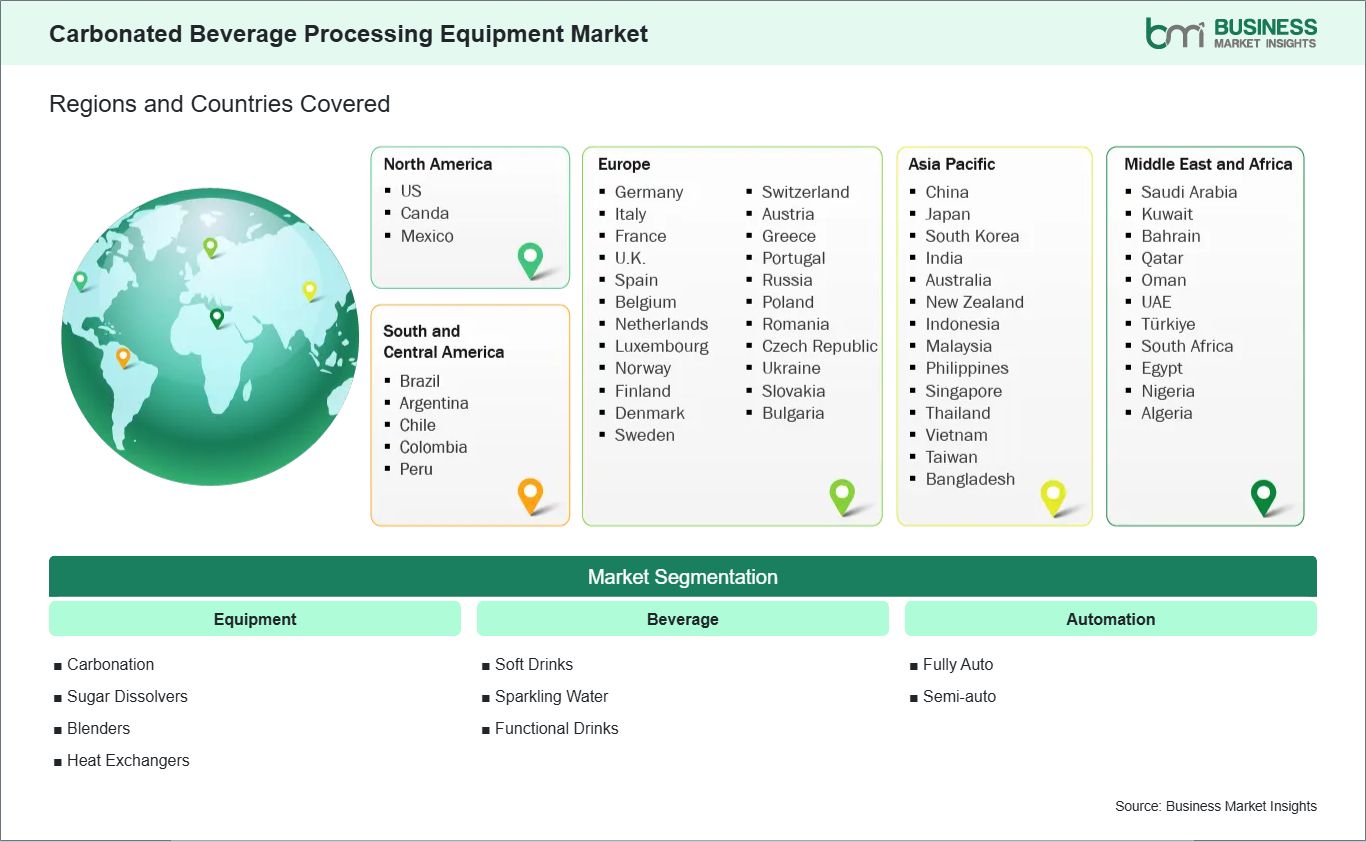
The carbonated beverage processing equipment market is segmented based on equipment type, beverage category, and automation level, reflecting the growing need for efficient production systems, consistent carbonation control, and optimized beverage formulation processes across industrial manufacturing environments.
By Equipment
- Carbonation - Supports precise carbon dioxide infusion for consistent beverage texture and taste.
- Sugar Dissolvers - Enhances ingredient dissolution efficiency during syrup preparation stages.
- Blenders - Enables uniform flavor integration across multi-ingredient beverage formulations.
- Heat Exchangers - Maintains controlled processing temperatures during beverage production cycles.
By Beverage
- Soft Drinks - Represents extensive processing demand across established bottling facilities.
- Sparkling Water - Encourages equipment modernization emphasizing carbonation consistency.
- Functional Drinks - Expands utilization of adaptable blending and ingredient management systems.
By Automation
- Fully Auto - Improves operational continuity through integrated production monitoring functions.
- Semi-auto - Offers flexibility for medium-capacity beverage manufacturing environments.
Market Forces
Carbonated Beverage Processing Equipment Market Drivers and Opportunities
Rising demand for carbonated soft drinks
Increasing trends of urban consumption and diversity in beverage offerings have been driving the beverage industry to make additional investments for increasing their production capacity. The production process necessitates high-quality equipment that includes carbonation equipment, blending machines, and temperature regulation equipment. An increase in the use of packaged beverages has led to the adoption of scalable processing equipment.
With the increased availability of flavored beverages and more refined carbonated beverages, there is an increase in demand for replacement of existing machinery. Manufacturers have become increasingly interested in technologies that facilitate precision control in addition to minimizing down time when production levels are at their highest. This is where the need for sophisticated processing machinery comes into play.
Functional sodas gaining popularity
The increasing demand for beverage products with vitamins, herbs, and other forms of sweeteners is influencing the formulation process at the carbonation plants. The functional soda drinks require precise blending systems with flexible ingredient formulation technologies that help maintain product uniformity. Beverage firms are adopting unique processing systems that accommodate different ingredients.
Product diversification in the future into different types of wellness drinks is expected to increase customization needs in relation to manufacturing equipment. Process equipment that can cater for multiple products is expected to be preferred in terms of business. Automation in handling and regulating temperature is also expected to affect future production decisions in this market segment.
Size and Share Analysis
Carbonated Beverage Processing Equipment Market Size and Share Analysis
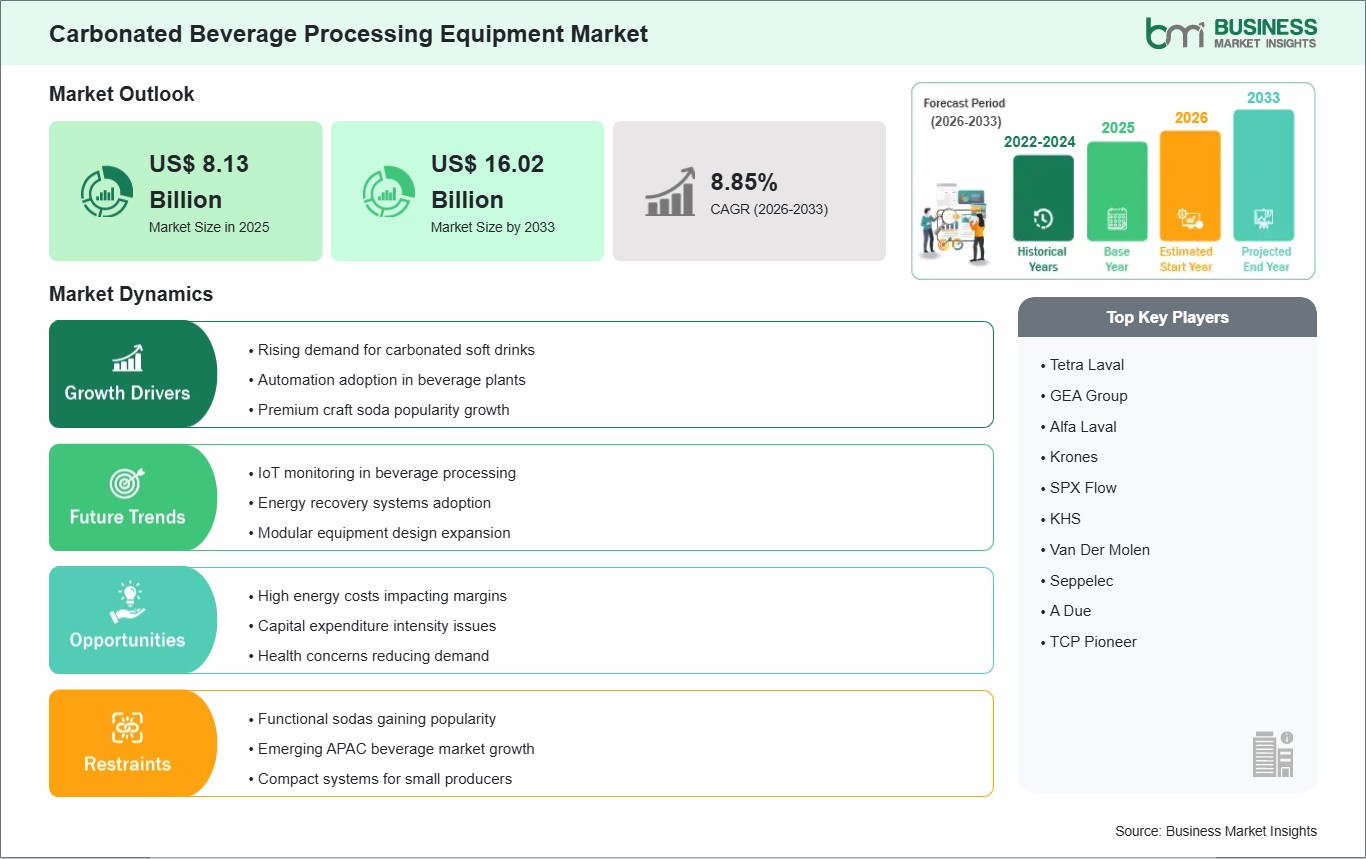
The Carbonated Beverage Processing Equipment Market is projected to grow from US$ 8.13 Billion in 2025 to US$ 16.02 Billion by 2033 , registering a CAGR of 8.85% from 2026 to 2033. The market expansion is supported by rising automation in beverage manufacturing facilities, increasing demand for consistent product quality, and expanding adoption of precision-controlled processing systems that enhance operational efficiency and production reliability.
By equipment, carbonation systems account for a significant share due to their essential role in maintaining beverage texture and carbonation consistency. Blenders continue witnessing broader deployment across multi-flavor beverage production environments requiring accurate ingredient integration. Sugar dissolvers remain important in syrup preparation processes supporting uniform sweetener distribution during large-scale manufacturing operations. Heat exchangers are expanding across advanced beverage facilities because of their capability to maintain controlled processing temperatures and product stability.
By beverage, soft drinks dominate market utilization owing to established global consumption patterns and extensive bottling infrastructure. Sparkling water production continues strengthening equipment demand as manufacturers expand flavored and premium hydration portfolios. Functional drinks are gaining momentum with increasing formulation complexity requiring adaptable blending and ingredient handling technologies.
By automation, fully automated systems hold a considerable market share due to their ability to improve operational continuity and production precision. Semi-automated configurations remain relevant among medium-capacity manufacturers seeking balanced operational flexibility and cost management. Automated processing integration is also advancing steadily as beverage producers prioritize reduced manual intervention and enhanced process synchronization.
Report Coverage
Carbonated Beverage Processing Equipment Market Report Coverage and Deliverables
The "Carbonated Beverage Processing Equipment Market Size and Forecast (2022 - 2033)" report provides a detailed analysis of the market covering below areas:
- The market size and forecast at global, regional, and country levels for all market segments covered under the scope
- The market trends, as well as drivers, restraints, and opportunities
- The market analysis covering key trends, global and regional framework, major players, regulations, and recent developments
- Industry landscape and competition analysis covering market concentration, heat map analysis, prominent players, and recent developments for the market
- Detailed company profiles, including SWOT analysis
Geographic Insights
Carbonated Beverage Processing Equipment Market Geographic Insights
The Carbonated Beverage Processing Equipment market shows diverse regional adoption patterns influenced by beverage consumption preferences, industrial automation readiness, production infrastructure, and manufacturing investment priorities. Trends related to the acquisition of equipment vary depending on local beverage ranges, the size of operations, and modernization programs implemented by beverage producers in different regions. The incorporation of processing technologies is constantly developing in conjunction with formulation and packaging innovations.
North America demonstrates mature deployment of advanced beverage processing systems supported by established soft drink manufacturing operations and automation-oriented production facilities. Regional drink manufacturers pay attention to accuracy in their operations, energy-efficient design of machinery, and process control mechanisms to guarantee product consistency. The requirement for advanced carbonation and mixing technology is still related to diversified products in carbonated and functional beverages.
In terms of Asia Pacific, increased industrialization can be seen through the increase in packaged beverages and manufacturing investments. There are efforts being made to enhance their manufacturing capabilities through automation processes. Consumer tastes and preferences have been changing to include more flavored and sparkling beverages, resulting in changes in demand towards processing technology.
Beverage production sites in Europe place great significance on issues such as efficient processing, high-quality control standards, and sustainable production practices. Efforts at updating production machinery in Europe have focused mainly on thermal management and better process monitoring mechanisms. Countries that are new to beverage production in regions like the Middle East, Africa, South and Central America have slowly improved their production facilities by installing semi-automatic beverage processing machines.
Industry Activity
Recent Developments
The carbonated beverage processing equipment market is evaluated by gathering qualitative and quantitative data post primary and secondary research, which includes important corporate publications, association data, and databases. A few of the key developments in the carbonated beverage processing equipment market are:
- In January 2026, Tetra Pak announced that it had invested US$ 69.77 million in a pilot plant in Lund, Sweden to accelerate development of paper-based barrier technology, aimed at improving sustainable packaging solutions for beverages, including carbonated drink applications and high-speed filling systems.
- In February 2026, Tetra Pak announced that it had expanded its paper-based barrier packaging technology to high-speed A3/Speed production lines in Asia, with Maeil Dairies among the first adopters, strengthening its processing and packaging capabilities for beverage manufacturers.
Trust & Transparency
Research Methodology
The market analysis combines proprietary research with secondary data from government agencies, company disclosures, regulatory filings, industry databases and expert interviews. Market estimates are validated through data triangulation, cross-market benchmarking and analyst
review.
View Full Research Methodology
Key Sources Referred:
International Organisation of Vine and Wine (OIV)
Food and Agriculture Organization (FAO)
S. Food and Drug Administration (FDA)
European Food Safety Authority (EFSA)
International Society of Beverage Technologists (ISBT)
Organisation for Economic Co-operation and Development (OECD)
International Organization for Standardization (ISO)
World Health Organization (WHO)