Market Summary
Executive Summary and Global Market Analysis
Beverage processing equipment market represents a critical segment within the food and beverage manufacturing industry, supporting the production, processing, mixing, filtration, carbonation, and packaging preparation of a wide range of beverages. Beverage processing equipment plays a vital role in ensuring product consistency, operational efficiency, food safety, and compliance with stringent quality standards across beverage manufacturing facilities worldwide. The market is experiencing stable growth owing to the increasing consumption of both alcoholic and non-alcoholic beverages, rapid industrialization, and rising investments in automated beverage production systems.
The growing consumer demand for functional beverages, premium alcoholic drinks, ready-to-drink products, flavored water, plant-based beverages, and energy drinks is significantly driving the adoption of advanced beverage processing technologies. Beverage manufacturers are increasingly focusing on enhancing production efficiency, reducing operational costs, and improving product quality, which is accelerating investments in technologically advanced processing equipment. In addition, rising urbanization and changing consumer lifestyles are contributing to increased demand for packaged and processed beverages globally.
Technological advancements are transforming the beverage processing landscape. Manufacturers are integrating automation, digital monitoring systems, robotics, and IoT-enabled technologies into beverage processing equipment to optimize productivity and minimize downtime. Smart equipment solutions capable of real-time monitoring, predictive maintenance, and energy-efficient operations are gaining popularity among beverage manufacturers seeking operational excellence and sustainability. Furthermore, the demand for flexible and modular equipment systems capable of handling multiple beverage formulations and packaging formats is increasing across production facilities.
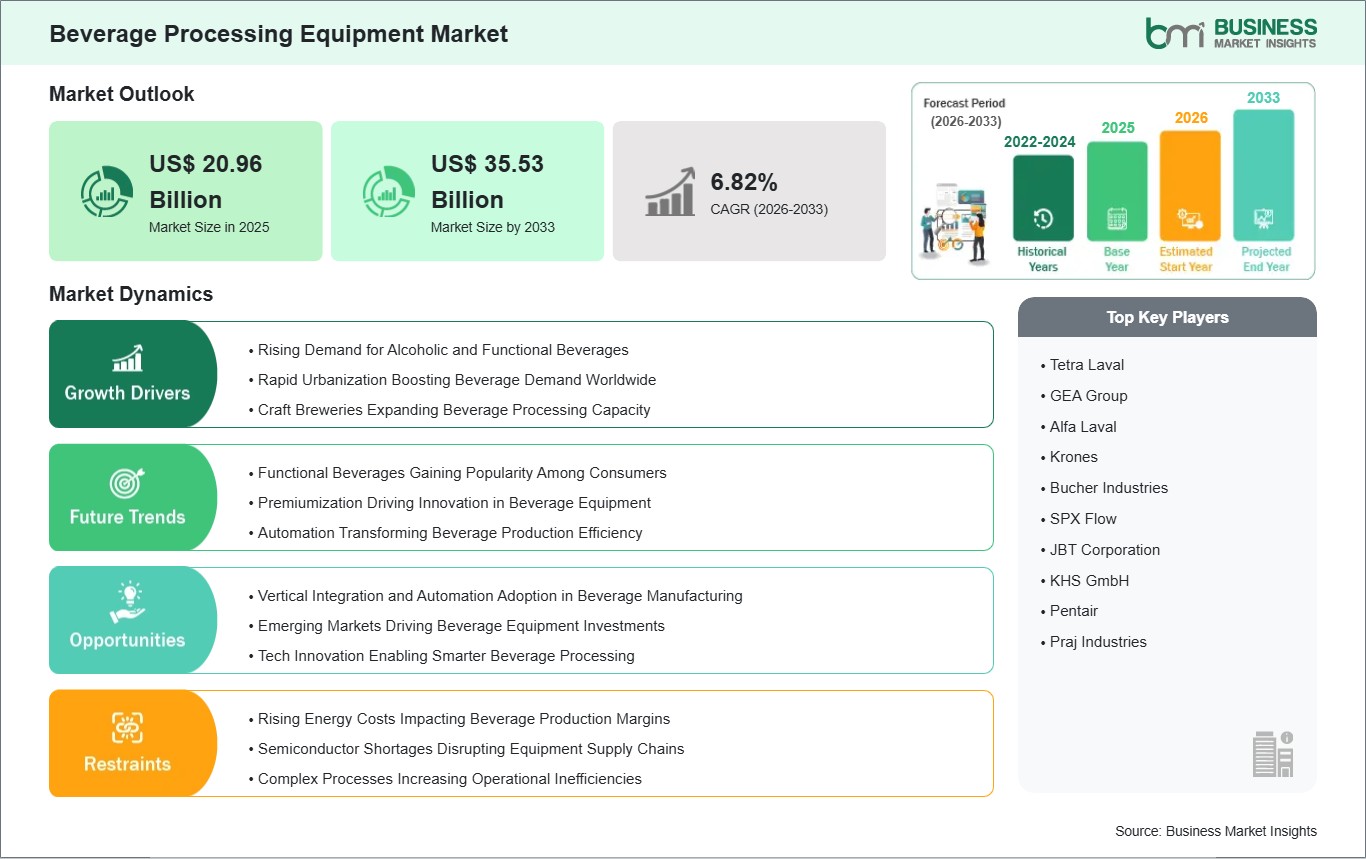
Despite positive growth prospects, the market faces several challenges. High installation and maintenance costs associated with advanced beverage processing systems can limit adoption among small and medium-sized beverage manufacturers. In addition, rising energy consumption, complex equipment integration processes, and stringent regulatory compliance requirements create operational challenges for manufacturers. However, growing investments in beverage manufacturing infrastructure, coupled with increasing demand for premium and customized beverages, are expected to create significant growth opportunities during the forecast period.
Segment Analysis
Beverage Processing Equipment Market Segmentation
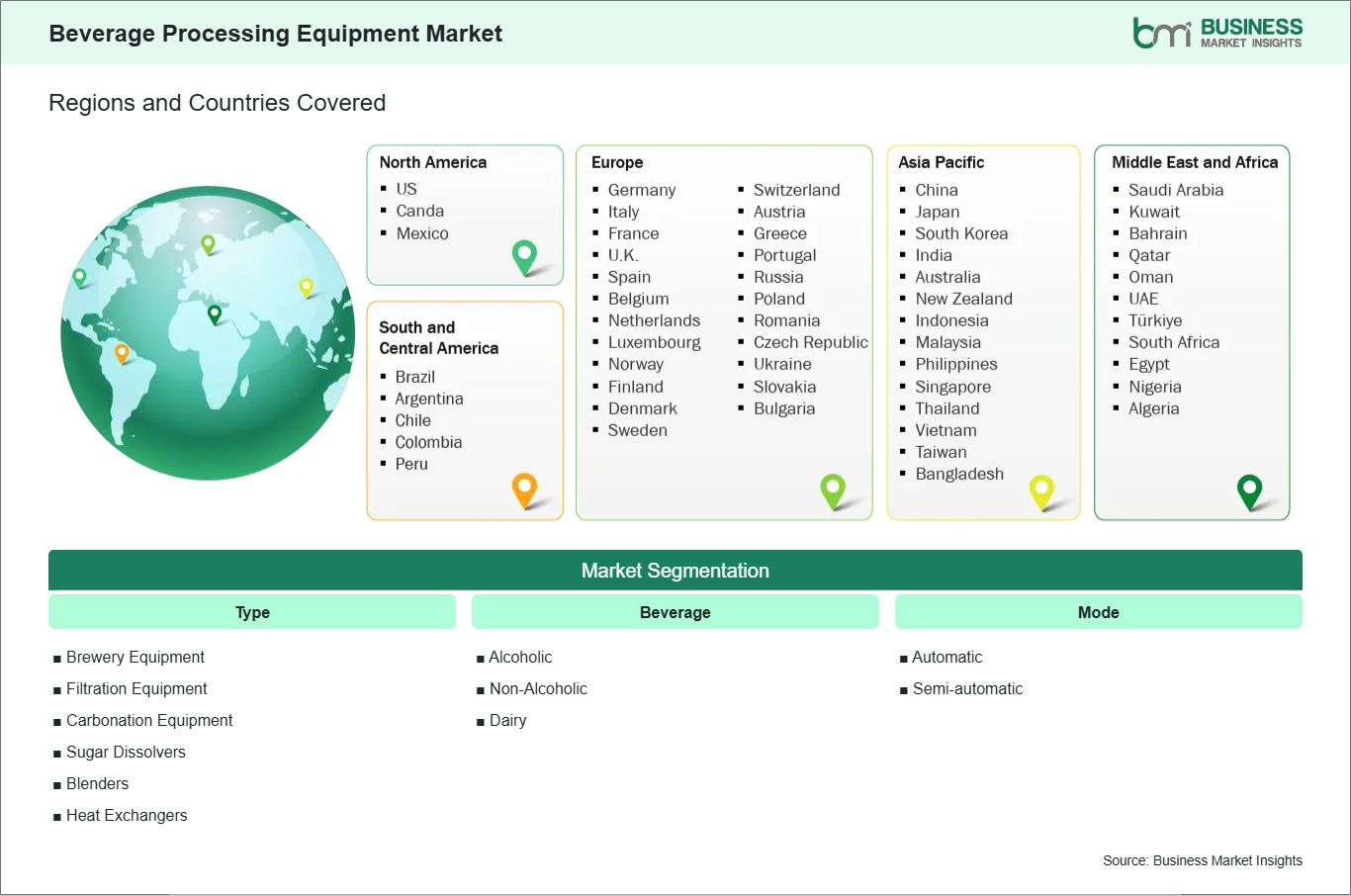
The beverage processing equipment market is segmented based on type, beverage, and mode, reflecting the growing demand for efficient beverage manufacturing systems, automation technologies, and advanced processing solutions across the global food and beverage industry.
By Type
- Brewery Equipment: Supports brewing, fermentation, and large-scale beer production processes with enhanced operational efficiency
- Filtration Equipment: Removes impurities and improves beverage clarity, stability, and shelf life during processing
- Carbonation Equipment: Controls and maintains carbonation levels for soft drinks, sparkling beverages, and beer products
- Sugar Dissolvers: Enables efficient dissolving and mixing of sugar ingredients for consistent beverage formulation
- Blenders: Facilitates uniform mixing of ingredients, flavors, additives, and concentrates in beverage production
- Heat Exchangers: Regulates temperature during heating and cooling processes to ensure product quality and energy efficiency
By Beverage
- Alcoholic: Widely used in beer, wine, spirits, and craft beverage production for efficient and high-quality processing
- Non-Alcoholic: Supports processing of juices, soft drinks, energy drinks, bottled water, and functional beverages
- Dairy: Enables hygienic processing of milk, flavored dairy beverages, yogurt drinks, and other dairy-based products
By Mode
- Automatic: Provides fully automated beverage processing operations with improved speed, precision, and reduced labor dependency
- Semi-automatic: Combines manual operation with automated functions for flexible and cost-effective beverage manufacturing processes
Market Forces
Beverage Processing Equipment Market Drivers and Opportunities
Rising demand for alcoholic and functional beverages
The beverage equipment market growth has been helped by increased alcohol and functional drinks demand globally and consumers are choosing to drink premium beers, craft drinks, and flavored alcoholic drinks, plus sports and energy drinks or drinks fortified by vitamins, probiotics, and plant-based ingredients drives beverage production expansion. Both of these trends create a need for manufacturers to purchase advanced beverage processing systems.
The use of advanced beverage processing equipment by food and beverage manufacturers is to provide consistent quality product output, enhance operational efficiency in the beverage manufacturing process, and meet food safety requirements. The overall increase in beverage manufacturers along with the increase in production capacity by beverage producers in North America, Europe and Asia also contributes to high beverage processing equipment demand. Additionally, the current trend of premiumization within the beverage industry also has encouraged manufacturers to invest in high-performance beverage processing equipment that consistently provides high-quality products as well as custom beverage formulas.
Vertical integration and automation adoption in beverage manufacturing
Manufacturers of beverages are making use of automated production lines in order to improve efficiency, reduce reliance on manual labor and minimize the potential for operational errors. The introduction of robotics, IoT monitoring systems and intelligent process controls allows manufacturers to make use of technology to optimize their production workflows and reduce the time spent on production by allowing for less downtime.
Growth in emerging economies due to fast industrialization and increased consumption of beverages has resulted in a growing number of investments in new beverage/manufacturing infrastructure. Companies are developing advanced production facilities that use energy-efficient and digitally connected equipment to produce large volumes of beverage products; additionally, the increasing demand for custom products and shorter production cycles is leading many manufacturers to automate or use modular, flexible equipment solutions. These trends will drive continued growth in the beverage processing equipment market, leading to technological innovation in the industry.
Size and Share Analysis
Beverage Processing Equipment Market Size and Share Analysis
The Beverage Processing Equipment Market is projected to grow from US$ 20.96 Billion in 2025 to US$ 35.53 Billion by 2033 , registering a CAGR of 6.82% from 2026 to 2033.
By type, brewery equipment accounts for a significant share as it forms the core infrastructure for brewing, fermentation, and large-scale beverage production operations. Filtration equipment continues to grow with its ability to improve beverage clarity, stability, and shelf life, while carbonation equipment is gaining traction in soft drinks, sparkling beverages, and beer production for maintaining consistent texture and taste profiles. Sugar dissolvers are expanding steadily with increasing demand for efficient ingredient mixing and formulation consistency in beverage manufacturing. Blenders witness strong adoption due to their role in achieving uniform flavor distribution and ingredient integration, while heat exchangers continue to gain importance for efficient temperature regulation, energy optimization, and enhanced production performance.
By beverage, alcoholic beverages dominate adoption owing to rising global consumption of beer, wine, spirits, and craft beverages requiring advanced processing technologies and high production capacities. Non-alcoholic beverages continue to witness strong growth driven by increasing demand for juices, soft drinks, energy drinks, bottled water, and functional beverages. Dairy beverages are gaining traction with growing consumption of flavored milk, yogurt drinks, and protein-based beverages that require hygienic and temperature-controlled processing systems.
By mode, automatic equipment dominates the market as beverage manufacturers increasingly invest in fully automated systems to improve production efficiency, minimize labor dependency, and support high-volume operations. Semi-automatic equipment is witnessing steady growth due to its operational flexibility, lower installation costs, and suitability for small- and medium-scale beverage production facilities.
Report Coverage
Beverage Processing Equipment Market Report Coverage and Deliverables
The "Beverage Processing Equipment Market Size and Forecast (2022 - 2033)" report provides a detailed analysis of the market covering below areas:
- The market size and forecast at global, regional, and country levels for all market segments covered under the scope
- The market trends, as well as drivers, restraints, and opportunities
- The market analysis covering key trends, global and regional framework, major players, regulations, and recent developments
- Industry landscape and competition analysis covering market concentration, heat map analysis, prominent players, and recent developments for the market
- Detailed company profiles, including SWOT analysis
Geographic Insights
Beverage Processing Equipment Market Geographic Insights
The beverage processing equipment market has varied regional characteristics that are shaped by innovations in automation technologies, growing demand for sustainable manufacturing, and increasing use of digital monitoring and IoT-enabled systems.
With North America being one of the most advanced regions in technology, it is home to some of the largest equipment manufacturers, with a very established beverage industry. The North American region is made up of United States and Canada. Investment continues to be made in automated solutions for advanced brewing technologies, filling technologies, separation technologies, and smart automation for factory usage. North America is focused on increasing efficiency in production, enhancing sustainability, and innovating processes within the beverage industry. The well-established industrial base and growing consumer demand for different beverage types has led to the large adoption rate of modern processing equipment such as breweries, dairy plants, juice facilities, and functional beverage manufacturers.
In the Asia Pacific region, continued growth is occurring due to the rapid growth of beverage production and manufacturing in a number of countries, high rates of urbanization, and increasing levels of disposable income. The Asia Pacific region consists of many countries, including China, India, Japan, and South Korea. Beverage manufacturers are modernizing their production facilities and installing new processing equipment. The focus of the Asia Pacific region is to continually grow their manufacturing capacity, increase sustainability, and innovate in the area of beverage automation. Additionally, premium beverage consumption is being driven, as well as plant-based and functional beverage consumption is increasing.
Industry Activity
Recent Developments
The beverage processing equipment market is evaluated by gathering qualitative and quantitative data post primary and secondary research, which includes important corporate publications, association data, and databases. A few of the key developments in the beverage processing equipment market are:
- In March 2026, Tetra Pak was awarded the Microsoft Intelligent Manufacturing Award (MIMA) 2026 in the Scale! category for its advanced digital portfolio, Tetra Pak Factory OS. This suite of modular, smart-factory technologies unifies data, automation, and analytics across an entire beverage plant.
- In July 2025, GEA officially opened its state-of-the-art, 13,000-square-foot New Food Application and Technology Center (ATC) in Janesville, Wisconsin. The facility is equipped with more than 15 pilot-scale machinery units—including decanter centrifuges and membrane filtration plants—allowing beverage and food brands to test complex formulations without interrupting their main revenue-generating manufacturing lines.
Trust & Transparency
Research Methodology
The market analysis combines proprietary research with secondary data from government agencies, company disclosures, regulatory filings, industry databases and expert interviews. Market estimates are validated through data triangulation, cross-market benchmarking and analyst
review.
View Full Research Methodology
Key Sources Referred:
International Society of Beverage Technologists
Brewers Association
European Federation of Bottled Waters
International Dairy Foods Association
World Packaging Organisation
Veterinary Imaging and Radiation Oncology Society (VIROS)