Market Summary
Executive Summary and Global Market Analysis
The High-Speed Engine covers engines designed to operate at elevated rotational speeds across industrial and transportation environments. These engines support continuous and standby operations where compact design, operational responsiveness, and reliable power output remain essential. Their deployment spans marine propulsion, electricity generation, railway systems, and construction activities requiring durable mechanical performance. Competitive conditions remain characterized by continuous product development and regional expansion strategies. Market participants are concentrating on equipment durability, application-specific customization, and aftermarket support services. Collaboration with industrial operators and infrastructure developers continues to influence product positioning and long-term supply agreements across multiple regions.
Industrial expansion and infrastructure modernization continue to influence purchasing decisions across several end-user sectors. Operators increasingly prefer equipment capable of supporting uninterrupted operations while meeting evolving fuel efficiency requirements. Mining sites, marine transport systems, and distributed power facilities are integrating advanced engine platforms to improve operational continuity and equipment flexibility. Technological developments are reshaping engine architecture, monitoring capabilities, and maintenance strategies. Manufacturers are incorporating digital diagnostics, automated control systems, and emission-focused engineering improvements into modern product lines. Hybrid integration concepts and fuel optimization technologies are also receiving attention as industries evaluate long-term operational efficiency and environmental alignment.
Segment Analysis
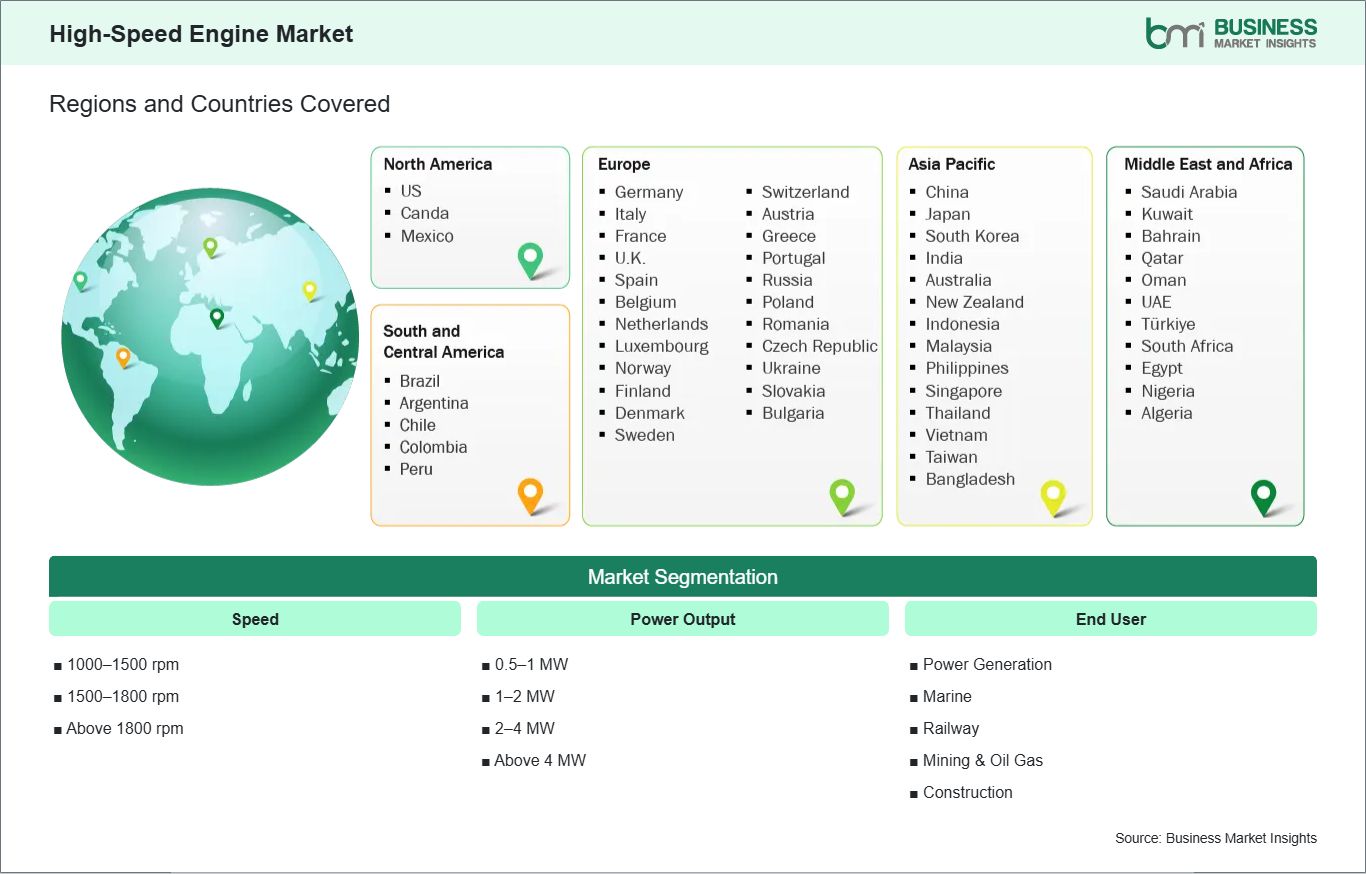
High-Speed Engine Market Segmentation
The High-Speed Engine market demonstrates differentiated demand patterns across speed ranges, power capacities, applications, and geographic regions.
By Speed
- 1000–1500 rpm – Preferred for balanced industrial and backup power operations
- 1500–1800 rpm – Strong presence across commercial and utility applications
- Above 1800 rpm – Suitable for compact, high-response operational environments
By Power Output
- 5–1 MW – Common across localized energy and auxiliary systems
- 1–2 MW – Supports medium-scale industrial and marine requirements
- 2–4 MW – Utilized in continuous heavy-duty operational environments
- Above 4 MW – Chosen for large-scale industrial and infrastructure projects.
By End User
- Power Generation – Maintains stable deployment across standby electricity systems
- Marine – Supports propulsion and onboard operational requirements
- Railway – Applied in locomotive and transport support operations
- Mining & Oil Gas – Functions within remote and energy-intensive sites
- Construction – Serves heavy machinery and infrastructure development activities.
Market Forces
High-Speed Engine Market Drivers and Opportunities
Industrial Infrastructure Expansion
Infrastructure development across transportation, industrial manufacturing, and utility networks continues to strengthen equipment requirements globally. High-speed engines support operations demanding reliable power delivery under continuous or variable load conditions. Construction sites, railway systems, and industrial facilities increasingly integrate high-performance engines to maintain operational stability across diverse working environments.
The industry also benefits from modernization programs emphasizing equipment reliability and operational efficiency. Regulatory attention toward optimized fuel consumption has encouraged manufacturers to redesign engine systems with enhanced performance characteristics. These developments reinforce the relevance of advanced high-speed engines within industrial applications requiring durable and responsive mechanical solutions.
Expansion of Distributed Power Systems
Distributed power generation projects are creating new application opportunities for high-speed engine technologies. Industrial facilities and commercial operations increasingly seek localized energy systems capable of supporting uninterrupted electricity supply. High-speed engines provide operational flexibility within decentralized energy frameworks where rapid response capabilities remain important for maintaining system continuity.
Future deployment opportunities may expand further as remote industrial operations prioritize independent energy infrastructure. Emerging economies are also strengthening investments in localized electricity generation across mining, construction, and transport sectors. Continued focus on energy reliability and infrastructure diversification is likely to support broader integration of high-speed engine systems over the long term.
Size and Share Analysis
High-Speed Engine Market Size and Share Analysis
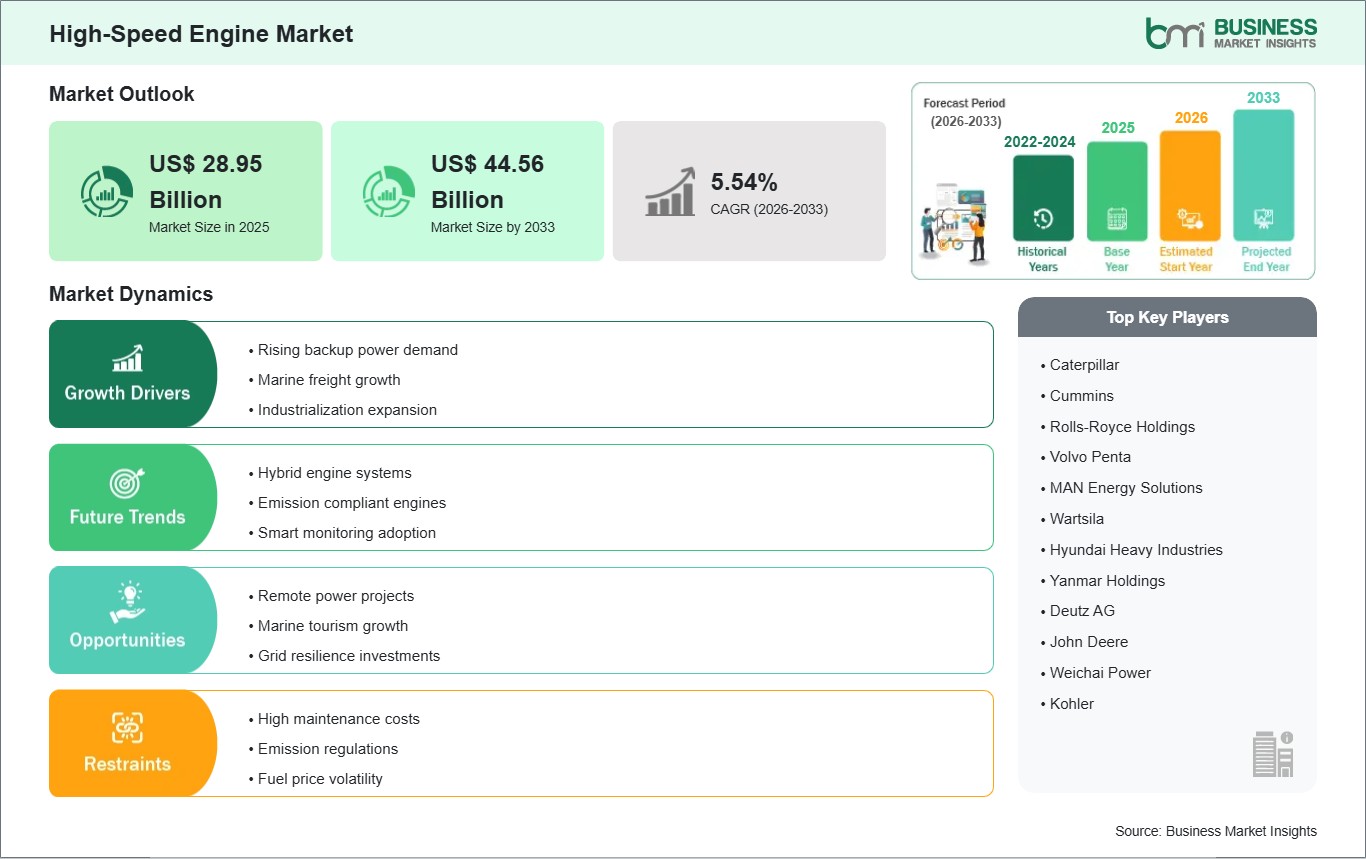
The High-Speed Engine Market is projected to grow from US$ 28.95 Billion in 2025 to US$ 44.56 Billion by 2033 , registering a CAGR of 5.54% from 2026 to 2033.
The market trajectory reflects sustained utilization across industrial power systems, transportation operations, and infrastructure-related activities requiring dependable engine performance under demanding operational conditions.
Among speed categories, the 1500–1800 rpm segment maintains notable positioning due to its compatibility with commercial and industrial applications. Mid-range power output categories also demonstrate broad utilization because they align with operational requirements across marine systems, backup power infrastructure, and medium-scale industrial facilities.
Power generation remains one of the leading application segments owing to increasing emphasis on electricity continuity and industrial reliability. Marine and construction activities also contribute significantly to market activity as operators prioritize equipment capable of supporting high-load and continuous operational environments.
Report Coverage
High-Speed Engine Market Report Coverage and Deliverables
The "High-Speed Engine Market Size and Forecast (2022–2033)" report provides a detailed analysis of the market covering:
- High-Speed Engine market size and forecast at global, regional, and country levels for all the key market segments covered under the scope
- High-Speed Engine market trends, as well as market dynamics such as drivers, restraints, and key opportunities
- Industry landscape and competition analysis covering market concentration, heat map analysis, prominent players, and recent developments
- Detailed company profiles, including SWOT analysis
Geographic Insights
High-Speed Engine Market Geographic Insights
The High-Speed Engine market is divided into geographic segments, which include North America, Asia Pacific, Europe, Middle East & Africa, and South & Central America. Regional demand structures differ according to construction intensity, marine transportation needs, and localized electricity generation priorities. Industrial modernization programs continue shaping procurement strategies across developed and developing economies.
North America maintains a stable position supported by industrial automation, commercial infrastructure upgrades, and backup power system installations. The United States demonstrates significant utilization across power generation and transportation operations, while Canada supports deployment through mining and energy-related activities. Infrastructure rehabilitation programs also contribute to replacement demand within industrial sectors.
Asia-Pacific continues to represent an important regional market due to extensive manufacturing expansion and large-scale infrastructure development. China maintains considerable industrial engine deployment across construction and transportation applications. India and Southeast Asian countries are also strengthening utilization through railway expansion, urban development projects, and localized power generation investments.
Industry Activity
Recent Developments
The High-Speed Engine market is evaluated by gathering qualitative and quantitative data post primary and secondary research, which includes important corporate publications, association data, and databases. A few of the key developments in the High-Speed Engine market are:
- In October 2025, Rolls-Royce has successfully tested the world’s first high-speed marine engine powered exclusively by methanol on its test bench in Friedrichshafen. Together with their partners in the meOHmare research project, Rolls-Royce engineers have thus reached an important milestone on the road to climate-neutral and environmentally friendly propulsion solutions for shipping.
- In June 2025, ABB announced the launch of the AMXE Marine Motor, a next-generation electric propulsion solution engineered to withstand the tough conditions at sea, including continuous exposure to corrosive saltwater and powerful ocean currents. Drawing on decades of experience in marine application and heavy-duty industries like mining and rail, ABB has developed this motor specifically for small to mid-sized electric and hybrid vessels and open deck applications, combining proven durability, high performance, and installation flexibility into one compact package.
Trust & Transparency
Research Methodology
The market analysis combines proprietary research with secondary data from government agencies, company disclosures, regulatory filings, industry databases and expert interviews. Market estimates are validated through data triangulation, cross-market benchmarking and analyst
review.
View Full Research Methodology
Key Sources Referred:
Government energy efficiency publications National building and environmental policy documents Industry white papers on thermal management technologies Research publications covering tire material innovation and efficiency trends Company website Company annual reports Company investor presentations