Market Summary
Executive Summary and Global Market Analysis
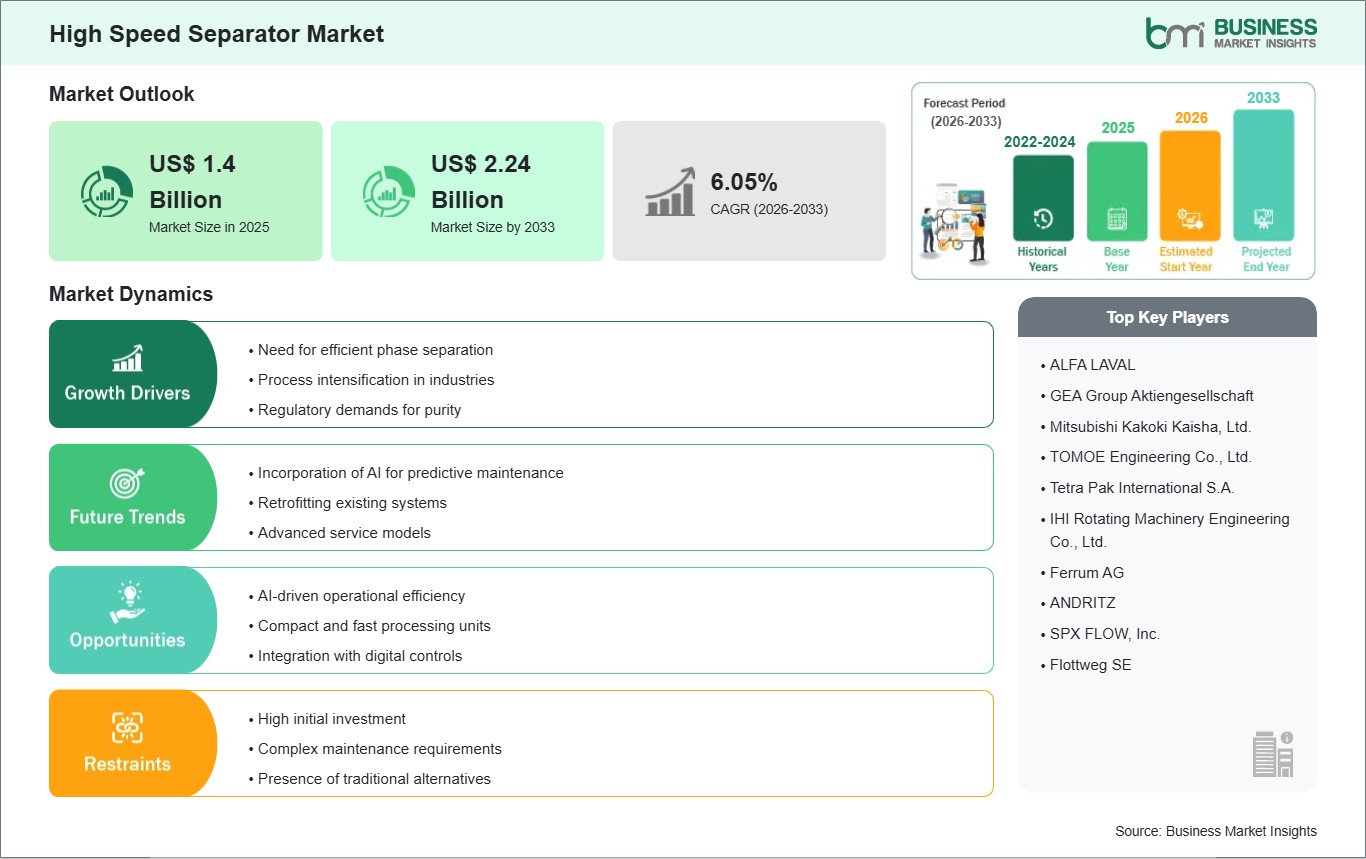
High Speed Separators refer to centrifuge-based separation systems engineered to efficiently separate liquids from solids or immiscible liquids of different densities at high rotational speeds. By utilizing advanced disc-stack or decanter technologies, these systems generate continuous, high-throughput separation of components, enabling purification, clarification, and concentration across multiple industries. This technology is fundamental to the operational architecture of modern industrial processing, enabling yield optimization, product purity enhancement, and waste reduction in pharmaceutical, food and beverage, chemical, and wastewater management sectors. Market expansion is being propelled by the rapid integration of automation solutions into industrial processing, the rising institutional requirement for product purity and regulatory compliance, and the increasing demand for energy-efficient separation technologies across manufacturing sectors.
However, several factors may restrain market progression. The high capital intensity associated with advanced separator systems, including stainless steel construction and precision engineering, remains a primary hurdle for small-scale processors and emerging economy operators with limited financial resources. The industry also faces persistent technical challenges regarding maintenance complexity and operational reliability, as high-speed rotating equipment requires specialized skills for installation, balancing, and upkeep. Additionally, the competition from alternative separation technologies such as membrane filtration and hydrocyclones creates substitution risks in specific applications. These hurdles, compounded by energy consumption concerns and the volatility of raw material prices affecting capital investment decisions, increase the total cost of ownership and the perceived financial risk for large-scale deployments.
Despite these hurdles, the market outlook remains highly favorable as the sector transitions toward intelligent, connected separation systems. Opportunities are emerging through the incorporation of AI technologies for predictive maintenance and real-time process adjustments, optimizing operational efficiency and increasing uptime while reducing costs. The expansion of continuous manufacturing in pharmaceutical and biotech sectors is gaining significant traction, with high-speed separators serving as critical components for cell harvesting and product recovery. Furthermore, the growth of water and wastewater treatment aligns with global goals for environmental sustainability, creating new applications for separators in sludge dewatering and oil-water separation. Collectively, these innovations position the High Speed Separator industry for sustained long-term development as a cornerstone of efficient, automated, and sustainable industrial processing.
Segment Analysis
High Speed Separator Market Segmentation
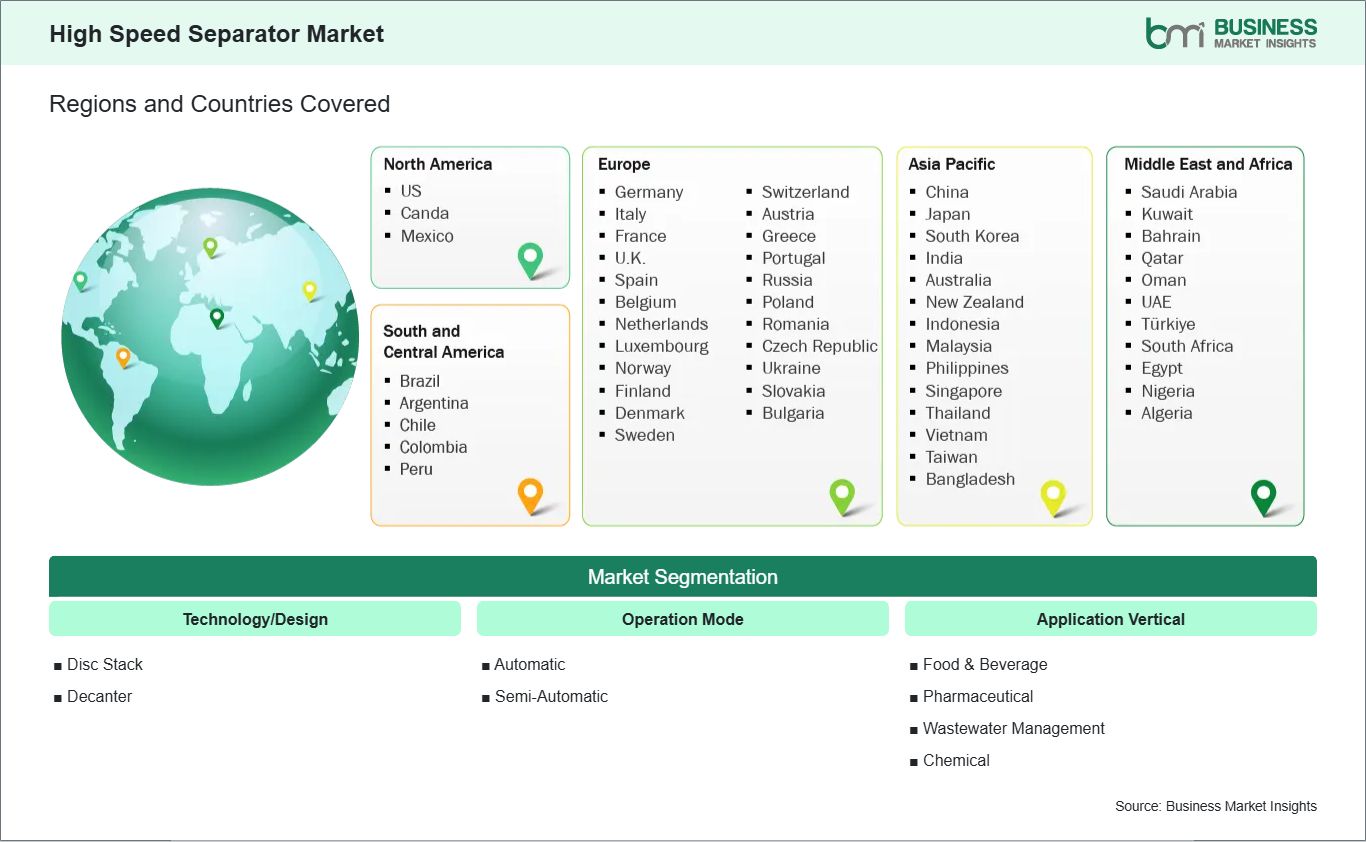
The High Speed Separator market is segmented based on technology/design, operation mode, and application vertical, reflecting the growing demand for efficient separation solutions across industrial sectors.
By Technology/Design
- Disc Stack: Features conical disc stack for high-efficiency liquid-liquid and liquid-solid separation; widely adopted in pharmaceutical and food applications
- Decanter: Utilizes screw conveyor for continuous solids discharge; preferred for high-solids applications in wastewater and chemical processing.
By Operation Mode
- Automatic: Programmable systems with self-cleaning and self-optimizing capabilities; represents the fastest-growing segment due to Industry 4.0 integration
- Semi-Automatic: Requires partial operator intervention for cleaning and maintenance; remains relevant in smaller facilities and batch processes
By Application Vertical
- Food & Beverage: Clarification of juices, wines, beer, edible oils, and dairy products
- Pharmaceutical: Cell harvesting, vaccine production, antibiotic recovery, and API purification
- Wastewater Management: Sludge dewatering, oil-water separation, and industrial effluent treatment
- Chemical: Solvent recovery, catalyst separation, and fine chemical purification
Market Forces
High Speed Separator Market Drivers and Opportunities
Rising Demand for Efficient Phase Separation and Process Intensification
The high speed separator market is being driven by the growing need for efficient phase separation across pharmaceutical, food and beverage, and wastewater management sectors. Unlike traditional slow batch clarifiers, high-speed separators offer compact design and fast processing capabilities, enabling higher throughput in smaller footprints. Rising adoption of continuous manufacturing processes is amplifying demand, as manufacturers increasingly seek automated, integrated separation solutions for uninterrupted production. Stringent regulatory requirements for product purity and yield optimization are reinforcing the importance of advanced separators over conventional methods. Additionally, industrial sectors are turning to high-speed separators to meet stricter environmental discharge standards while recovering valuable by-products. The expansion of Industry 4.0 and digital transformation initiatives is further propelling adoption. Collectively, efficiency requirements and regulatory compliance are fueling sustained growth in the global high speed separator market.
Rising Integration of AI, IoT, and Smart Manufacturing Technologies
Opportunities in the high speed separator market are expanding through the integration of artificial intelligence, IoT sensors, and predictive maintenance platforms. AI-enabled separators are opening lucrative opportunities by delivering real-time process adjustments, anomaly detection, and optimized cleaning cycles based on actual fouling conditions rather than fixed schedules. The growing emphasis on continuous production in pharmaceutical manufacturing is fueling demand for separators with advanced automation capabilities and seamless integration with upstream and downstream equipment. Emerging applications in the biotechnology sector are driving innovation, as single-use and modular separator designs accommodate flexible, multi-product facilities. In wastewater treatment, smart separators are increasingly used for real-time solids monitoring and automated sludge discharge, improving effluent quality and reducing operator intervention. Additionally, sustainability trends are encouraging deployment of energy-efficient separator designs that reduce power consumption and carbon footprint. Vendors who focus on cost-effective, AI-driven, and sustainable solutions are well-positioned to capture growth.
Size and Share Analysis
High Speed Separator Market Size and Share Analysis
The High Speed Separator Market is projected to grow from US$ 1.4 Billion in 2025 to US$ 2.24 Billion by 2033 , registering a CAGR of 6.05% from 2026 to 2033.
By technology/design, disc stack separators hold a significant share due to their versatility and high separation efficiency across liquid-liquid and liquid-solid applications. Decanter centrifuges are witnessing steady growth in high-solids applications such as sludge dewatering and chemical processing.
By operation mode, automatic separators represent the fastest-growing segment as food, pharmaceutical, and chemical producers seek to reduce operator dependency and improve process consistency through Industry 4.0 integration.
By application vertical, the food and beverage segment maintains a strong presence due to high-volume production of clarified juices, edible oils, and dairy products requiring reliable separation. The pharmaceutical segment is experiencing significant growth driven by vaccine production and continuous manufacturing adoption. The wastewater management segment is expanding steadily as municipalities and industries invest in treatment infrastructures.
Report Coverage
High Speed Separator Market Report Coverage and Deliverables
The "High Speed Separator Market Size and Forecast (2022–2033)" report provides a detailed analysis of the market covering below areas:
- High Speed Separator HSS market size and forecast at global, regional, and country levels for all market segments covered under the scope
- High Speed Separator HSS market trends, as well as drivers, restraints, and opportunities
- High Speed Separator HSS market analysis covering key trends, global and regional framework, major players, regulations, and recent developments
- Industry landscape and competition analysis covering market concentration, heat map analysis, prominent players, and recent developments
- Detailed company profiles, including SWOT analysis
Geographic Insights
High Speed Separator Market Geographic Insights
The High Speed Separator Market shows diverse regional adoption patterns influenced by industrialization levels, regulatory frameworks, and manufacturing activity.
Europe maintains a strong market position driven by stringent pharmaceutical and food safety regulations, well-established manufacturing sectors, and early adoption of continuous processing technologies. The region focuses on enhancing separation efficiency and reducing energy consumption through advanced automation.
Asia Pacific is the fastest-growing region, driven by rapid industrialization in China and India, expanding food processing sectors, and increasing pharmaceutical manufacturing activity. Government initiatives for wastewater treatment infrastructure are also contributing to market growth.
North America demonstrates steady growth supported by biopharmaceutical manufacturing expansion, aging wastewater infrastructure upgrades, and adoption of Industry 4.0 technologies.
Report Guidance
High Speed Separator Market Report Guidance
The report includes qualitative and quantitative data for the High Speed Separator market across technology/design, operation mode, application vertical, and geography.
- The report starts with the key takeaways (chapter 2), highlighting the key trends and outlook of the High Speed Separator Market.
- Chapter 3 focuses on the research methodology of the study.
- Chapter 4 includes ecosystem analysis.
- Chapter 5 highlights the major industry dynamics in the High Speed Separator Market, including factors that are driving the market, prevailing deterrents, potential opportunities, as well as future trends.
- Chapter 6 discusses the High Speed Separator Market scenario, in terms of historical market revenues, and forecast till the year 2033.
- Chapters 7 to 10 cover High Speed Separator Market segments by technology/design, operation mode, application vertical, and geography across North America, Europe, Asia Pacific, Middle East and Africa, and South and Central America.
- Chapter 11 describes the competitive analysis along with the heat map analysis for the key players operating in the market.
- Chapter 12 describes the industry landscape analysis with market initiatives, new developments, mergers, and joint ventures globally.
- Chapter 13 provides detailed profiles of major companies operating in the High Speed Separator Market.
- Chapter 14 includes a brief overview of the company, list of abbreviations, and disclaimer.
Industry Activity
Recent Developments
The High Speed Separator Market is evaluated by gathering qualitative and quantitative data post primary and secondary research, which includes important corporate publications, association data, and databases. A few of the key developments in the High Speed Separator Market are:
- In May 2026, AnteoTech has signed a strategic collaboration and sales agreement binding term sheet with South Korean separator technology company Xerabrid Corporation, expanding its battery materials push into next-generation separator technology.
- In October 2025, The launch of the Culturefuge 200 B separator opens new possibilities for pharmaceutical businesses of all sizes. They can now operate medium-scale processes, turning to high-density fermentation to boost productivity and maximize the yield of valuable biologics, such as monoclonal antibodies. The Culturefuge 200 B extends our successful Bactofuge portfolio, bringing proven technology and gentle, continuous separation to medium-sized biopharma producers.
Trust & Transparency
Research Methodology
The market analysis combines proprietary research with secondary data from government agencies, company disclosures, regulatory filings, industry databases and expert interviews. Market estimates are validated through data triangulation, cross-market benchmarking and analyst
review.
View Full Research Methodology
Key Sources Referred:
World Health Organization (WHO) – Diagnostic Imaging and Medical Device Guidelines
International Society for Pharmaceutical Engineering (ISPE) – Continuous Manufacturing Guidelines
Food and Agriculture Organization (FAO) – Food Processing Technology Reports
Company Annual Reports and Investor Presentations (Major Injector Manufacturers)
Company Websites and Product Catalogs
Environmental Protection Agency (EPA) – Wastewater Treatment Technology Guidelines