Market Summary
Executive Summary and Global Market Analysis
High pressure pumps are industrial fluid handling systems engineered to transfer liquids under elevated pressure conditions across critical processing environments. These systems support applications requiring controlled flow rates, operational reliability, and resistance to abrasive or corrosive substances. Their integration remains essential in industrial cleaning, hydraulic operations, water treatment, and energy-related processing facilities where pressure consistency directly influences process stability.
Industrial modernization continues to reshape procurement priorities across energy, manufacturing, and chemical processing sectors. Facilities are increasingly emphasizing equipment capable of sustaining operational continuity under demanding workloads. The need for efficient fluid movement in upstream extraction, refinery circulation, and thermal power operations has strengthened equipment replacement cycles. Expanding deployment of automated production infrastructure also contributes to steady utilization across industrial facilities requiring pressure-intensive operations.
Segmentation patterns indicate broad utilization across both moderate and ultra-high-pressure operating environments. Pumps within the 101–500 bar category maintain substantial industrial relevance due to their compatibility with continuous-duty applications. Among end users, oil and gas facilities represent a significant adoption base because of drilling support, pipeline operations, and refinery processing requirements. Manufacturing environments also demonstrate stable utilization linked to industrial washing, material handling, and hydraulic equipment integration.
Technological refinement within the industry increasingly centers on durability optimization, energy-efficient motor integration, and predictive maintenance compatibility. Manufacturers are incorporating advanced sealing systems, corrosion-resistant materials, and digitally monitored pressure control mechanisms to improve lifecycle performance. Compact system architecture and modular pump configurations are also gaining attention among facilities pursuing operational flexibility and reduced maintenance interruptions.
The competitive environment reflects a mixture of established engineering manufacturers and specialized industrial equipment suppliers. Market participants are concentrating on product customization, aftermarket service expansion, and application-specific engineering capabilities. Long-term supply agreements, industrial retrofitting projects, and regional distribution partnerships continue shaping competitive positioning across mature and developing industrial economies.
Segment Analysis
High Pressure Pumps Market Segmentation
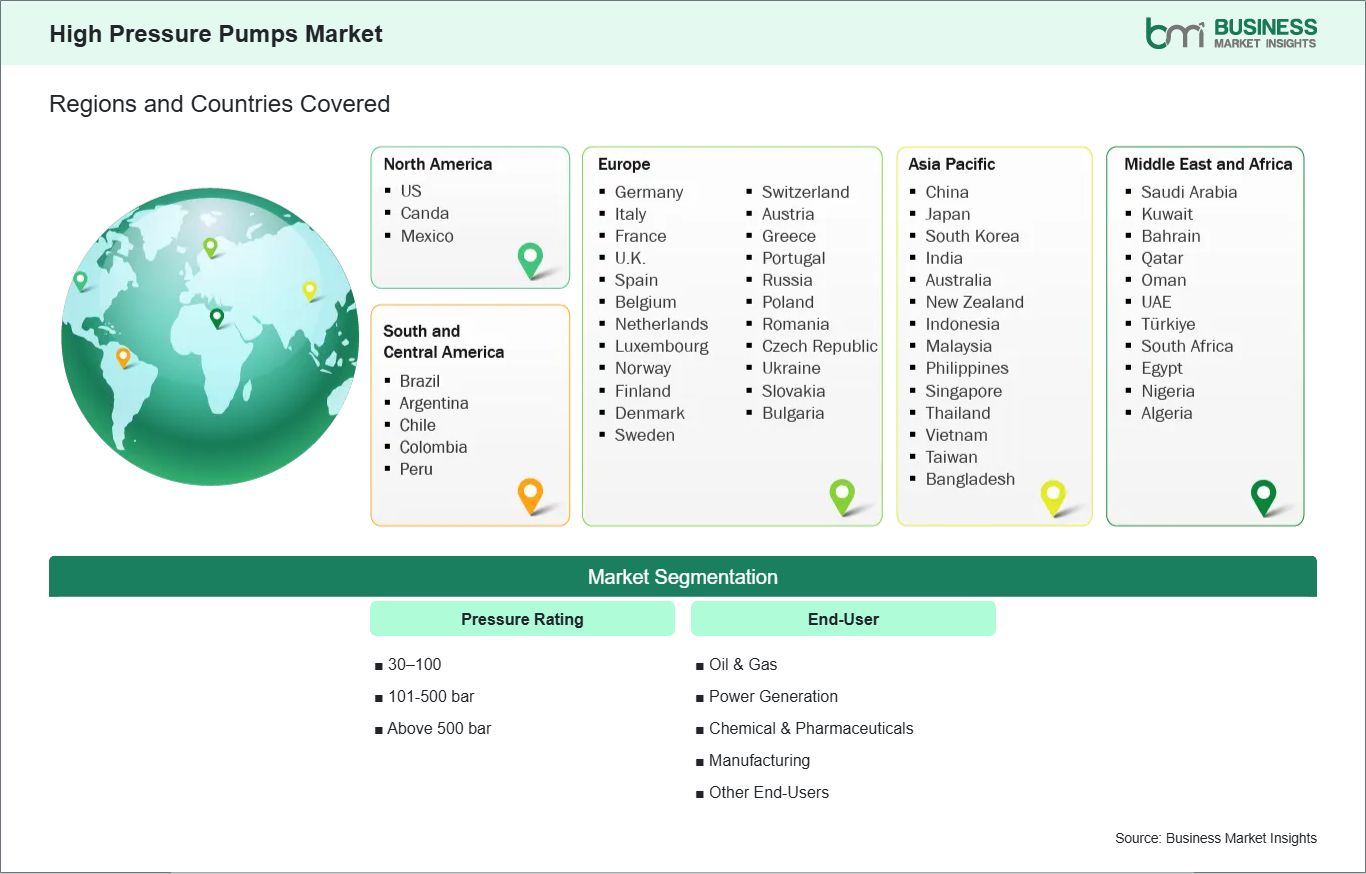
The High Pressure Pumps market is segmented based on pressure rating and end user.
By Pressure Rating
- 30–100 bar: Preferred for industrial cleaning and moderate-pressure transfer operations.
- 101–500 bar: Supports continuous-duty processing across energy and manufacturing facilities.
- Above 500 bar: Utilized in specialized cutting, injection, and ultra-high-pressure applications.
By End-User
- Oil & Gas: Requires pressure-intensive systems for drilling, refining, and fluid injection processes.
- Power Generation: Employs pumps within boiler feed and cooling circulation operations.
- Chemical & Pharmaceuticals: Prioritizes corrosion-resistant systems for controlled fluid processing.
- Manufacturing: Integrates pumps into hydraulic machinery and industrial washing equipment.
- Others: Includes municipal, marine, and infrastructure-related industrial applications.
Market Forces
High Pressure Pumps Market Drivers and Opportunities
Rising Industrial Automation Across Process Industries
Industrial facilities are increasingly integrating automated processing systems requiring stable high-pressure fluid transfer capabilities. Advanced production environments depend on uninterrupted pumping operations to maintain process precision, equipment synchronization, and operational continuity. This transition has accelerated procurement of high pressure pumps across refining, chemical manufacturing, and heavy industrial operations where pressure consistency directly influences output efficiency and equipment reliability.
The operational impact extends beyond productivity improvements into maintenance planning and process optimization strategies. Industrial operators are prioritizing pumping systems with digital monitoring compatibility and enhanced durability characteristics. Facilities upgrading aging infrastructure frequently replace conventional fluid handling systems with technologically advanced high-pressure alternatives capable of supporting automated and continuous manufacturing conditions.
Expansion of Water Treatment and Industrial Cleaning Applications
Industrial cleaning and water management activities are creating new deployment avenues for high pressure pumping systems. Processing facilities increasingly utilize pressure-intensive equipment for descaling, wastewater handling, and surface treatment operations. Enhanced environmental oversight has also encouraged industries to modernize fluid treatment infrastructure, supporting wider implementation of pressure-controlled pumping technologies across industrial environments.
Future opportunities are expected to emerge from integrated water recycling systems and advanced cleaning technologies. Industrial operators continue pursuing resource optimization initiatives requiring efficient fluid circulation and controlled discharge management. The sector may also benefit from expanding infrastructure modernization programs emphasizing industrial sanitation, operational efficiency, and sustainable water utilization practices across manufacturing and utility facilities..
Size and Share Analysis
High Pressure Pumps Market Size and Share Analysis
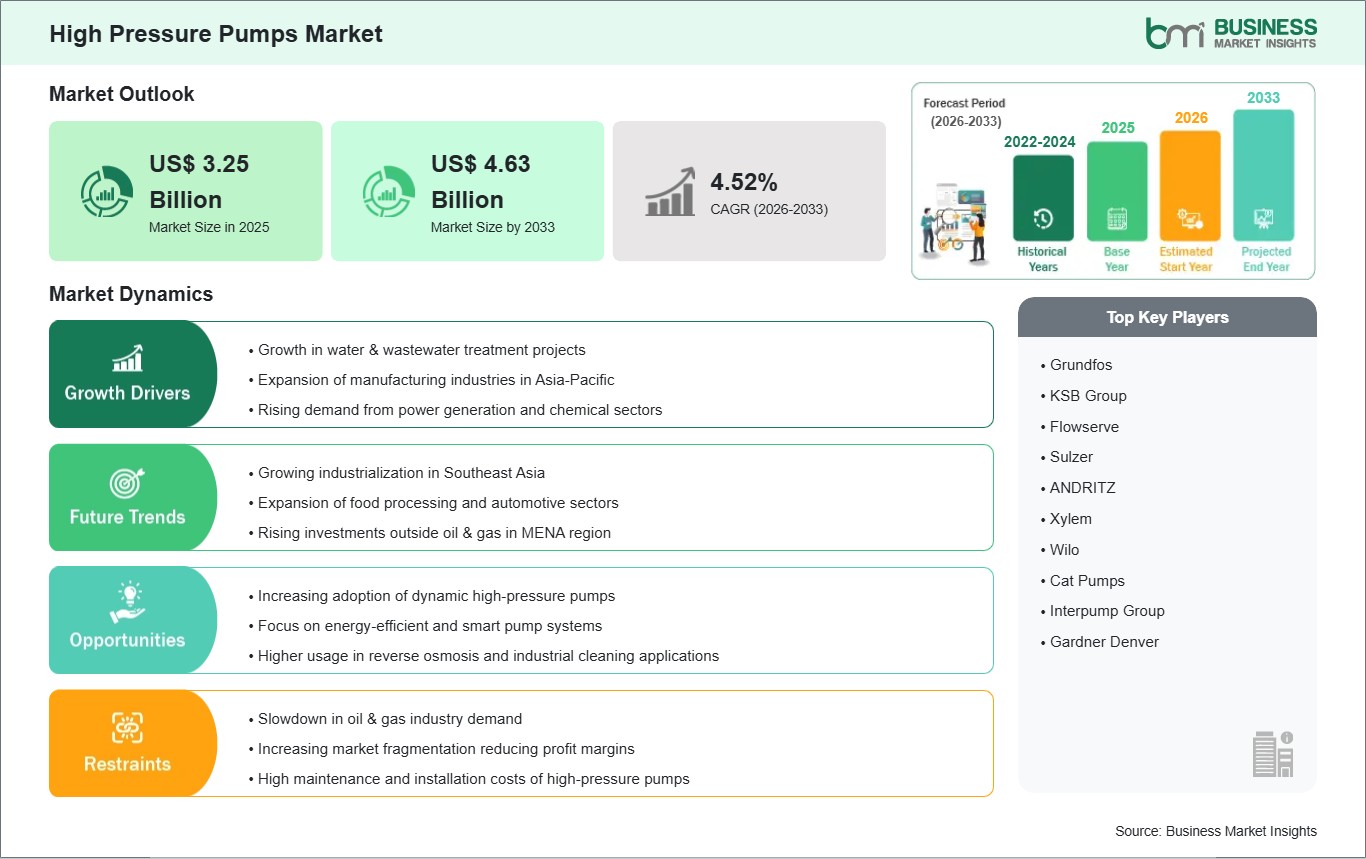
The High Pressure Pumps Market is projected to grow from US$ 3.25 Billion in 2025 to US$ 4.63 Billion by 2033 , registering a CAGR of 4.52% from 2026 to 2033.
Market expansion remains closely associated with infrastructure modernization, industrial equipment replacement cycles, and wider utilization of pressure-controlled systems within energy and manufacturing environments.
The 101–500 bar pressure category maintains a prominent market position due to its compatibility with multiple industrial processes. Medium-to-high-pressure systems are extensively integrated into refinery operations, industrial cleaning activities, and hydraulic processing environments where operational continuity and controlled fluid transfer remain essential requirements.
Oil and gas applications continue representing a substantial share of overall industry utilization. High pressure pumps support drilling operations, pipeline transportation, and refinery circulation systems requiring consistent pressure delivery under demanding operational conditions. Manufacturing and power generation sectors also contribute significantly through continuous industrial processing requirements..
Report Coverage
High Pressure Pumps Market Report Coverage and Deliverables
The "High Pressure Pumps Market Size and Forecast (2022–2033)" report provides a detailed analysis of the market covering below areas:
- Market size and forecast at global, regional, and country levels for all market segments covered under the scope
- Market trends, as well as drivers, restraints, and opportunities
- Market analysis covering key trends, global and regional framework, major players, regulations, and recent developments
- Industry landscape and competition analysis covering market concentration, heat map analysis, prominent players, and recent developments for the market
- Detailed company profiles, including SWOT analysis
Geographic Insights
High Pressure Pumps Market Geographic Insights
The High Pressure Pumps market shows diverse regional adoption patterns influenced by industrial infrastructure maturity, energy sector investments, manufacturing intensity, and process automation requirements. Demand distribution varies according to regional industrial priorities, with developed economies emphasizing operational efficiency improvements while emerging markets focus on infrastructure expansion and industrial capacity development.
North America maintains a strong industry presence due to established oil and gas operations, refinery modernization programs, and advanced manufacturing infrastructure. Industrial facilities across the region continue integrating pressure-intensive systems into automated processing environments requiring high operational reliability. Equipment replacement initiatives and maintenance optimization strategies further reinforce procurement activity among industrial operators.
Asia Pacific demonstrates expanding deployment supported by manufacturing expansion, infrastructure construction activity, and increasing industrial processing requirements. Countries across the region continue strengthening domestic production capabilities within chemicals, power generation, and heavy manufacturing sectors. Industrialization trends and broader investments in water management infrastructure also contribute to sustained utilization of high pressure pumping systems.
Europe reflects stable market activity supported by technological modernization initiatives and stringent industrial efficiency standards. Demand across the region increasingly centers on energy-efficient pumping solutions and advanced monitoring integration within industrial operations. Meanwhile, emerging markets in the Middle East, Africa, and South and Central America are witnessing gradual adoption associated with energy infrastructure projects, industrial diversification programs, and expanding process industry investments..
Industry Activity
Recent Developments
The High Pressure Pumps market is evaluated by gathering qualitative and quantitative data post primary and secondary research, which includes important corporate publications, association data, and databases. A few of the key developments in the High Pressure Pumps market are:
- In January 2026, DYNASET is launching three new models in the HPW Hydraulic High Pressure Water Pump product family: The HPW230, the HPW310, and the HPW600. These new models offer increased performance for cleaning applications and demanding hydro-scaling projects. The new pumps are based on DYNASET Technology: an excellent power-to-size ratio, minimal maintenance requirements, and easy installation for all types of mobile machinery.
- In September 2025, Rehobot Hydraulics launched its brand new battery powered hydraulic pump PEP70-2500MRV. A compact high quality pump, driven by a powerful BLDC motor and designed to use the Makita 18V LXT battery range. Battery-powered high-pressure hydraulic pumps are ideal for intermittent jobs that require a combination of portability, speed and safety. These cordless pumps are ideal for remote locations without access to power, but also indoors where tripping hazards, ergonomics or size are a factor. The cordless pump is compatible with all REHOBOT hydraulic tools and small to medium cylinders.
Trust & Transparency
Research Methodology
The market analysis combines proprietary research with secondary data from government agencies, company disclosures, regulatory filings, industry databases and expert interviews. Market estimates are validated through data triangulation, cross-market benchmarking and analyst
review.
View Full Research Methodology
Key Sources Referred:
Industry white papers related to industrial pumping systems Government industrial manufacturing and infrastructure publications Engineering and fluid mechanics journals Company annual reports and regulatory filings Industrial automation and process engineering studies Energy and water treatment sector publications Technical documentation from industrial equipment associations