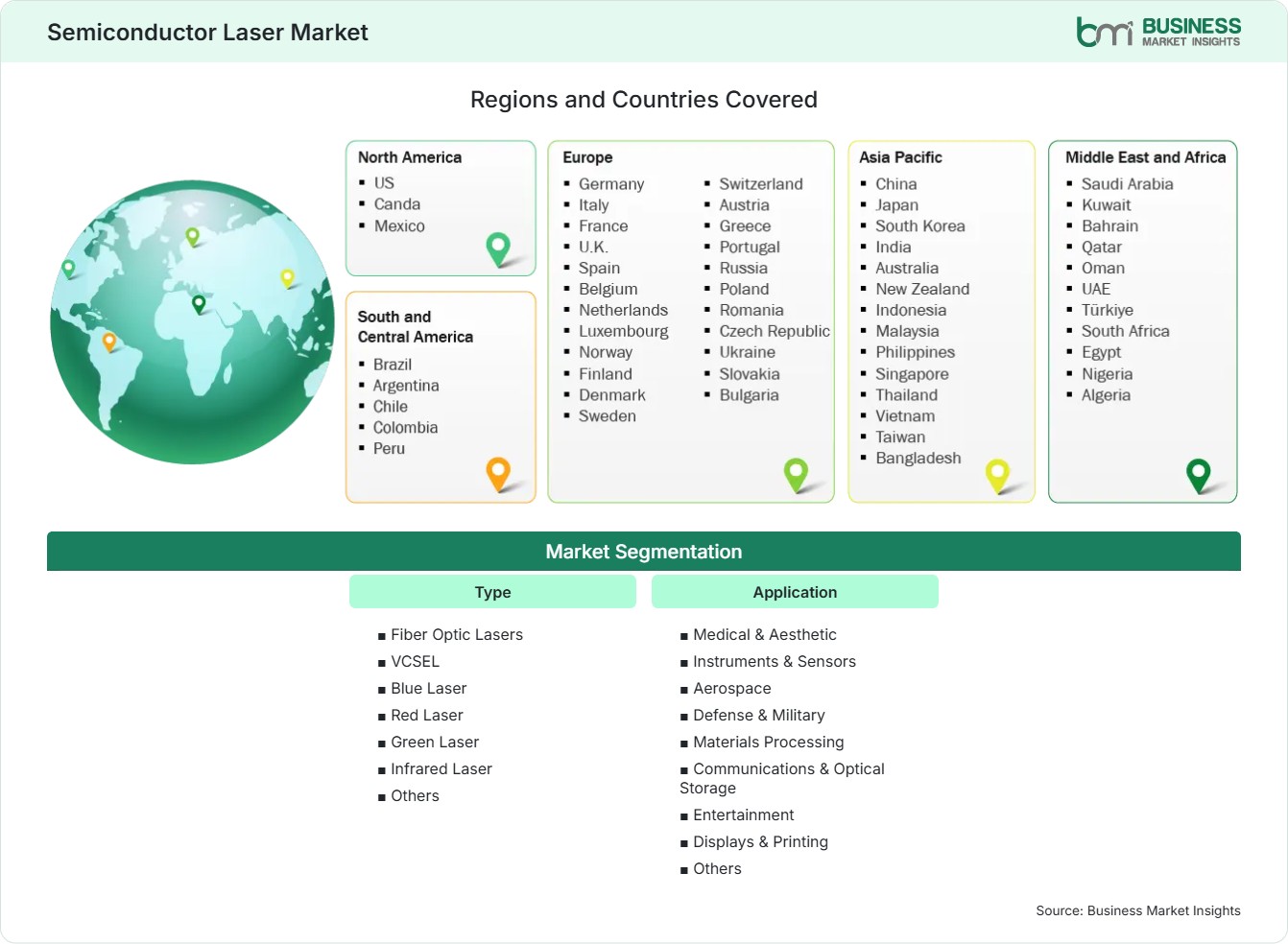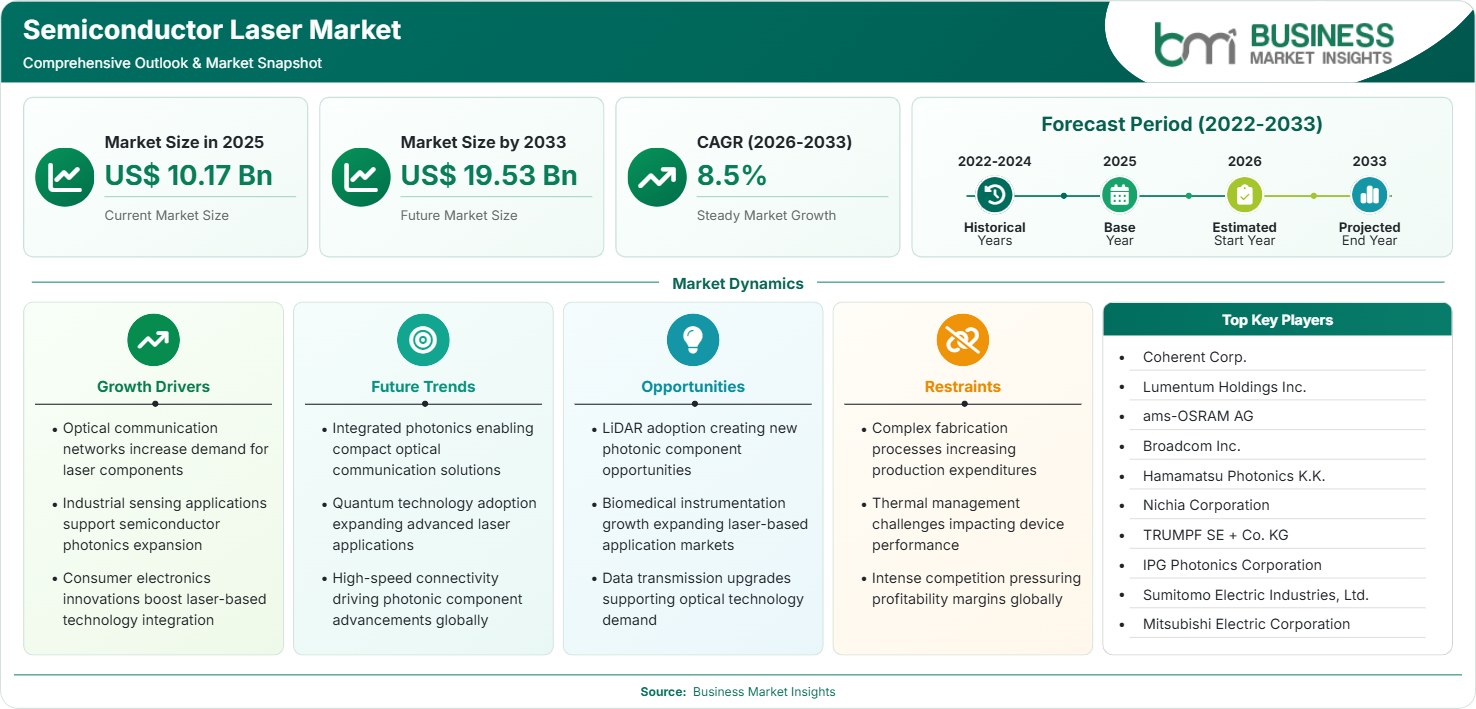
Semiconductor Laser Market Regional Highlights
North America Semiconductor Laser Market
North America represented 24%–27% share in 2025 and is projected to expand at a 7.5%–8.5% CAGR through 2033. The region benefits from hyperscale computing, defense electronics, medical instrumentation, and industrial automation. The Semiconductor Laser Market share is reinforced by established photonics suppliers and advanced semiconductor ecosystems.
- The need for optical transceivers, laser sources, and photonic components is growing in AI data centers, as these components must support higher bandwidth while keeping power consumption and thermal loads under control.
- The defense programs support special laser applications in the areas of sensing, communications, ranging, and electro-optical systems, and prefer those suppliers who have strict qualification, reliability, and environmental-performance capabilities.
- Industrial customers are now using laser processing in the areas of electronics, batteries, precision manufacturing, and advanced materials, which is leading to greater demand for compact laser sources that provide a stable output and allow for scalable production.
- The incentives for semiconductors are helping to boost domestic capabilities in manufacturing and packaging, and this is leading to greater collaboration between device manufacturers, equipment suppliers, photonics companies, and system integrators.
US Semiconductor Laser Market
The US Semiconductor Laser Market represents approximately 70%–75% of North American demand in 2025 and is projected to grow at 7.8%–8.8% CAGR through 2033. Its market position is supported by hyperscale computing, defense modernization, medical technology, industrial automation, and strong photonics research.
- The large-scale investment presents opportunities for the use of lasers in transceivers, optical engines, and in the new co-packaged architectures, which require higher bandwidth density and energy efficiency.
- The defense procurement program provides support for infrared, visible, and fiber-based technologies used in sensing, communications, guidance, and electro-optical systems, which demand high reliability and excellent environmental performance.
- In medical technology, compact laser sources are used in a variety of equipment, such as that used for diagnosis, therapy, dermatology, and surgery, since the stability of the wavelength and the controlled delivery of power affect the performance of the devices.
Europe Semiconductor Laser Market
Europe Semiconductor Laser Market held 20%–23% share in 2025 and is forecast to grow at 7.0%–8.0% CAGR through 2033. Germany leads industrial demand, while France, the United Kingdom, and Italy contribute to aerospace, defense, healthcare, and photonics applications.
- Germany has expertise in the production of motor vehicles, in industrial laser technology, and in the manufacture of machine tools, and this enables it to meet the demand for equipment used in processing, inspection, sensing, and automated production.
- France gains the advantages of aerospace, defense, research, and communications applications, which require specialized optical sensing and laser technologies.
- The UK has opportunities in the fields of quantum technology, optical communications, sensing, and research-intensive photonics, due to a robust innovation ecosystem.
- European initiatives aimed at improving manufacturing efficiency promote the use of precise laser processing in the case of batteries, electronics, advanced materials, and components, since efficient use of materials and good process control are important.
Asia Pacific Semiconductor Laser Market
The Asia Pacific market held 38%–42% share in 2025 and is projected to achieve 9.5%–10.5% CAGR through 2033. China provides scale, Japan offers advanced photonics expertise, and South Korea and Taiwan benefit from electronics and semiconductor concentration. Semiconductor Laser Market growth is reinforced by localization, telecommunications investment, consumer electronics, and industrial automation.
- China carries out large-scale production of electronics while at the same time expanding its involvement in optical communications, automotive sensing, industrial processing, and semiconductors, thus generating demand for a number of laser systems.
- Japan is still influential in the fields of precision photonics, sensing, medical equipment, optical components, and semiconductor technologies, which in turn supports the high demand for reliable application-specific sources.
- South Korea has the advantage of its industries in consumer electronics, telecommunications, automotive technology, and semiconductor manufacturing, which in turn provides opportunities for VCSELs and compact sensing components.
- Because bandwidth demands are rising, Taiwan has strategic advantages in the fields of photonic integration, optical communications, packaging, and high-performance computing infrastructure.
Rest of World Semiconductor Laser Market
South and Central America Semiconductor Laser Market represented a smaller portion of global demand in 2025, with Brazil providing the strongest base through manufacturing, communications, healthcare, and industrial applications. The Rest of World region represents 10%–13% share in 2025 and is estimated at 6.5%–7.5% CAGR through 2033.
- Brazil provides a wide variety of opportunities in the fields of data centers, healthcare, industrial automation, and advanced manufacturing, which helps to decrease reliance on any one application sector.
- The economies of the Gulf are advancing infrastructure that is technology-intensive, as well as their capabilities in the field of aerospace, their healthcare systems, and various smart-city projects, which support applications involving optical communications and sensing.
- South Africa offers opportunities in the fields of telecommunications, scientific instrumentation, healthcare, and industrial systems, even though the size of the market is limited by the state of the infrastructure and the investment conditions.
- By forming regional partnerships, international suppliers of laser equipment can work with system integrators, distributors, equipment manufacturers, and organizations specialized in application engineering to speed up the process of adoption.