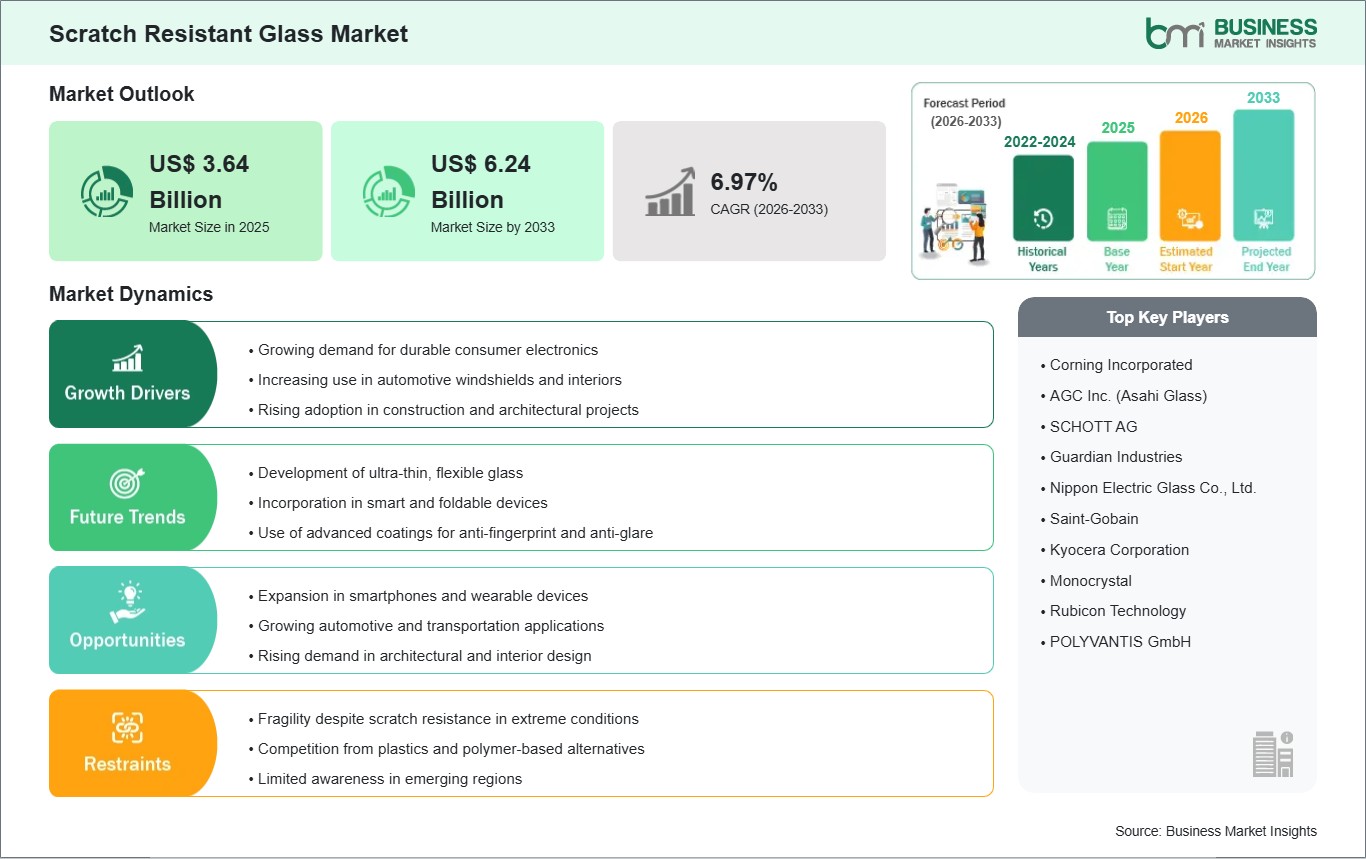
The Scratch Resistant Glass Market size is expected to reach US$ 6.24 billion by 2033 from US$ 3.64 billion in 2025. The market is estimated to record a CAGR of 6.97% from 2026 to 2033.
The global scratch resistant glass market is witnessing substantial growth, driven by the increasing demand for durable and long-lasting glass products across consumer electronics, automotive, construction, and aerospace industries. Scratch resistant glass, often produced using chemical strengthening, coatings, or advanced laminates, provides enhanced surface hardness and improved resistance to wear and abrasion, making it essential for smartphones, tablets, touchscreens, windshields, and architectural facades. The growing consumer preference for devices and vehicles with longer lifespans, coupled with rising urbanization and infrastructural development, is further fueling demand. Technological advancements in coating processes, such as anti-scratch and oleophobic layers, are enabling manufacturers to improve product longevity while maintaining optical clarity and aesthetics.
However, the market faces certain challenges. High production costs for chemically strengthened and coated glass can limit adoption, particularly in price-sensitive regions. Additionally, achieving a balance between scratch resistance and impact strength remains a technical constraint, especially in large-scale architectural or automotive applications. Environmental concerns regarding chemical treatments and energy-intensive production processes are also factors restraining growth. Despite these challenges, innovation in eco-friendly coatings, lightweight glass solutions, and multifunctional materials, along with increasing dema

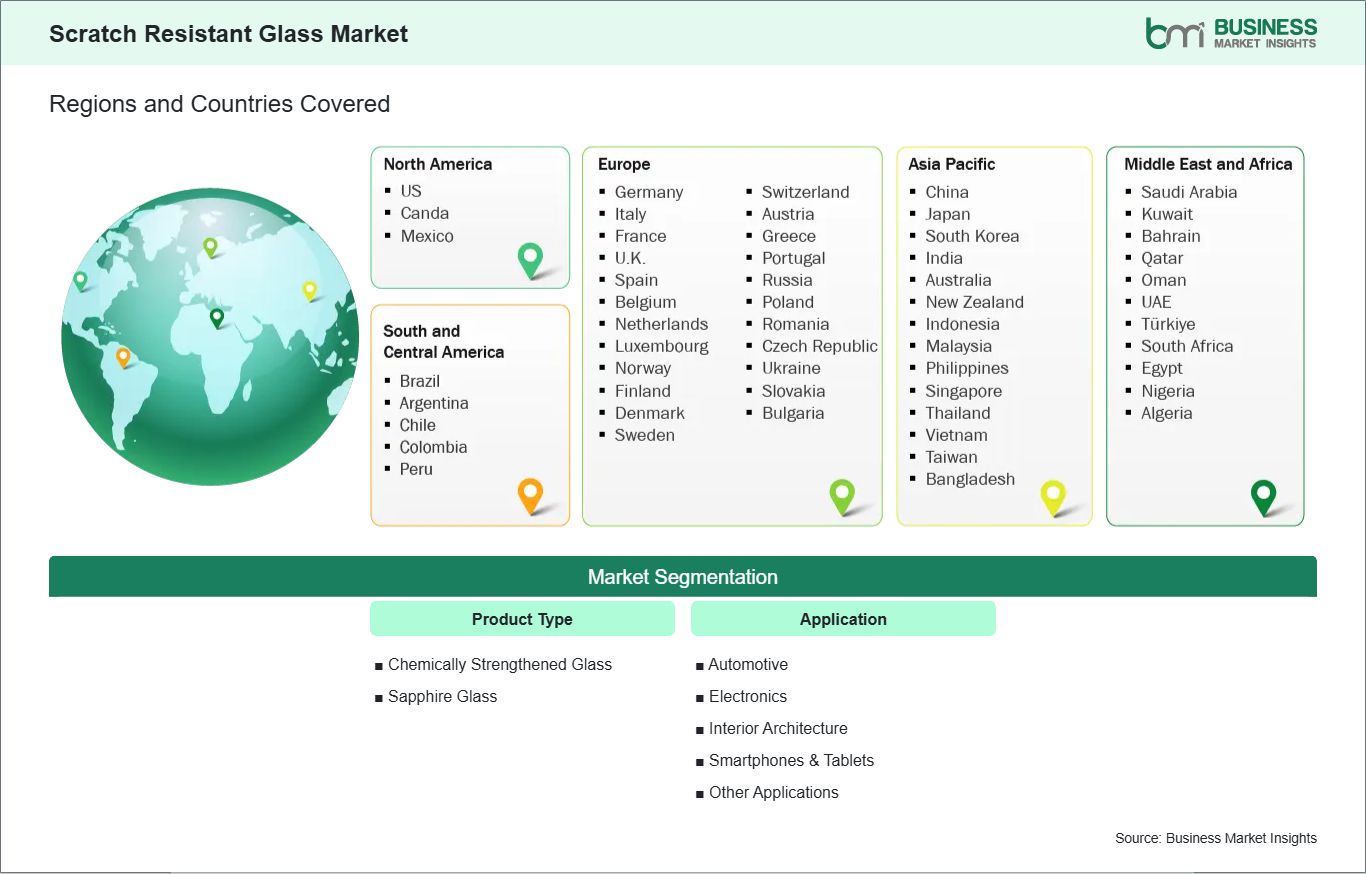
Key segments that contributed to the derivation of the scratch resistant glass market analysis are product type and application
The usage of scratch-resistant glass in Western Europe’s automotive industry is growing as car companies focus on durability, safety, and luxury. Automobile companies in Western Europe, like Germany and France, are increasingly using advanced glass technology in windshields, windows, and display screens. The glass is resistant to daily wear and tear due to dust, debris, and mechanical damage. This feature is now becoming part of luxury cars rather than an option, as people’s expectations are changing.
Another factor that is contributing to the demand is vehicle interior design. Modern vehicles in Western European countries have larger digital screens, touch screen control panels, and glass-based surface materials that give vehicles a sleek, minimalist look. The high frequency of interaction with these materials makes scratch resistance an essential feature for maintaining visibility. Glass manufacturers have developed materials that increase hardness while maintaining touch sensitivity. This is especially true in high-frequency interaction zones such as dashboard panels.
Another factor that is contributing to the demand is fleet vehicles. Ride-sharing services in cities such as Amsterdam and Paris have vehicles that have high usage frequency. This makes scratch-resistant glass an essential feature in maintaining the appearance of vehicles during their long service life. Refurbishing vehicles is expensive, which makes scratch-resistant glass an essential feature in maintaining fleet vehicles.
One factor that is driving the demand for scratch-resistant glass is the prevalence of smartphones and wearable technology in Western Europe. Western Europeans are known for investing in superior technology and want it to look as good as it performs. This means that as devices get replaced over time, durability is becoming an important factor in purchasing decisions, and companies are being forced to make better glass for screens. Scratch-resistant glass is now expected in mid-to-premium smartphones available in markets like the UK, Germany, and the Nordics.
Wearable technology is also contributing to increased demand. Wearables like smartwatches and fitness bands are always exposed to friction, accidental damage, and exposure to the elements. In areas like Scandinavia and Alpine countries, people have active lifestyles and need wearables that can withstand daily wear and tear without sustaining any damage. This has led to the incorporation of sophisticated glass materials that include strengthened and composite glass.
Sustainability and durability are also contributing to demand. Western Europeans are becoming increasingly aware of reducing waste in electronic devices. They prefer devices that last for a longer time and remain in pristine condition. This is being addressed by companies that are highlighting durability as an essential feature in their product offerings. This is not only improving customer satisfaction but also contributing to sustainability, thus maintaining demand for sophisticated Glass materials in Western Europe’s consumer electronics industry.

The global scratch resistant glass market is experiencing steady growth, with market size and share analysis reflecting evolving treatment preferences and competitive dynamics among key players. The report evaluates important subsegments categorized within product type and application highlighting their respective contributions to overall market performance.
By product type, the chemically strengthened glass subsegment dominated the market in 2025 because it offers strong scratch resistance at a much lower cost than sapphire glass. It is lighter, easier to manufacture in large volumes, and provides sufficient durability for most everyday applications. This makes it the preferred option for mass-market products.
By application, the smartphones & tablets subsegment dominated the market in 2025 because they are used constantly and require durable, scratch-resistant surfaces. High production volumes and frequent device upgrades drive continuous demand for protective glass. The need for clear display quality along with durability makes this segment the largest consumer.
| Report Attribute | Details |
|---|---|
| Market size in 2025 | US$ 3.64 Billion |
| Market Size by 2033 | US$ 6.24 Billion |
| Global CAGR (2026 - 2033) | 6.97% |
| Historical Data | 2022-2024 |
| Forecast period | 2026-2033 |
| Segments Covered | By Product Type
|
|
Regions and Countries Covered
| |
| North America | US, Canada, Mexico |
| Europe | Belgium, Austria, Finland, Denmark, Greece, Poland, Romania, Russia, Ukraine, Czech Republic, Slovakia, Bulgaria, Italy, Luxembourg, Germany, Switzerland, France, Netherlands, Norway, Portugal, Spain, Sweden, United Kingdom |
| Asia-Pacific | Australia, China, India, Japan, South Korea, Indonesia, Malaysia, Philippines, Singapore, Thailand, Vietnam, Bangladesh, New Zealand, Taiwan |
| South and Central America | Brazil, Argentina, Peru, Chile, Colombia |
| Middle East and Africa | Bahrain, Kuwait, Oman, Qatar, Saudi Arabia, United Arab Emirates, Turkiye, South Africa, Egypt, Algeria, Nigeria |
| Market leaders and key company profiles |
|
The "Scratch Resistant Glass Market Size and Forecast (2022 - 2033)" report provides a detailed analysis of the market covering below areas:
The geographical scope of the Scratch resistant glass market report is divided into: North America, Asia Pacific, Europe, Middle East & Africa, and South & Central America. North America held the largest share in 2025.
North America dominates the scratch resistant glass market due to its advanced technology infrastructure, strong consumer electronics sector, and mature automotive industry. The United States leads adoption, driven by high demand for smartphones, tablets, and other personal devices that require durable, scratch-resistant displays. In the automotive sector, manufacturers increasingly use chemically strengthened or coated glass for windshields, sunroofs, and interior surfaces to enhance vehicle longevity and passenger safety.
The region enjoys access to high R&D capabilities and mature supply chains that enable innovation in high-performance coatings and multifunctional glass solutions. The demand for high-quality products in North America, where consumers in the United States desire high-quality electronics and vehicles, creates opportunities for manufacturers to integrate scratch-resistant glass in both standard and high-end products. The regulatory requirements for safety and environmental regulations also create opportunities for high-quality glass solutions.
Although there have been concerns regarding production costs and sourcing materials, North America continues to be at the forefront in terms of innovation in scratch-resistant glass solutions, driven by high levels of consumer knowledge regarding product longevity.

The scratch resistant glass market is evaluated by gathering qualitative and quantitative data post primary and secondary research, which includes important corporate publications, association data, and databases. A few of the key developments in the Scratch resistant glass market are:
The Scratch Resistant Glass Market is valued at US$ 3.64 Billion in 2025, it is projected to reach US$ 6.24 Billion by 2033.
As per our report Scratch Resistant Glass Market, the market size is valued at US$ 3.64 Billion in 2025, projecting it to reach US$ 6.24 Billion by 2033. This translates to a CAGR of approximately 6.97% during the forecast period.
The Scratch Resistant Glass Market report typically cover these key segments-
The historic period, base year, and forecast period can vary slightly depending on the specific market research report. However, for the Scratch Resistant Glass Market report:
The Scratch Resistant Glass Market is populated by several key players, each contributing to its growth and innovation. Some of the major players include:
The Scratch Resistant Glass Market report is valuable for diverse stakeholders, including:
Essentially, anyone involved in or considering involvement in the Scratch Resistant Glass Market value chain can benefit from the information contained in a comprehensive market report.
Please tell us your area of interest
(Market Segments/ Regions and Countries/ Companies)