Impact Resistant Glass Market Outlook (2022-2033)

Historic Data: 2022-2024   |   Base Year: 2025   |   Forecast Period: 2026-2033
Report Content: Market Scope, Market Segmentation, Market Dynamics, and Competitive Analysis

Report Coverage:
  • Interlayer (Polyvinyl Butyral, Ionoplast Polymer, Ethylene Vinyl Acetate, Other Interlayers)
  • End-Use Industry (Construction & Infrastructure, Automotive & Transportation, Other End-Use Industries)

No. of Pages: 405
Report Code: BMIPUB00033983
Category: Chemicals and Materials
Impact Resistant Glass Market

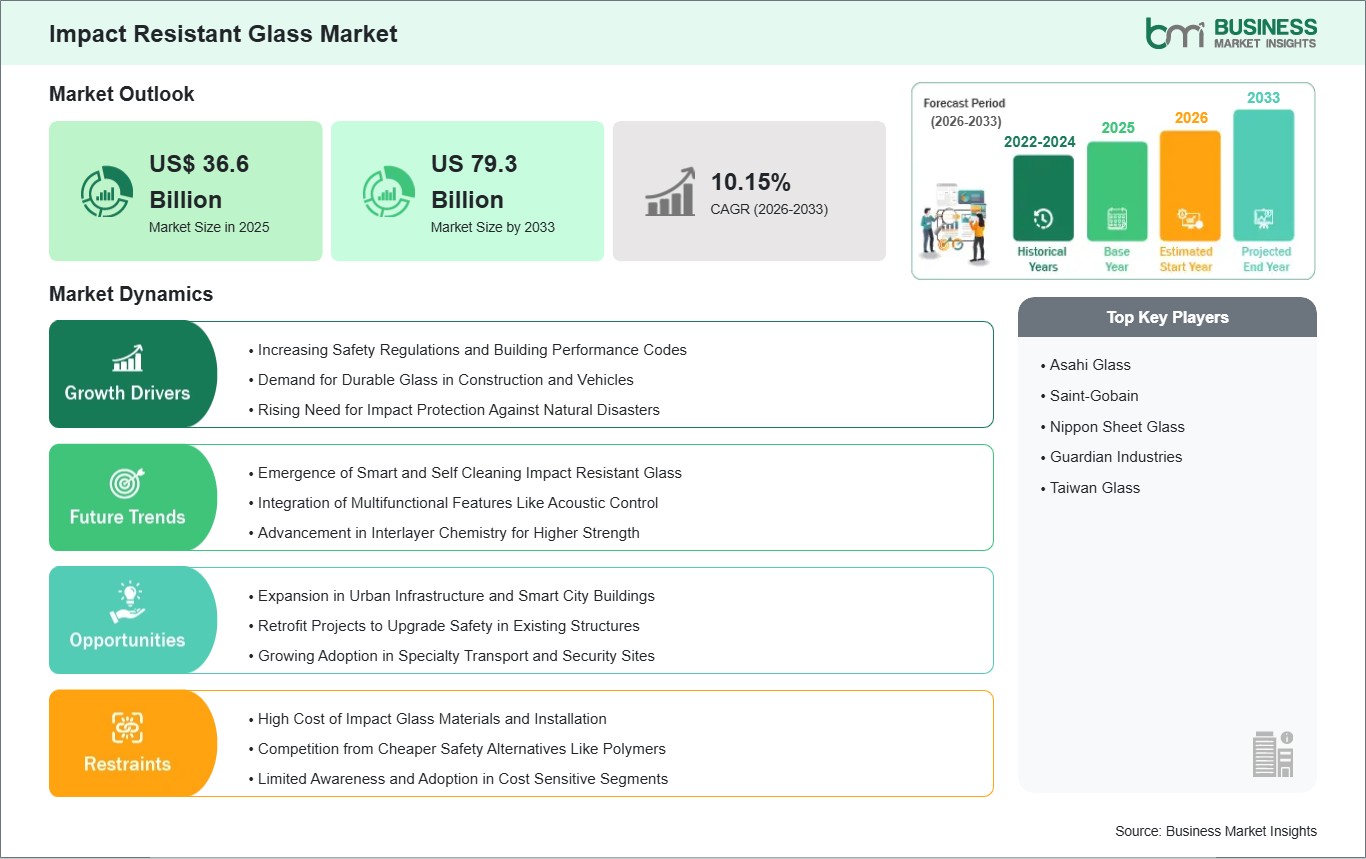
The Impact Resistant Glass Market size is expected to reach US$ 79.3 Billion by 2033 from US$ 36.6 Billion in 2025. The market is estimated to record a CAGR of 10.15% from 2026 to 2033.

Executive Summary and Global Market Analysis:

The global market for impact-resistant glass is primarily focused on solutions that have been engineered to resist tremendous mechanical forces and shock, as well as harsh weather. Impact-resistant glass is also known as safety glass. This type of glass is engineered using advanced manufacturing techniques that incorporate tempered glass and laminates. This type of glass is highly suitable for application areas where safety is a major consideration. Some of the major application areas where impact-resistant glass is used include the automotive industry, construction industry, transportation industry, and security industry. In buildings, this type of glass is used to improve storm debris resistance and safety. In addition, this type of glass is also used to improve aesthetic appeal. In the automotive industry, this type of glass is used to improve safety and performance.

The market is fueled by an increasing global focus on safety standards, regulatory compliance for protective glazing solutions, and an increasing need for safety in urban environments through building materials. Weather conditions such as hurricanes and stormy weather have also prompted an increasing need for building envelopes to withstand such conditions without shattering.

The automotive industry's focus on safety has also prompted an increasing need for manufacturers to incorporate impact-resistant glass in windshields and side windows. The increasing need for comfort in automotive and building materials has also prompted an increasing need for such materials. The market is also likely to be subject to several restraints. The manufacturing process for impact-resistant glass is quite complex. The manufacturing process for such materials is quite complex, and it is essential to ensure optical clarity in such materials. The increasing need for such materials in safety-focused products has ensured the relevance of such materials in the market.

The relevance of such materials in safety-focused products has ensured their relevance of such materials in the market. The relevance of such materials in safety-focused products has ensured their relevance of such materials in the market.

Impact Resistant Glass Market - Strategic Insights:

global-market-strategic-framework
Get more information on this report

Impact Resistant Glass Market Segmentation Analysis:

Key segments that contributed to the derivation of the impact resistant glass market analysis are interlayer and end‑user industry.

  • By interlayer, the impact resistant glass market is segmented into Polyvinyl Butyral, Ionoplast Polymer, Ethylene Vinyl Acetate, and Other interlayers. The Polyvinyl Butyral subsegment dominated the market in 2025.
  • In terms of end‑use industry, the impact resistant glass market is divided into Construction & Infrastructure, Automotive & Transportation, and Other end‑use industries. The Construction & Infrastructure subsegment dominated the market in 2025.

Impact Resistant Glass Market Drivers and Opportunities:

Increasing Safety Regulations and Building Performance Codes

The global demand for impact resistant glass is being driven by the rising emphasis on safety regulations and stringent building performance codes. Governments and construction authorities worldwide are increasingly enforcing standards to ensure that buildings can withstand environmental hazards, accidental impacts, and security threats. Impact resistant glass, including laminated, tempered, and chemically strengthened varieties, is designed to prevent shattering and protect occupants from injuries during collisions or breakage. This has made such glass an essential component in residential, commercial, and public infrastructure projects, where safety compliance is non-negotiable.

In addition to regulatory compliance, impact resistant glass enhances overall building performance by improving durability and longevity. Modern constructions are expected to endure harsh weather conditions, temperature fluctuations, and mechanical stress over extended lifecycles. Laminated and multi-layered glass solutions provide superior resistance to cracks, penetration, and blast impacts, making them ideal for high-traffic areas such as schools, hospitals, and airports. Architects and designers are increasingly specifying impact resistant glass not only for safety but also to meet performance criteria that ensure the structural integrity and resilience of buildings across diverse environmental conditions worldwide.

Moreover, the adoption of impact resistant glass aligns with broader trends in sustainable and resilient construction. These glass solutions often offer additional benefits such as acoustic insulation, UV protection, and thermal efficiency, which help buildings meet green building certifications and energy standards. By integrating impact resistant glass, developers can address multiple building performance goals simultaneously, enhancing occupant safety and comfort while optimizing energy usage. As global safety codes continue to evolve and expand, the role of impact resistant glass in ensuring secure, durable, and high-performance buildings is becoming increasingly critical across all regions.

Expansion in Urban Infrastructure and Smart City Buildings

The growing development of urban infrastructure and smart city projects is driving the global adoption of impact resistant glass. Urban centers are witnessing an unprecedented increase in high-rise buildings, transportation hubs, and mixed-use complexes, where glass plays a key architectural and functional role. Impact resistant glass is essential in these environments, providing structural safety while allowing for expansive façades, curtain walls, and transparent elements that enhance aesthetic appeal. Its ability to maintain clarity, strength, and resistance to impact makes it suitable for pedestrian-heavy areas and high-traffic public spaces in cities around the world.

In smart city applications, impact resistant glass is increasingly integrated with advanced technologies such as solar control coatings, dynamic tinting, and embedded sensors. These features enhance building functionality by regulating sunlight, improving energy efficiency, and supporting connected infrastructure for lighting, security, and climate control. For public transportation systems, including metro stations, airports, and bus terminals, laminated and tempered glass is used extensively to protect passengers, prevent accidents, and withstand frequent usage. This dual focus on safety and technology underscores the material’s critical role in modern urban planning and smart infrastructure development globally.

Additionally, impact resistant glass is also playing an important role in sustainable development in cities. The use of impact resistant glass in building facades, windows, and partitions enables the development of lighter buildings without compromising safety. At the same time, impact resistant glass is also playing an important role in reducing maintenance costs for urban buildings. Considering the importance of infrastructure modernization and smart cities in cities across the world, impact resistant glass is now being recognized as an important material for balancing safety, aesthetics, energy efficiency, and technology in cities.

Impact Resistant Glass Market Size and Share Analysis:

The impact resistant glass market is experiencing steady growth, with market size and share analysis reflecting evolving treatment preferences and competitive dynamics among key players. The report evaluates important subsegments categorized within interlayer and end‑user industry, highlighting their respective contributions to overall market performance.

By interlayer, the Polyvinyl Butyral subsegment dominated the Impact Resistant Glass market in 2025. Polyvinyl Butyral provides excellent adhesion, toughness, and optical clarity, making it highly suitable for safety and laminated glass applications, driving its widespread adoption.

In terms of end-use industry, the Construction & Infrastructure subsegment dominated the Impact Resistant Glass market in 2025. Construction and infrastructure applications demand durable, impact-resistant, and safety-compliant glass solutions, reinforcing the dominance of this segment in the market.

Impact Resistant Glass Market Report Highlights:

Report Attribute Details
Market size in 2025 US$ 36.6 Billion
Market Size by 2033 US 79.3 Billion
Global CAGR (2026 - 2033)10.15%
Historical Data 2022-2024
Forecast period 2026-2033
Segments Covered By Interlayer
  • Polyvinyl Butyral
  • Ionoplast Polymer
  • Ethylene Vinyl Acetate
  • Other Interlayers
By End-Use Industry
  • Construction & Infrastructure
  • Automotive & Transportation
  • Other End-Use Industries
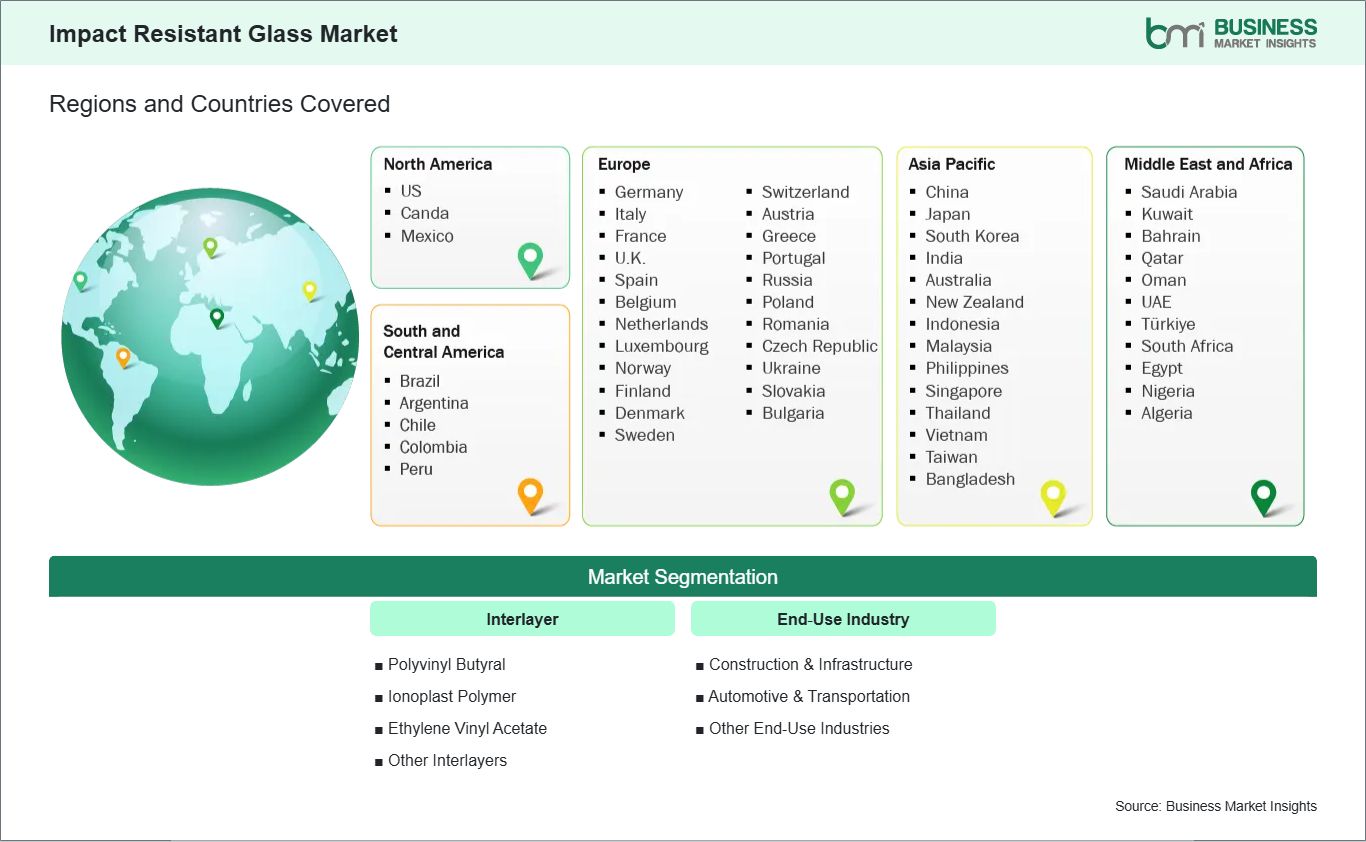
Regions and Countries Covered
North America US, Canada, Mexico
Europe Belgium, Austria, Finland, Denmark, Greece, Poland, Romania, Russia, Ukraine, Czech Republic, Slovakia, Bulgaria, Italy, Luxembourg, Germany, Switzerland, France, Netherlands, Norway, Portugal, Spain, Sweden, United Kingdom
Asia-Pacific Australia, China, India, Japan, South Korea, Indonesia, Malaysia, Philippines, Singapore, Thailand, Vietnam, Bangladesh, New Zealand, Taiwan
South and Central America Brazil, Argentina, Peru, Chile, Colombia
Middle East and Africa Bahrain, Kuwait, Oman, Qatar, Saudi Arabia, United Arab Emirates, Turkiye, South Africa, Egypt, Algeria, Nigeria
Market leaders and key company profiles
  • Asahi Glass
  • Saint-Gobain
  • Nippon Sheet Glass
  • Guardian Industries
  • Taiwan Glass
Get more information on this report

Impact Resistant Glass Market Report Coverage and Deliverables:

The "Impact Resistant Glass Market Size and Forecast (2022 - 2033)" report provides a detailed analysis of the market covering below areas:

  • Impact Resistant Glass market size and forecast at global, regional, and country levels for all the key market segments covered under the scope
  • Impact Resistant Glass market trends, as well as drivers, restraints, and opportunities
  • Impact Resistant Glass market analysis covering key trends, regional framework, major players, regulations, and recent developments
  • Industry landscape and competition analysis covering market concentration, heat map analysis, prominent players, and recent developments for the Impact Resistant Glass market
  • Detailed company profiles, including SWOT analysis

Impact Resistant Glass Market Geographic Insights:

The geographical scope of the Impact Resistant Glass market report is divided into five regions: North America, Asia Pacific, Europe, Middle East & Africa, and South & Central America. The Impact Resistant Glass market in North America is expected to grow during the forecast period.

North America has a major market position in the global market for impact resistant glass. This is attributed to factors such as the stringent safety regulations in the region, the development of infrastructure in the region, and the awareness of consumers in the region with regard to safety building and automotive products. The region has a well-established building and construction sector with commercial, residential, and institutional buildings using impact resistant glass for the development of safer buildings. In coastal areas where there is a higher possibility of hurricanes, buildings are constructed with impact resistant glass systems in the windows and doors of the buildings. This is in order to protect the buildings from the impact of wind-borne objects in the event of a hurricane.

The automotive industry in North America also contributes to the demand in the region. Due to the emphasis on safety standards in vehicles, the automotive industry uses impact-resistant glass in windshields and side windows to enhance the safety of vehicles in the region. Advances in the technology used in the lamination of glass also contribute to the development of features such as reduced weight, improved optical properties, and scratch and weather resistance. Apart from the construction and automotive industries, impact-resistant glass has started gaining popularity in the development of infrastructure related to transportation, where the safety of the public is a major concern.

The region has a well-established base for research, which has a positive impact on the development of impact-resistant glass in the region. Manufacturers in the region are also emphasizing the development of impact-resistant glass that not only provides the desired impact characteristics but also has aesthetic appeal, recyclability, and compatibility with green buildings.

global-market-geography
Get more information on this report

Impact Resistant Glass Market Research Report Guidance:

  • The report includes qualitative and quantitative data in the Impact Resistant Glass market across interlayer, end‑user industry, and geography.
  • The report starts with the key takeaways (chapter 2), highlighting the key trends and outlook of the Impact Resistant Glass market.
  • Chapter 3 focuses on the research methodology of the study.
  • Chapter 4 includes ecosystem analysis.
  • Chapter 5 highlights the major industry dynamics in the Impact Resistant Glass market, including factors that are driving the market, prevailing deterrents, potential opportunities, as well as future trends. Impact analysis of these drivers and restraints is also covered in this section.
  • Chapter 6 discusses the Impact Resistant Glass market scenario, in terms of historical market revenues, and forecast till the year 2033.
  • Chapters 7 to 9 cover the Impact Resistant Glass market segments by interlayer, end‑user industry, and geography across North America, Europe, Asia Pacific, Middle East and Africa, and South and Central America. They cover the market volume, revenue forecast, and factors driving the market.
  • Chapter 10 describes the competitive analysis with the heat map analysis for the key players operating in the market.
  • Chapter 11 describes the industry landscape analysis. It provides detailed descriptions of business activities such as market initiatives, new developments, mergers, and joint ventures globally, along with a competitive landscape.
  • Chapter 12 provides detailed profiles of the major companies operating in the Impact Resistant Glass market. Companies have been profiled on the basis of their key facts, business descriptions, products, financial overview, SWOT analysis, and key developments.
  • Chapter 13, i.e., the appendix, is inclusive of a brief overview of the company, list of abbreviations, and disclaimer.

Impact Resistant Glass Market News and Key Development:

The impact resistant glass market is evaluated by gathering qualitative and quantitative data post primary and secondary research, which includes important corporate publications, association data, and databases. A few of the key developments in the impact resistant glass market are:

  • In April 2025, MITER Brands announced that its Diamond Glass impact‑resistant glass product was named one of Green Builder Magazine’s 2025 Sustainable Products of the Year, highlighting its breakthrough design that combines lightweight construction with exceptional impact resistance for safer and more efficient building applications.
  • In January 2025, MITER Brands announced that two of its products including Diamond Glass were named in the 2024 Window + Door Awards, with Diamond Glass winning the Unique Innovation award for its durable and high‑performance laminated impact glass, reinforcing the company’s innovation leadership in impact‑resistant glazing solutions.

Key Sources Referred:

  • International Organization for Standardization (ISO)
  • American Society for Testing and Materials (ASTM International)
  • Bureau of Indian Standards (BIS)
  • Environmental Protection Agency (EPA), USA
  • European Chemicals Agency (ECHA)
  • Central Pollution Control Board (CPCB), India
  • Ministry of Chemicals and Fertilizers, India
  • American Chemistry Council (ACC)
  • Indian Chemical Council (ICC)
  • European Chemical Industry Council (Cefic)
  • Specialty Chemical Association of India (SCAI)
  • Company Websites
  • Company Annual Reports
  • Company Investor Presentations
The List of Companies - Impact Resistant Glass Market
  • Asahi Glass
  • Saint-Gobain
  • Nippon Sheet Glass
  • Guardian Industries
  • Taiwan Glass
Frequently Asked Questions
How big is the Impact Resistant Glass Market?

The Impact Resistant Glass Market is valued at US$ 36.6 Billion in 2025, it is projected to reach US 79.3 Billion by 2033.

What is the CAGR for Impact Resistant Glass Market by (2026 - 2033)?

As per our report Impact Resistant Glass Market, the market size is valued at US$ 36.6 Billion in 2025, projecting it to reach US 79.3 Billion by 2033. This translates to a CAGR of approximately 10.15% during the forecast period.

What segments are covered in this report?

The Impact Resistant Glass Market report typically cover these key segments-

  • Interlayer (Polyvinyl Butyral, Ionoplast Polymer, Ethylene Vinyl Acetate, Other Interlayers)
  • End-Use Industry (Construction & Infrastructure, Automotive & Transportation, Other End-Use Industries)

What is the historic period, base year, and forecast period taken for Impact Resistant Glass Market?

The historic period, base year, and forecast period can vary slightly depending on the specific market research report. However, for the Impact Resistant Glass Market report:

  • Historic Period : 2022-2024
  • Base Year : 2025
  • Forecast Period : 2026-2033
  • Who are the major players in Impact Resistant Glass Market?

    The Impact Resistant Glass Market is populated by several key players, each contributing to its growth and innovation. Some of the major players include:

  • Asahi Glass
  • Saint-Gobain
  • Nippon Sheet Glass
  • Guardian Industries
  • Taiwan Glass
  • Who should buy this report?

    The Impact Resistant Glass Market report is valuable for diverse stakeholders, including:

    • Investors: Provides insights for investment decisions pertaining to market growth, companies, or industry insights. Helps assess market attractiveness and potential returns.
    • Industry Players: Offers competitive intelligence, market sizing, and trend analysis to inform strategic planning, product development, and sales strategies.
    • Suppliers and Manufacturers: Helps understand market demand for components, materials, and services related to concerned industry.
    • Researchers and Consultants: Provides data and analysis for academic research, consulting projects, and market studies.
    • Financial Institutions: Helps assess risks and opportunities associated with financing or investing in the concerned market.

    Essentially, anyone involved in or considering involvement in the Impact Resistant Glass Market value chain can benefit from the information contained in a comprehensive market report.

    Available Report Formats

    pdf-format excel-format pptx-format
    Buy Now
    Sales Assistance
    +1 646 791 7070 (US & UK)
    Customization Form

    Please tell us your area of interest
    (Market Segments/ Regions and Countries/ Companies)