
Robotic Process Automation (RPA) Market Outlook: Size, Share, Trends, Growth Analysis, Competitive Landscape & Forecast, 2026-2033

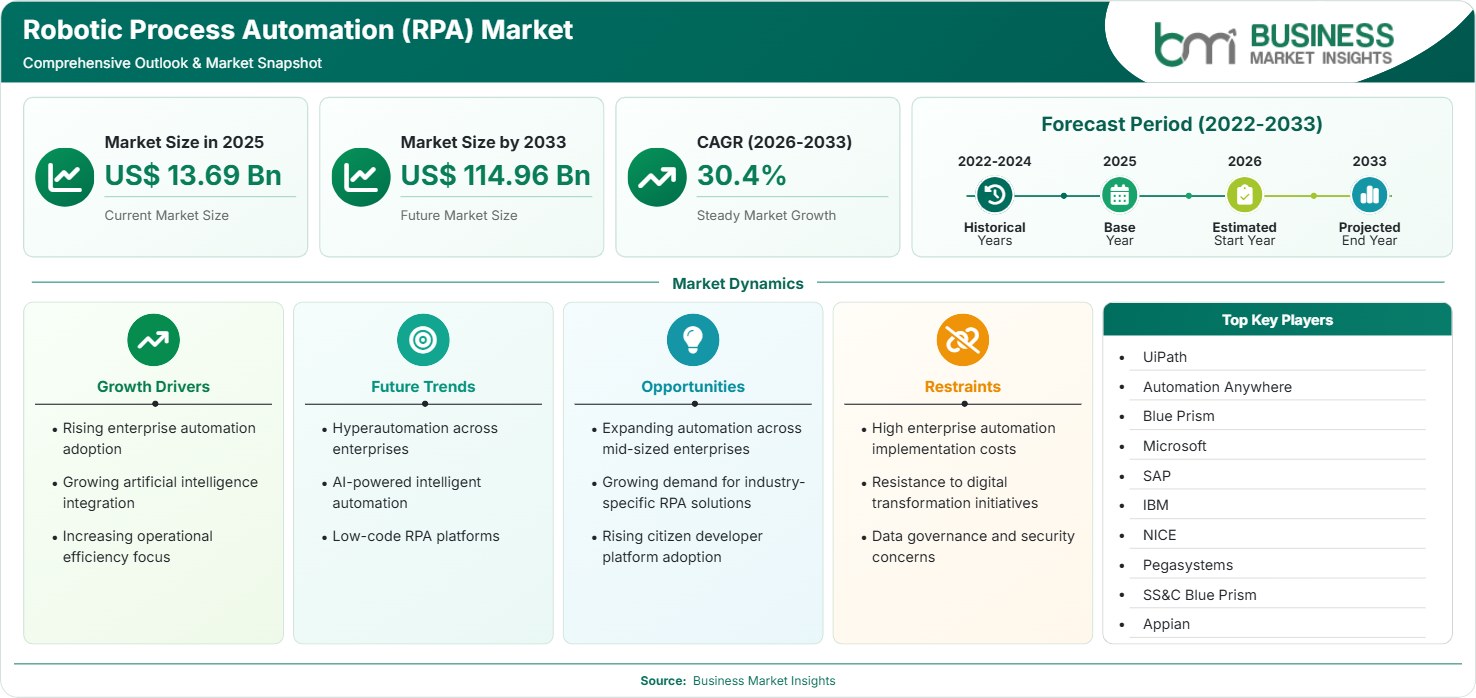
The Robotic Process Automation (RPA) Market size was valued at US$ 13.69 Billion in 2025 and is projected to reach US$ 114.96 Billion by 2033, growing at a CAGR of 30.4% during 2026–2033, driven by rising enterprise automation adoption, growing artificial intelligence integration, and increasing operational efficiency focus, creating opportunities across industries.

Report Coverage
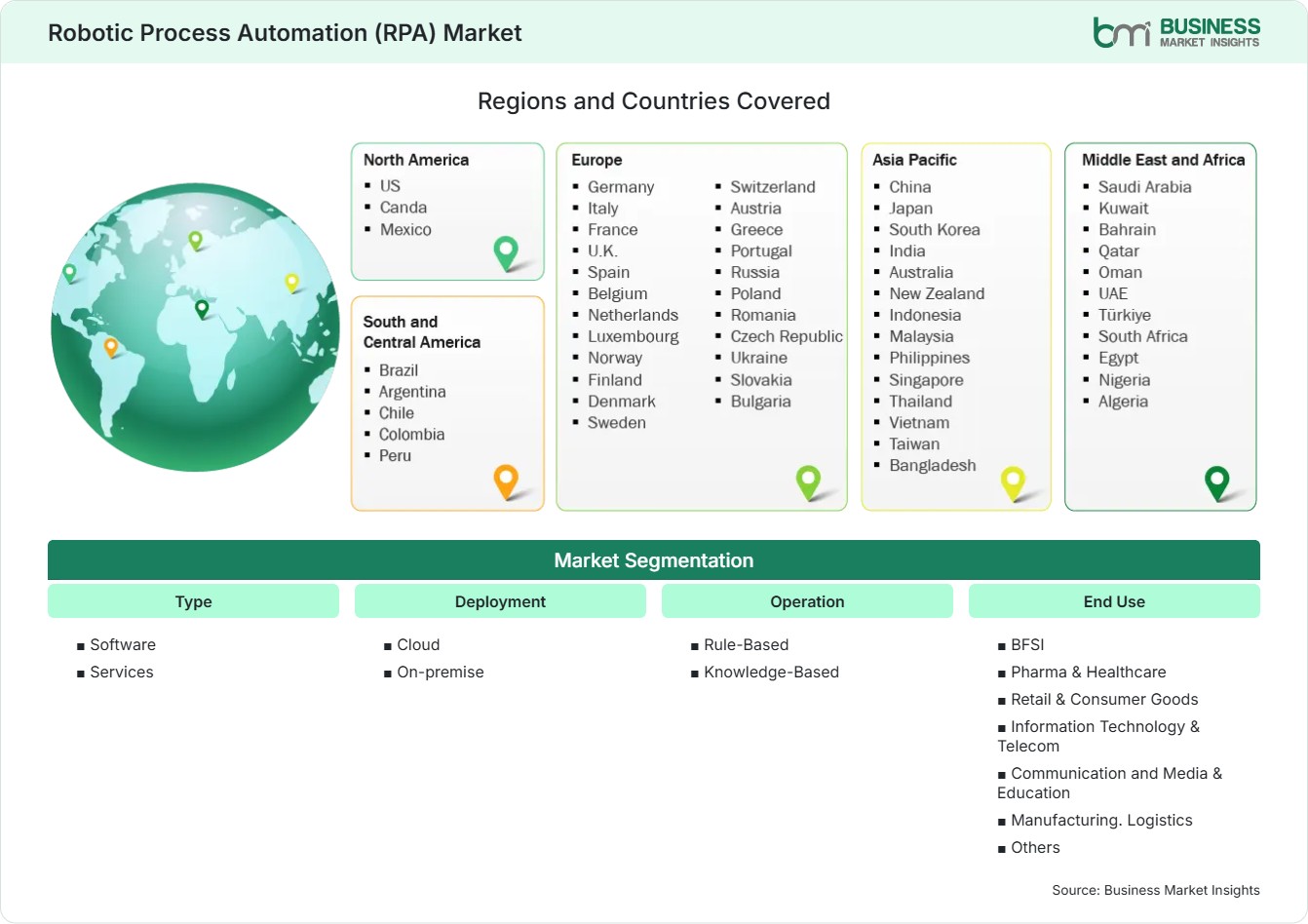
  • Type: Software, Services
  • Deployment: Cloud, On-premise
  • Operation: Rule-Based, Knowledge-Based
  • End Use: BFSI, Pharma & Healthcare, Retail & Consumer Goods, Information Technology & Telecom, Communication and Media & Education, Manufacturing. Logistics, Others
US$ 13.69 Bn Market size in 2025
US$ 114.96 Bn Market Size by 2033
30.4% CAGR, 2026 - 2033
2026-2033 Forecast Period

01 AI Overview

Robotic Process Automation (RPA) Market Summary

  • North America Region: North America holds a market share of 38%–42% in 2025, growing with a CAGR of 28%–30% influenced by enterprise automation adoption, artificial intelligence integration, and operational efficiency focus. The US market demonstrates strong enterprise deployment across BFSI and IT sectors, with a CAGR of 29%–31% during 2026–2033.
  • Fastest Growing Region: Asia Pacific holds a Robotic Process Automation (RPA) market share of 25%–29% in 2025, expanding with a CAGR of 33%–35% supported by expanding automation adoption among enterprises, digital transformation initiatives, and increasing implementation of scalable cloud-based automation platforms.
  • Leading Segment: Software holds a market share of 60%–64% in 2025, growing with a CAGR of 31%–33% driven by increasing demand for automation platforms, workflow optimization capabilities, artificial intelligence integration, and enterprise process management solutions.
  • High Growth Segment: Cloud deployment holds a market share of 45%–49% in 2025, expanding with a CAGR of 34%–36% due to flexible implementation models, scalability advantages, reduced infrastructure requirements, and increasing adoption among mid-sized enterprises.
  • Key Market Opportunity: Expanding automation across mid-sized enterprises, growing demand for industry-specific RPA solutions, and rising citizen developer platform adoption are creating new opportunities for vendors to deliver accessible automation capabilities.
  • Major Market Players: UiPath, Automation Anywhere, Blue Prism, Microsoft, SAP, IBM, NICE, Pegasystems, SS&C Blue Prism, Appian.
02 Strategic Insights

Robotic Process Automation (RPA) Market: Strategic Insights

Robotic Process Automation (RPA) Market Strategic Framework
FREE PDF
Request your free sample
Request free sample
03 Stakeholder View

Key Takeaways

  • The market ecosystem is shifting from standalone automation tools toward integrated intelligent automation platforms combining software robots, artificial intelligence capabilities, analytics, and enterprise workflow management solutions.
  • Software-based automation platforms represent the core value opportunity as enterprises prioritize scalable automation systems that can manage repetitive processes across departments while improving operational consistency.
  • Artificial intelligence integration is reshaping automation capabilities by enabling platforms to process more complex workflows, improve decision-making support, and expand beyond traditional rule-based automation.
  • North America remains a strategic investment region due to established enterprise technology adoption, strong presence of automation providers, and increasing automation implementation across large organizations.
  • Robotic Process Automation (RPA) Market consolidation is increasing as technology companies strengthen automation portfolios through partnerships, acquisitions, and platform expansion strategies targeting broader enterprise requirements.
  • Mid-sized enterprise adoption represents an important growth avenue as cloud-based automation platforms reduce deployment barriers and provide accessible solutions for organizations seeking productivity improvements.
04 Geographic Outlook

Robotic Process Automation (RPA) Market Regional Highlights

North America Robotic Process Automation (RPA) Market

North America accounted for a market share of 38%–42% in 2025 and is projected to expand at a CAGR of 28%–30% from 2026–2033. The region maintains leadership due to strong enterprise technology adoption, advanced digital infrastructure, and widespread automation implementation across industries. The Robotic Process Automation (RPA) Market share remains concentrated among major technology providers, while market expansion is supported by artificial intelligence integration and enterprise demand for operational efficiency improvements.

  • Enterprise automation adoption continues increasing as organizations implement software robots to streamline repetitive workflows and improve business process management capabilities.
  • Artificial intelligence integration is enhancing automation platforms by enabling more advanced workflow handling and expanding use cases across enterprise functions.
  • BFSI organizations are adopting automation solutions to improve transaction processing, compliance operations, and customer service efficiency.
  • Technology providers are expanding automation platforms with cloud capabilities to support flexible deployment models and broader enterprise accessibility.

US Robotic Process Automation (RPA) Market

The US accounted for a market share of 32%–35% in 2025 and is expected to register a CAGR of 29%–31% during 2026–2033. The country represents a major automation hub due to strong enterprise software adoption, technology investment, and demand for productivity improvement. The US market benefits from automation deployment across BFSI, healthcare, retail, and information technology sectors, supported by increasing enterprise focus on process optimization.

  • Large enterprises in the US are implementing automation platforms to improve operational efficiency and reduce manual process dependency.
  • Artificial intelligence-powered automation solutions are gaining adoption as organizations seek more advanced workflow capabilities and intelligent decision support.
  • Cloud-based automation platforms are expanding accessibility among businesses seeking scalable and cost-effective implementation approaches.

Europe Robotic Process Automation (RPA) Market

Europe represented a market share of 24%–27% in 2025 and is anticipated to grow at a CAGR of 27%–29% between 2026–2033. The region demonstrates strong automation adoption due to enterprise modernization programs, digital transformation initiatives, and increasing demand for productivity enhancement. Leading markets include the United Kingdom, Germany, and France, while Nordic countries demonstrate growing adoption through technology-focused business environments and automation investments.

  • European enterprises are adopting automation solutions to improve operational workflows and strengthen efficiency across administrative and business processes.
  • BFSI organizations are deploying RPA platforms to support compliance activities, document processing, and customer service operations.
  • Germany continues expanding automation adoption through manufacturing and enterprise technology modernization initiatives.
  • The United Kingdom remains a key automation market due to strong software adoption and financial services demand.
  • France is increasing RPA implementation as organizations focus on digital transformation and process optimization strategies.

Asia Pacific Robotic Process Automation (RPA) Market

Asia Pacific accounted for a market share of 25%–29% in 2025 and is projected to expand at a CAGR of 33%–35% from 2026–2033. The region represents the fastest-growing market due to increasing enterprise automation adoption, expanding digital transformation initiatives, and rising demand for scalable automation solutions. China, India, Japan, South Korea, and Southeast Asian economies are contributing to regional growth through technology investments and enterprise modernization programs.

  • Enterprises across Asia Pacific are adopting automation platforms to improve productivity, streamline workflows, and support operational improvements across business functions.
  • Cloud-based automation solutions are gaining traction as organizations seek flexible deployment models with reduced infrastructure requirements and simplified implementation processes.
  • India is emerging as a significant automation hub due to its large IT services ecosystem and increasing enterprise technology adoption.
  • China and Japan are advancing automation implementation through investments in intelligent technologies and enterprise digitalization initiatives.
  • Southeast Asian markets are expanding automation adoption as businesses modernize operations and seek competitive advantages through process optimization.

Rest of World Robotic Process Automation (RPA) Market

The Rest of World region accounted for a market share of 8%–11% in 2025 and is estimated to grow at a CAGR of 30%–32% between 2026–2033. South and Central America are witnessing increasing interest in automation technologies as enterprises focus on productivity improvements. The Middle East and Africa are developing automation capabilities through digital transformation programs, technology investment, and growing awareness of process automation benefits.

  • Brazil and Mexico are increasing automation adoption as enterprises modernize operations and improve efficiency across business processes.
  • Latin American organizations are exploring RPA platforms to automate repetitive activities and optimize resource utilization across multiple sectors.
  • Middle Eastern enterprises are investing in automation solutions as part of broader technology modernization strategies.
  • African businesses are gradually adopting cloud-based automation platforms to overcome infrastructure limitations and improve accessibility.
  • Regional technology providers are developing automation capabilities to support enterprise digitization and workflow optimization requirements.
Global Market Geography
FREE PDF
Request your free sample
Request free sample
05 Segment Analysis

Robotic Process Automation (RPA) Market Segmentation

Type

The Segment-Type category includes Software and Services, with software representing the leading component of the market in 2025. Software platforms are driving adoption through automation capabilities, workflow management, and integration features, while services support implementation, consulting, and maintenance requirements. The segment is projected to expand at a CAGR of 31%–33% between 2026–2034 as enterprises continue investing in automation technologies.

  • Software: Software platforms provide automation capabilities for repetitive business processes, enabling organizations to improve workflow efficiency, integrate applications, and manage automated operations.
  • Services: Services include consulting, implementation, training, and support activities that help enterprises deploy, customize, and maintain automation solutions effectively.

Deployment

The Deployment segment includes Cloud and On-premise models. Cloud deployment is gaining momentum due to flexibility, scalability, and simplified implementation advantages for organizations. On-premise deployment continues supporting enterprises requiring direct infrastructure control and customized security environments. The deployment segment is expected to grow at a CAGR of 34%–36% between 2026–2034 as businesses evaluate different automation implementation approaches.

  • Cloud: Cloud-based RPA platforms enable flexible access, reduced infrastructure requirements, and scalable automation deployment for enterprises of different sizes.
  • On-premise: On-premise solutions provide organizations with greater infrastructure control, customization options, and deployment flexibility for specific operational requirements.

Operation

The Operation segment consists of Rule-Based and Knowledge-Based automation approaches. Rule-based automation remains widely adopted for structured processes, while knowledge-based solutions are expanding through artificial intelligence integration in Robotic Process Automation (RPA) market. The segment is projected to grow at a CAGR of 30%–32% between 2026–2034 as enterprises seek automation solutions capable of handling increasingly complex workflows.

  • Rule-Based: Rule-based automation executes predefined tasks using structured workflows, supporting repetitive operations requiring consistent processing and predictable outcomes.
  • Knowledge-Based: Knowledge-based automation enables more advanced processes by using intelligent capabilities to manage complex tasks requiring contextual understanding and improved decision support.

End Use

The End Use segment includes BFSI, Pharma & Healthcare, Retail & Consumer Goods, Information Technology (IT) & Telecom, Communication and Media & Education, Manufacturing, Logistics, and Others. BFSI and IT sectors represent major adoption areas due to process-intensive operations and technology-driven transformation initiatives. The segment is expected to expand at a CAGR of 30%–32% between 2026–2034.

  • BFSI: Financial institutions implement automation solutions to optimize operational workflows, improve processing efficiency, and support large-scale transaction management activities.
  • Pharma & Healthcare: Healthcare organizations adopt automation platforms to streamline administrative processes, manage documentation, and improve operational workflows.
  • Retail & Consumer Goods: Retail companies use automation to enhance customer processes, optimize operations, and improve workflow efficiency across business functions.
  • Information Technology (IT) & Telecom: IT and telecom organizations deploy RPA solutions to automate service management, operational processes, and technology workflows.
  • Communication and Media & Education: Organizations in these sectors utilize automation to improve administrative processes, content workflows, and operational efficiency.
  • Manufacturing: Manufacturers implement automation platforms to optimize business processes, improve productivity, and support operational consistency.
  • Logistics: Logistics companies adopt automation solutions to improve process coordination, documentation management, and operational workflow efficiency.
06 Market Forces

Robotic Process Automation (RPA) Market Dynamics

Key Market Drivers

Rising Enterprise Automation Adoption

Rising enterprise automation adoption is a primary factor supporting market expansion as organizations increasingly implement automation platforms to streamline repetitive activities and improve business workflows. Enterprises across BFSI, healthcare, retail, manufacturing, and technology sectors are integrating automation solutions to enhance productivity and create standardized operational processes. The Robotic Process Automation (RPA) Market growth is closely connected with organizations seeking scalable technologies that support digital transformation objectives. Increasing availability of enterprise automation platforms is allowing businesses to automate processes across departments while improving operational consistency.

Growing Artificial Intelligence Integration

Growing artificial intelligence integration is enhancing automation capabilities by enabling platforms to manage more complex processes and improve workflow intelligence. AI technologies are helping automation solutions analyze information, support decision-making, and expand beyond traditional predefined tasks. The Robotic Process Automation (RPA) Market trends indicate increasing collaboration between automation providers and artificial intelligence technology developers. Enterprises are adopting AI-enabled automation platforms to improve process flexibility, increase automation coverage, and address evolving operational requirements across industries.

Increasing Operational Efficiency Focus

Increasing operational efficiency focus is encouraging organizations to adopt automation technologies that reduce manual workloads and optimize business processes. Companies are prioritizing solutions that improve productivity, minimize repetitive tasks, and support more efficient resource allocation. The Robotic Process Automation (RPA) Market growth reflects growing demand for technologies that enable organizations to achieve measurable operational improvements. Businesses are evaluating automation investments based on efficiency gains, process accuracy, and the ability to support long-term digital transformation strategies.

Key Market Opportunities

Expanding Automation Across Mid-Sized Enterprises

Automation growth in mid-sized enterprises becomes an enormous potential due to the fact that small companies have begun to look for solutions to enhance their productivity and increase efficiency. Cloud technologies and simpler models of implementation help overcome adoption barriers for mid-size companies. Automation vendors design flexible solutions to meet the needs of companies with limited technological capabilities. This is how vendors can find customers not only among large enterprises but also among other companies.

Growing Demand for Industry-Specific RPA Solutions

The rising need for industry-specific RPA solutions presents an opportunity for companies to create customized platforms that meet the demands of particular sectors. This is because businesses need customized automation tools that address their particular challenges in areas such as BFSI, healthcare, manufacturing, retail, and logistics industries. Vendors focusing on specialized automation capabilities can strengthen Robotic Process Automation (RPA) market positioning by delivering solutions aligned with industry processes and business objectives.

Rising Citizen Developer Platform Adoption

Increased use of citizen developer platforms is providing opportunities through allowing business personnel to build workflows through automation without requiring extensive coding skills. The use of easy-to-use automation platforms is enabling firms to extend automation participation outside technical personnel. This strategy will help speed up automation implementation and process innovation. Platform providers focusing on ease of use will be able to cater to the needs of businesses interested in employee empowerment.

Market Restraints and Challenges

High Enterprise Automation Implementation Costs

Factor: High enterprise automation implementation costs can limit adoption among organizations with restricted technology budgets and complex operational environments.

Impact: Initial investment requirements for software, integration, training, and deployment can delay automation initiatives. Enterprises must evaluate implementation expenses against expected efficiency improvements before committing to large-scale automation programs. Cost considerations remain particularly important for mid-sized businesses seeking affordable automation solutions. Vendors are addressing this challenge through flexible pricing models and cloud-based deployment options.

Resistance to Digital Transformation Initiatives

Factor: Resistance to digital transformation initiatives can slow automation adoption due to organizational concerns, workforce adaptation challenges, and limited internal readiness.

Impact: Businesses may experience delayed implementation timelines and reduced automation effectiveness when employees and processes are not aligned with transformation goals. Successful automation adoption requires organizational support, workforce engagement, and effective change management strategies. Enterprises must address cultural barriers and improve awareness of automation benefits to maximize implementation outcomes.

07 Company Analysis

Competitive Landscape

The Robotic Process Automation (RPA) Market analysis highlights a competitive environment driven by software innovation, enterprise automation capabilities, artificial intelligence integration, and industry-focused platform development. Leading companies are expanding automation ecosystems through advanced software platforms, cloud deployment models, strategic partnerships, and solutions designed for diverse enterprise requirements. The market includes established technology providers and specialized automation companies focusing on improving workflow automation, scalability, and operational efficiency across multiple industries.

Company Name

Overview

Products and Services relevant to this market

UiPath

UiPath develops enterprise automation platforms focused on workflow automation, artificial intelligence integration, and digital transformation solutions.

Offers automation software, process discovery, robotic automation tools, AI-powered automation, and enterprise workflow management services.

Automation Anywhere

Automation Anywhere provides cloud-native automation platforms designed to help enterprises automate business processes across departments.

Provides intelligent automation software, bot development platforms, AI automation tools, and enterprise automation services.

Blue Prism

Blue Prism is an enterprise automation technology provider known for secure robotic process automation capabilities.

Delivers digital workforce platforms, process automation software, workflow automation, and enterprise automation solutions.

Microsoft

Microsoft provides enterprise technology platforms integrating automation, artificial intelligence, and business productivity solutions.

Offers Power Automate, AI-powered automation tools, workflow management solutions, and enterprise cloud automation services.

SAP

SAP develops enterprise software solutions supporting business process management and automation across industries.

Provides SAP Build Process Automation, workflow automation tools, business process intelligence, and enterprise integration services.

IBM

IBM delivers automation technologies combining artificial intelligence, analytics, and enterprise software capabilities.

Provides IBM Automation solutions, AI-powered workflow automation, process mining, and intelligent automation platforms.

NICE

NICE provides automation and customer experience technologies supporting enterprise workflow optimization.

Offers robotic automation software, customer service automation, workforce management, and process optimization solutions.

Pegasystems

Pegasystems develops low-code automation platforms supporting enterprise process management and digital transformation.

Provides Pega Platform, workflow automation, customer engagement automation, and business process management solutions.

SS&C Blue Prism

SS&C Blue Prism offers enterprise automation solutions following its integration into SS&C Technologies’ technology ecosystem.

Provides robotic process automation platforms, intelligent automation tools, process orchestration, and enterprise automation services.

Appian

Appian delivers low-code automation platforms designed to simplify application development and workflow automation.

Provides process automation software, low-code application platforms, workflow management, and enterprise automation solutions.

08 Industry Activity

Recent Developments

September 2025

UiPath expanded its agentic automation platform with new orchestration capabilities, pre-built solutions, and tools for building and testing AI agents, enabling enterprises to combine AI agents, robots, and human workflows under a governed automation environment.

June 2025

Automation Anywhere launched pre-built Agentic Solutions and a new agentic solutions workspace that allows business users to create and interact with AI agents through natural language interfaces, integrating AI agents, RPA, APIs, and governance features for enterprise automation use cases.

June 2025

SS&C Blue Prism enhanced its RPA ecosystem with the release of AI Gateway capabilities, enabling organizations to integrate AI services into Blue Prism automations and support more intelligent enterprise workflows

April 2025

UiPath introduced its next-generation Platform for Agentic Automation, combining AI agents, robots, and people within a unified automation system to support enterprise-scale intelligent workflow execution and accelerate adoption of AI-powered automation.

10 Trust & Transparency

Research Methodology

The market analysis combines proprietary research with secondary data from government agencies, company disclosures, regulatory filings, industry databases and expert interviews. Market estimates are validated through data triangulation, cross-market benchmarking and analyst review.

View Full Research Methodology

11 Questions Answered

Frequently Asked Questions

Which industries are adopting RPA solutions extensively?

Industries including BFSI, healthcare, retail, IT and telecom, manufacturing, and logistics are adopting RPA solutions to improve workflow efficiency, automate repetitive activities, and optimize operational processes.

What is the role of citizen developer platforms in RPA adoption?

Citizen developer platforms allow business users with limited programming expertise to create automated workflows, helping organizations expand automation adoption across departments and accelerate digital transformation initiatives.

How is artificial intelligence influencing Robotic Process Automation (RPA) Market forecasts?

Artificial intelligence is enabling automation platforms to manage more complex workflows, improve decision support capabilities, and expand automation beyond traditional rule-based processes.

Which deployment model is gaining higher adoption in RPA?

Cloud deployment is gaining momentum due to scalability, flexibility, and reduced infrastructure requirements. Organizations are increasingly selecting cloud-based automation platforms to simplify implementation and support distributed business operations.

What factors are driving the Robotic Process Automation (RPA) Market report expansion?

The market expansion is primarily supported by rising enterprise automation adoption, growing artificial intelligence integration, and increasing operational efficiency focus. Organizations across industries are deploying automation platforms to optimize repetitive processes and improve productivity.

Access the Full Robotic Process Automation (RPA) Market Report

Get segment-level forecasts, regional estimates, competitive benchmarking, company profiles and downloadable Excel datasets.

Access the full Robotic Process Automation (RPA) Market Report
350 pages PDF & Excel | 2026-07-31