
Home Automation Market Outlook: Size, Share, Trends, Growth Analysis, Competitive Landscape & Forecast, 2022-2033

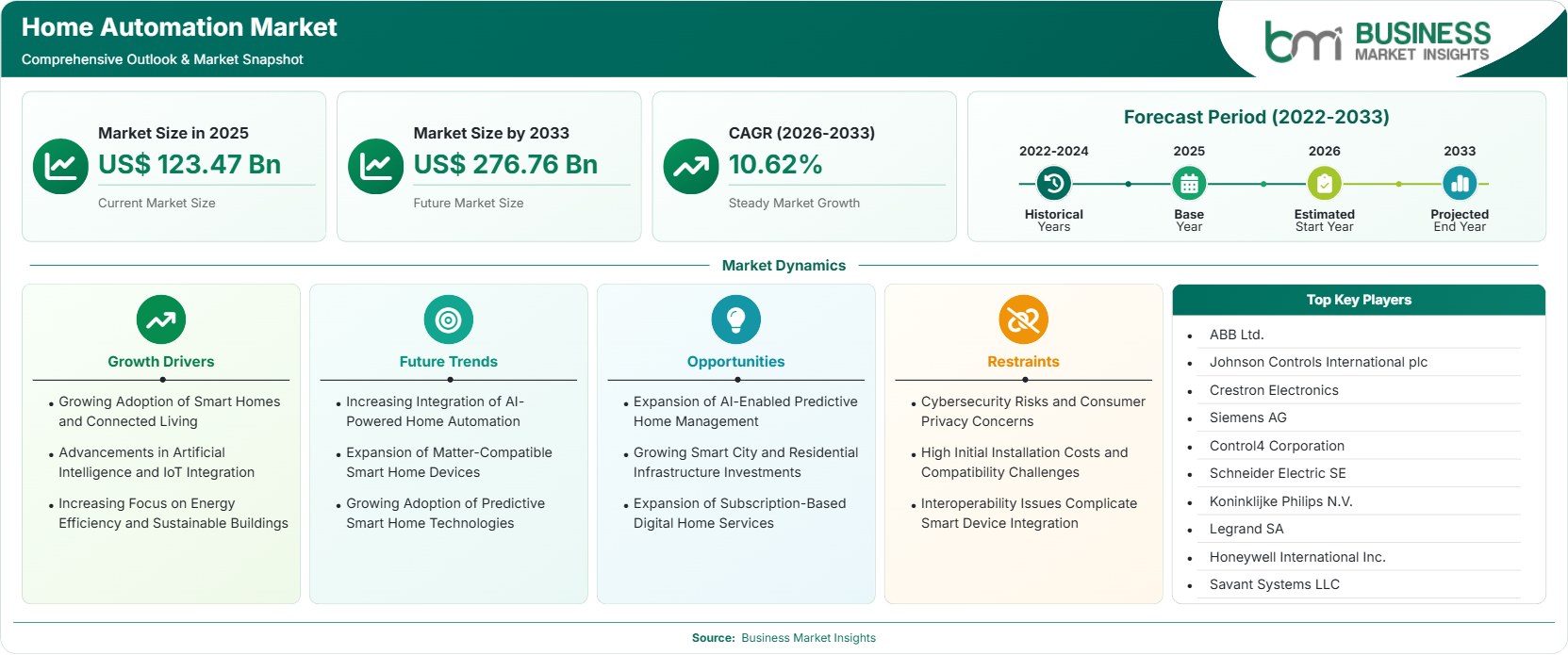
The Home Automation Market size was valued at US$ 123.47 Billion in 2025 and is projected to reach US$ 276.76 Billion by 2033, growing at a CAGR of 10.62% during 2026–2033. Increasing smart home adoption, expanding IoT ecosystems, energy-efficient building initiatives, AI-enabled connected devices, and rising consumer demand for intelligent security solutions continue creating attractive long-term opportunities across residential automation worldwide.

Report Coverage
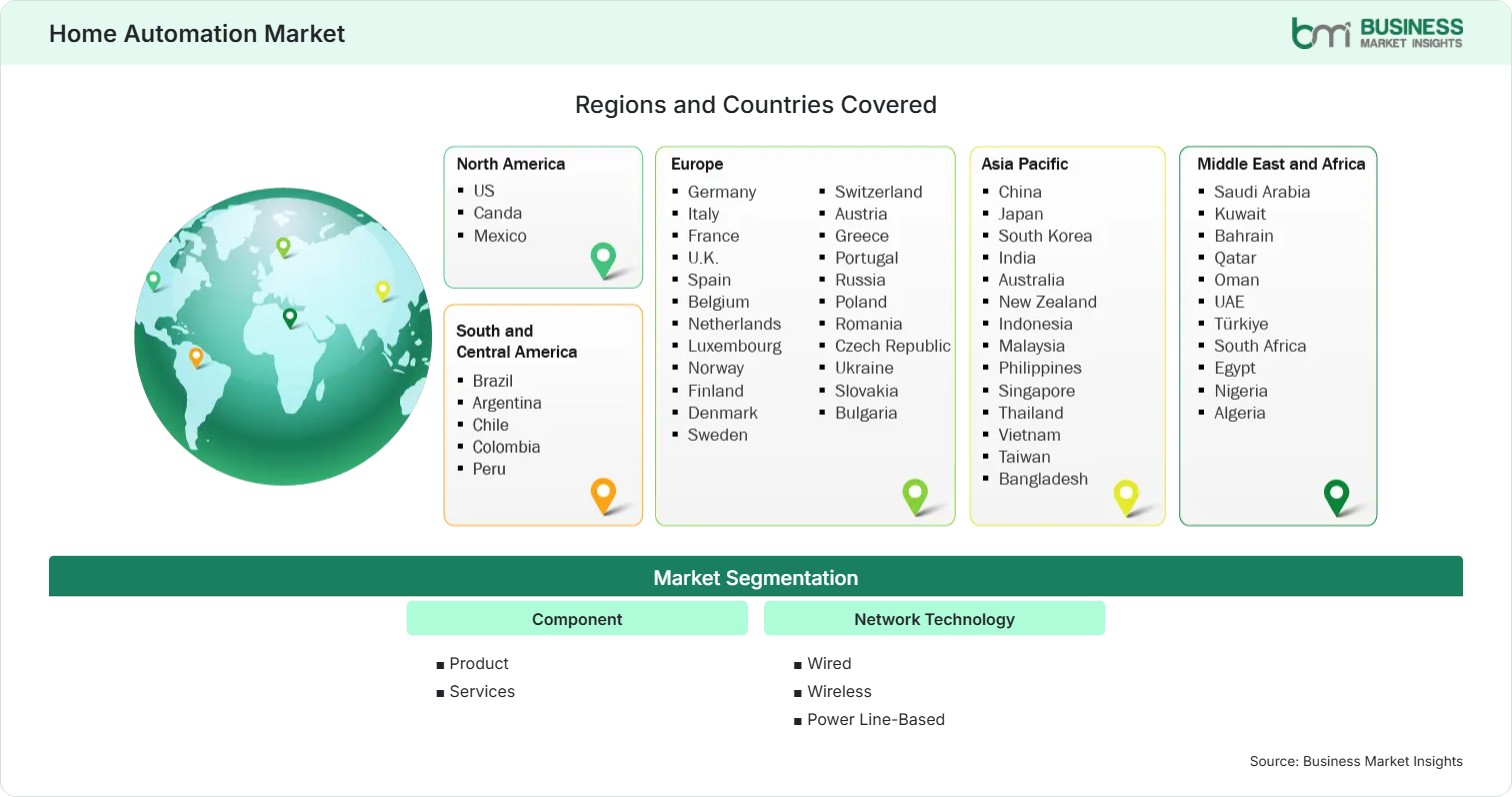
  • Component: Product, Services
  • Network Technology: Wired, Wireless, Power Line-Based
US$ 123.47 Bn Market size in 2025
US$ 276.76 Bn Market Size by 2033
10.62% CAGR, 2026 - 2033
2026-2033 Forecast Period

AI Overview

Home Automation Market Summary

  • North America Region: North America holds 36%–39% share in 2025, expanding at a 9.8%–10.4% CAGR during 2026–2033, supported by advanced smart home infrastructure, high broadband penetration, AI-powered connected devices, and growing investments in residential energy management and security solutions. The U.S. dominates regional demand through mature smart home adoption, extensive IoT deployment, premium residential construction, and a projected 9.9%–10.5% CAGR through 2033.
  • Fastest Growing Region: Asia Pacific accounts for 27%–30% share in 2025 while registering the fastest 12.1%–12.8% CAGR through 2026–2033, driven by rapid urbanization, smart city initiatives, increasing disposable income, affordable connected devices, and expanding digital infrastructure investments.
  • Leading Segment: Product represents 71%–74% share in 2025 and is anticipated to grow at a 10.3%–10.9% CAGR, supported by rising demand for smart lighting, intelligent security, connected HVAC controls, entertainment systems, and voice-enabled home devices.
  • High Growth Segment: Wireless network technology holds 61%–64% share in 2025 and records the highest 11.8%–12.5% CAGR, supported by simplified installation, interoperability improvements, Wi-Fi 6 adoption, Matter protocol implementation, and increasing consumer preference for cable-free smart homes.
  • Key Market Opportunity: Integration of artificial intelligence, edge computing, interoperable IoT ecosystems, predictive energy management, and subscription-based smart home services creates long-term revenue opportunities for technology providers and system integrators globally.
  • Major Market Players: ABB Ltd.; Johnson Controls International plc; Crestron Electronics; Siemens AG; Control4 Corporation; Schneider Electric SE; Koninklijke Philips N.V.; Legrand SA; Honeywell International Inc.; Savant Systems LLC.
Strategic Insights

Home Automation Market: Strategic Insights

Home Automation Market Strategic Framework
FREE PDF
Request your free sample
Request free sample
Stakeholder View

Key Takeaways

  • The industry value chain increasingly integrates semiconductor suppliers, software developers, cloud service providers, communication technology vendors, installers, and smart device manufacturers, creating highly interconnected residential automation ecosystems.
  • Intelligent security systems, energy management platforms, and wireless connected devices present the strongest commercial opportunities as homeowners increasingly prioritize safety, sustainability, and digital convenience.
  • Artificial intelligence, edge analytics, Matter-enabled interoperability, digital twins, and predictive automation are redefining residential technology development while encouraging greater investment in software-driven smart home platforms.
  • Asia Pacific offers the most compelling regional investment opportunity due to rapid urban housing expansion, government-backed smart city initiatives, increasing internet penetration, and rising consumer purchasing power.
  • Strategic acquisitions, software platform integration, cloud partnerships, and subscription-based service offerings continue strengthening competitive positioning while expanding long-term recurring revenue opportunities for leading technology providers.
  • Manufacturers investing in cybersecurity, interoperability standards, energy optimization, and AI-enabled automation are expected to strengthen customer retention and differentiate their product portfolios in an increasingly competitive environment.
Geographic Outlook

Home Automation Market Regional Highlights

North America Home Automation Market

North America accounted for 36%–39% of the Home Automation Market share in 2025 and is projected to register a 9.8%–10.4% CAGR during 2026–2033. High household connectivity, strong consumer purchasing power, mature IoT ecosystems, and widespread deployment of intelligent security and energy management technologies continue supporting regional leadership. Continuous innovation in AI-enabled automation and residential digital infrastructure further enhances market competitiveness.

  • Strong adoption of voice-controlled assistants, intelligent lighting, connected HVAC systems, and advanced surveillance technologies supports continuous residential automation upgrades across the United States and Canada.
  • Utility companies increasingly collaborate with technology providers to promote energy-efficient smart homes through demand-response programs, connected thermostats, and intelligent electricity consumption management.
  • Growing residential renovation activities encourage homeowners to integrate connected security, entertainment, lighting, and environmental control systems into existing housing infrastructure.
  • Cloud-based home management platforms, predictive analytics, and cybersecurity improvements continue enhancing consumer confidence while expanding long-term subscription-based smart home services.
  • Continuous investment in Matter-enabled interoperability improves compatibility between connected devices, reducing installation complexity and strengthening overall user experience.

US Home Automation Market

The United States contributes approximately 80%–84% of North American revenue while expanding at a 9.9%–10.5% CAGR through 2033. High smart speaker penetration, advanced broadband infrastructure, premium residential construction, and widespread adoption of AI-enabled connected devices continue driving sustained demand. Technology partnerships and increasing consumer awareness further accelerate deployment across residential applications.

  • Smart security cameras, connected doorbells, intelligent locks, and remote monitoring solutions continue experiencing robust household adoption driven by increasing security awareness.
  • Residential builders increasingly integrate smart technologies into new housing developments, improving convenience, sustainability, and long-term property value for homeowners.
  • Subscription-based monitoring services and cloud-enabled automation platforms strengthen recurring revenue opportunities while improving customer engagement and system functionality.
  • Expanding adoption of energy-efficient connected appliances aligns with federal and state sustainability initiatives encouraging reduced residential energy consumption.

Europe Home Automation Market

Europe represented 24%–27% market share in 2025 and is expected to record a 10.1%–10.7% CAGR through 2033. Stringent energy efficiency regulations, smart building initiatives, and increasing consumer preference for sustainable residential technologies continue driving regional expansion. Germany leads the regional market, while Spain demonstrates one of the strongest growth trajectories through digital housing modernization.

  • European energy performance regulations encourage widespread deployment of intelligent lighting, smart thermostats, and connected energy management systems across residential buildings.
  • Germany maintains leadership through advanced building automation technologies, premium residential construction, and strong industrial capabilities supporting smart device manufacturing.
  • Spain records rapid expansion due to increasing residential digitalization, government sustainability incentives, and accelerating consumer adoption of wireless smart home technologies.
  • Telecommunications providers continue strengthening broadband infrastructure, enabling reliable operation of cloud-connected residential automation ecosystems throughout Europe.
  • Rising cybersecurity investments enhance consumer confidence in connected home technologies while supporting broader smart living adoption.

Asia Pacific Home Automation Market

Asia Pacific accounted for 27%–30% share during 2025 while registering the fastest 12.1%–12.8% CAGR through 2033. Rapid urbanization, smart city development, expanding middle-class populations, affordable IoT devices, and government-backed digital transformation initiatives continue accelerating adoption. China leads regional demand, while India records the fastest expansion through residential infrastructure growth and increasing internet connectivity.

  • China benefits from large-scale electronics manufacturing, advanced IoT ecosystems, and strong domestic demand for intelligent residential technologies.
  • India experiences accelerated growth through affordable smart devices, expanding broadband penetration, government digital initiatives, and increasing urban residential construction.
  • Japan and South Korea continue investing in AI-powered residential robotics, elderly care technologies, and advanced home automation platforms supporting demographic changes.
  • Regional technology manufacturers strengthen innovation through artificial intelligence, cloud computing, and interoperable communication protocols supporting connected living environments.
  • Growing smartphone penetration significantly improves accessibility and control of residential automation systems across emerging consumer markets.

Rest of World Home Automation Market

Rest of World accounted for 10%–13% market share in 2025 while expanding at a 10.4%–11.0% CAGR through 2026–2033. South & Central America benefits from increasing smart residential developments, while the Middle East & Africa experiences growing investments in luxury housing, digital infrastructure, and energy-efficient residential technologies supporting long-term automation adoption.

Brazil remains the largest market within South & Central America, whereas the United Arab Emirates and Saudi Arabia continue driving regional expansion through premium residential developments, smart city investments, and advanced digital infrastructure initiatives.

  • Luxury residential developments increasingly integrate intelligent lighting, security, climate control, and entertainment systems to differentiate premium housing projects.
  • Government smart city initiatives across Gulf Cooperation Council countries encourage deployment of interoperable residential automation technologies supporting digital transformation strategies.
  • Rising broadband connectivity and smartphone adoption improve consumer access to cloud-managed home automation platforms throughout emerging markets.
  • International technology providers continue expanding regional distribution partnerships, installation networks, and localized after-sales services to strengthen market penetration.
  • Growing awareness of energy efficiency, home security, and digital convenience continues supporting sustained adoption across residential consumer segments.
Global Market Geography
FREE PDF
Request your free sample
Request free sample
Segment Analysis

Home Automation Market Segmentation

Component

The Component segment forms the foundation of the Home Automation Market by combining intelligent hardware with value-added implementation and lifecycle support. This segment accounted for 100% of the market, with the Product category representing 71%–74% share in 2025 and the overall component segment projected to register a 10.4%–11.0% CAGR during 2026–2033. Continuous innovation in connected devices, cloud software, and installation capabilities continues expanding the Home Automation Market scope across residential buildings, apartments, and premium housing developments.

  • Product: Smart lighting, intelligent thermostats, connected security cameras, smart locks, sensors, entertainment systems, and voice-controlled devices continue driving adoption through improved convenience, energy optimization, and seamless interoperability across residential environments.
  • Services: Installation, consulting, system integration, maintenance, remote monitoring, software upgrades, and managed support services remain essential for maximizing performance, ensuring cybersecurity, and enhancing long-term customer satisfaction across connected homes.

Network Technology

Network Technology remains a critical enabler of connected residential ecosystems by ensuring secure, reliable, and interoperable communication between multiple smart devices. The segment is projected to expand at a 10.8%–11.4% CAGR during 2026–2033, supported by improvements in wireless communication standards, intelligent gateways, and cloud-based home management platforms. Increasing adoption of AI-powered automation, Matter interoperability, and digital building infrastructure continues strengthening Home Automation Market trends across developed and emerging residential markets.

  • Wired: Wired automation networks continue serving premium residential projects requiring high-speed, low-latency, and highly reliable communication for integrated lighting, HVAC, entertainment, and advanced security systems.
  • Wireless: Wireless technologies dominate new residential deployments because of simplified installation, lower infrastructure costs, smartphone integration, Wi-Fi, Zigbee, Z-Wave, Thread, and Matter compatibility supporting flexible connected living experiences.
  • Power Line-Based: Power line communication solutions utilize existing electrical infrastructure to connect automation devices, reducing installation complexity while providing practical connectivity options for renovation projects and established residential properties.
Market Forces

Home Automation Market Dynamics

Key Market Drivers

Growing Adoption of Smart Homes and Connected Living

The desire for convenience, safety, and energy savings on the part of consumers fuels the quick adoption of smart homes around the world. Lighting, thermostats, assistants, lock mechanisms, and surveillance have become common in all residential homes. The growth of the home automation market is being spurred on even more by improved connectivity, affordable IoT solutions, and the availability of smartphones that make it possible to operate systems remotely. Improved interoperability, artificial intelligence, and cloud automation platforms keep enhancing the adoption of home automation technology in housing markets everywhere.

Advancements in Artificial Intelligence and IoT Integration

AI and IoT are continuously developing the residential automation industry from being just a basic remote control system to an intelligent ecosystem that learns on its own. The analysis carried out using artificial intelligence helps to make predictive maintenance, automation based on user behavior, temperature control based on occupancy, and increased home security. There is an increase in the use of interoperable platforms to facilitate communications between smart devices in order to increase reliability and reduce installation difficulties. With voice assistants and edge computing, there is improved responsiveness and reduced latency.

Increasing Focus on Energy Efficiency and Sustainable Buildings

Efforts are being made by the government, power companies, and homeowners to introduce energy efficiency technologies that will reduce the usage of electricity and carbon emissions. Energy-efficient technologies like smart thermostats, automatic lighting controls, appliance connectivity, and energy management systems can be utilized to ensure maximum utilization of energy while still keeping the comfort level of the residents. Building codes in North America, Europe, and Asia are enabling the introduction of digital controls in residences through certain incentives. Utility demand response programs are encouraging people to use these technologies for their benefit.

Key Market Opportunities

Expansion of AI-Enabled Predictive Home Management

The advent of artificial intelligence has huge potential for future residential automation through applications like predictive maintenance, adaptive climate control, intelligent appliance usage, and tailored living experiences. Machine learning constantly analyzes patterns of occupation, energy usage, and preferences in order to automate operations within homes in a more efficient manner. In Home Automation Market Forecast predictions, there is a rising demand for AI-powered software solutions that combine aspects of security, entertainment, health monitoring, and energy management into one ecosystem. Companies involved in such advanced technologies are anticipated to create a competitive edge and earn through subscription services.

Growing Smart City and Residential Infrastructure Investments

All governments in the world are still spending money on building smart cities, developing their digital infrastructures, and sustainable residential properties, which means that there is a good environment for the implementation of home automation. Modern housing complexes are being built, taking into account the installation of automated lights, HVAC systems, security systems, and energy management solutions. Fast urbanization in the Asia Pacific, the Middle East, and Latin America regions will promote the need for such systems in residential areas. Cooperation between real estate development companies, telecommunication providers, and automation firms helps to increase the speed of ecosystem development and enhance the installation process.

Expansion of Subscription-Based Digital Home Services

There is great potential for earnings through service-based business models besides the sale of hardware products. The customers are becoming more aware of using cloud-based monitoring services, cybersecurity services, remote diagnostics, predictive maintenance, software upgradation, and managed home monitoring services. These services help companies retain customers while ensuring that they keep releasing newer features through software upgrades. Increased adoption of 5G technologies, edge computing, and cloud security technologies ensures that service delivery becomes easier and scalable. Companies able to offer hardware, software, and service integration are poised to succeed in the future.

Market Restraints and Challenges

Cybersecurity Risks and Consumer Privacy Concerns

Factor: The interconnected ecosystem of home devices constantly transfers private information through the use of cloud computing, wireless technologies, and mobile apps, leading to an increased risk of cyber attacks, unauthorized access, ransomware, and privacy breaches. Impact: Vulnerabilities in terms of security make consumers less trusting, delay purchase decisions, incur higher costs for compliance, and result in large sums being spent by manufacturers on encryption, authentication procedures, updates, and monitoring cybersecurity issues. The need for constant changes on the part of cyber attackers necessitates regular firmware updates and improvements in security standards.

High Initial Installation Costs and Compatibility Challenges

Factor: High-end residential automation solutions typically entail heavy initial investments, professional installation, upgrade of old technology systems, and integration of products from various technology firms. Impact: Ownership and interoperability issues make such systems unattractive to price-conscious consumers, especially in emerging markets. Differences in communication technologies and software ecosystems can lead to increased deployment challenges and operational overheads. The adoption of residential automation solutions will depend on the standardization of communication architecture using solutions such as Matter, reduced costs of devices, and easier installations.

Company Analysis

Competitive Landscape

The competitive environment is characterized by continuous innovation in connected devices, software-defined automation, artificial intelligence, cloud platforms, and interoperable ecosystems. Home Automation Market analysis indicates that leading companies are strengthening their positions through strategic acquisitions, partnerships with construction firms, investments in AI-enabled home management platforms, and expansion of energy-efficient automation portfolios. Vendors increasingly focus on cybersecurity, open communication protocols, and subscription-based digital services to enhance customer retention and differentiate their smart home ecosystems.

Company Name

Overview

Products and Services Relevant to this Market

ABB Ltd.

Global electrification and automation leader delivering intelligent building technologies, digital energy management, and connected residential automation solutions through integrated hardware and software platforms.

Smart switches, home energy management systems, building automation controllers, intelligent sensors, EV charging solutions, and connected residential electrical infrastructure.

Johnson Controls International plc

International provider of smart building technologies, HVAC controls, digital automation platforms, and energy management solutions supporting connected residential environments.

Smart thermostats, HVAC automation, security systems, building management software, connected sensors, and residential energy optimization technologies.

Crestron Electronics, Inc.

Premium automation specialist serving luxury residential projects with advanced control systems, integrated audiovisual platforms, and intelligent home management technologies.

Home control processors, intelligent lighting, climate automation, multimedia integration, smart security controls, and unified automation software.

Siemens AG

Global technology company offering digital building technologies, intelligent infrastructure, and energy-efficient automation solutions for residential and commercial applications.

Smart building controls, connected energy management, automation software, intelligent sensors, HVAC control systems, and digital infrastructure solutions.

Control4 Corporation

Leading residential automation provider specializing in integrated smart home ecosystems with centralized control across entertainment, security, lighting, and environmental systems.

Smart home controllers, lighting automation, intelligent security, audiovisual integration, remote monitoring, and home automation software platforms.

Schneider Electric SE

Global leader in digital energy management and automation focused on sustainable residential technologies and intelligent home energy optimization.

Home energy management, connected electrical systems, smart switches, automation controllers, digital energy platforms, and intelligent building technologies.

Koninklijke Philips N.V.

International health technology and consumer electronics company recognized for connected smart lighting and residential wellness technologies.

Philips Hue smart lighting, connected lighting controls, home automation integration, intelligent lighting accessories, and mobile application platforms.

Legrand SA

Global specialist in electrical infrastructure and connected living technologies supporting intelligent residential automation and energy-efficient buildings.

Smart wiring devices, connected switches, home automation controls, intelligent electrical systems, digital infrastructure, and residential networking solutions.

Honeywell International Inc.

Diversified technology company providing intelligent security, climate control, and connected home solutions through advanced digital automation platforms.

Smart thermostats, connected security systems, indoor air quality controls, automation software, sensors, and residential comfort management solutions.

Savant Systems LLC

Premium smart home automation company delivering integrated luxury residential control platforms with advanced energy management and entertainment solutions.

Home automation software, intelligent lighting, smart power systems, energy management, audiovisual control, and integrated residential automation services.

Trust & Transparency

Research Methodology

The market analysis combines proprietary research with secondary data from government agencies, company disclosures, regulatory filings, industry databases and expert interviews. Market estimates are validated through data triangulation, cross-market benchmarking and analyst review.

View Full Research Methodology

Questions Answered

Frequently Asked Questions

What information does a Home Automation Market Report provide?

The report typically includes market sizing, forecasts, competitive landscape, regional analysis, segmentation, technology trends, regulatory developments, investment opportunities, company profiles, and strategic recommendations for industry participants.

Which region offers the greatest future investment opportunity in the Home Automation Market?

Asia Pacific presents the strongest long-term opportunity due to rapid urbanization, expanding middle-class populations, government smart city initiatives, increasing broadband penetration, and growing investments in connected residential infrastructure.

How does artificial intelligence improve home automation systems?

Artificial intelligence enables predictive maintenance, personalized automation routines, intelligent energy optimization, occupancy detection, proactive security monitoring, and adaptive climate control, creating more efficient and responsive connected home environments.

Which network technology is expected to experience the fastest expansion?

Wireless communication technologies are expected to record the strongest growth because they offer simplified installation, flexible scalability, compatibility with multiple smart devices, and support for emerging interoperability standards such as Matter.

What factors are driving adoption of home automation solutions?

Growing demand for convenience, residential security, energy efficiency, AI-powered automation, high-speed internet connectivity, and smartphone-based remote control are the primary factors accelerating smart home technology adoption across residential markets.

Access the Full Home Automation Market Report

Get segment-level forecasts, regional estimates, competitive benchmarking, company profiles and downloadable Excel datasets.

Access the full Home Automation Market Report
350 pages PDF & Excel | 2026-08-17
Similar Research

Related Market Reports