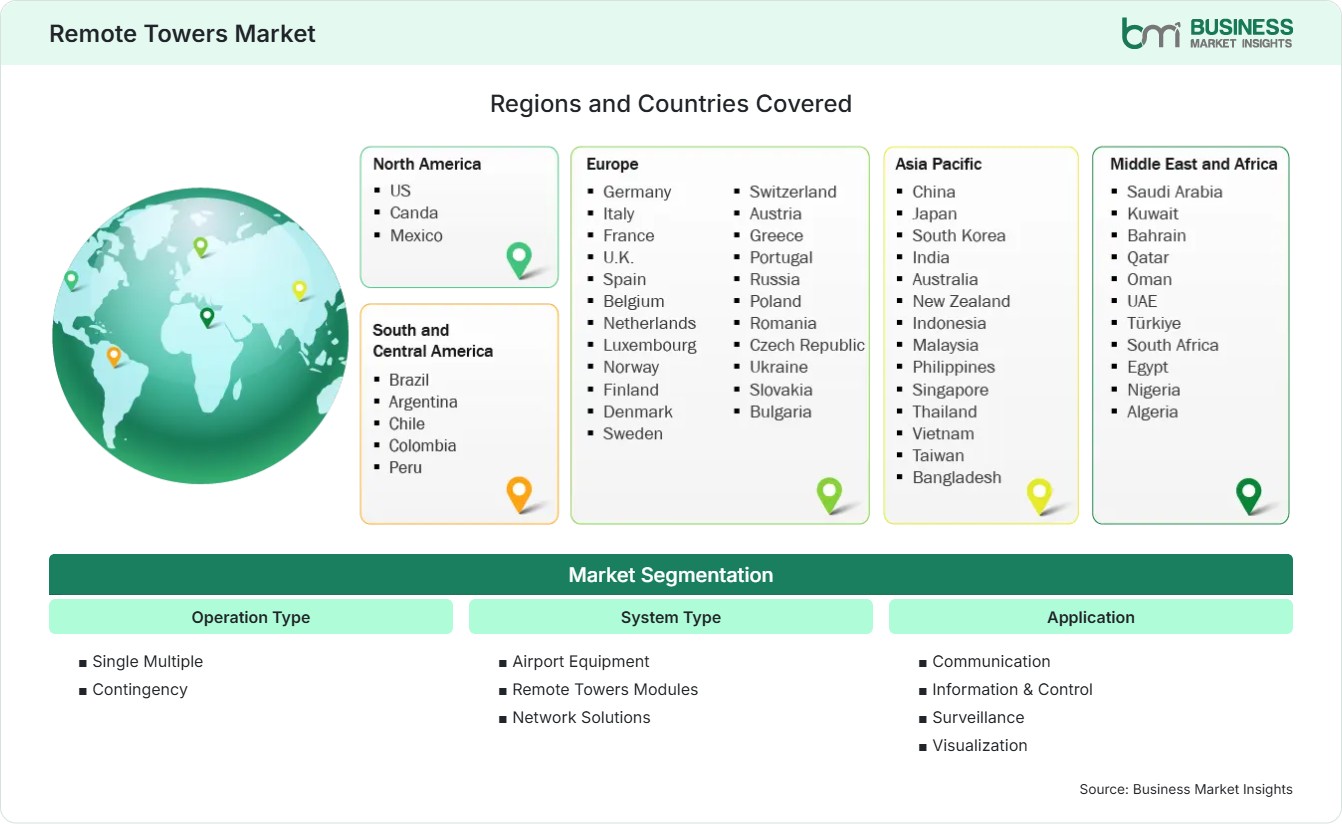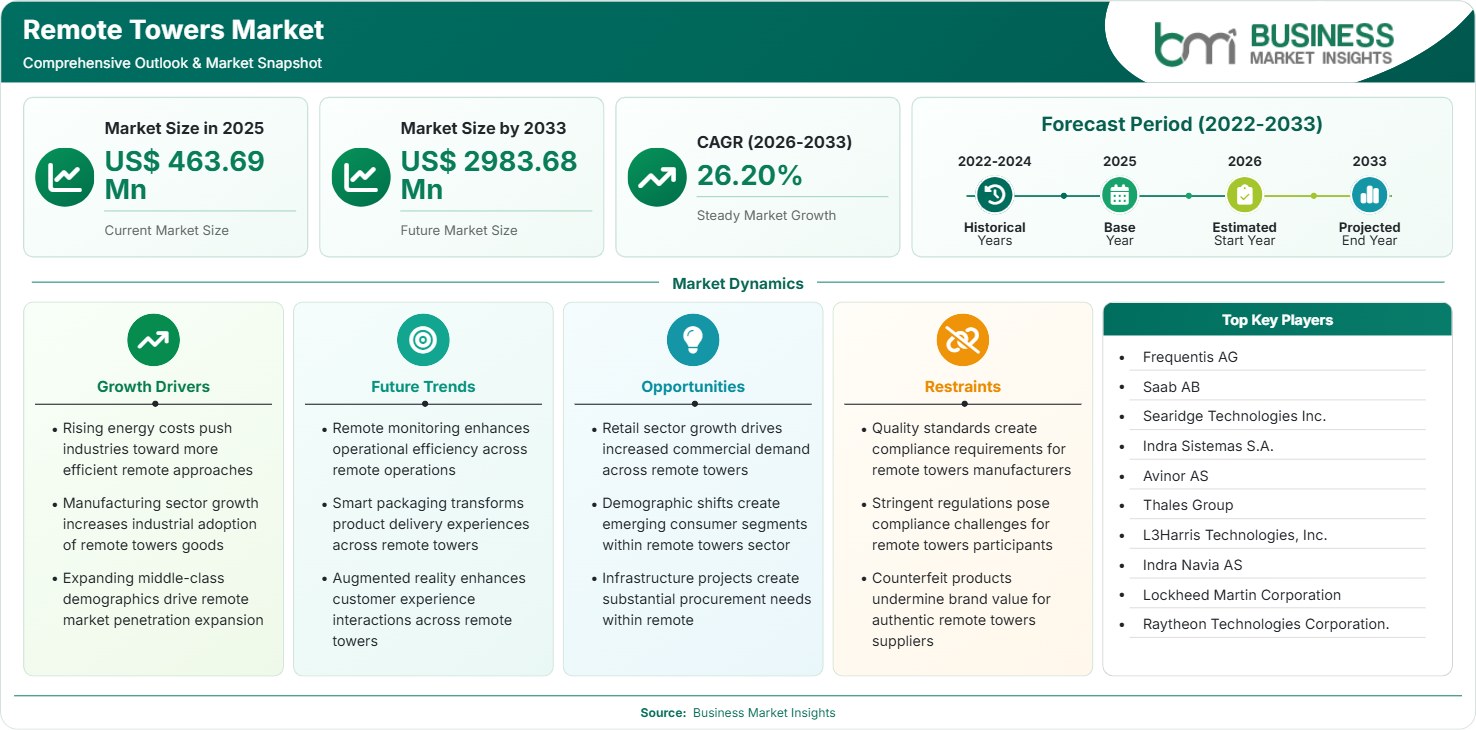
Remote Towers Market Regional Highlights
North America Remote Towers Market
North America accounted for approximately 34%–37% of global revenue in 2025 and is expected to expand at a CAGR of 24%–27% during 2026–2033. The region benefits from advanced aviation infrastructure, extensive air traffic management modernization programs, and strong regulatory support for digital air traffic solutions. The Remote Towers Market share remains highest in this region due to continuous investments in surveillance technologies, communication networks, and operational efficiency initiatives. Growing demand from regional airports and increasing adoption of remote operational concepts continue to support long-term expansion.
- FAA-led modernization initiatives are encouraging airports to evaluate digital tower solutions that enhance situational awareness, reduce infrastructure costs, and improve service continuity during operational disruptions.
- Strong technology ecosystems enable rapid integration of high-definition cameras, radar systems, sensor fusion platforms, and communication technologies supporting advanced air traffic control capabilities.
- Regional airports increasingly seek centralized traffic management models to optimize staffing resources while maintaining compliance with stringent aviation safety requirements.
- Collaboration between air navigation service providers and technology vendors continues accelerating commercial deployment and operational validation of remote tower architectures.
- Increasing focus on cybersecurity, operational resilience, and network redundancy drives investments in next-generation digital aviation infrastructure across the region.
US Remote Towers Market
The United States represents approximately 72%–76% Remote Towers Market share within North America and is projected to record a CAGR of 25%–28% through 2033. The country benefits from extensive airport infrastructure, high aviation activity, and substantial investment in modernization initiatives. Federal programs supporting digital transformation and advanced surveillance technologies continue to stimulate adoption. Airport operators are increasingly evaluating remote control concepts to improve efficiency while addressing workforce challenges and operational scalability requirements.
- Major airports and regional facilities are investing in digital control technologies to improve operational visibility, safety management, and resource utilization.
- Strong participation from defense, aerospace, and aviation technology companies accelerates innovation in remote surveillance and communication systems.
- Advanced testing programs and pilot deployments continue validating remote operational frameworks under complex airspace conditions.
- Increasing demand for scalable air traffic management infrastructure supports long-term commercialization opportunities across the aviation sector.
Europe Remote Towers Market
Europe held approximately 29%–32% of Remote Towers Market revenue in 2025 and is forecast to grow at a CAGR of 25%–28% through 2033. The region remains a pioneer in remote tower implementation, supported by progressive aviation regulations and successful operational deployments. Sweden and Norway remain leading adopters due to early commercialization initiatives, while Germany is emerging as a high-growth market with a CAGR of 27%–30%. Strong collaboration among aviation authorities and technology providers continues supporting widespread adoption.
- Several European airports have successfully transitioned to remote operations, demonstrating commercial viability and operational efficiency improvements.
- Regulatory frameworks developed by EASA and national aviation authorities provide a structured pathway for technology certification and deployment.
- Scandinavian countries continue serving as innovation hubs for centralized tower concepts and multi-airport operational models.
- Growing sustainability initiatives encourage digital infrastructure investments that reduce construction requirements and improve resource efficiency.
- Increased focus on regional connectivity strengthens demand for cost-effective air traffic management solutions at smaller airports.
Asia Pacific Remote Towers Market
Asia Pacific accounted for approximately 24%–27% of global Remote Towers Market revenue in 2025 and is expected to register the fastest CAGR of 28%–31% during 2026–2033. Rapid airport construction, rising passenger traffic, and government-led aviation modernization programs create favorable market conditions. China represents the largest regional contributor, while India emerges as the fastest-growing country with a CAGR of 30%–33%. Investments in smart airport ecosystems and digital infrastructure are supporting accelerated technology adoption throughout the region.
- Large-scale airport development programs generate significant demand for modern air traffic management technologies and remote operational capabilities.
- Governments increasingly prioritize aviation digitalization to improve safety, efficiency, and airspace utilization across expanding transportation networks.
- Smart airport initiatives encourage integration of advanced visualization, surveillance, and communication platforms into airport infrastructure strategies.
- Rising regional connectivity requirements create opportunities for centralized control centers managing multiple airport operations simultaneously.
- Increasing collaboration with global technology providers accelerates knowledge transfer and deployment of advanced remote tower solutions.
Rest of World Remote Towers Market
The Rest of World region represented approximately 9%–12% of global Remote Towers Market revenue in 2025 and is projected to grow at a CAGR of 26%–29% during 2026–2033. In South and Central America, modernization of regional aviation infrastructure supports adoption of digital tower technologies. Brazil remains the leading market, while Chile demonstrates strong growth potential.
In the Middle East and Africa, expanding airport capacity and aviation diversification strategies are encouraging investments in advanced air traffic management systems. The United Arab Emirates leads regional deployment activity, while Saudi Arabia records notable expansion opportunities supported by aviation infrastructure development programs.
- Airport modernization initiatives across emerging economies are creating favorable conditions for deployment of advanced surveillance and communication systems.
- Governments increasingly recognize remote operational models as cost-efficient alternatives for supporting aviation growth in underserved regions.
- Tourism-driven airport expansion projects stimulate demand for scalable air traffic management technologies and centralized operational capabilities.
- Strategic partnerships with international technology vendors facilitate implementation of advanced digital aviation infrastructure and operational expertise.
- Long-term aviation development plans across the Middle East and Latin America continue supporting sustained investment in remote tower ecosystems.