
Refined Petroleum Products Market Outlook: Size, Share, Trends, Growth Analysis, Competitive Landscape & Forecast, 2026-2033

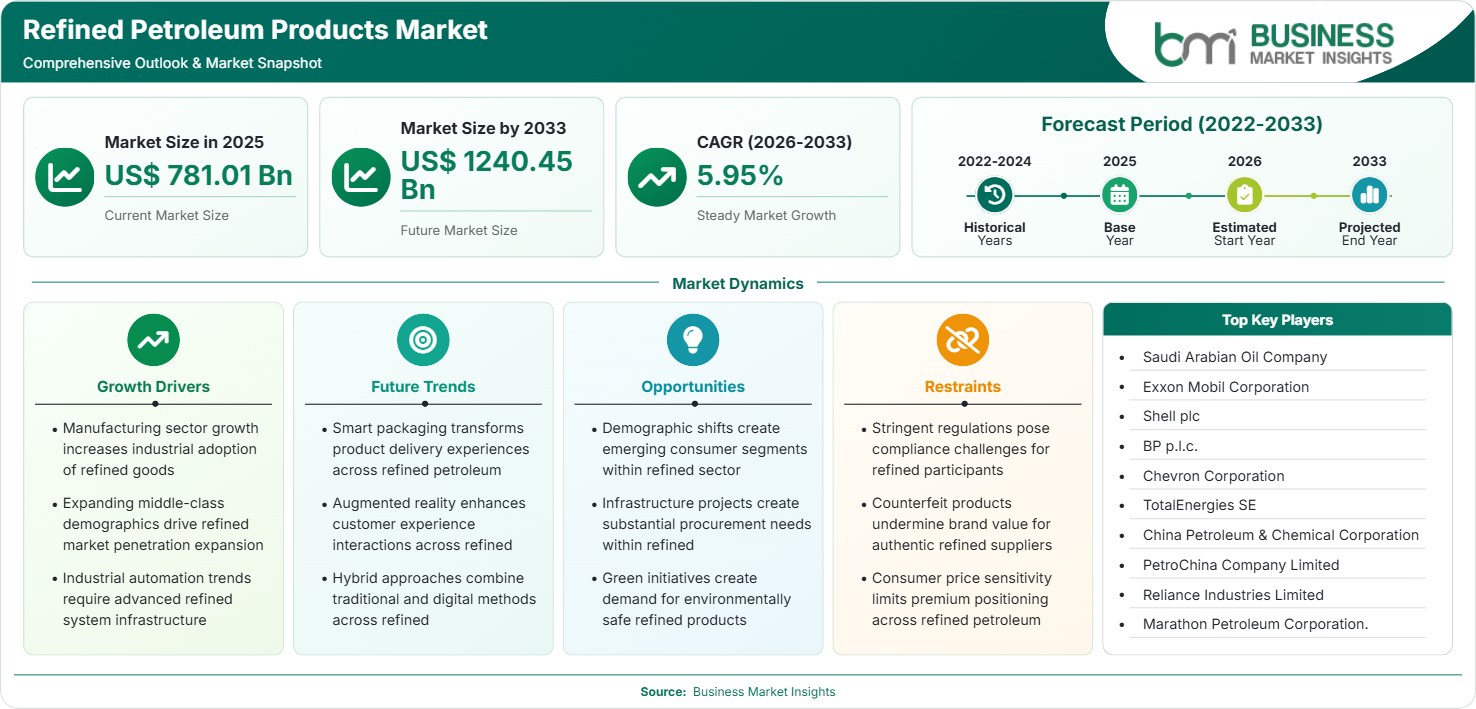
The Refined Petroleum Products Market size was valued at US$ 781.01 Billion in 2025 and is projected to reach US$ 1240.45 Billion by 2033, growing at a CAGR of 5.95% during 2026–2033. Key drivers include transportation fuel demand, expanding refining capacity, aviation recovery, industrial energy consumption, petrochemical feedstock requirements, and modernization investments creating opportunities across emerging economies.

Report Coverage
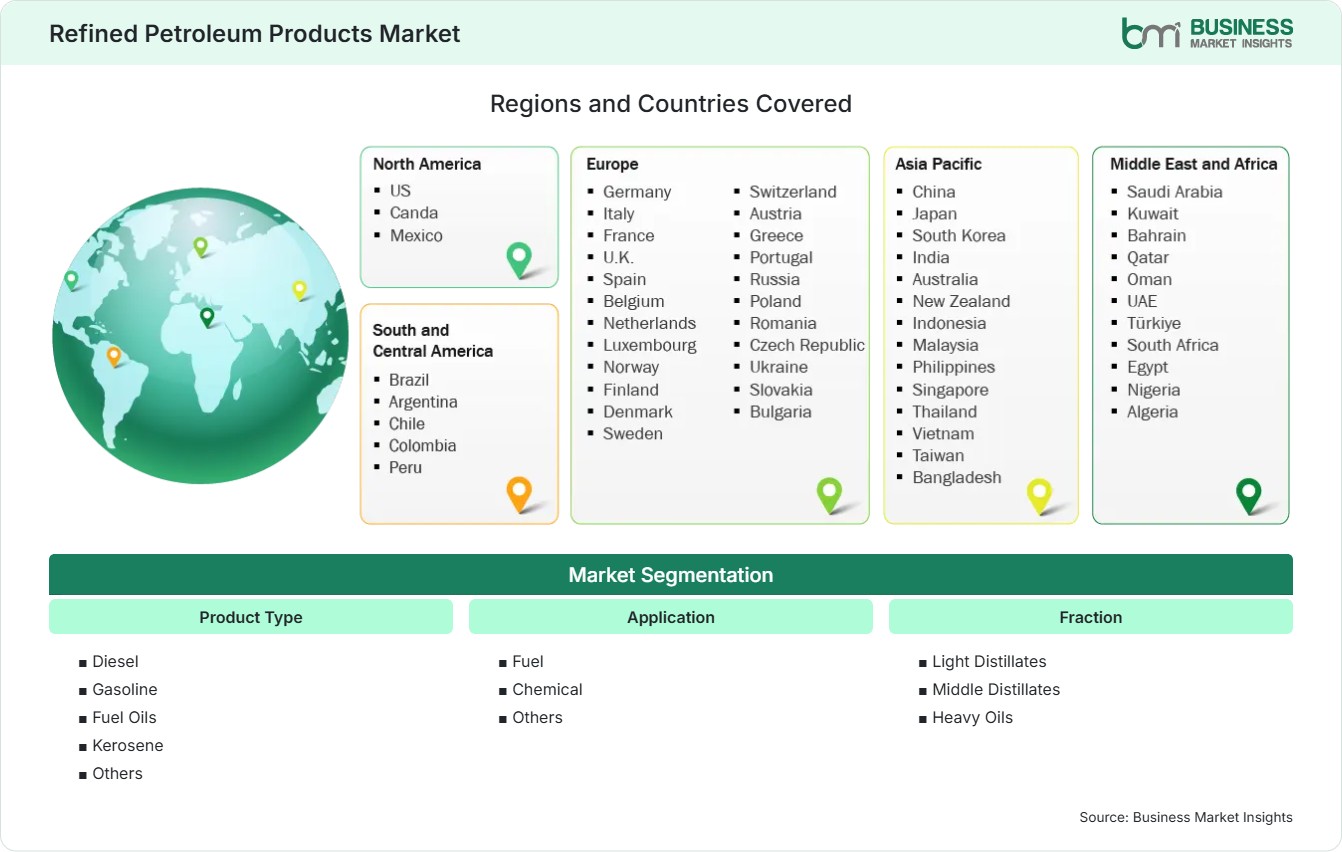
  • Product Type: Diesel, Gasoline, Fuel Oils, Kerosene, Others
  • Application: Fuel , Chemical, Others
  • Fraction: Light Distillates, Middle Distillates, Heavy Oils
US$ 781.01 Bn Market size in 2025
US$ 1240.45 Bn Market Size by 2033
5.95% CAGR, 2026 - 2033
2026-2033 Forecast Period

AI Overview

Refined Petroleum Products Market Summary

  • North America Region: North America holds a 33%–36% share in 2025 and grows at a CAGR of 5.3%–5.8% during 2026–2033. Refinery upgrades, transportation demand, export growth, petrochemical integration, energy security initiatives, efficiency improvements, logistics investments, capacity optimization, and stable industrial consumption support market expansion. The US leads regional demand and advances at a CAGR of 5.4%–5.9% through 2033.
  • Fastest Growing Region: Asia Pacific accounts for a 29%–32% share in 2025 and records a CAGR of 6.6%–7.1% through 2033. Industrialization, vehicle ownership growth, aviation expansion, refining investments, import requirements, and petrochemical demand support sustained consumption.
  • Leading Segment: Diesel represents a 34%–38% share in 2025 and expands at a CAGR of 6.0%–6.5% during 2026–2033. Commercial transportation, construction activity, mining demand, logistics expansion, and industrial usage remain key growth contributors.
  • High Growth Segment: Middle Distillates account for a 37%–41% share in 2025 and grow at a CAGR of 6.2%–6.7% through 2033. Freight transportation, aviation fuel demand, industrial consumption, and refining optimization strategies support expansion.
  • Key Market Opportunity: Integration of advanced refining technologies, cleaner fuel standards, export infrastructure development, and demand growth across emerging regions present substantial opportunities for producers and distributors.
  • Major Market Players: Saudi Arabian Oil Company, Exxon Mobil Corporation, Shell plc, BP p.l.c., Chevron Corporation, TotalEnergies SE, China Petroleum & Chemical Corporation, PetroChina Company Limited, Reliance Industries Limited, Marathon Petroleum Corporation.
Strategic Insights

Refined Petroleum Products Market: Strategic Insights

Refined Petroleum Products Market Strategic Framework
FREE PDF
Request your free sample
Request free sample
Stakeholder View

Key Takeaways

  • Integrated refining and petrochemical operations are increasingly creating competitive advantages through margin optimization and product diversification.
  • Diesel and middle distillate categories continue delivering the strongest commercial opportunities due to logistics, industrial, and transportation demand.
  • Refinery digitalization, predictive maintenance, and process automation are becoming central investment priorities.
  • Asia Pacific provides the most attractive expansion opportunity due to sustained economic growth and rising fuel consumption.
  • Strategic acquisitions, refinery modernization projects, and logistics investments continue reshaping competitive dynamics.
  • Cleaner fuel mandates are accelerating development of advanced refining processes and higher-value product portfolios.
Geographic Outlook

Refined Petroleum Products Market Regional Highlights

North America Refined Petroleum Products Market

North America accounts for 33%–36% of global revenue in 2025 and is projected to expand at a CAGR of 5.3%–5.8% through 2033. Strong refining infrastructure, export capacity, and transportation demand sustain regional leadership. The Refined Petroleum Products Market share remains supported by integrated refining operations, petrochemical demand, and logistics networks. Refinery modernization investments continue enhancing efficiency and supporting supply resilience.

  • Strong transportation demand sustains consumption of gasoline, diesel, and aviation fuels across commercial and industrial sectors.
  • Refinery upgrades support cleaner fuel production and operational efficiency.
  • Export-oriented infrastructure strengthens regional competitiveness.
  • Petrochemical integration improves margin opportunities and asset utilization.

US Refined Petroleum Products Market

The United States contributes 75%–79% of North American revenue and grows at a CAGR of 5.4%–5.9% through 2033. Large refinery capacity, extensive logistics infrastructure, and export strength support market leadership. Demand remains driven by transportation, industrial activities, and petrochemical manufacturing.

  • Gulf Coast refiners continue expanding export capabilities.
  • Industrial and freight activity supports distillate fuel consumption.
  • Advanced refining technologies improve operating performance.
  • Strategic storage and distribution assets strengthen supply reliability.

Europe Refined Petroleum Products Market

Europe holds 22%–25% of global revenue in 2025 and advances at a CAGR of 5.0%–5.5% through 2033. Germany leads regional demand while Eastern Europe demonstrates stronger expansion rates. Refiners focus on efficiency improvements, cleaner fuels, and energy security objectives.

  • Cleaner fuel regulations encourage refinery modernization.
  • Germany remains a major refining and consumption hub.
  • Eastern Europe experiences investment in logistics and storage assets.
  • Industrial demand supports steady product consumption.

Asia Pacific Refined Petroleum Products Market

Asia Pacific commands a 29%–32% share in 2025 and records the fastest CAGR of 6.6%–7.1% through 2033. China leads regional revenue while India posts some of the fastest growth. Industrialization, urbanization, and transportation expansion continue supporting demand. Market growth remains strongest in rapidly developing economies.

  • China continues expanding refining and petrochemical capacity.
  • India benefits from growing transportation fuel demand.
  • Aviation recovery supports consumption of jet fuel products.
  • Urbanization increases energy and mobility requirements.
  • Export-oriented refineries strengthen regional supply capabilities.

Rest of World Refined Petroleum Products Market

Rest of World accounts for 12%–15% of global demand and grows at a CAGR of 5.8%–6.3% during the forecast period. Middle Eastern countries continue investing in world-scale refining projects and export infrastructure.

South and Central America benefit from industrial development and transportation demand. The Refined Petroleum Products Market share in these regions continues improving through refinery upgrades and expanding fuel distribution networks.

  • Saudi Arabia leads investment in integrated refining complexes.
  • Brazil supports regional expansion through transportation demand.
  • Export infrastructure projects improve market access.
  • Industrial growth supports fuel consumption.
  • Logistics modernization enhances supply-chain efficiency.
Global Market Geography
FREE PDF
Request your free sample
Request free sample
Segment Analysis

Refined Petroleum Products Market Segmentation

Product Type

Product Type represented the largest source of industry value creation. Diesel accounted for 34%–38% market share in 2025 and is projected to grow at a CAGR of 6.0%–6.5% through 2033. Transportation, freight operations, industrial activities, and infrastructure construction continue driving consumption. The market scope remains broad due to diversified fuel requirements.

  • Diesel: Critical for freight transportation, industrial machinery, construction equipment, and commercial vehicle fleets across developed and emerging markets.
  • Gasoline: Maintains large consumption volumes through passenger vehicle demand and expanding mobility requirements.
  • Fuel Oils: Utilized in marine transportation, industrial heating, and selected power generation applications.
  • Kerosene: Supported by aviation demand, airport activity, and international air travel expansion.

Application

Application diversification supports demand stability across economic cycles. Fuel applications represented a 61%–65% share in 2025 and expand at a CAGR of 5.8%–6.3%. The Refined Petroleum Products Market trends indicate transportation and industrial uses remaining dominant despite energy-transition initiatives.

  • Fuel – Automobile: Passenger vehicles continue generating significant gasoline and diesel consumption worldwide.
  • Fuel – Power Generation: Supports electricity production where liquid fuels remain strategically important.
  • Chemical: Refined products serve as important feedstocks for downstream chemical manufacturing.

Fraction

Fraction types influence refining economics and strategy. The Middle Distillates had a market share of 37%–41% in 2025 and are expected to grow at a CAGR of 6.2%–6.7%. Robust demand from the transportation and industrial industries drives segment growth.

  • Light Distillates: Include gasoline-oriented fractions serving mobility and consumer energy applications.
  • Middle Distillates: Support freight, aviation, industrial activities, and commercial transportation requirements.
  • Heavy Oils: Utilized in marine, industrial, and specialized energy applications.
Market Forces

Refined Petroleum Products Market Dynamics

Key Market Drivers

Growing Transportation and Freight Demand

Trade and transportation of goods worldwide continue to be key drivers of demand for refined fuels. The growth of logistics systems, e-commerce activities, and the need for heavy-duty transportation and infrastructure development continue to underpin demand for diesel and its derivatives. Emerging economies are especially significant sources of demand due to their rapid economic development and high mobility. Growth in port development, highway construction, rail connections, and industrial parks helps sustain fuel demand through steady flows of goods and raw materials. Increasing cross-border trade, expanding manufacturing output, and growing construction activities also reinforce long-term consumption of transportation fuels across both domestic and international logistics networks.

Refinery Modernization and Capacity Expansion

There is an increase in investment in hydrocracking, catalytic processes, desulfurization, and digitization to enhance yields and product quality. New capacity in Asia and the Middle East will increase the supply and increase operational flexibility. The state-of-the-art infrastructure will ensure greater profitability for companies and enable the production of fuels that meet environmental standards. The use of advanced technologies such as process automation, predictive maintenance, and real-time monitoring helps refiners optimize energy utilization, avoid unplanned downtime, and reduce operational costs. Modern refinery infrastructure will help producers vary their yields in response to market demand.

Aviation and Industrial Recovery

Aviation fuel needs and industry production support continued use of products. Growth of manufacturing activities, mining operations, and construction results in higher fuel needs. The current market dynamics reflect steady demand for products that require stable and high-energy fuel. Higher numbers of air passengers, increased cargo transportation, and growing industrial activity in developing nations are also among the factors driving fuel demand. Investments in energy systems, petrochemical production, and large-scale developments have been contributing to the steady demand for refined petroleum products, ensuring steady growth in the market amid improvements in energy efficiency and energy diversification toward alternative energy sources.

Key Market Opportunities

Expansion of Export-Oriented Refining Hubs

Certain regions are also planning to develop large-scale refining facilities to facilitate their role in international business. According to the Refined Petroleum Products Market Forecasts, there is an expectation of sustained demand for the development of export and storage facilities and logistics capabilities. Companies that operate near key transportation routes gain some competitive advantages. The development of strategic petroleum facilities, pipelines, and marine transportation infrastructure can improve supply chain resilience and distribution capabilities in some regions. Moreover, logistics investments will enable efficient cross-border fuel transportation.

Cleaner Fuel Development

The need for low-sulfur fuels opens the door to improved refining technologies. The use of upgraded processing facilities will not only improve compliance but also provide access to higher market tiers, making the company more competitive. The use of advanced catalyst technologies, efficient processing systems, and emissions-reduction technologies will enable the company to manufacture high-quality fuels and improve its operations. Modernizing the refining facilities will also result in greater production flexibility, improved product quality, better environmental performance, and stronger positioning in markets that require high fuel quality standards.

Petrochemical Integration Strategies

Refining and petrochemical processing are combined, enabling better monetization of crude materials. Firms are seeking facilities capable of manufacturing both fuels and chemical components. The integration of such facilities is beneficial, as it results in efficient feedstock use, improved economic viability, and reduced vulnerability to changes in transport fuel demand by increasing petrochemical output. Modern developments in process integration, infrastructure sharing, and digital transformation help firms cope with changing global market and customer demands.

Market Restraints and Challenges

Price Volatility in Crude Oil Markets

Factor: Crude oil prices continue to be highly influenced by geopolitical tensions, production policy changes, supply-chain disruptions, and broader macroeconomic conditions, resulting in frequent fluctuations across global energy markets and feedstock procurement channels. Impact: This volatility directly affects refining margins, crude procurement costs, inventory valuation, and overall profitability for market participants. Refiners often face challenges in forecasting cash flows and optimizing purchasing strategies during periods of rapid price movement. In addition, fluctuating feedstock costs can complicate investment planning, operational budgeting, and capacity-utilization decisions, prompting companies to strengthen risk-management frameworks and improve supply-chain flexibility.

Energy Transition and Regulatory Pressure

Factor: Increasing electrification across transportation sectors, stricter emissions regulations, and the accelerating deployment of renewable energy technologies are gradually altering long-term fuel demand expectations and regulatory requirements for petroleum-based products. Impact: Refiners are under growing pressure to modernize facilities, reduce carbon intensity, and enhance environmental compliance to remain competitive in a changing energy landscape. Companies are increasingly allocating capital toward efficiency improvements, lower-emission technologies, and product diversification initiatives. The evolving policy environment is also influencing long-term investment decisions, encouraging refiners to balance conventional fuel production with strategies that support emerging energy-transition objectives.

Company Analysis

Competitive Landscape

Current Refined Petroleum Products Market analysis indicates competition centered on refining efficiency, product quality, logistics integration, export capabilities, and petrochemical diversification.

Company Name

Overview

Products and Services relevant to this market

Saudi Arabian Oil Company

Global integrated energy producer with large refining footprint.

Refined fuels, petrochemical feedstocks, distribution and export services.

Exxon Mobil Corporation

Major international oil and refining company.

Gasoline, diesel, jet fuel, lubricants and refinery products.

Shell plc

Global energy company with extensive refining assets.

Transportation fuels, industrial fuels and petrochemical products.

BP p.l.c.

International energy company operating refining facilities.

Fuel production, marketing and distribution solutions.

Chevron Corporation

Major refiner serving transportation and industry sectors.

Diesel, gasoline, aviation fuels and specialty products.

TotalEnergies SE

Integrated energy company with global refining operations.

Refined fuels, petrochemicals and trading services.

China Petroleum & Chemical Corporation

Leading Asian refiner and fuel supplier.

Transportation fuels, chemicals and downstream products.

PetroChina Company Limited

Major producer and refiner serving domestic markets.

Gasoline, diesel, kerosene and industrial products.

Reliance Industries Limited

Operator of one of the world's largest refining complexes.

Exports fuels, petrochemical feedstocks and specialty products.

Marathon Petroleum Corporation

Significant North American refining and logistics operator.

Refines fuels, transportation solutions and distribution networks.

Trust & Transparency

Research Methodology

The market analysis combines proprietary research with secondary data from government agencies, company disclosures, regulatory filings, industry databases and expert interviews. Market estimates are validated through data triangulation, cross-market benchmarking and analyst review.

View Full Research Methodology

Questions Answered

Frequently Asked Questions

What information does a Refined Petroleum Products Market Report provide?

A Refined Market Report evaluates demand drivers, regional consumption patterns, competitive landscapes, segment performance, regulatory influences, and future investment opportunities.

How does petrochemical integration benefit refiners?

Integration creates diversified revenue streams, improves feedstock utilization, and increases resilience against fuel-margin volatility.

Which segment offers the highest growth potential?

Middle distillates show strong growth prospects due to demand from freight transportation, industrial machinery, and aviation-related applications.

How are refiners improving profitability?

Companies increasingly use digital technologies, refinery integration, process optimization, and higher-value product production strategies to improve operational performance and margins.

What factor most strongly influences demand for refined petroleum products?

Transportation activity remains the largest demand driver because road freight, passenger mobility, aviation, and industrial logistics collectively consume significant volumes of refined fuels.

Access the Full Refined Petroleum Products Market Report

Get segment-level forecasts, regional estimates, competitive benchmarking, company profiles and downloadable Excel datasets.

Access the full Refined Petroleum Products Market Report
350 pages PDF & Excel | 2026-08-31
Similar Research

Related Market Reports