
Recyclable Packaging Market Outlook: Size, Share, Trends, Growth Analysis, Competitive Landscape & Forecast, 2026-2033

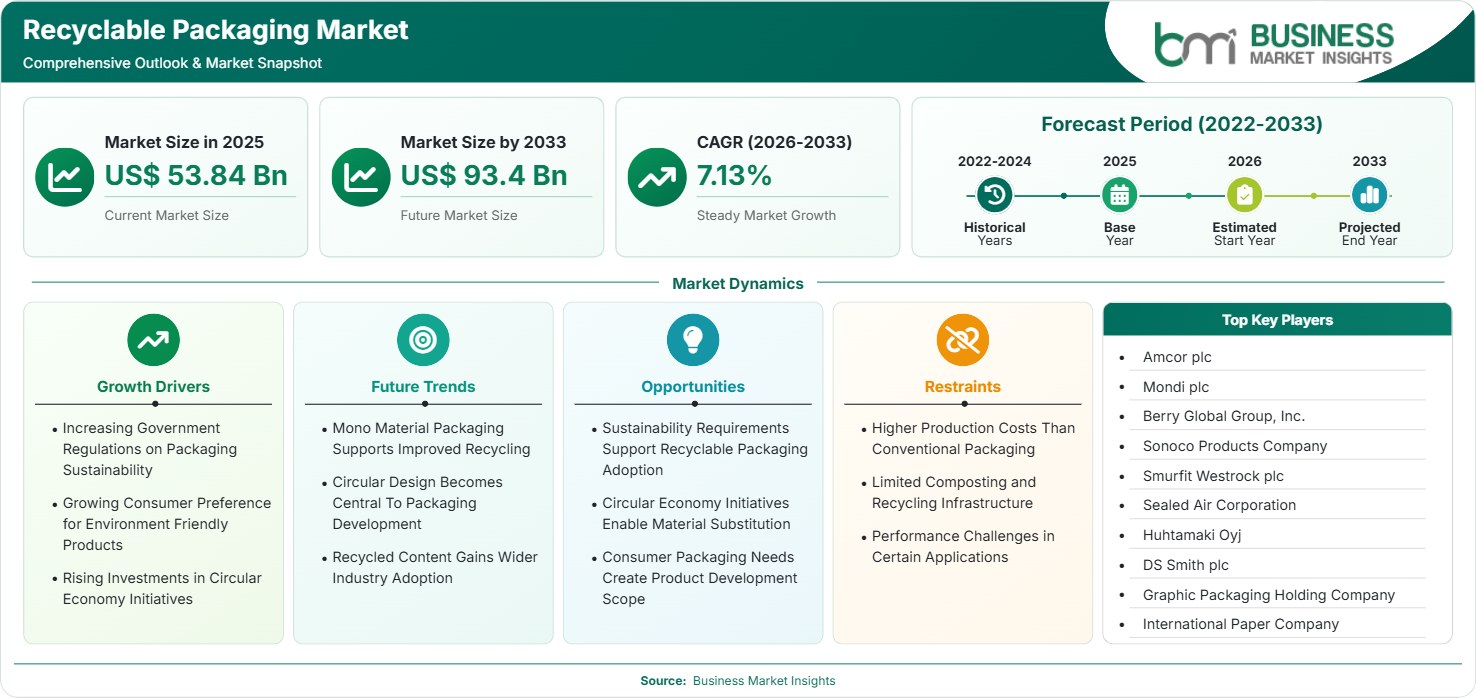
The Recyclable Packaging Market size was valued at US$ 53.84 Billion in 2025 and is projected to reach US$ 93.4 Billion by 2033, growing at a CAGR of 7.13% during 2026–2033. Key growth drivers include tightening packaging waste regulations, circular economy commitments, recycled-content mandates, sustainable retail strategies, and rising consumer preference for environmentally responsible packaging solutions across food, healthcare, and e-commerce sectors.

Report Coverage
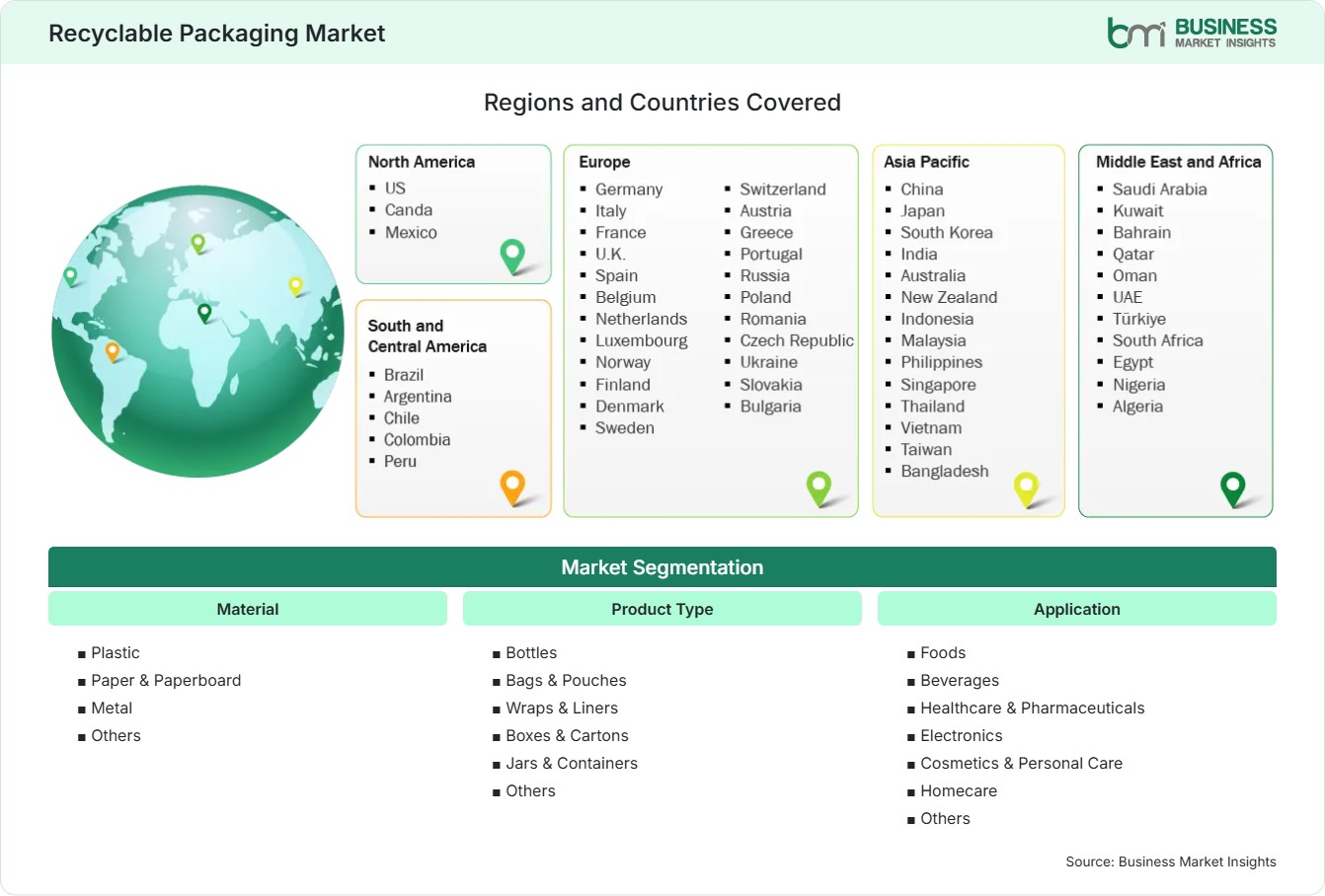
  • Material: Plastic, Paper & Paperboard, Metal, Others
  • Product Type: Bottles, Bags & Pouches, Wraps & Liners, Boxes & Cartons, Jars & Containers, Others
  • Application: Foods, Beverages, Healthcare & Pharmaceuticals, Electronics, Cosmetics & Personal Care, Homecare, Others
US$ 53.84 Bn Market size in 2025
US$ 93.4 Bn Market Size by 2033
7.13% CAGR, 2026 - 2033
2026-2033 Forecast Period

AI Overview

Recyclable Packaging Market Summary

  • North America Region: Holds 33%–36% share in 2025, growing at 6.1%–6.8% CAGR during 2026–2033. Growth is supported by extended producer responsibility programs, corporate sustainability targets, recycled-content investments, and retail demand for circular packaging systems across industries. US market benefits from advanced recycling infrastructure, major packaging innovators, and 6.3%–7.0% CAGR expansion.
  • Fastest Growing Region: Asia Pacific holds 27%–30% share in 2025, growing at 8.2%–9.0% CAGR during 2026–2033. Expansion is driven by urban consumption, packaging modernization, regulatory reforms, manufacturing growth, and increasing brand commitments toward recyclable and resource-efficient materials.
  • Leading Segment: Paper & Paperboard holds 38%–42% share in 2025 and advances at 7.0%–7.8% CAGR through 2033. Demand is supported by regulatory acceptance, fiber recovery networks, e-commerce expansion, and replacement of difficult-to-recycle multi-material packaging formats.
  • High Growth Segment: Healthcare & Pharmaceuticals holds 11%–14% share in 2025 and grows at 8.5%–9.3% CAGR. Adoption is supported by compliant sustainable packaging, product traceability, sterile barrier innovations, and pharmaceutical industry decarbonization initiatives.
  • Key Market Opportunity: Development of mono-material structures, advanced sorting technologies, and food-grade recycled content creates scalable opportunities for converters, brand owners, recyclers, and material innovators supporting circular packaging ecosystems globally.
  • Major Market Players: Amcor plc, Mondi plc, Berry Global Group, Inc., Sonoco Products Company, Smurfit Westrock plc, Sealed Air Corporation, Huhtamaki Oyj, DS Smith plc, Graphic Packaging Holding Company, and International Paper Company.
Strategic Insights

Recyclable Packaging Market: Strategic Insights

Recyclable Packaging Market Strategic Framework
FREE PDF
Request your free sample
Request free sample
Stakeholder View

Key Takeaways

  • The value chain increasingly integrates material suppliers, converters, recyclers, technology providers, and brand owners, creating stronger circular packaging ecosystems and improved feedstock recovery.
  • Healthcare, pharmaceuticals, premium food products, and e-commerce logistics represent the most attractive long-term opportunity areas due to performance and compliance requirements.
  • Innovation focuses on mono-material flexible packaging, high-barrier recyclable substrates, water-based coatings, and food-grade recycled-content technologies.
  • Asia Pacific presents the strongest investment case because packaging demand growth is aligned with industrialization, urbanization, and expanding consumer markets.
  • Strategic acquisitions continue to strengthen geographic reach, recycling capabilities, and sustainable packaging portfolios among leading global converters.
  • Digital traceability, smart labeling, and packaging lifecycle analytics are emerging differentiators supporting recycling efficiency and regulatory compliance.
Geographic Outlook

Recyclable Packaging Market Regional Highlights

North America Recyclable Packaging Market

North America accounts for approximately 33%–36% of global demand in 2025 and is projected to expand at a CAGR of 6.1%–6.8% through 2033. The region benefits from mature recycling infrastructure, strong retailer sustainability targets, and increasing adoption of circular packaging principles. The Recyclable Packaging Market share remains supported by regulatory requirements and corporate environmental commitments. Food packaging, consumer goods, and healthcare applications continue driving material innovation and recycled-content utilization across major packaging value chains.

  • Extended producer responsibility legislation improves collection rates and strengthens investment confidence across packaging recovery systems.
  • Consumer brands are redesigning packaging portfolios around recyclability and material simplification objectives.
  • Flexible packaging innovation focuses on mono-material formats compatible with existing recycling streams.
  • Advanced recycling projects support feedstock availability for high-quality recycled materials.

US Recyclable Packaging Market

The United States represents 78%–82% of North American revenue and is projected to develop at 6.3%–7.0% CAGR. Retailers and manufacturers of consumer goods are focusing more on procuring packaging that can be recycled. The policies of packaging at the state level affect their approach to product development. Increased focus on developing recycling systems and circular manufacturing systems presents more business opportunities.

  • Major consumer brands continue shifting toward recyclable and recycled-content packaging commitments.
  • Investments in advanced recycling infrastructure improve material circularity and feedstock availability.
  • E-commerce packaging optimization encourages lightweight and recyclable material adoption.
  • Healthcare packaging applications create demand for compliant sustainable solutions.

Europe Recyclable Packaging Market

Europe holds 28%–31% share in 2025 and is expected to register 6.8%–7.5% CAGR through 2033. Stringent packaging waste regulations and circular economy policies make the region a sustainability leader. Germany remains the largest country market, while Eastern European economies demonstrate stronger expansion rates. Packaging innovation increasingly focuses on reducing material complexity and maximizing recyclability across food, beverage, healthcare, and consumer goods sectors.

  • EU packaging regulations accelerate adoption of recyclable materials and recycled-content targets.
  • Germany leads regional demand, while Poland records faster growth near 7.8%–8.5%.
  • Fiber-based packaging innovations gain traction across retail and e-commerce applications.
  • Consumer preference for environmentally responsible products supports premium sustainable packaging.

Asia Pacific Recyclable Packaging Market

Asia Pacific accounts for 27%–30% share in 2025 and represents the fastest-growing region with 8.2%–9.0% CAGR through 2033. Fast-paced industrialization, systematic development of organized retailing, and heightened environmental consciousness facilitate adoption. China dominates the market in terms of market valuation, whereas India stands out in terms of growth. The regional government has started taking steps toward reducing waste and adopting recycling measures.

  • China remains the largest regional market supported by industrial packaging consumption.
  • India records high growth between 9.0% and 9.8% due to modernization initiatives.
  • Rising food delivery and e-commerce activity increases sustainable packaging requirements.
  • Packaging producers invest in local recycling ecosystems and material recovery facilities.
  • International brand commitments stimulate demand for recyclable formats across sectors.

Rest of World Recyclable Packaging Market

The Rest of World region holds 9%–11% share in 2025 and is forecast to expand at 7.0%–7.8% CAGR. Sustainability practices are being undertaken by multinational consumer goods corporations in South and Central America. In the Middle East and Africa, regulatory and waste management systems are becoming more robust. Demand for packaging materials is strong in Brazil, Latin America, and in the UAE and Saudi Arabia for circular economy and packaging innovations.

  • Brazil remains the leading Latin American market with increasing sustainable packaging adoption.
  • GCC countries promote circular economy frameworks supporting recyclable material usage.
  • Food and beverage industries generate substantial demand for compliant packaging solutions.
  • International investment improves recycling infrastructure and waste collection efficiency.
Global Market Geography
FREE PDF
Request your free sample
Request free sample
Segment Analysis

Recyclable Packaging Market Segmentation

Material

Material categories shape performance, sustainability, and processing economics. Paper & Paperboard represents the leading segment with 38%–42% share in 2025 and is projected to advance at 7.0%–7.8% CAGR. The Recyclable Packaging Market scope continues expanding as converters balance recyclability, barrier protection, cost efficiency, and regulatory compliance across applications.

  • Plastic: Mono-material innovations and recycled-content integration improve circularity while preserving lightweight performance characteristics for consumer and industrial packaging.
  • Paper & Paperboard: Strong collection networks, regulatory acceptance, and brand sustainability goals sustain extensive adoption across retail and e-commerce applications.
  • Metal: Aluminum and steel packaging benefit from high recovery rates, durability, and value retention in recycling streams.

Product Type

Packaging formats vary according to logistics, shelf-life, and consumer convenience requirements. Boxes & Cartons account for 27%–31% share in 2025 and expand at 7.1%–7.9% CAGR, supported by retail distribution and e-commerce growth.

  • Bottles: Widely utilized in beverage, homecare, and personal care applications emphasizing material recovery and recycled-content integration.
  • Bags & Pouches: Innovation focuses on recyclable flexible structures offering material efficiency and transportation advantages.
  • Wraps & Liners: Demand grows through protective packaging applications requiring lightweight and adaptable formats.
  • Boxes & Cartons: Strong usage across shipping, foodservice, and consumer goods supports sustained demand.
  • Jars & Containers: Preferred where product integrity and multiple-use potential remain critical requirements.

Application

Application demand reflects consumer preferences, regulatory requirements, and supply-chain sustainability priorities. Food applications dominate with 32%–36% share in 2025 and a CAGR of 7.0%–7.7%. The phrase Recyclable Packaging Market trends increasingly reflects sustainable sourcing and circular material utilization across end-user industries.

  • Foods: Sustainability commitments and packaged food consumption drive adoption of recyclable formats.
  • Beverages: High-volume consumption creates strong opportunities for recycled-content and circular packaging strategies.
  • Healthcare & Pharmaceuticals: Compliance requirements encourage development of advanced sustainable packaging solutions.
  • Electronics: Protective recyclable packaging supports corporate environmental performance objectives.
  • Cosmetics & Personal Care: Premium brands increasingly prioritize environmentally responsible packaging designs.
  • Homecare: Consumer demand and retailer requirements accelerate uptake of recyclable packaging formats.
Market Forces

Recyclable Packaging Market Dynamics

Key Market Drivers

Global Packaging Waste Regulations and Circular Economy Policies

Governments across North America, Europe, and Asia are implementing packaging waste directives, recycled-content requirements, and extended producer responsibility frameworks. Circular Economy Efforts by OECD and UNEP Continue to Impact Corporate Sustainability Programs. Changes in regulation lead companies to redesign their packaging systems based on recyclability and resource efficiency. Increased environmental pressure leads to an increased need for recoverable materials like paperboard, metals, and recyclable plastics. Companies that wish to meet regulatory standards and reduce their environmental impact are working on package redesign and recycling cooperation. Such trends continue to be the most robust drivers for sustainable practices in packaging-intensive industries.

Expansion of Sustainable Consumer Goods and E-Commerce

Brand preference is shifting to favor those companies whose sustainability efforts can be quantified. Food delivery services, e-commerce, and direct-to-consumer supply chains call for packaging formats that must provide protection while being environmentally friendly. Companies are moving away from multi-material substrates that are difficult to recycle towards more sustainable options. The global rise in e-commerce shipping volume means more packaging materials are being used, which results in a need to lower waste generation. Procurement decisions of multinationals are now based on sustainability considerations.

Advances in Recycling and Material Processing Technologies

Innovation in sorting technology, optical scanning, digital watermarks, and chemical recycling leads to better results in terms of circularity. Material science innovations help achieve recyclable technologies that preserve barrier properties and ensure product protection. Recycling investment leads to increased availability of feedstocks for the packaging companies striving to meet their recycled content targets. More efficient collection and processing decreases losses of materials in recycling processes. The technological innovations improve the economics of sustainable packaging adoption while helping with the circular economy goals.

Key Market Opportunities

Food-Grade Recycled Content Supply Chains

Regulatory approval for food contact-compatible recycled materials presents significant business opportunities. Packaging firms are forming alliances with recyclers, material suppliers, and technology vendors to obtain quality raw materials. The needs of the beverages, food, and personal care sectors drive the commercialization of new recycling technologies. Long-term Recyclable Packaging Market Forecasts indicate strong opportunities for companies capable of delivering traceable, compliant, and high-performance recycled-content solutions. Businesses investing early in certification systems, purification technologies, and closed-loop supply chains are positioned to capture sustainable competitive advantage through the forecast period.

Mono-Material Flexible Packaging Commercialization

Flexible packaging producers are accelerating the development of recyclable mono-material structures capable of replacing difficult-to-recycle laminates. Barrier enhancements, sealing technology, and material science advancements enhance suitability for foods, health care products, and household goods. The improvements help meet sustainability goals without sacrificing efficiency. More commercial adoption will take place since companies search for ways to create packages that fit existing recycling frameworks. Those manufacturers who are able to combine all aspects will be rewarded by high demand.

Emerging Market Recycling Infrastructure Development

There are substantial opportunities for growth in developing countries due to improvements in waste management and recycling systems. There is an increasing investment by the government and private entities in the development of collection systems, sorting centers, and material recovery operations, which is increasing the recycling rate. The factors of fast urbanization and consumer preference for sustainable products have increased the need for recyclable and environmentally friendly packaging. Organizations that develop local sourcing and recycling systems can gain a market edge and reduce operational risks. The development of such infrastructure will create a good market environment.

Market Restraints and Challenges

Recycling Infrastructure Gaps and Uneven Material Recovery

Factor: Even though recyclable designs keep improving, there is still a significant difference in the quality of the infrastructure used across regions. The way that collection and sorting take place and how people respond to the process vary. Impact: Packaging intended for recycling may fail to deliver its expected environmental benefits due to inadequate recycling infrastructure. This becomes a problem in making sure that the material collected can be used again. Manufacturers who operate in various markets need to design products according to the local recycling ability.

Sustainable Material Cost Premiums and Margin Pressures

Recycled-content materials and advanced sustainable packaging technologies often carry cost premiums relative to conventional alternatives. Impact: Higher procurement and conversion costs could limit uptake in price-sensitive sectors and developing countries. Uncertainties in the availability of the feedstocks used in the recycling process could also affect price structures. Firms trying to balance their green credentials with profit-making ventures continue to struggle to maintain price competitiveness.

Company Analysis

Competitive Landscape

The Recyclable Packaging Market analysis indicates competition is driven by sustainability innovation, recycling capabilities, global manufacturing footprints, and partnerships supporting circular economy objectives.

Company Name

Overview

Products and Services relevant to this market

Amcor plc

Global packaging leader focused on recyclable and responsible packaging innovation.

Recyclable flexible packaging, rigid containers, recycled-content solutions.

Mondi plc

Integrated packaging and paper company with strong sustainability portfolio.

Barrier paper, corrugated packaging, recyclable industrial packaging.

Berry Global Group, Inc.

Major producer specializing in sustainable plastic packaging technologies.

Recyclable containers, films, closures, recycled-content products.

Sonoco Products Company

Diversified packaging manufacturer serving industrial and consumer sectors.

Paper packaging, rigid packaging, recycling services.

Smurfit Westrock plc

Global fiber-based packaging leader following industry consolidation.

Corrugated packaging, paper-based recyclable solutions.

Sealed Air Corporation

Protective packaging specialist emphasizing material efficiency.

Flexible films, protective packaging, recyclable structures.

Huhtamaki Oyj

Sustainable foodservice and consumer packaging manufacturer.

Fiber packaging, recyclable food packaging products.

DS Smith plc

Circular packaging specialist with strong recycling integration.

Corrugated packaging, recycling services, design solutions.

Graphic Packaging Holding Company

Leading paperboard packaging company serving consumer products.

Cartons, paperboard packaging, recyclable containers.

International Paper Company

Global producer of fiber-based packaging materials.

Corrugated packaging, containerboard, sustainable paper packaging.

Trust & Transparency

Research Methodology

The market analysis combines proprietary research with secondary data from government agencies, company disclosures, regulatory filings, industry databases and expert interviews. Market estimates are validated through data triangulation, cross-market benchmarking and analyst review.

View Full Research Methodology

Questions Answered

Frequently Asked Questions

What information does a Recyclable Packaging Market Report typically include?

It commonly covers market sizing, technology developments, regulatory trends, competitive benchmarking, regional dynamics, investment opportunities, and segmentation analysis supporting strategic decision-making.

What makes Asia Pacific attractive for investment?

Rapid industrialization, growing consumer markets, packaging modernization, and increasing regulatory focus on recycling create favorable conditions for long-term expansion.

Which end-use industries generate the highest demand?

Food, beverages, healthcare, personal care, and e-commerce sectors collectively account for the largest demand because of high packaging consumption and sustainability commitments.

How does recyclable packaging benefit brand owners?

It helps improve environmental performance, supports ESG objectives, strengthens regulatory compliance, and enhances consumer perception while reducing long-term material waste.

What factors are accelerating adoption of recyclable packaging solutions?

Regulatory mandates, retailer sustainability targets, consumer environmental awareness, and advances in recycling technologies are encouraging companies to redesign packaging formats around recyclability and circular economy principles.

Access the Full Recyclable Packaging Market Report

Get segment-level forecasts, regional estimates, competitive benchmarking, company profiles and downloadable Excel datasets.

Access the full Recyclable Packaging Market Report
350 pages PDF & Excel | 2026-09-16
Similar Research

Related Market Reports