
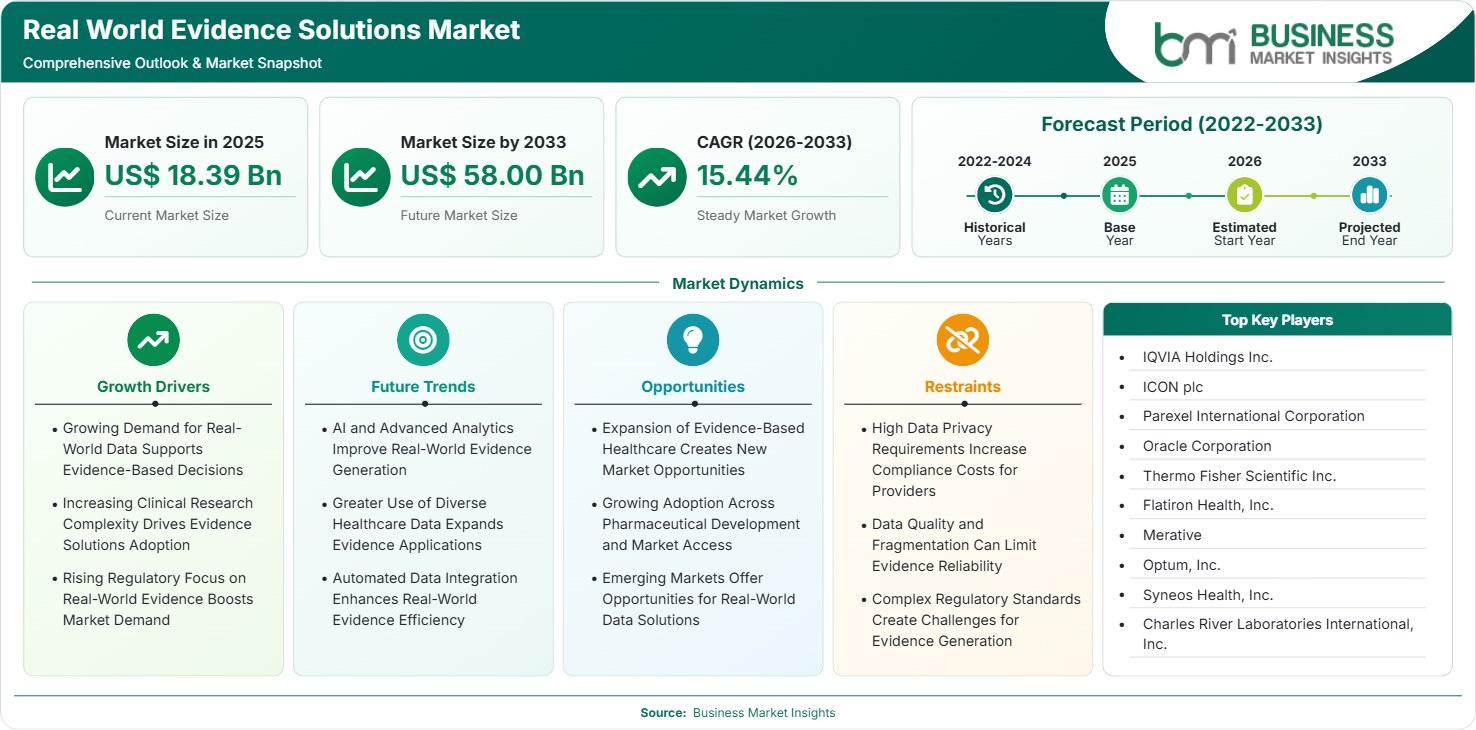
Real World Evidence Solutions Market Outlook: Size, Share, Trends, Growth Analysis, Competitive Landscape & Forecast, 2026–2033

The Real-World Evidence Solutions Market size was valued at US$ 18.39 Billion in 2025 and is projected to reach US$ 58.00 Billion by 2033, growing at a CAGR of 15.44% during 2026–2033, supported by regulatory adoption, clinical data expansion, and precision healthcare demand.

Report Coverage
  • Type: Clinical Setting Data, Claims Data, Pharmacy Data, Patient Powered Data, Others
  • Application: Pharmaceutical and Medical Device Companies, Healthcare Payers, Healthcare Providers, Others
US$ 18.39 Bn Market size in 2025
US$ 58.00 Bn Market Size by 2033
15.44% CAGR, 2026 - 2033
2026-2033 Forecast Period

AI Overview

Real World Evidence Solutions Market Summary

  • North America: North America holds a 38%–41% Real-World Evidence Solutions Market share in 2025, growing at a 14%–16% CAGR, supported by mature healthcare databases, regulatory acceptance, pharmaceutical R&D demand, payer analytics, and expanding evidence requirements.
  • Fastest Growing Region: Asia Pacific holds a 20%–23% share in 2025 and is growing at a 17%–19% CAGR, driven by expanding clinical research, digital health infrastructure, pharmaceutical outsourcing, and improving healthcare data availability.
  • Leading Segment: Clinical Setting Data holds a 30%–34% share in 2025 and grows at a 14%–16% CAGR, supported by electronic records, longitudinal patient information, clinical research, safety monitoring, and evidence generation.
  • High Growth Segment: Patient Powered Data holds a 15%–19% share in 2025 and grows at an 18%–21% CAGR, driven by digital engagement, remote monitoring, patient-reported outcomes, connected devices, and decentralized evidence collection.
  • Key Market Opportunity: Pharmaceutical development, payer decision-making, regulatory submissions, and post-market monitoring are creating demand for integrated datasets, advanced analytics, longitudinal evidence, and faster evidence-generation workflows.
  • Major Market Players: IQVIA Holdings Inc., ICON plc, Parexel International Corporation, Oracle Corporation, Thermo Fisher Scientific Inc., Flatiron Health, Inc., Merative, Optum, Inc., Syneos Health, Inc., and Charles River Laboratories International, Inc.
Strategic Insights

Real World Evidence Solutions Market: Strategic Insights

Real World Evidence Solutions Market Strategic Framework
FREE PDF
Request your free sample
Request free sample
Stakeholder View

Key Takeaways

  • Generation of healthcare evidence is transitioning towards data ecosystems, making it increasingly valuable to have data providers who integrate acquisition, normalization, governance, analytics, and regulatory-quality reporting into an ecosystem process.
  • Data from patients and data from clinical trial setting offer upside potential for sponsors looking to access longitudinal data outside conventional research setting, especially in safety evaluation, treatment adherence, use of healthcare and patient outcome.
  • AI, natural language processing, predictive analytics, and data harmonization automation are revolutionizing the evidence generation process by minimizing manual analysis and optimizing cohort creation, signal detection and study execution.
  • Asia Pacific offers an attractive expansion case because pharmaceutical development, healthcare digitization, data infrastructure investment, and clinical research capacity are increasing across major healthcare markets.
  • Competitive positioning is increasingly influenced by proprietary datasets, evidence platforms, analytical capabilities, privacy controls, and strategic partnerships that improve access to differentiated healthcare information.
  • M&A and platform consolidation are likely to remain relevant as service providers seek broader datasets, specialized analytics, stronger technology capabilities, and greater geographic coverage across the evidence-generation value chain.
Geographic Outlook

Real World Evidence Solutions Market Regional Highlights

North America Real-World Evidence Solutions Market

North America accounted for a 38%–41% share in 2025 and North America Real-World Evidence Solutions Market forecast to expand at a 14%–16% CAGR through 2033. This region has access to healthcare data resources, a strong clinical research environment, payer analytics experience, and regulation-friendly use of real-world data. The United States is the leading national market, while Canada drives regional demand due to digital health infrastructure and evidence-based health programs.

  • The regulator's familiarity with real-world data contributes to adoption, especially since sponsors devise their evidence strategy considering effectiveness, safety, utilization, and post-market activities.
  • Evidence generation in pharmaceutical and biotech industries is growing, and there is increased demand for longitudinal data, comparative effectiveness research, safety studies, and market access analytics.
  • Healthcare payers are increasing analytical requirements for treatment outcomes, utilization, cost effectiveness, and population management, creating additional demand for claims-linked and clinical datasets.
  • Investment in interoperability and healthcare analytics is improving access to structured information, allowing evidence providers to combine multiple data sources while maintaining governance and traceability.

US Real-World Evidence Solutions Market

The U.S. Real-World Evidence Solutions Market represented 78%–82% of North America's regional share in 2025 and is projected to grow at a 14.5%–16.5% CAGR through 2033. The market benefits from extensive electronic health records, claims infrastructure, pharmaceutical R&D spending, specialized evidence providers, and established regulatory pathways. FDA initiatives continue to strengthen the role of fit-for-purpose real-world data in regulatory decision-making.

  • The activities of federal regulation are helping build confidence among sponsors regarding RWE with new guidelines focused on relevance, reliability, documentation, methodology, and proper submission of evidence.
  • Big data in the healthcare field allows patient segmentation, pathway analysis, safety monitoring, outcome study, and comparative analysis among others.
  • Payers and providers need more evidence based on outcomes and hence there is a growing demand for analytics related to healthcare cost and utilization.

Europe Real-World Evidence Solutions Market

Europe Real-World Evidence Solutions Market held a 25%–28% share in 2025 and is forecast to grow at a 14%–16% CAGR through 2033. Germany, the United Kingdom, France, and Italy remain leading markets, while Spain and the Netherlands provide high-growth opportunities. Greater health-data coordination, regulatory modernization, and cross-border research are improving the commercial environment for evidence platforms and analytical services.

  • Germany and the United Kingdom maintain strong demand through pharmaceutical research, health technology assessment, outcomes analysis, and structured healthcare data programs.
  • France and Italy are strengthening evidence capabilities as healthcare systems place greater emphasis on treatment outcomes, resource utilization, and post-market monitoring.
  • European data infrastructure is becoming more coordinated, supporting broader secondary use of health information while increasing requirements for governance and interoperability.
  • The European Health Data Space entered into force in March 2025, supporting a more structured framework for health-data access and exchange across the European Union.

Asia Pacific Real-World Evidence Solutions Market

Asia Pacific Real-World Evidence Solutions Market represented a 20%–23% share in 2025 and is projected to grow at a 17%–19% CAGR through 2033. China, Japan, South Korea, and Australia lead regional adoption, while India and Southeast Asia provide high-growth opportunities. Expanding pharmaceutical research, digital healthcare infrastructure, patient-data availability, and outsourcing activity are broadening demand for evidence services.

  • China is strengthening healthcare data capabilities alongside pharmaceutical innovation, clinical research expansion, and growing demand for evidence supporting product development and market access.
  • Japan and South Korea benefit from advanced healthcare systems, established pharmaceutical industries, and increasing use of structured data for outcomes research and safety assessment.
  • India is developing stronger digital health infrastructure and pharmaceutical research capabilities, supporting demand for analytics, patient insights, and evidence generation services.
  • Australia offers a mature regulatory and healthcare environment that supports observational research, health technology assessment, and evidence-based resource allocation.

Rest of World Real-World Evidence Solutions Market

South and Central America represented part of the 10%–13% Rest of World share in 2025, with the regional market growing at a 13%–15% CAGR. Brazil and Mexico lead adoption as pharmaceutical activity, healthcare digitization, and payer analytics develop. Demand remains concentrated around evidence supporting access, treatment utilization, outcomes, and healthcare resource allocation.

The Middle East and Africa also fall within the 10%–13% regional share range and are projected to expand at a 13%–15% CAGR. Saudi Arabia, the United Arab Emirates, and South Africa provide leading opportunities as healthcare modernization, digital infrastructure, and pharmaceutical investment improve data availability.

  • Brazil and Mexico are strengthening healthcare analytics capabilities, increasing demand for evidence supporting reimbursement, treatment pathways, population health, and pharmaceutical market access.
  • Gulf health care system investments in digital transformation generate demands for structured patient information systems and analytical platforms enabling data-driven planning and resource allocation.
  • The healthcare research environment is relatively advanced in South Africa but general African use will rely on infrastructure, interoperability, privacy management, and specialized analytical expertise.
  • The regional spread of the technology needs scalable cloud platforms able to support integration of disparate datasets with adaptation to diverse financing and regulatory systems.
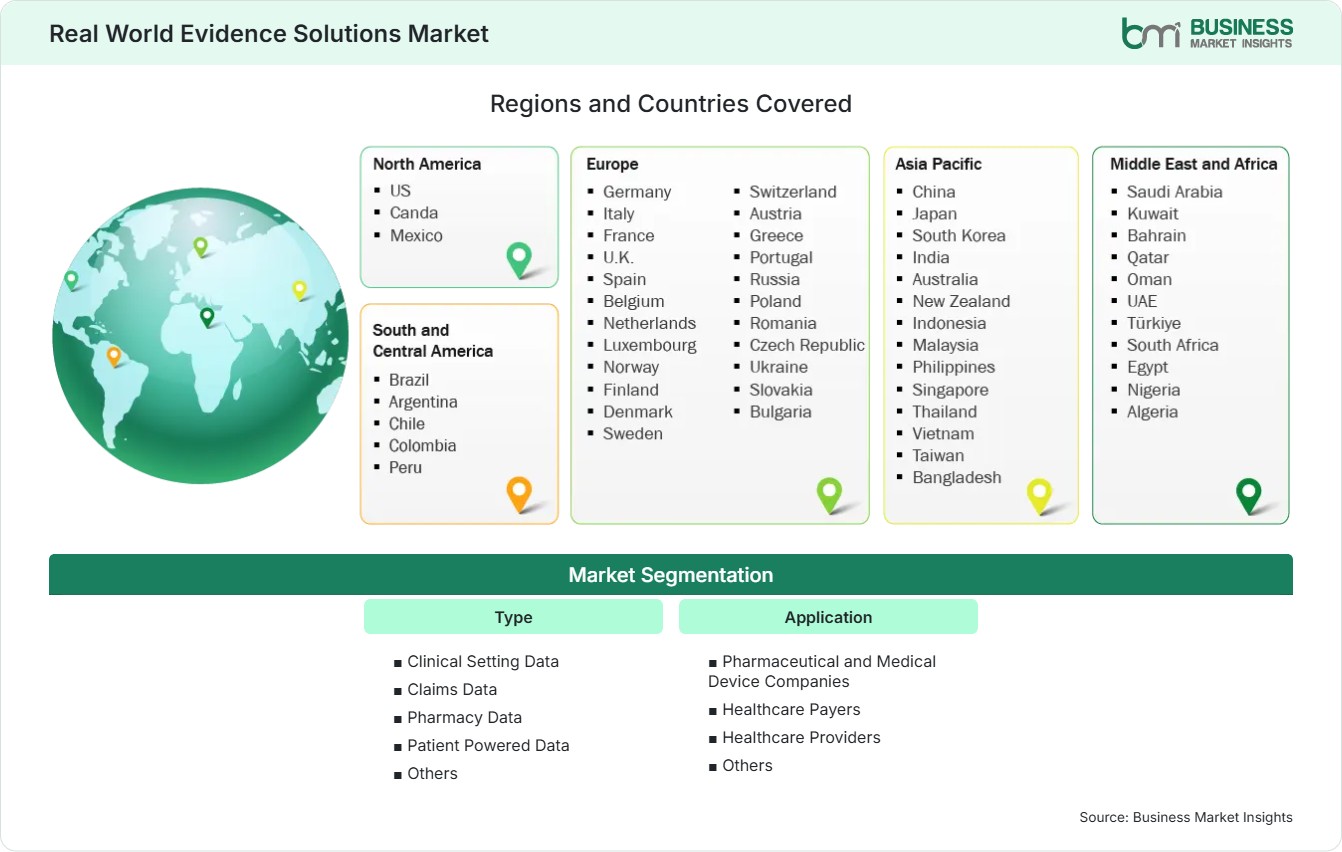
Global Market Geography
FREE PDF
Request your free sample
Request free sample
Segment Analysis

Real World Evidence Solutions Market Segmentation

Type

The Type segment is led by Clinical Setting Data, which accounted for a 30%–34% share in 2025 and is projected to grow at a 14%–16% CAGR through 2033. Adoption reflects the expanding use of clinical information for outcomes research, safety assessment, and evidence generation.

  • Clinical Setting Data: Electronic clinical information supports longitudinal analysis, treatment-pathway evaluation, outcomes research, and safety assessment, with interoperability improvements strengthening its value for evidence-generation workflows.
  • Claims Data: Claims datasets provide structured information on utilization, reimbursement, treatment patterns, and healthcare expenditure, supporting payer analytics, comparative studies, and market access decisions.
  • Pharmacy Data: Pharmacy information improves visibility into dispensing, adherence, persistence, switching, and treatment utilization, strengthening evidence analysis for medicines across commercial and post-market settings.
  • Patient Powered Data: Patient-reported information and digitally generated health data extend evidence collection beyond formal care settings, improving longitudinal insight into outcomes, behavior, treatment experience, and adherence.

Application

Pharmaceutical and Medical Device Companies represented the leading application group with a 44%–48% share in 2025 and a 15%–17% CAGR through 2033. Demand reflects evidence requirements spanning development, regulatory submissions, safety monitoring, commercialization, reimbursement, and lifecycle management.

  • Pharmaceutical and Medical Device Companies: Sponsors use evidence solutions across development, regulatory strategy, safety monitoring, market access, treatment outcomes, and lifecycle planning, supporting continued demand for integrated data services.
  • Healthcare Payers: Payers apply evidence to assess utilization, treatment outcomes, population risk, reimbursement strategies, and resource allocation, increasing demand for standardized and analytically robust datasets.
  • Healthcare Providers: Providers use evidence analytics to assess care pathways, patient outcomes, utilization patterns, and service performance, supporting quality improvement and population health management.
Market Forces

Real World Evidence Solutions Market Dynamics

Key Market Drivers

Growing Demand for Real-World Data Supports Evidence-Based Decisions

Healthcare organizations are increasingly requiring evidence in regard to regular treatments, usage, outcomes, and behaviour. The development of the Real-World Evidence Solutions Market is fostered by the expanded role of evidence in regulatory, payor, clinical, and commercial decision-making processes. Providers of healthcare data are increasingly working on such tasks as harmonization, cohort building, longitudinal linking, and quality control. The change occurs from mere access to evidence to an environment for conducting reproducible analysis with provenance and proper statistics.

Increasing Clinical Research Complexity Drives Evidence Solutions Adoption

Development programs have become more data-driven due to the complexity of patient populations being enrolled in studies, as well as the growing number of endpoints, follow-up duration, and specialized treatment options. Evidence solutions are designed to bridge routine care data with the clinical research processes in order to facilitate patient enrollment, pathway analytics, safety monitoring, and post-market studies. Such an environment is conducive to integrated platforms for data engineering, observational research design, and statistical analysis.

Rising Regulatory Focus on Real-World Evidence Boosts Market Demand

Increased regulatory acceptance is contributing towards growing demand for evidence capabilities based on quality and methodological standards. This creates a growing requirement for specialized evidence design, data qualification, analysis management, and submissions. The Real-World Evidence Solutions Market trends for real-world evidence solutions will increasingly be aligned with regulatory-level data preparation, rather than just basic healthcare analytics.

Key Market Opportunities

Expansion of Evidence-Based Healthcare Creates New Market Opportunities

Healthcare systems are placing greater emphasis on measurable outcomes, resource utilization, treatment effectiveness, and population-level performance. This creates opportunities for evidence providers to build platforms that connect clinical, claims, pharmacy, and patient-generated information within governed environments. Demand extends beyond pharmaceutical development into payer strategy, provider performance, health technology assessment, and population health. Opportunity is strongest where fragmented datasets prevent timely analysis and where organizations require repeatable evidence workflows rather than individual studies.

Growing Adoption Across Pharmaceutical Development and Market Access

Pharmaceutical companies increasingly need evidence throughout discovery translation, clinical development, regulatory planning, reimbursement, launch, and post-market monitoring. This creates demand for datasets and analytics that answer different evidence questions without requiring separate infrastructure at every stage. Real World Evidence Solutions Market Forecasts therefore favor providers that can serve multiple functions through one governed environment, reducing duplicated data acquisition and improving consistency between clinical, regulatory, and commercial evidence programs.

Emerging Markets Offer Opportunities for Real-World Data Solutions

Emerging healthcare markets provide room for evidence infrastructure development because pharmaceutical research, digital health adoption, and healthcare modernization are progressing alongside growing requirements for measurable outcomes. Providers can address gaps through cloud-based platforms, standardized data models, localized governance, and partnerships with healthcare institutions. India, Southeast Asia, Latin America, and selected Middle Eastern markets offer opportunities where health-data systems are becoming more digital but remain fragmented across providers and payers.

Market Restraints and Challenges

High Data Privacy Requirements Increase Compliance Costs for Providers

Factor: Healthcare evidence systems have to meet very stringent compliance obligations concerning the privacy of patients, consent, access to the data, cross-jurisdictional transfer, retention, and secondary use of the data. Impact: The compliance obligations lead to increased costs associated with technology, law, and operations, and extended timelines for implementation. Evidence providers maintain controlled access, documented data-processing and auditability procedures across multiple jurisdictions.

Data Quality and Fragmentation Can Limit Evidence Reliability

Factor: Healthcare information is collected through systems with different coding structures, completeness levels, update cycles, patient identifiers, and clinical documentation practices. Impact: Fragmentation can create bias, missing observations, inconsistent variables, and uncertainty around population representativeness, reducing confidence in analytical conclusions. Evidence providers must invest in data curation, validation, harmonization, linkage, and quality monitoring before datasets can support robust studies.

Company Analysis

Competitive Landscape

The Real-World Evidence Solutions Market analysis indicates a competitive structure combining healthcare intelligence companies, clinical research organizations, technology providers, specialized data platforms, and analytical service firms. Competitive differentiation increasingly depends on proprietary datasets, evidence-generation capabilities, regulatory knowledge, interoperability, privacy controls, and the ability to deliver longitudinal insights across multiple stages of healthcare product development.

Company Name

Overview

Products and Services relevant to this market

IQVIA Holdings Inc.

Global healthcare intelligence provider with extensive capabilities spanning clinical research, technology, analytics, and real-world evidence services.

Real-world data, evidence generation, patient insights, analytics, observational research, market access, and lifecycle evidence services.

ICON plc

Healthcare intelligence and clinical research organization providing evidence-generation capabilities across development and post-market activities.

Evidence platforms, real-world data analytics, observational research, patient data linkage, registries, and evidence-generation services.

Parexel International Corporation

Clinical research and consulting organization supporting pharmaceutical and biotechnology companies across product development.

Real-world evidence strategy, observational research, market access evidence, post-market studies, and regulatory evidence support.

Oracle Corporation

Technology company providing healthcare data infrastructure and analytical capabilities for life sciences organizations.

Oracle Health Real-World Data, healthcare data analytics, clinical research technology, data management, and evidence-supporting platforms.

Thermo Fisher Scientific Inc.

Life sciences company combining laboratory, clinical research, diagnostics, and healthcare technology capabilities.

Clinical research services, data solutions, laboratory information, analytics, and evidence-supporting research capabilities.

Flatiron Health, Inc.

Healthcare technology company focused on oncology data and clinical research infrastructure.

Oncology data, clinical research technology, evidence generation, data analytics, and structured oncology information.

Merative

Healthcare technology provider delivering data, analytics, and decision-support capabilities for healthcare organizations.

Clinical and claims data, healthcare analytics, population insights, outcomes research, and evidence-supporting information services.

Optum, Inc.

Healthcare services and data organization with extensive capabilities across analytics, research, payer, and provider environments.

Claims data, healthcare analytics, outcomes research, evidence services, population health, and market access analytics.

Syneos Health, Inc.

Biopharmaceutical services provider combining clinical development, commercialization, and healthcare intelligence capabilities.

Real-world evidence, observational research, patient insights, market access, evidence strategy, and post-market research services.

Charles River Laboratories International, Inc.

Research services provider supporting pharmaceutical and biotechnology development across the product lifecycle.

Clinical research support, data services, evidence generation, regulatory support, and analytical capabilities for development programs.

Trust & Transparency

Research Methodology

The market analysis combines proprietary research with secondary data from government agencies, company disclosures, regulatory filings, industry databases and expert interviews. Market estimates are validated through data triangulation, cross-market benchmarking and analyst review.

View Full Research Methodology

Questions Answered

Frequently Asked Questions

How will privacy requirements influence future evidence solutions?

Privacy requirements will favor platforms with strong governance, controlled access, secure analytics, de-identification, consent management, and auditable workflows.

What role does real-world evidence play after product launch?

Post-launch evidence can support safety monitoring, treatment utilization analysis, comparative outcomes, adherence assessment, population characterization, reimbursement discussions, and lifecycle planning.

How are healthcare organizations improving real-world data quality?

Organizations are using common data models, validation rules, terminology mapping, patient-level linkage, provenance tracking, and continuous quality monitoring.

What makes a real-world dataset suitable for evidence generation?

Suitability depends on relevance to the research question, data completeness, reliability, population representativeness, and appropriate governance. Dataset volume alone does not determine whether information can generate reliable evidence.

Why is real-world evidence becoming more important in Real-World Evidence Solutions Market report?

Real-world evidence provides information on treatment use, outcomes, safety, and healthcare utilization outside controlled research settings. Its value is increasing as stakeholders seek evidence that reflects routine clinical practice and supports decisions across the product lifecycle.

Access the Full Real World Evidence Solutions Market Report

Get segment-level forecasts, regional estimates, competitive benchmarking, company profiles and downloadable Excel datasets.

Access the full Real World Evidence Solutions Market Report
350 pages PDF & Excel | 2026-08-19