
Rare Earth Elements Market Outlook: Size, Share, Trends, Growth Analysis, Competitive Landscape & Forecast, 2026-2033

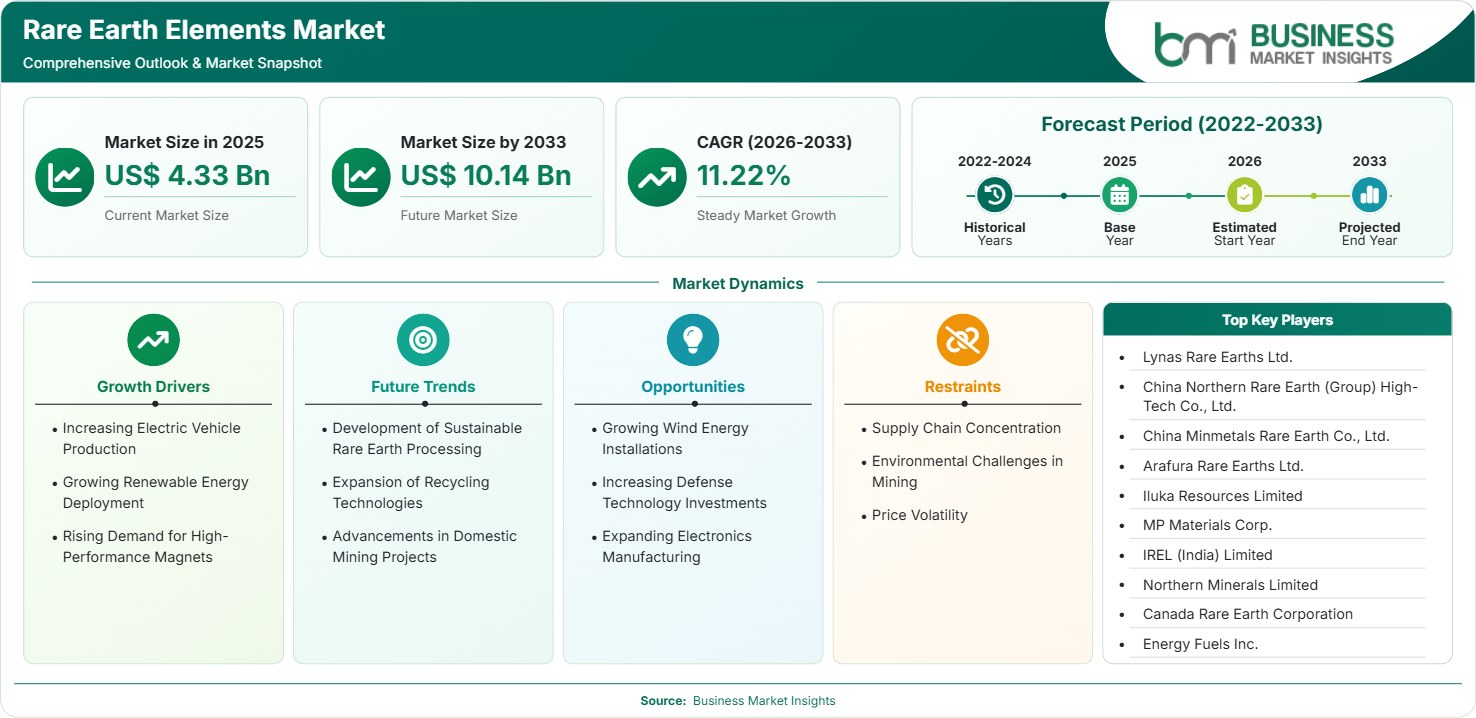
The Rare Earth Elements Market size was valued at US$ 4.33 Billion in 2025 and is projected to reach US$ 10.14 Billion by 2033, growing at a CAGR of 11.22% during 2026–2033. Rising electric vehicle production, expanding renewable energy installations, and increasing demand for high-performance permanent magnets are accelerating market expansion, while supply diversification initiatives and advanced recycling technologies continue creating long-term growth opportunities.

Report Coverage
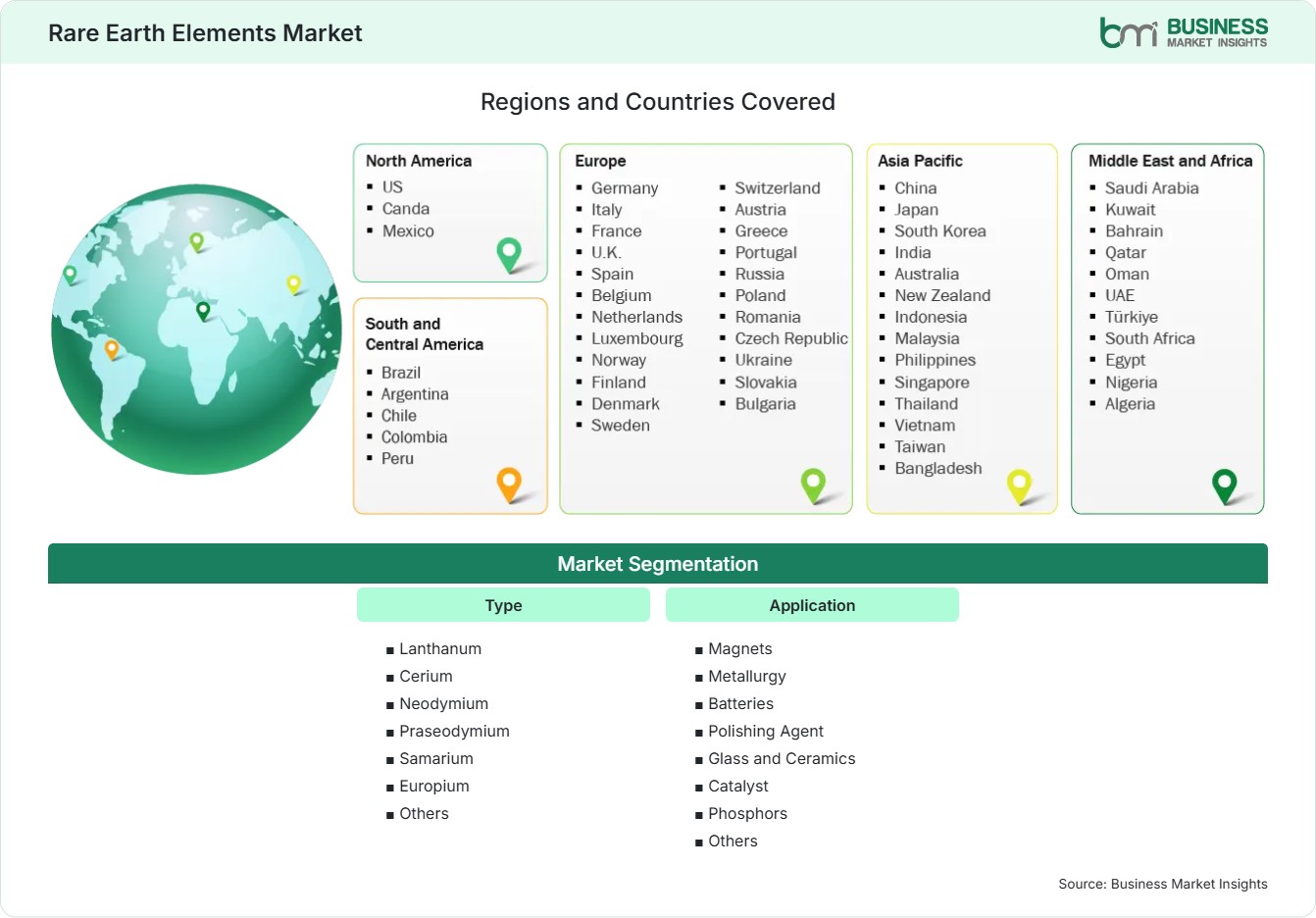
  • Type: Lanthanum, Cerium, Neodymium, Praseodymium, Samarium, Europium, Others
  • Application: Magnets, Metallurgy, Batteries, Polishing Agent, Glass and Ceramics, Catalyst, Phosphors, Others
US$ 4.33 Bn Market size in 2025
US$ 10.14 Bn Market Size by 2033
11.22% CAGR, 2026 - 2033
2026-2033 Forecast Period

01 AI Overview

Rare Earth Elements Market Summary

  • North America Region: North America accounts for 18%–21% market share in 2025 and is projected to grow at a 10.4%–11.1% CAGR during 2026–2033. Government-backed critical mineral strategies, domestic processing investments, and expanding electric vehicle manufacturing strengthen regional demand while encouraging resilient supply chains and downstream manufacturing capabilities. The U.S. benefits from expanding domestic mining, magnet manufacturing investments, and supportive critical mineral policies, advancing at a CAGR of 10.6%–11.3% through 2033.
  • Fastest Growing Region: Asia Pacific holds 52%–55% market share in 2025 while advancing at a 12.1%–12.8% CAGR during 2026–2033. Strong manufacturing ecosystems, rapid electric vehicle adoption, renewable energy deployment, and sustained investments in magnet production continue strengthening regional leadership across multiple industrial applications.
  • Leading Segment: Magnets represent 41%–44% market share in 2025 and are forecast to expand at a 12.0%–12.7% CAGR through 2033. Increasing adoption of permanent magnets across electric vehicles, industrial automation, wind turbines, robotics, and advanced electronics continues driving sustained consumption worldwide.
  • High Growth Segment: Neodymium accounts for 24%–27% market share in 2025 while registering a 12.6%–13.3% CAGR during the forecast period. Growing utilization in high-strength permanent magnets, electric motors, aerospace systems, and clean energy technologies continues supporting accelerated demand.
  • Key Market Opportunity: Expanding investments in rare earth recycling, downstream processing facilities, and geographically diversified supply chains are creating attractive opportunities for producers seeking secure, sustainable, and technologically advanced production ecosystems.
  • Major Market Players: Lynas Rare Earths Ltd., China Northern Rare Earth (Group) High-Tech Co., Ltd., China Minmetals Rare Earth Co., Ltd., Arafura Rare Earths Ltd., Iluka Resources Limited, MP Materials Corp., IREL (India) Limited, Northern Minerals Limited, Canada Rare Earth Corporation, and Energy Fuels Inc.
02 Strategic Insights

Rare Earth Elements Market: Strategic Insights

Rare Earth Elements Market Strategic Framework
FREE PDF
Request your free sample
Request free sample
03 Stakeholder View

Key Takeaways

  • The value chain continues evolving from conventional mining toward integrated ecosystems combining exploration, mineral processing, oxide refining, alloy production, permanent magnet manufacturing, recycling, and downstream industrial applications, improving supply security and reducing dependence on single-source suppliers.
  • Permanent magnets used in electric vehicles, wind turbines, industrial robotics, and precision manufacturing represent the strongest commercial opportunity, encouraging producers to expand processing capacity and develop higher-purity materials for advanced industrial applications.
  • Innovation is increasingly focused on environmentally responsible extraction methods, improved separation efficiency, advanced recycling technologies, and next-generation magnet materials that reduce waste while improving production economics and long-term sustainability.
  • The Asia Pacific region is still the largest producer and consumer of this resource, while the regions of Australia, United States, Canada, and India keep attracting major investments intended to improve local processing capacities and build robust alternatives to supply chains.
  • Partnerships, government-supported financing, vertical integration, and long-term contracts have become major competitive tools of the trade as producers strive to secure access to key raw materials needed for the development of green energy and advanced manufacturing sectors.
  • Firms that can integrate mining, processing, recycling technologies, and innovative capabilities are likely to benefit from competitive advantage due to growing importance of secure, transparent, and sustainable supply chains.
04 Geographic Outlook

Rare Earth Elements Market Regional Highlights

North America Rare Earth Elements Market

North America Rare Earth Elements Market accounted for 18%–21% of the global market share in 2025 and is projected to register a 10.4%–11.1% CAGR during 2026–2033. The region continues strengthening its critical mineral ecosystem through investments in domestic mining, separation facilities, and permanent magnet manufacturing. Public funding, strategic mineral policies, and increasing procurement from automotive, defense, and renewable energy sectors are encouraging supply chain localization.

  • Government initiatives supporting domestic critical mineral production are accelerating investments in mining, refining, and downstream manufacturing. These measures improve supply resilience while strengthening the regional ecosystem for electric vehicles, defense equipment, and renewable energy technologies.
  • Rising adoption of electric vehicles is expanding demand for neodymium and praseodymium permanent magnets. Automotive manufacturers continue establishing localized supply agreements to improve procurement security and reduce exposure to international supply disruptions.
  • Wind energy expansion across the United States and Canada continues increasing consumption of high-performance permanent magnets. Offshore wind projects particularly require advanced magnetic materials that improve turbine efficiency and long-term operational reliability.
  • Investments in rare earth recycling technologies are increasing as manufacturers pursue circular economy strategies. Recovering valuable elements from end-of-life electronics and industrial equipment helps diversify supply while reducing environmental impact.

US Rare Earth Elements Market

The United States represented 72%–75% of North American demand in 2025 and is anticipated to expand at a 10.6%–11.3% CAGR through 2033. Growing procurement from defense, aerospace, semiconductor, and electric vehicle industries strengthens long-term consumption while encouraging development of integrated domestic value chains.

  • Federal funding programs continue supporting exploration, refining, and downstream manufacturing to reduce dependence on imported critical minerals while improving long-term industrial resilience across strategic industries.
  • Expanding semiconductor and electronics manufacturing increases demand for high-purity rare earth compounds used in polishing applications, specialty materials, and precision electronic components supporting advanced production technologies.
  • Collaboration between mining companies and automotive manufacturers encourages vertically integrated supply agreements that improve raw material availability while supporting domestic electric vehicle manufacturing initiatives.
  • Research institutions continue developing environmentally responsible extraction and recycling technologies capable of improving resource utilization and reducing production costs across commercial operations.

Europe Rare Earth Elements Market

Europe Rare Earth Elements Market share captured 16%–19% of global revenue during 2025 and is forecast to record a 10.8%–11.5% CAGR throughout the forecast period. The European Union's critical raw materials initiatives encourage domestic exploration, recycling, and processing investments while reducing supply chain vulnerabilities. Germany remains the leading regional market, whereas Sweden demonstrates the fastest growth due to emerging mining developments and strategic mineral investments.

  • Electric vehicle production across Germany, France, and Italy continues supporting higher consumption of permanent magnet materials used in traction motors and advanced automotive systems.
  • European recycling initiatives encourage recovery of valuable rare earth materials from industrial waste and electronic products, strengthening sustainable resource management and reducing raw material dependency.
  • Wind energy capacity additions across Northern Europe continue driving magnet demand as turbine manufacturers increase deployment of high-efficiency direct-drive technologies requiring advanced rare earth materials.
  • Public-private partnerships supporting strategic processing facilities improve regional competitiveness while creating opportunities for downstream manufacturers seeking diversified critical mineral supply sources.

Asia Pacific Rare Earth Elements Market

Asia Pacific held the largest Rare Earth Elements Market share of 52%–55% in 2025 and is expected to grow at a 12.1%–12.8% CAGR during 2026–2033. China maintains leadership through integrated mining, refining, and magnet manufacturing capabilities, while Japan, South Korea, and India continue strengthening downstream consumption. China remains the largest contributor, whereas India records the fastest regional growth owing to increasing domestic processing investments.

  • China continues expanding advanced refining and magnet manufacturing capabilities, strengthening its position across the global critical mineral value chain and supporting multiple downstream industries.
  • India is increasing investments in domestic exploration, mineral processing, and manufacturing facilities to reduce import dependency while supporting expanding renewable energy and electric vehicle production.
  • Japan and South Korea continue emphasizing advanced material innovation for electronics, robotics, and automotive applications requiring high-performance magnetic materials with superior efficiency characteristics.
  • Rapid industrial automation and consumer electronics manufacturing continue supporting consistent consumption of specialty rare earth compounds across multiple high-value industrial applications.
  • Growing renewable energy deployment across Asia strengthens demand for permanent magnets used in wind turbines and high-efficiency power generation technologies.

Rest of World Rare Earth Elements Market

The Rest of World region represented 8%–11% of global demand in 2025 and is projected to register a 10.1%–10.8% CAGR through 2033.

South and Central America continue attracting exploration investments as governments seek to diversify mineral production and strengthen export potential. Brazil remains the leading regional market, while Argentina demonstrates promising growth through expanding mineral development activities.

The Middle East and Africa are gradually improving participation through exploration projects and international mining partnerships. South Africa leads regional demand, whereas Saudi Arabia is emerging as a high-growth market supported by industrial diversification and strategic mineral investment programs.

  • Increasing exploration activity across Latin America is expanding long-term production potential while encouraging international mining companies to diversify future resource development portfolios.
  • Governments across the Middle East are incorporating critical minerals into industrial diversification strategies, creating investment opportunities for global mining and processing companies.
  • International partnerships facilitate technology transfer, financing, and operational expertise required to commercialize new mining projects while strengthening regional processing capabilities.
  • Growing renewable energy deployment across emerging economies gradually increases demand for advanced magnetic materials supporting clean power generation and industrial electrification initiatives.
Global Market Geography
FREE PDF
Request your free sample
Request free sample
05 Segment Analysis

Rare Earth Elements Market Segmentation

Type

The Type segment accounted for approximately 58%–61% of the market in 2025 and is projected to grow at a 11.4%–12.1% CAGR through 2033. Demand is shaped by the increasing utilization of individual rare earth oxides across permanent magnets, catalysts, polishing compounds, and advanced electronics. The Rare Earth Elements Market scope continues expanding as industries prioritize high-purity materials supporting electrification, renewable energy infrastructure, and next-generation manufacturing technologies.

  • Lanthanum: Widely utilized in petroleum refining catalysts, optical glass, hydrogen storage batteries, and specialty alloys. Stable industrial demand is supported by refining modernization and increasing requirements for energy-efficient catalytic applications.
  • Cerium: Maintains broad adoption in glass polishing, automotive catalytic converters, specialty chemicals, and precision manufacturing. Continued industrial production and environmental emission control technologies sustain commercial consumption across global manufacturing industries.
  • Neodymium: Represents the most commercially valuable material for manufacturing high-strength permanent magnets used in electric vehicles, wind turbines, industrial motors, robotics, and consumer electronics requiring compact, high-efficiency magnetic performance.
  • Praseodymium: Increasingly combined with neodymium to improve magnetic strength and thermal stability in permanent magnets supporting electric mobility, aerospace systems, and advanced industrial equipment operating under demanding conditions.
  • Samarium: Extensively applied in high-temperature permanent magnets serving aerospace, military, and industrial applications where thermal resistance, corrosion protection, and operational reliability remain critical performance requirements.
  • Europium: Primarily utilized in phosphors for advanced display technologies, LED lighting, medical imaging equipment, and specialized optical applications demanding superior brightness, color accuracy, and energy efficiency.

Application

The Application segment represented nearly 39%–42% market share in 2025 and is anticipated to register the highest 12.0%–12.7% CAGR during the forecast period. Growing electrification, industrial automation, renewable energy deployment, and electronics manufacturing continue increasing consumption across diversified end-use industries.

  • Magnets: The dominant application, supported by expanding electric vehicle production, offshore wind installations, robotics, industrial automation, and high-efficiency electric motors requiring superior magnetic performance and long operational lifecycles.
  • Metallurgy: Rare earth elements improve alloy strength, corrosion resistance, heat tolerance, and machinability across aerospace, automotive, defense, and industrial manufacturing applications requiring enhanced material performance.
  • Batteries: Growing deployment of rechargeable battery technologies, energy storage systems, and hybrid transportation solutions continues supporting demand for selected rare earth compounds improving battery efficiency and durability.
  • Polishing Agent: Precision polishing applications across semiconductor manufacturing, optical components, display panels, and specialty glass continue generating steady commercial demand as electronics manufacturing capacity expands globally.
  • Glass and Ceramics: Rare earth additives improve optical clarity, thermal stability, ultraviolet protection, and mechanical performance across premium glass products, ceramic components, and industrial manufacturing applications.
  • Catalyst: Petroleum refining, chemical processing, and emission control technologies continue utilizing rare earth-based catalysts to improve reaction efficiency, environmental performance, and operational productivity across industrial facilities.
  • Phosphors: LED lighting, display technologies, medical imaging equipment, and advanced visualization systems continue supporting demand for phosphor materials delivering superior brightness, efficiency, and color quality.
06 Market Forces

Rare Earth Elements Market Dynamics

Key Market Drivers

Increasing Electric Vehicle Production

Global electric vehicle manufacturing continues to transform demand for rare earth materials, particularly neodymium and praseodymium used in permanent magnet synchronous motors. High-performing magnetic materials have become a necessity in order for automakers to enhance efficiency, increase driving range, and minimize energy losses. The Rare Earth Elements Market growth demand for such magnets increases, investment in mining and processing of such materials will continue. With increasing emphasis by the government on emissions-free transportation and increasing production capacity, the demand for rare earth elements is likely to remain high in the forecast period.

Growing Renewable Energy Deployment

The accelerating installation of renewable energy infrastructure is significantly increasing consumption of rare earth elements across modern wind power technologies. Direct-drive offshore wind turbines rely heavily on high-performance permanent magnets to improve operational efficiency while reducing maintenance requirements. Increasing investments in clean energy generation in the Asia-Pacific region, Europe, and North America have continued to provide support for material demand in the long run. National goals for decarbonization, increased offshore wind developments, and electrification of power networks will continue to provide impetus for critical minerals supply chain investments.

Rising Demand for High-Performance Magnets

High-performance permanent magnets have become indispensable across advanced manufacturing industries, including robotics, aerospace, industrial automation, consumer electronics, and medical equipment. Further advancement in miniaturization of electronic devices and increasing preference for energy-saving motors will help increase usage of rare earth magnetic materials. The need for stronger, durable, and reliable magnets to perform in tough operating conditions is gaining increased importance among industries. Further, innovations in magnetic material along with growing automation in the manufacturing industries is driving the demand for the Rare Earth Elements Market growth.

Key Market Opportunities

Growing Wind Energy Installations

The rapid deployment of onshore and offshore wind farms is creating sustained demand for rare earth-based permanent magnets used in direct-drive turbine generators. Renewable energy production goals in Europe, Asia-Pacific, and North America remain on the increase, driving wind farm developments with increasingly large and efficient turbines. This trend calls for superior magnetic components which are expected to offer superior performance and longevity in addition to increased efficiency in energy conversion. The Rare Earth Elements Market Forecasts, investment in wind generation facilities, on-site magnets production and improved materials processing will provide lucrative prospects for mining and refining companies as well as end users.

Increasing Defense Technology Investments

Increasing programs for defense modernization around the globe are leading to the use of rare earth metals in precision-guided weapons, advanced radars, aerospace vehicles, communication devices, and electronic warfare technology. Nations are making huge investments in the formation of safe supply chains to ensure the availability of strategically vital materials on an uninterrupted basis. Rare Earth Elements Market trends are likely to encourage mining and processing operations along with procurement arrangements between defense organizations and materials suppliers. Organizations that are able to produce quality material with traceability and reliable logistics are set to gain from such trends.

Expanding Electronics Manufacturing

The continued expansion of consumer electronics, industrial electronics, semiconductor production, and smart manufacturing technologies presents substantial commercial opportunities for rare earth producers. High-performance magnets, phosphors, polishing materials, and other specialty products are still required for smartphones, electric motors, sensors, displays, and manufacturing machinery. Fast-paced digitalization and automation along with greater use of AI-enabled gadgets help maintain the demand for these materials. The Rare Earth Elements Market trend indicates use of advanced manufacturing techniques and processes allows producers to earn higher profits and meet the needs of changing technology requirements.

Market Restraints and Challenges

Supply Chain Concentration

Factor: Global production and processing remain highly concentrated within a limited number of countries, creating structural supply chain vulnerabilities for downstream manufacturers.

Impact: Geographic concentration increases exposure to export controls, geopolitical tensions, pricing fluctuations, and logistics disruptions that may affect production planning across automotive, renewable energy, defense, and electronics industries. Manufacturers increasingly pursue diversified sourcing strategies, strategic stockpiling, and regional processing investments to reduce dependence on concentrated supply networks.

Environmental Challenges in Mining

Factor: Mining and processing rare earth minerals require complex extraction techniques that may generate waste materials, increase water consumption, and demand stringent environmental management practices.

Impact: Tightening environmental regulations and growing sustainability expectations increase operational costs for producers while extending permitting timelines for new mining developments. Successfully balancing production expansion with responsible environmental stewardship will remain essential for maintaining regulatory compliance, investor confidence, and long-term industry competitiveness.

07 Company Analysis

Competitive Landscape

The competitive environment reflects increasing investments in upstream mining, separation technologies, downstream magnet production, and strategic partnerships. The Rare Earth Elements Market analysis indicates that companies are emphasizing vertical integration, sustainable production, capacity expansion, and geographic diversification to strengthen competitive positioning.

Company Name

Overview

Products and Services Relevant to this Market

Lynas Rare Earths Ltd.

Leading producer with integrated mining and processing operations outside China, supporting diversified global supply.

Rare earth oxides, separation services, specialty materials, and products supporting magnet manufacturing industries.

China Northern Rare Earth (Group) High-Tech Co., Ltd.

One of the world's largest integrated rare earth enterprises with extensive mining and refining capabilities.

Rare earth oxides, metals, alloys, magnets, polishing materials, and industrial chemicals.

China Minmetals Rare Earth Co., Ltd.

Major producer engaged in mining, refining, processing, and distribution of rare earth materials.

Rare earth oxides, metals, alloys, magnetic materials, and advanced industrial products.

Arafura Rare Earths Ltd.

Australian developer advancing integrated mining and processing projects supporting diversified supply chains.

Rare earth concentrates, separated oxides, and processing solutions for industrial customers.

Iluka Resources Limited

Diversified mineral producer expanding rare earth refining capabilities through strategic investments.

Mineral sands, rare earth feedstocks, refined oxides, and specialty mineral products.

MP Materials Corp.

Integrated U.S. producer strengthening domestic mining, processing, and magnet manufacturing capabilities.

Rare earth concentrates, oxides, magnetic materials, and value-added processing services.

IREL (India) Limited

Government-backed producer supporting India's strategic mineral development and processing activities.

Rare earth compounds, mineral concentrates, industrial chemicals, and refined materials.

Northern Minerals Limited

Australian company focused on heavy rare earth development and commercial project advancement.

Heavy rare earth concentrates and mineral development services.

Canada Rare Earth Corporation

Company developing supply chain solutions linking mining, processing, and commercial distribution activities.

Rare earth concentrates, trading services, and processing support.

Energy Fuels Inc.

Critical mineral producer expanding rare earth processing alongside existing resource operations.

Rare earth carbonate, processing services, and critical mineral production solutions.

10 Trust & Transparency

Research Methodology

The market analysis combines proprietary research with secondary data from government agencies, company disclosures, regulatory filings, industry databases and expert interviews. Market estimates are validated through data triangulation, cross-market benchmarking and analyst review.

View Full Research Methodology

11 Questions Answered

Frequently Asked Questions

How does this Rare Earth Elements Market Report help stakeholders?

The report offers valuable information about market structure, competitive landscape, regional dynamics, segmentation patterns, investment opportunities, and other strategic factors that will help to make decisions.

Why are governments investing in domestic rare earth supply chains?

Countries are focusing on domestic manufacturing for the purpose of improving critical mineral security, reducing reliance on imports, increasing resilience of their manufacturing base, and enabling their strategic sectors such as defense, renewable energy, and advanced technologies.

Which region dominates global demand?

Asia Pacific region holds the dominance of the global market due to its comprehensive ecosystem from mining and refining to manufacturing and electronics production along with significant investment in electric mobility and renewable energy sources.

Which application generates the highest revenue?

Permanent Magnets hold the position for generating the highest revenues since they are used in a wide range of applications including electric motors, wind turbines, robotics, consumer electronics, and many more.

What factors are accelerating demand for rare earth elements market?

Demand is primarily driven by electric vehicles, renewable energy systems, industrial automation, defense technologies, and advanced electronics that require high-performance magnetic materials and specialty rare earth compounds.

Access the Full Rare Earth Elements Market Report

Get segment-level forecasts, regional estimates, competitive benchmarking, company profiles and downloadable Excel datasets.

Access the full Rare Earth Elements Market Report
350 pages PDF & Excel | 2026-08-12