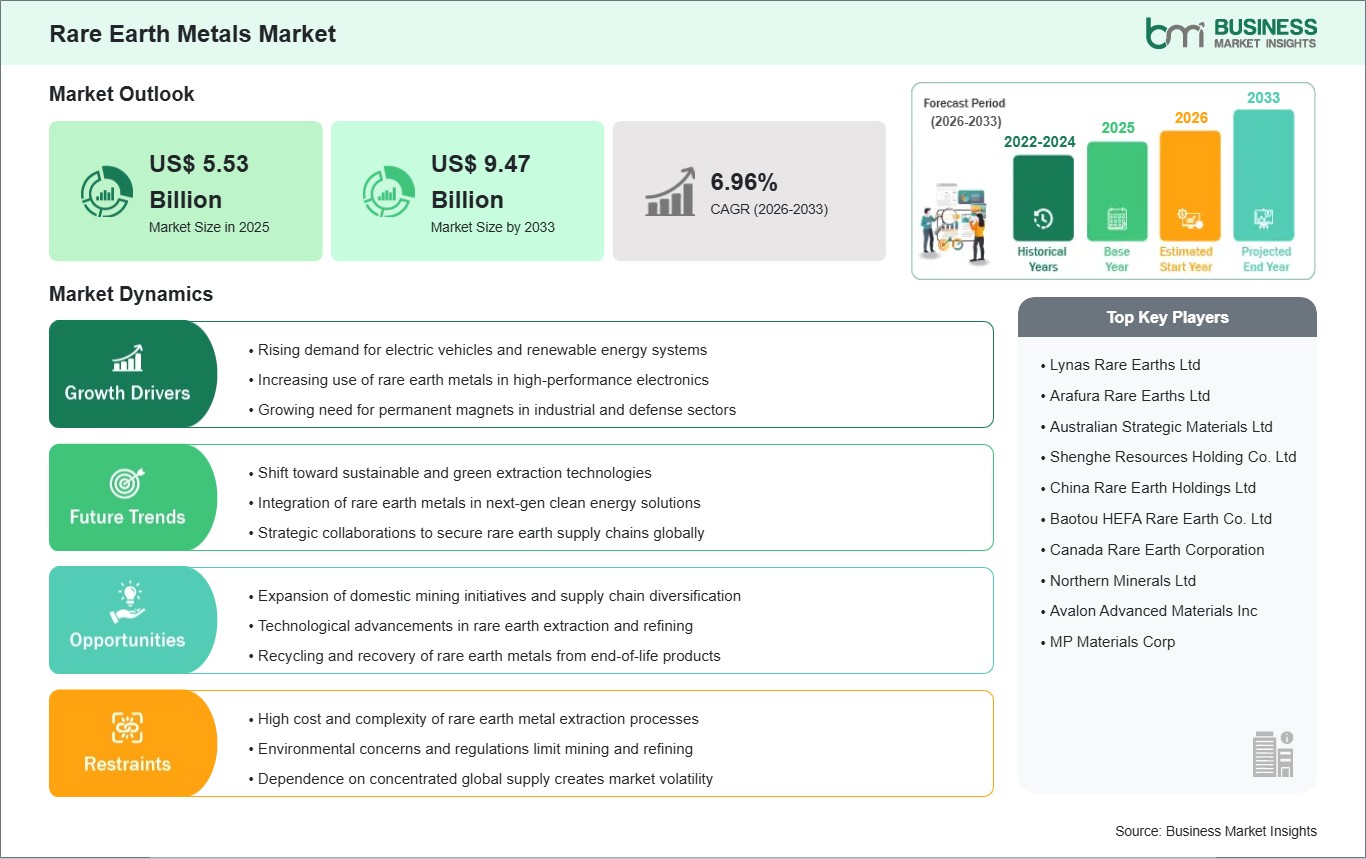
The Rare Earth Metals Market size is expected to reach US$ 9.47 billion by 2033 from US$ 5.53 billion in 2025. The market is estimated to record a CAGR of 6.96% from 2026 to 2033.
The global rare earth metals market is witnessing dynamic growth driven primarily by the escalating demand for high-performance materials, which clean energy, electronics and defense applications require. The production of permanent magnets and batteries, catalysts and phosphors, which are essential to electric vehicles (EVs), wind turbines, hybrid vehicles and consumer electronics, depends on rare earth metals, which include neodymium and dysprosium, praseodymium and cerium. The market development occurs because governments increase their support for renewable energy initiatives while the world moves to adopt electrification and digital technologies.
North America, Europe and the Asia Pacific are making significant investments in rare earth exploration and refining facilities because these metals hold crucial industrial value in present-day industrial systems. The market benefits from technological advancements, which improve extraction methods and refining processes to achieve better metal recovery and higher quality outcomes. The production of high-purity rare earth metals has improved through better hydrometallurgical techniques, solvent extraction and magnetic separation methods, which decrease dependence on a single dominant country and enhance supply chain security. The mining sector benefits from local mining projects, while chemical suppliers and mining companies establish strategic partnerships to increase resource availability and build vertical business operations throughout their entire production process. The market encounters difficulties because environmental regulations and extraction processing expenses create obstacles.
The process of rare earth mining requires multiple steps to extract valuable minerals, and it produces dangerous waste materials, which create environmental problems that limit mining activities in specific areas. Geopolitical elements, which include trade limitations and the dependency on specific supply resources, have the potential to disrupt international market equilibrium. The rising strategic value of rare earth metals for defense and energy and advanced technology sectors drives research and investment and market growth which helps maintain a strong and durable global market.

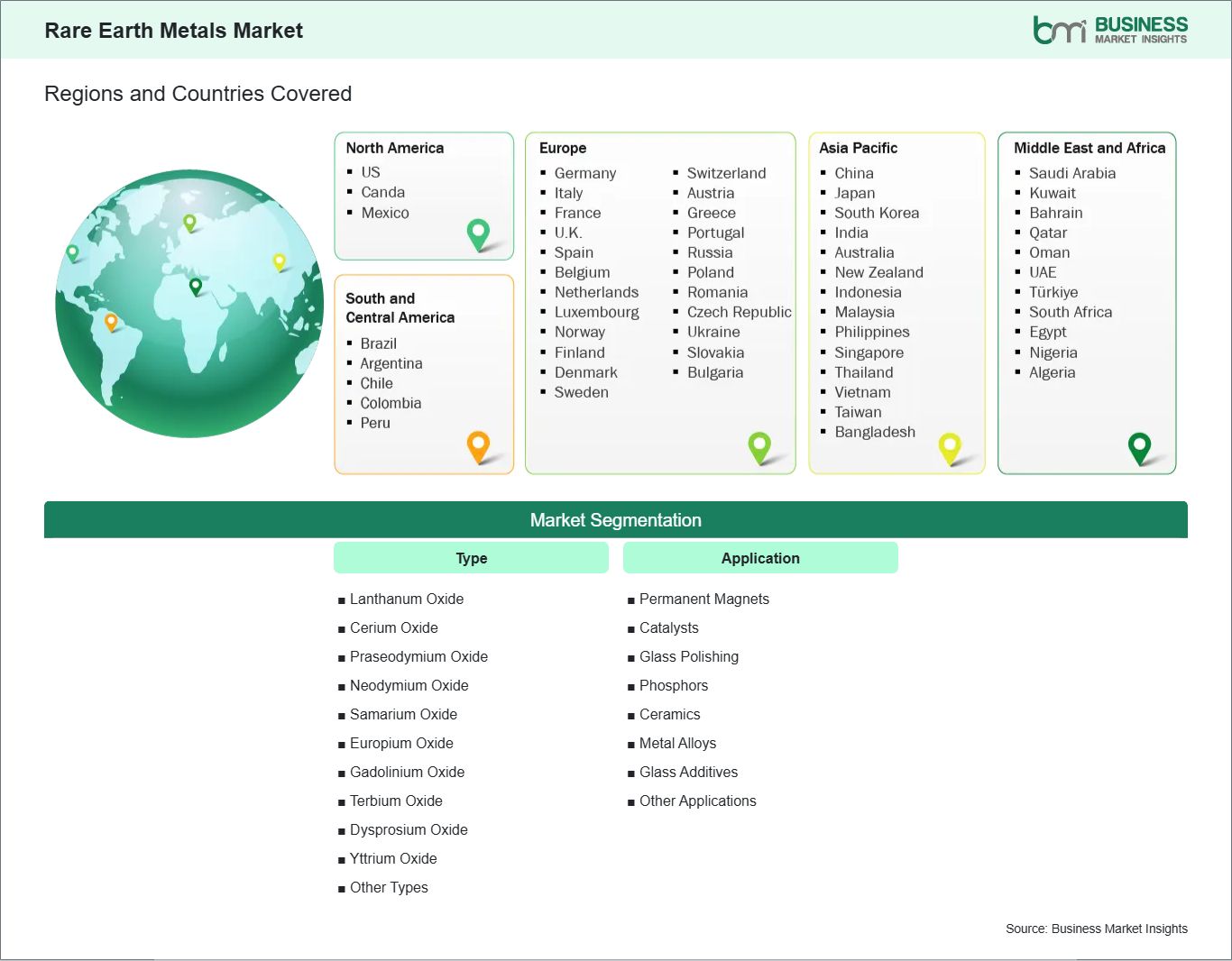
Key segments that contributed to the derivation of the rare earth metals market analysis are type and application.
The global shift toward decarbonization, combined with increased use of renewable energy sources, creates higher demand for rare earth metals because these materials are essential for manufacturing high-performance magnets, which electric vehicles and wind turbines require. North America, European countries and Asia Pacific nations all invest in EV adoption programs and renewable energy infrastructure, which leads to increased demand for neodymium, praseodymium and dysprosium. These metals become vital components for permanent magnets, which power EV motors, wind turbine generators and advanced battery systems that support the clean energy transition.
China maintains its lead as the primary producer and supplier of rare earth metals in the Asia Pacific, while Australia and India develop their mining capacities to establish alternative sources of supply to global markets. North America uses government-funded initiatives to build national extraction and refining operations, which protect the supply chains necessary for automotive manufacturing and renewable energy production. The rising demand for EVs, hybrid vehicles and energy-efficient industrial equipment leads to permanent growth in rare earth metal consumption throughout these areas because companies maintain stockpiles to protect against supply interruptions.
The market faces operational difficulties despite high demand from customers. Environmental issues, together with the extraction process complexity, create limitations for production expansion. The process of mining and refining rare earth metals needs advanced equipment, which produces chemical waste that organizations must dispose of according to strict legal standards. Technological innovations in hydrometallurgical and solvent extraction processes work together with the market to achieve higher efficiency and environmental sustainability while complying with increased global demand and operating safety standards.
Governments and private players worldwide are investing in domestic mining and refining projects to reduce dependence on concentrated sources and secure rare earth supply chains. In North America, initiatives to expand mining operations and develop local processing plants are enabling domestic availability of critical metals, supporting defense, EV, and electronics industries. Strategic partnerships with chemical suppliers and international mining firms further strengthen the integration of raw material sourcing with downstream industrial applications.
Europe is also focusing on local production and recycling to ensure consistent supply for its clean energy and industrial sectors. Collaborative projects between European mining companies and technology providers aim to establish efficient, environmentally compliant refining facilities for rare earth oxides, enhancing regional supply chain resilience. In Asia Pacific, diversification efforts in Australia and India are creating alternative sources to complement China’s dominant production, mitigating geopolitical and trade risks.
Recycling of rare earth metals from end-of-life electronics and permanent magnets is emerging as a complementary strategy to mining. Companies are investing in technologies to recover neodymium, dysprosium, and praseodymium from magnets, batteries, and electronic devices, creating a circular supply model. This not only reduces environmental impact but also enhances global supply security, positioning the market for sustainable growth amid rising demand from EVs, renewable energy, and high-performance industrial applications.

The rare earth metals market demonstrates steady growth, with size and share analysis highlighting evolving trends and competitive dynamics among key players. The report examines subsegments categorized within type and application, offering insights into their contribution to overall market performance.
By type, the neodymium oxide subsegment dominated the market in 2025, driven by its essential role in producing high‑performance permanent magnets widely used in EV motors, renewable energy systems, and advanced electronics.
In terms of application, the permanent magnets subsegment dominated the market in 2025, driven by surging demand from electric mobility, wind energy, and automation sectors where high strength and efficiency are critical.
| Report Attribute | Details |
|---|---|
| Market size in 2025 | US$ 5.53 Billion |
| Market Size by 2033 | US$ 9.47 Billion |
| Global CAGR (2026 - 2033) | 6.96% |
| Historical Data | 2022-2024 |
| Forecast period | 2026-2033 |
| Segments Covered | By Type
|
|
Regions and Countries Covered
| |
| North America | US, Canada, Mexico |
| Europe | Belgium, Austria, Finland, Denmark, Greece, Poland, Romania, Russia, Ukraine, Czech Republic, Slovakia, Bulgaria, Italy, Luxembourg, Germany, Switzerland, France, Netherlands, Norway, Portugal, Spain, Sweden, United Kingdom |
| Asia-Pacific | Australia, China, India, Japan, South Korea, Indonesia, Malaysia, Philippines, Singapore, Thailand, Vietnam, Bangladesh, New Zealand, Taiwan |
| South and Central America | Brazil, Argentina, Peru, Chile, Colombia |
| Middle East and Africa | Bahrain, Kuwait, Oman, Qatar, Saudi Arabia, United Arab Emirates, Turkiye, South Africa, Egypt, Algeria, Nigeria |
| Market leaders and key company profiles |
|
The "Rare Earth Metals Market Size and Forecast (2022 - 2033)" report provides a detailed analysis of the market covering below areas:
The geographical scope of the Rare Earth Metals Market report is divided into North America, Asia Pacific, Europe, Middle East & Africa, and South & Central America. North America held the largest share in 2025.
North America controls the worldwide rare earth metals market because countries in this region implement plans to create domestic supply networks that support their defense requirements, renewable energy needs and advanced electronic devices.
The United States and Canada are investing heavily in exploration, mining and processing infrastructure to reduce dependency on imports and strengthen national security. Advanced extraction technologies, which include hydrometallurgical processes and solvent extraction methods, show increased use to extract high-purity rare earth elements to meet production demands from the electric vehicle and aerospace industries. Government research programs, which receive financial support from the government together with public-private partnerships, create an environment for rare earth production research and sustainable mining research, which establishes North America as a central site for both resource supply and technological progress.
Asia Pacific holds major global power because China has maintained its rare earth mining and refining and downstream manufacturing control for many years. The region serves as a global supplier of critical materials, which include neodymium, praseodymium and dysprosium that serve as vital components in magnets, batteries and catalysts. Countries such as Australia and India are increasing their funding for exploration and processing activities to create additional supply sources, which will satisfy growing industrial requirements. The Asia Pacific region serves as a central location where manufacturers use rare earth metals to produce electric vehicle motors, wind turbine components and electronic devices, which strengthens the region's status as a leading market for these metals.
The European market develops its structure through sustainability programs and its requirement to source materials from within Europe to achieve its clean energy goals and electric vehicle development. European mining companies work together with chemical suppliers to create recycling programs and green extraction technologies, which will reduce their dependence on outside suppliers while they implement circular economy practices.
The Middle East and Africa region is becoming a new market, with Morocco, South Africa and other nations developing their rare earth resources to attract foreign investment and expand their mineral export capabilities. Brazil leads South and Central America in developing rare earth mining operations while establishing partnerships with international chemical and technology firms to create downstream processing facilities. The regions from which these rare earth metals originate create an emerging ecosystem that supports international production and innovation efforts while implementing sustainable practices to meet rising global demand for advanced industrial and technological applications.

The Rare Earth Metals Market is evaluated by gathering qualitative and quantitative data post primary and secondary research, which includes important corporate publications, association data, and databases. A few of the key developments in the rare earth metals market are:
The Rare Earth Metals Market is valued at US$ 5.53 Billion in 2025, it is projected to reach US$ 9.47 Billion by 2033.
As per our report Rare Earth Metals Market, the market size is valued at US$ 5.53 Billion in 2025, projecting it to reach US$ 9.47 Billion by 2033. This translates to a CAGR of approximately 6.96% during the forecast period.
The Rare Earth Metals Market report typically cover these key segments-
The historic period, base year, and forecast period can vary slightly depending on the specific market research report. However, for the Rare Earth Metals Market report:
The Rare Earth Metals Market is populated by several key players, each contributing to its growth and innovation. Some of the major players include:
The Rare Earth Metals Market report is valuable for diverse stakeholders, including:
Essentially, anyone involved in or considering involvement in the Rare Earth Metals Market value chain can benefit from the information contained in a comprehensive market report.
Please tell us your area of interest
(Market Segments/ Regions and Countries/ Companies)