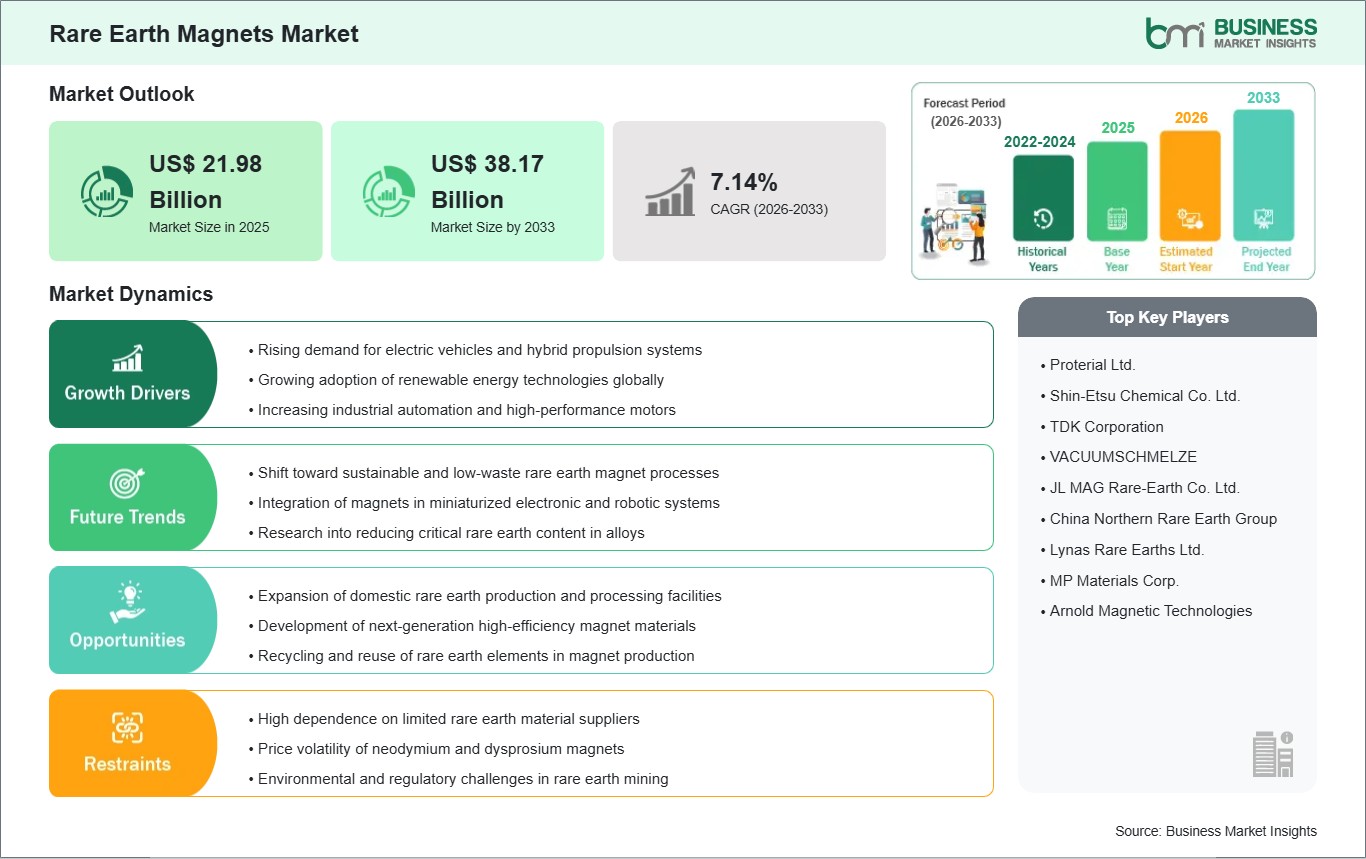
The Rare Earth Magnets Market size is expected to reach US$ 38.17 billion by 2033 from US$ 21.98 billion in 2025. The market is estimated to record a CAGR of 7.14% from 2026 to 2033.
The global rare earth magnets market has grown into a strategically significant segment of the broader materials and advanced manufacturing landscape because clean energy, electronics and automotive and industrial sectors need high-performance magnetic solutions. Rare earth magnets, which include neodymium and samarium-cobalt types, possess exceptional magnetic strength, thermal stability and resistance to demagnetization, which makes them valuable. These qualities make them critical components in electric motors, generators, sensors, actuators, and advanced electronic devices, distinguishing them from conventional ferrite or alnico magnets. Industries around the world require more efficient, compact and sustainable solutions, which makes rare earth magnets essential for developing technologies in electric vehicles, wind turbines, robotics and high-efficiency consumer electronics.
The global market for rare earth magnets depends on the ongoing worldwide shift to electrification and decarbonization. Electric vehicles and hybrid powertrains use neodymium magnets, which provide the torque, power density and energy efficiency needed for next-generation propulsion systems. The renewable energy sector depends on rare earth magnet solutions to provide wind turbine permanent magnet direct-drive systems with reliable operation under difficult conditions. The demand for industrial automation solutions and robotics technologies and miniaturization in consumer electronics creates a need for small, strong magnets, which enable the development of lighter, smaller and more efficient products.
The market experiences significant limitations because of two main factors, which include material supply issues and geopolitical conflicts. Most of the world's supply of rare earth processing facilities and magnet production plants has existed in certain geographical areas throughout history, which raises doubts about both supply chain strength and market price stability.
Countries have developed strategic government initiatives that enable them to create new supply sources, build their local mining and processing industries, and decrease their reliance on single-source suppliers. Environmental problems and regulatory requirements with rare earth extraction and refining processes force organizations to deal with dual challenges, which arise from the need for intensive processing and environmental protection measures. The market maintains its stability because of ongoing advancements in magnet production processes, recycling programs and the development of new metal alloys.
Researchers are currently increasing their efforts to develop recycling programs and alloy optimization methods, which will decrease the need for rare earth elements. The demand for these programs continues to rise across industries that experience rapid growth. Rare earth magnets will continue to serve as essential components for the development of innovative, sustainable technologies that drive the worldwide shift towards electrification and efficient systems.

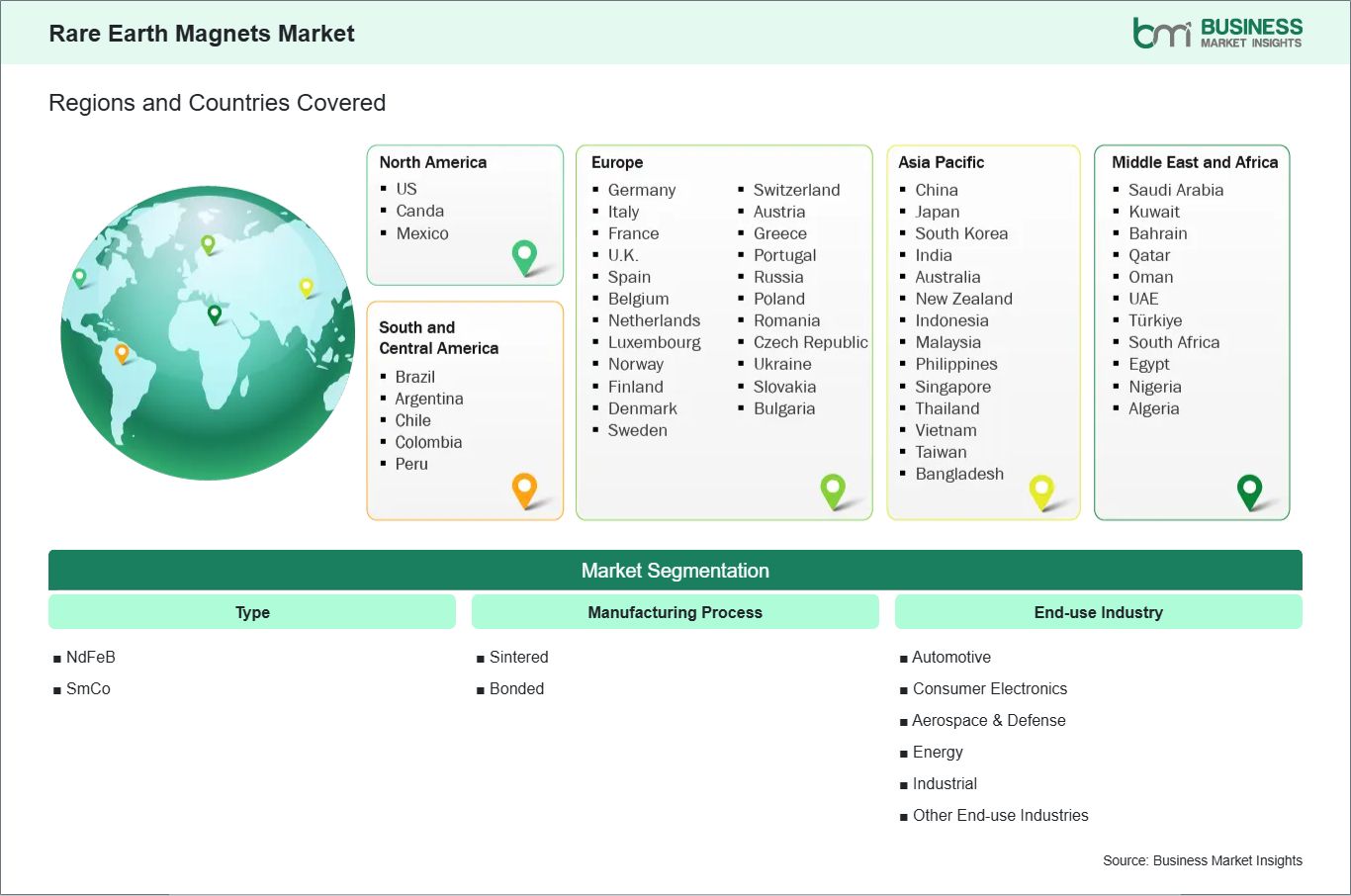
Key segments that contributed to the derivation of the rare earth magnets market analysis are type, manufacturing process, and end-use industry.
The worldwide rare earth magnets market experiences strong growth because more people are starting to use electric vehicles and hybrid power systems. The need for high-performance neodymium-iron-boron (NdFeB) magnets exists because they serve as essential parts for EV traction motors that need to deliver high energy efficiency together with high torque density. Automotive manufacturers are now using rare earth magnets in their designs because governments across the world mandate electrification to cut down carbon emissions, which has created major market demand for these magnets. North America and Europe invest heavily in electric vehicle charging infrastructure, while Asia Pacific maintains its position as the main production center, which creates a system that dynamically balances supply and demand for advanced magnets.
Electric vehicle manufacturers design motors to be smaller and lighter because they want to achieve better battery performance and higher vehicle efficiency. Rare earth magnets enable designers to create more efficient motor systems that meet strict requirements for space and weight by producing strong magnetic fields, which only require small amounts of material. Hybrid vehicles depend on these magnets, which provide accurate control of their energy recovery systems to support their use in environmentally friendly automotive technologies. The automotive industry now requires rare earth magnets as vital equipment because all automotive systems need these materials for their electric power systems.
Expansion of domestic rare earth production and processing capabilities presents a significant opportunity for the global rare earth magnets market. Historically, the supply chain has been concentrated in specific regions, creating dependency and vulnerability. Countries including the United States, Australia, and several European nations are now actively investing in local mining and processing facilities to secure a stable supply of neodymium, dysprosium, and other critical rare earth elements. This strategic push reduces reliance on imports and mitigates geopolitical risks while supporting domestic industrial growth.
In addition to supply chain resilience, new production facilities are integrating advanced processing technologies to improve extraction efficiency and environmental performance. Innovative hydrometallurgical and solvent extraction techniques allow higher recovery rates and lower waste generation, which is essential given increasing regulatory scrutiny. The ability to produce high-purity rare earth metals locally also supports the manufacturing of specialized magnets required for automotive, wind energy, and high-tech electronics applications, thereby opening avenues for market expansion.
Emerging producers are also exploring partnerships with global automotive and electronics companies to ensure long-term supply agreements, reinforcing confidence among end-users. Simultaneously, investments in magnet recycling programs complement domestic production initiatives, allowing reuse of critical rare earth elements from end-of-life motors, turbines, and electronics. By combining production expansion, technological innovation, and sustainable practices, the global rare earth magnets market is poised to meet growing demand while addressing supply chain challenges and environmental concerns.
The rare earth magnets market demonstrates steady growth, with size and share analysis highlighting evolving trends and competitive dynamics among key players. The report examines subsegments categorized within type, manufacturing process, and end-use industry, offering insights into their contribution to overall market performance.
By type, the NdFeB subsegment dominated the market in 2025, driven by its unmatched magnetic strength, making it ideal for compact, high-efficiency applications.
Based on manufacturing process, the sintered subsegment dominated the market in 2025, driven by its superior durability and thermal stability in high-performance magnet production.
In terms of end-use industry, the automotive subsegment dominated the market in 2025, driven by the increasing demand for electric and hybrid vehicles requiring high-efficiency motors.
| Report Attribute | Details |
|---|---|
| Market size in 2025 | US$ 21.98 Billion |
| Market Size by 2033 | US$ 38.17 Billion |
| Global CAGR (2026 - 2033) | 7.14% |
| Historical Data | 2022-2024 |
| Forecast period | 2026-2033 |
| Segments Covered | By Type
|
|
Regions and Countries Covered
| |
| North America | US, Canada, Mexico |
| Europe | Belgium, Austria, Finland, Denmark, Greece, Poland, Romania, Russia, Ukraine, Czech Republic, Slovakia, Bulgaria, Italy, Luxembourg, Germany, Switzerland, France, Netherlands, Norway, Portugal, Spain, Sweden, United Kingdom |
| Asia-Pacific | Australia, China, India, Japan, South Korea, Indonesia, Malaysia, Philippines, Singapore, Thailand, Vietnam, Bangladesh, New Zealand, Taiwan |
| South and Central America | Brazil, Argentina, Peru, Chile, Colombia |
| Middle East and Africa | Bahrain, Kuwait, Oman, Qatar, Saudi Arabia, United Arab Emirates, Turkiye, South Africa, Egypt, Algeria, Nigeria |
| Market leaders and key company profiles |
|
The "Rare Earth Magnets Market Size and Forecast (2022 - 2033)" report provides a detailed analysis of the market covering below areas:
The geographical scope of the Rare Earth Magnets Market report is divided into North America, Asia Pacific, Europe, Middle East & Africa, and South & Central America. North America held the largest share in 2025.
North America leads the worldwide market for rare earth magnets because of its advanced manufacturing systems, high demand from electric vehicle and renewable energy industries and its efforts to establish domestic rare earth supply chains. The United States has established a primary goal that supports the development of domestic mining and processing and magnet production facilities to decrease its reliance on overseas sources of neodymium and dysprosium which serve as key components for high-performance magnets.
Canada supports its expanding electric vehicle and aerospace industries through the use of rare earth magnet technology, which powers electric motors, wind turbines and defense systems. The Asia Pacific region functions as the largest global production center, while China operates as the main force in mining and processing and magnet production, serving both local and worldwide markets. The countries of the region, which include Japan, South Korea, and India, develop advanced technology products through their work on robotics, consumer electronics and precision machinery, while they depend on imported raw materials and spend money on research and development to enhance magnet efficiency. The European market requires rare earth magnets because of its growing electric vehicle market, industrial automation needs and its wind energy expansion activities. The European market depends on Germany, France, and the United Kingdom, which focus on sustainable sourcing, advanced motor design and rare earth element recycling to minimize supply chain risks.
The Middle East & Africa region is an emerging market that has been created through the development of renewable energy projects and industrial expansion, but it currently faces restrictions because of inadequate infrastructure and limited supply chain connectivity. The South & Central American market shows growth through Brazilian and Mexican interest in electric vehicle infrastructure, industrial applications and renewable energy projects, but remains less developed than North America and the Asia Pacific. Supply chain security and technological innovation, together with end-use demand, represent the main elements that determine how markets will develop throughout different areas.
The leadership position of North America strengthens through government incentives, domestic production investments and high industrial demand, while Asia Pacific maintains its role as the main production center. Europe shows its dedication to sustainability through its supply chain diversification efforts, while its international trade activities with the Middle East and Africa and South American markets create a worldwide market that connects different regions while exhibiting distinct patterns of industrial growth.

The Rare Earth Magnets Market is evaluated by gathering qualitative and quantitative data post primary and secondary research, which includes important corporate publications, association data, and databases. A few of the key developments in the rare earth magnets market are:
The Rare Earth Magnets Market is valued at US$ 21.98 Billion in 2025, it is projected to reach US$ 38.17 Billion by 2033.
As per our report Rare Earth Magnets Market, the market size is valued at US$ 21.98 Billion in 2025, projecting it to reach US$ 38.17 Billion by 2033. This translates to a CAGR of approximately 7.14% during the forecast period.
The Rare Earth Magnets Market report typically cover these key segments-
The historic period, base year, and forecast period can vary slightly depending on the specific market research report. However, for the Rare Earth Magnets Market report:
The Rare Earth Magnets Market is populated by several key players, each contributing to its growth and innovation. Some of the major players include:
The Rare Earth Magnets Market report is valuable for diverse stakeholders, including:
Essentially, anyone involved in or considering involvement in the Rare Earth Magnets Market value chain can benefit from the information contained in a comprehensive market report.
Please tell us your area of interest
(Market Segments/ Regions and Countries/ Companies)