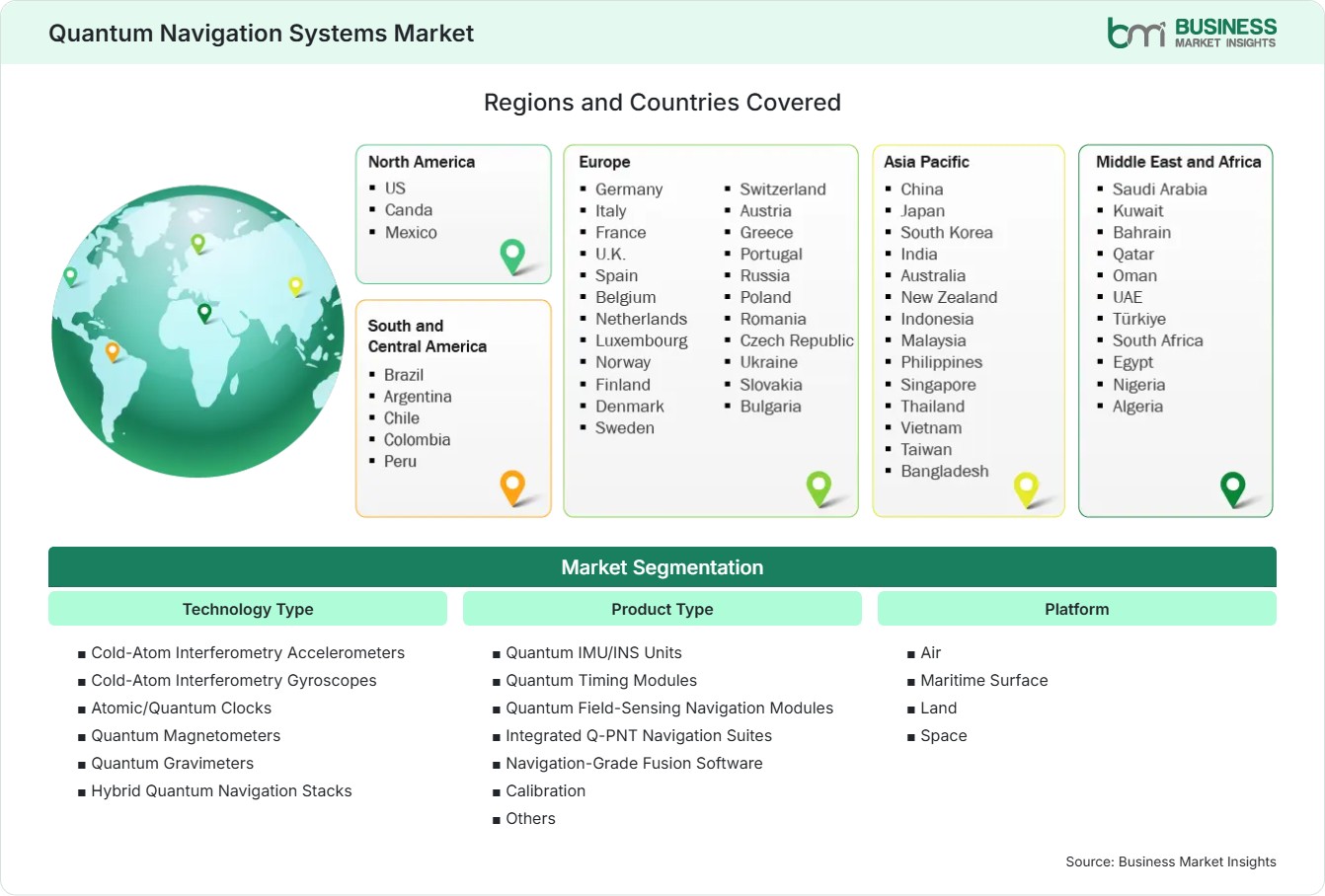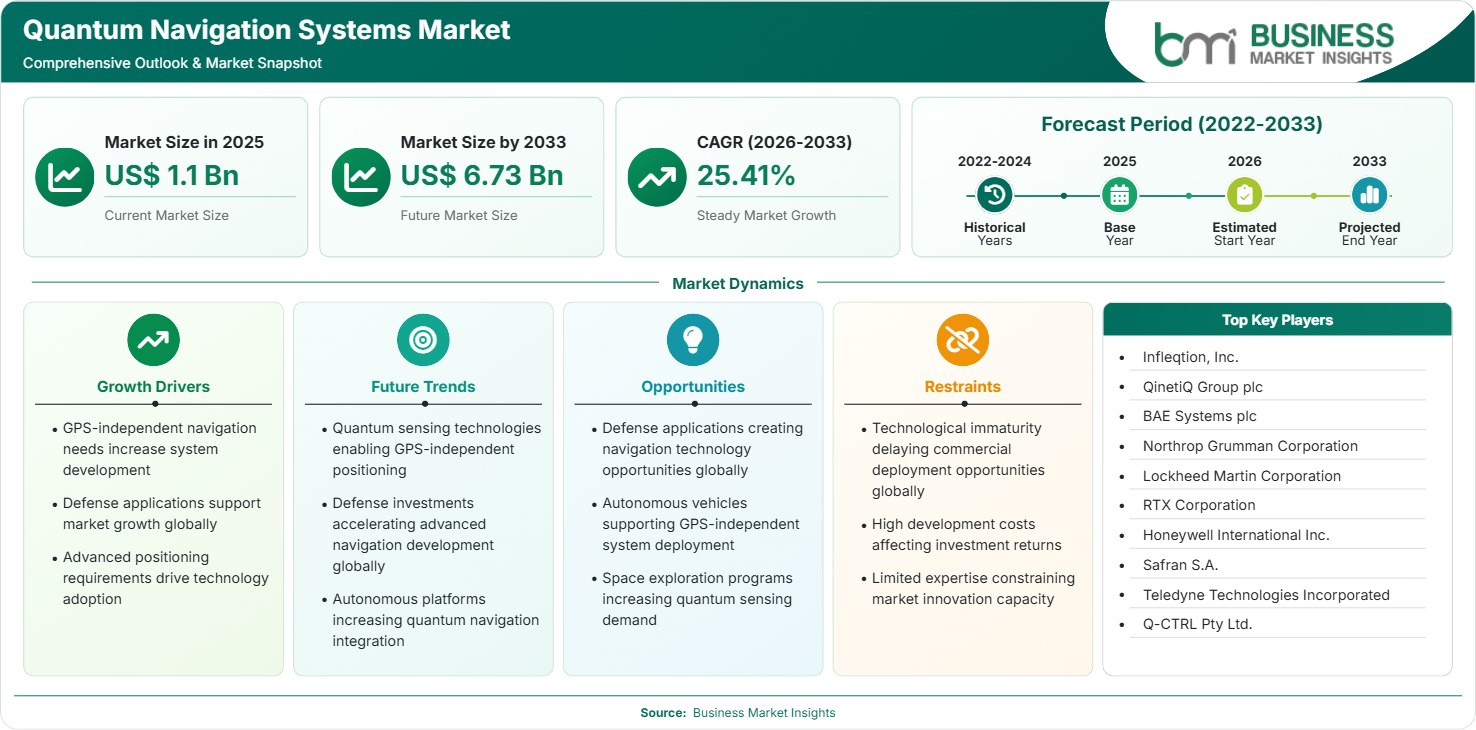
Quantum Navigation Systems Market Regional Highlights
North America Quantum Navigation Systems Market
North America accounted for 38%–41% of the Quantum Navigation Systems Market share in 2025 and is projected to register a CAGR of 23.5%–25.5% through 2033. Regional leadership is supported by extensive military procurement programs, advanced aerospace manufacturing capacity, strong venture capital activity, and government-backed quantum technology initiatives. The United States represents the dominant contributor, while Canada continues expanding quantum sensing research capabilities. Growing investments in resilient PNT systems, electronic warfare preparedness, and autonomous defense platforms are strengthening regional demand across air, maritime, land, and space applications.
- U.S. defense modernization programs increasingly prioritize navigation technologies able to operate during GPS disruption scenarios, accelerating adoption of advanced sensing architectures across airborne, naval, and terrestrial mission environments.
- Major aerospace contractors and defense integrators continue forming partnerships with quantum technology developers to accelerate prototype validation, production scaling, and deployment readiness across defense applications.
- Government-backed research networks facilitate technology transfer from academic institutions into commercial and military environments, helping reduce development timelines and improve operational performance.
- Demand for autonomous systems across surveillance, logistics, and strategic defense missions encourages integration of resilient inertial navigation platforms capable of operating in contested electromagnetic environments.
US Quantum Navigation Systems Market
The US accounted for 82% - 86% of North American revenues in 2025 and is anticipated to experience a CAGR of 24% - 26% by 2033. High levels of defense spending, robust DARPA research initiatives, dominance in the aerospace industry, and quantum technology startups are continuing to drive commercialization. Demand is increasing for military aircraft, ships, autonomous vehicles, and infrastructure development. The federal spending on resilient positioning, navigation, and timing technologies is facilitating market penetration, and collaboration among defense contractors and quantum experts is enhancing local manufacturing capacity.
- Military demand continues to drive procurement of advanced inertial navigation systems capable of maintaining positioning precision during contested operations where GNSS signals are unavailable or intentionally disrupted.
- Aerospace companies are integrating quantum sensing technologies into next-generation aircraft architectures to improve navigation reliability, mission endurance, and operational resilience.
- Venture capital investment and federal quantum initiatives continue supporting startup commercialization, research translation, and scaling of deployable navigation-grade solutions.
- Increasing emphasis on critical infrastructure resilience is encouraging evaluation of quantum timing and navigation technologies across transportation, energy, and communications sectors.
Europe Quantum Navigation Systems Market
The Europe region holds around 27% - 30% of the Quantum Navigation Systems Market share in 2025 and is expected to grow at a CAGR of 24.5% - 26.5% from 2026 to 2033. Growth in this region is driven by the government's technology policies, increased partnerships within the defense sector, and an excellent research base within universities. The UK stands out as the largest market, while Germany is the fastest-growing country, with a CAGR of 26% - 28%. The growing demand for these systems is evident in the aerospace, maritime, and defense sectors.
- The United Kingdom leads regional commercialization through government-supported quantum technology programs and strong participation from aerospace and defense contractors.
- Germany benefits from increasing investments in advanced manufacturing, industrial automation, and next-generation defense technologies, supporting accelerated market adoption.
- European Union funding initiatives continue fostering cross-border collaboration among universities, technology providers, and defense agencies.
- Maritime security and naval modernization programs are creating favorable opportunities for resilient navigation systems in contested operational environments.
- Growing satellite resilience concerns are accelerating adoption of alternative positioning technologies for mission-critical infrastructure.
Asia Pacific Quantum Navigation Systems Market
Asia Pacific held a 24%–27% Quantum Navigation Systems Market share in 2025 and is expected to witness the fastest expansion at a CAGR of 27.5%–29.5% through 2033. China is the largest participant, while India will be the fastest-growing national market with a CAGR of 29%-31%. Regional growth will be fueled by defense upgrades, indigenous technology development, increased activity in aerospace manufacturing, and investment in quantum infrastructure. Governments have become interested in navigation independence, which will facilitate the development and implementation of quantum-enabled positioning technologies.
- China continues investing heavily in quantum science programs, defense technologies, and space exploration initiatives, strengthening regional demand for navigation innovations.
- India is expanding quantum technology funding while supporting indigenous aerospace and defense manufacturing capabilities, creating strong long-term growth prospects.
- Regional maritime security requirements are encouraging deployment of resilient navigation systems for naval fleets and autonomous maritime platforms.
- Expanding commercial aerospace production supports demand for high-accuracy inertial sensing technologies across aviation ecosystems.
- Space agencies across the region are evaluating advanced positioning technologies for future satellite and exploration missions.
Rest of World Quantum Navigation Systems Market
The Rest of World region accounted for a 6%–8% Quantum Navigation Systems Market share in 2025 and is projected to register a CAGR of 25%–27% through 2033. South and Central America are benefiting from selective defense modernization programs and increasing aerospace collaborations. Meanwhile, Middle East and Africa markets are witnessing investments in security infrastructure, strategic defense capabilities, and smart transportation initiatives.
The United Arab Emirates remains the leading regional market, while Saudi Arabia demonstrates the highest growth potential with a CAGR of 27%–29%. Rising emphasis on technological sovereignty and infrastructure resilience continues to support adoption across critical sectors.
- Middle Eastern governments are increasing investments in advanced defense technologies to strengthen operational capability and reduce strategic vulnerabilities.
- Saudi Arabia's technology diversification programs are creating additional opportunities for quantum-enabled navigation investments.
- Aerospace partnerships and international collaboration agreements support technology transfer and capability development across emerging markets.
- Critical infrastructure operators are exploring resilient timing and positioning technologies to support secure operations during signal interference events.
- Maritime security initiatives and border surveillance projects are fostering demand for high-precision navigation capabilities.