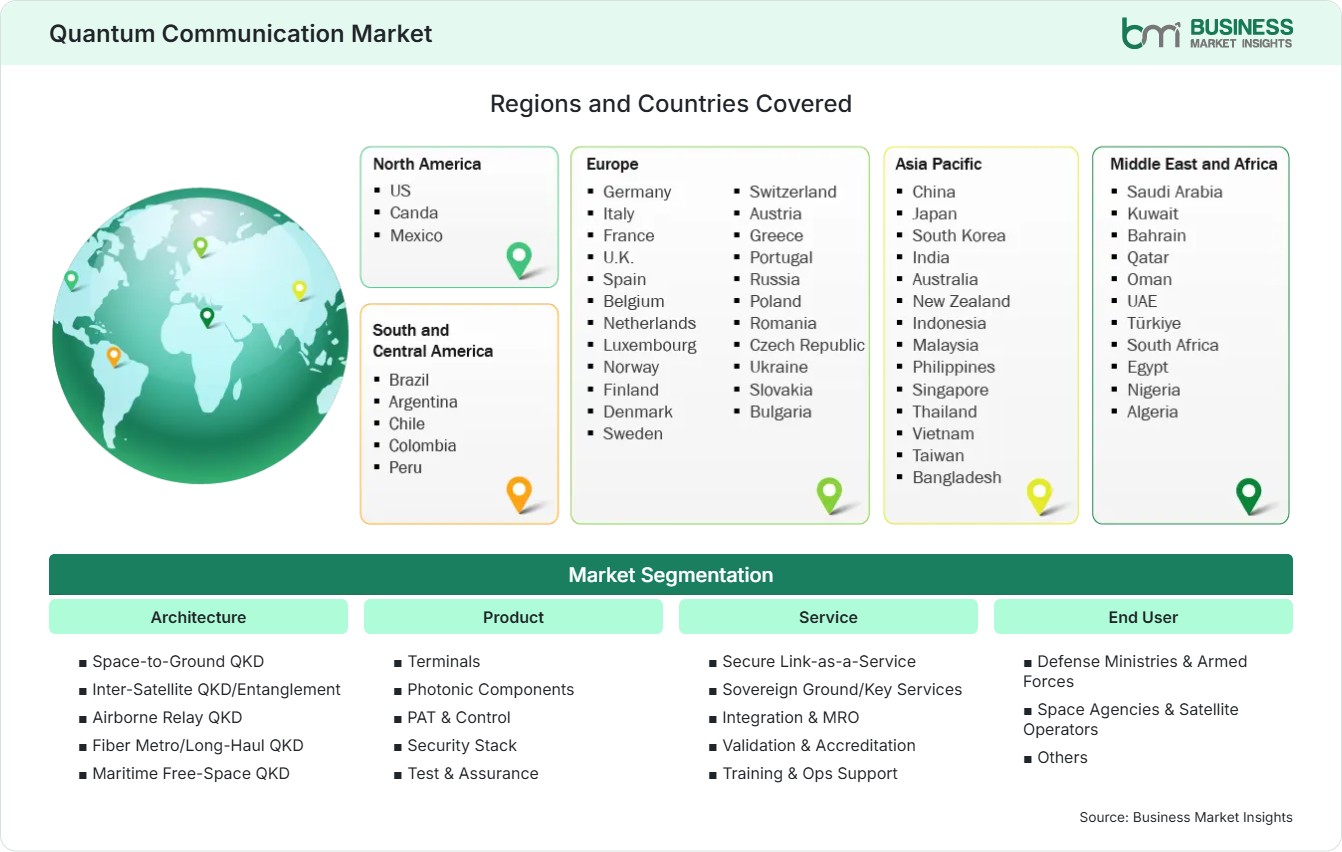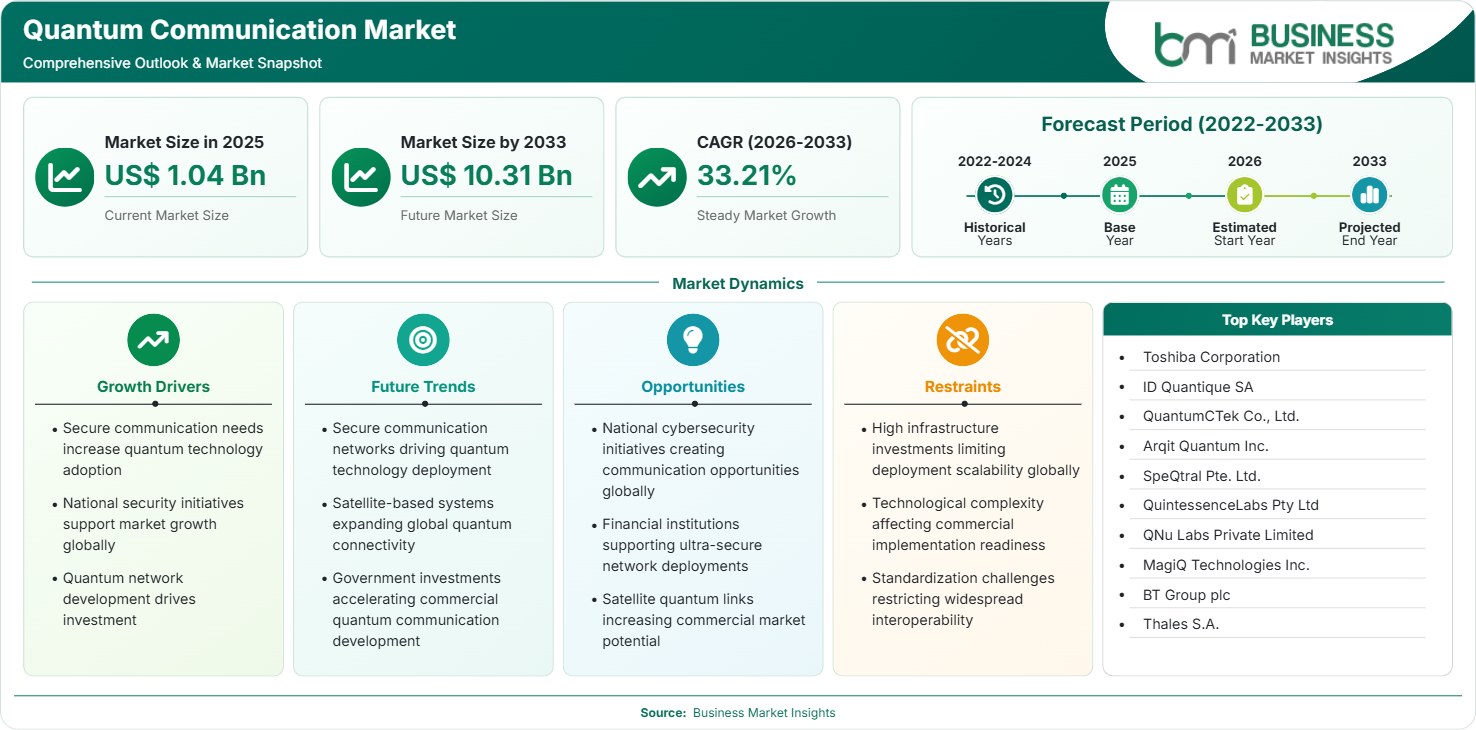
Quantum Communication Market Regional Highlights
North America Quantum Communication Market
North America remains the largest regional market, accounting for 34%–37% of the Quantum Communication Market share in 2025 while advancing at a CAGR of 31%–34% during 2026–2033. Strong defense spending, federal quantum initiatives, advanced research infrastructure, telecommunications innovation, and cybersecurity modernization programs support adoption.
- Federal funding programs promote the development of secure communication systems that are enabled by satellites, encouraging technology validation, the carrying out of pilot deployments, and large-scale procurement in national security and critical infrastructure situations.
- Telecommunication operators are incorporating quantum-safe networking technologies into their strategic roadmaps to meet the needs of their enterprise customers who want enhanced protection against future cryptographic vulnerabilities and cyber threats.
- Increasingly, financial institutions are assessing quantum-secure communication solutions to protect sensitive transactions, improve their operational resilience, and meet the changing cybersecurity governance frameworks.
- As cooperation between the public and private sectors increases, the process of commercialization is sped up, which allows research institutions and private companies to develop communication infrastructure and security platforms that are ready for deployment.
• The need for modernizing defense continues to be a major factor since military organizations are focusing on resilient communication systems that are capable of functioning in contested and highly secure environments.
US Quantum Communication Market
The United States represents approximately 72%–76% of the North American Quantum Communication Market in 2025 and is projected to achieve a CAGR of 32%–35% during 2026–2033. Strong federal research funding, defense procurement initiatives, advanced quantum startups, and extensive telecommunications infrastructure support leadership.
- The need for national security is pushing forward investment in quantum networking programs that are capable of supporting secure military, intelligence, and government communications.
- There is strong activity among start-ups leading to innovation in the software for quantum networking, in the technologies for key distribution and in the photonic hardware systems used by commercial and defense customers.
- The modernization of telecommunications infrastructure sets favorable conditions for the integration of advanced quantum communication technologies into existing networks.
- The demand for enterprise solutions from key industries including finance, energy, and healthcare is helping to drive commercialization beyond those cases which are solely funded by the government.
Europe Quantum Communication Market
Europe accounts for 27%–30% of the Quantum Communication Market share in 2025 and is projected to grow at a CAGR of 32%–35% during 2026–2033. Regional growth is supported by sovereign digital infrastructure strategies, cross-border quantum network initiatives, cybersecurity regulations, and investments from defense and research organizations.
- Germany has the highest rate of adoption in the region, with a compound annual growth rate ranging from 33% to 36%, due to its industrial digitization, emphasis on cybersecurity, and active public-private investment.
- France continues to make a substantial contribution due to its defense-related quantum communication programs, its investments in satellite infrastructure, and its capabilities in advanced photonics research.
- The Netherlands has strong ecosystems for quantum research and is involved in various international collaboration programs aimed at the development of secure networking infrastructure.
- The European Space Agency's involvement in quantum communication projects helps to develop secure infrastructure enabled by satellites among the member states.
- Increasingly, financial institutions and operators of critical infrastructure are assessing quantum-secure networking solutions to enhance their long-term cyber resilience strategies.
Asia Pacific Quantum Communication Market
Asia Pacific represents 24%–27% of the Quantum Communication Market share in 2025 and is expected to expand at a CAGR of 36%–39% during 2026–2033, making it the fastest-growing regional market. Significant investments in national quantum technology programs, satellite communication projects, domestic manufacturing capabilities, and cybersecurity infrastructure are accelerating adoption.
- China is leading demand in the region with a compound annual growth rate of 37% to 40%, due to its large-scale investment in satellite-based quantum communication and in the development of domestic technology.
- India is showing rapid adoption, which is being promoted by its national quantum mission, efforts to modernize its cybersecurity, and increasing involvement from private technology companies.
- Japan has strong research capabilities and industrial collaborations aimed at putting secure communication technologies into commercial use for strategic applications.
- South Korea is making greater investments in the fields of photonics, telecommunications, and secure networking infrastructure to enhance its technological competitiveness.
- Operators in various regions are looking at commercial deployment models that are capable of supporting cross-border secure communication services.
Rest of World Quantum Communication Market
The Rest of World region accounts for 9%–12% of the Quantum Communication Market share in 2025 and is anticipated to grow at a CAGR of 34%–37% during 2026–2033. Demand across South and Central America is supported by digital infrastructure modernization and rising cybersecurity awareness.
- Brazil has the highest compound annual growth rate in both South and Central America, ranging from 35% to 38%, due to its research initiatives, investments in telecommunications, and efforts to modernize its cybersecurity.
- Mexico is benefiting from the rising demand for secure enterprise communication infrastructure and the increasing digital transformation taking place in various key industries.
- The United Arab Emirates is becoming one of the leading markets in the Middle East as a result of its investments in advanced digital infrastructure and its sovereign technology initiatives.
- Saudi Arabia is carrying out expansion projects in the field of cybersecurity and smart infrastructure, which may provide long-term opportunities for secure communication platforms.
- South Africa is still supporting research-oriented innovation and secure networking projects which are intended to enhance its cyber resilience capabilities.