
Public Transportation Market Outlook: Size, Share, Trends, Growth Analysis, Competitive Landscape & Forecast, 2026-2033

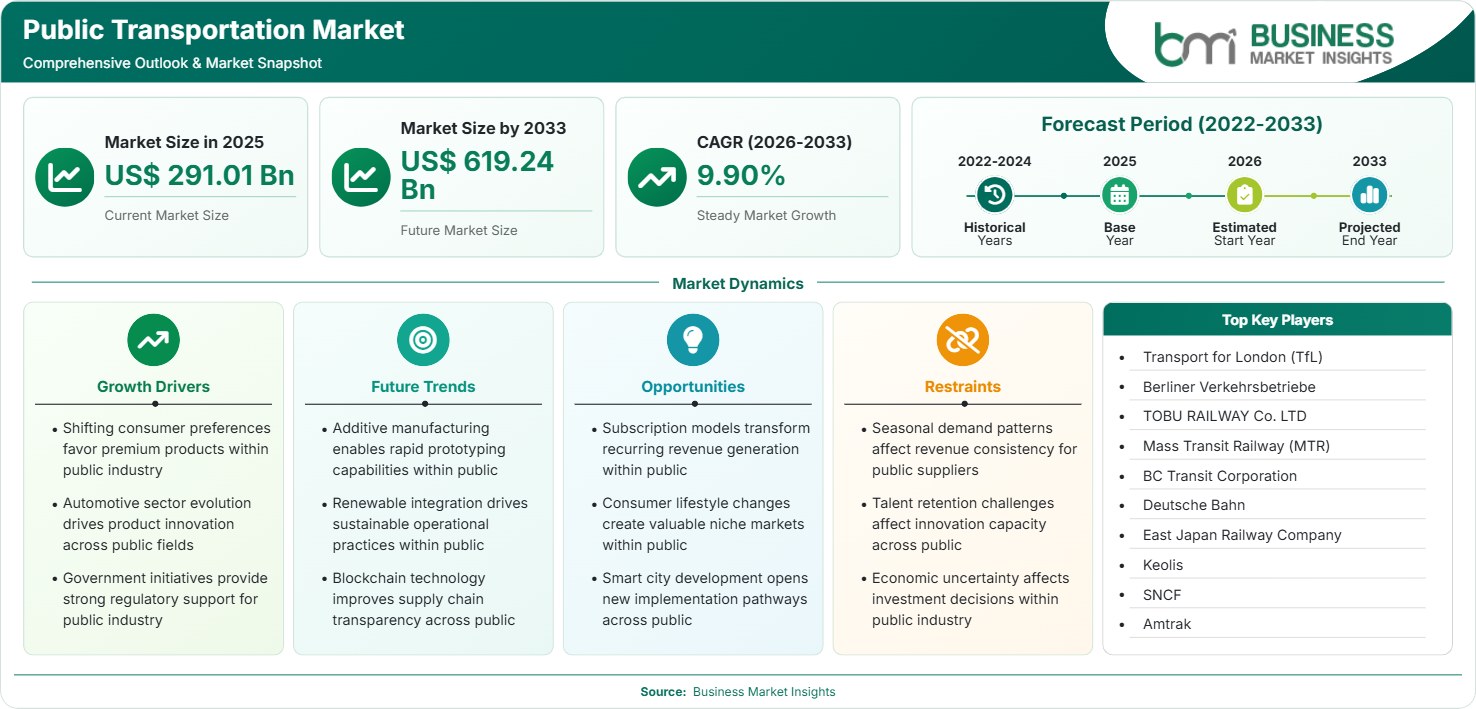
The Public Transportation Market size was valued at US$ 291.01 billion in 2025 and is projected to reach US$ 619.24 billion by 2033, growing at a CAGR of 9.90% during 2026–2033. Increasing urbanization, rising investments in smart mobility infrastructure, expansion of electric public transit systems, and growing demand for sustainable transportation solutions are driving market expansion. Opportunities are emerging through digital ticketing platforms, connected transportation networks, autonomous mobility solutions, and government initiatives focused on reducing carbon emissions from urban transport systems.

Report Coverage
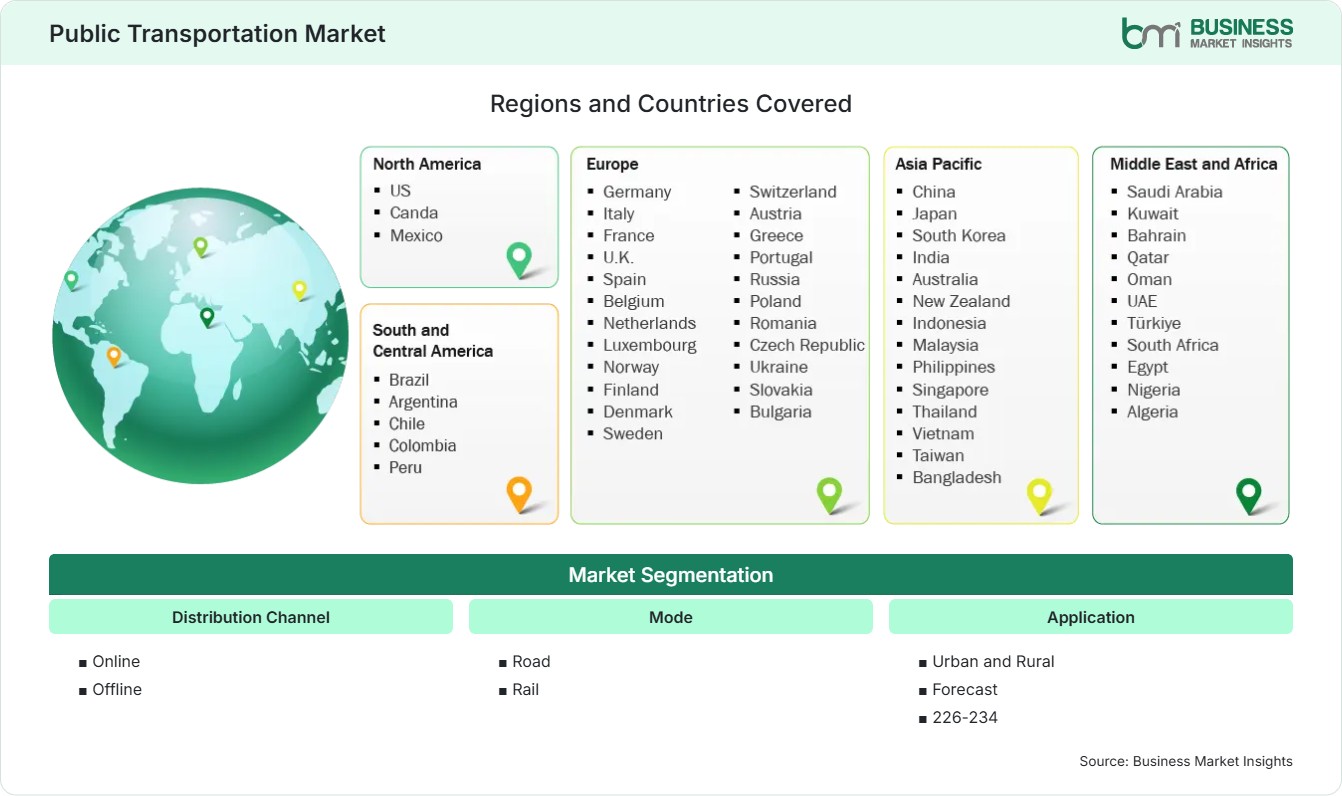
  • Distribution Channel: Online, Offline
  • Mode: Road, Rail
  • Application (Urban and Rural), Forecast, 226-234
US$ 291.01 Bn Market size in 2025
US$ 619.24 Bn Market Size by 2033
9.90% CAGR, 2026 - 2033
2026-2033 Forecast Period

AI Overview

Public Transportation Market Summary

  • North America Region: North America holds 29%–32% market share in 2025 and is projected to grow at a 8.2%–9.0% CAGR during 2026–2033. Investments in transit modernization, electric buses, rail infrastructure upgrades, smart ticketing systems, and integrated mobility platforms are strengthening regional growth. The U.S. represents the leading contributor with a projected 8.5%–9.2% CAGR, supported by urban transit expansion, federal infrastructure funding, and increasing adoption of digital mobility solutions.
  • Fastest Growing Region: Asia Pacific accounts for 38%–41% market share in 2025 and is expected to register the fastest growth with a 10.8%–11.6% CAGR during 2026–2033. Rapid urban population growth, metro rail expansion, government transportation investments, high-speed rail development, and smart city programs are accelerating public transit adoption across major economies.
  • Leading Segment: Rail holds 54%–57% market share in 2025 and is projected to expand at a 9.7%–10.4% CAGR during 2026–2033. Growing demand for high-capacity transportation, urban rail connectivity, electrification initiatives, and investments in metro and railway networks continue supporting segment leadership.
  • High Growth Segment: Online Distribution Channel represents 42%–45% market share in 2025 and is anticipated to grow at a 11.2%–12.0% CAGR through 2033. Increasing digital payment adoption, mobile ticketing applications, journey planning platforms, and connected travel experiences are accelerating online channel expansion.
  • Key Market Opportunity: Integration of artificial intelligence, mobility-as-a-service platforms, electric transportation systems, and real-time passenger information technologies creates significant opportunities for operators to improve efficiency, sustainability, passenger experience, and operational performance.
  • Major Market Players: Transport for London (TfL); Berliner Verkehrsbetriebe (BVG); TOBU RAILWAY Co., Ltd.; MTR Corporation Limited; BC Transit Corporation; Deutsche Bahn AG; East Japan Railway Company; Keolis Group; Metropolitan Transportation Authority (MTA); RATP Group.
Strategic Insights

Public Transportation Market: Strategic Insights

Public Transportation Market Strategic Framework
FREE PDF
Request your free sample
Request free sample
Stakeholder View

Key Takeaways

  • Public transportation ecosystems are evolving from traditional service models into integrated mobility networks combining rail operators, bus providers, digital platforms, payment solution companies, infrastructure developers, and technology providers to deliver seamless passenger experiences.
  • Urban transit expansion, metro rail development, electric bus deployment, and multimodal connectivity represent major growth opportunities as cities worldwide address congestion challenges and invest in efficient mass mobility solutions.
  • Technology innovation is reshaping transportation operations through artificial intelligence-based route optimization, predictive maintenance systems, automated ticketing, smart fleet management, and real-time passenger analytics that improve service reliability.
  • Asia Pacific presents a strong investment opportunity due to rapid urban population growth, large-scale metro expansion projects, government infrastructure programs, and increasing adoption of sustainable transportation technologies across major economies.
  • Strategic partnerships, infrastructure investments, and public-private collaboration are becoming increasingly important as transportation operators seek funding, operational expertise, and technology capabilities to modernize aging transit networks.
  • Future market competitiveness will depend on operators’ ability to integrate electrification, digital mobility platforms, data-driven management systems, and passenger-centric services while maintaining affordability and accessibility across urban and rural communities.
Geographic Outlook

Public Transportation Market Regional Highlights

North America Public Transportation Market

North America accounted for 29%–32% of the global Public Transportation Market in 2025 and is projected to expand at a 8.2%–9.0% CAGR during 2026–2033. The region benefits from transportation modernization programs, electric fleet adoption, advanced rail infrastructure, and increasing investment in smart mobility platforms. Public agencies are upgrading aging transit networks through digital ticketing, connected systems, and sustainable mobility solutions. Strong government support, urban development initiatives, and increasing passenger demand continue strengthening the regional transportation ecosystem, positioning North America as a major contributor to global market expansion.

  • Increasing federal and state-level investments in transit infrastructure modernization are supporting fleet electrification, railway improvements, and deployment of intelligent transportation systems across major metropolitan regions.
  • Electric bus adoption is accelerating as transit authorities focus on reducing emissions, improving energy efficiency, and achieving sustainability targets through cleaner public mobility solutions.
  • Digital ticketing, mobile applications, and integrated payment platforms are transforming passenger experiences by enabling convenient access, real-time travel updates, and seamless multimodal transportation.
  • Urban congestion challenges are encouraging cities to expand mass transit networks, improve connectivity, and develop efficient alternatives to private vehicle usage.

US Public Transportation Market

The United States represents the largest contributor within the North American region, accounting for 82%–86% of regional market share in 2025 and expanding at a 8.5%–9.2% CAGR through 2033. Public Transportation Market Growth is supported by infrastructure modernization programs, increasing urban mobility demand, and investments in rail, bus, and smart transit solutions. Federal transportation funding, sustainability initiatives, and digital transformation efforts are encouraging transit agencies to improve service efficiency and passenger accessibility across metropolitan areas.

  • Government infrastructure initiatives are supporting upgrades of rail networks, transit stations, and vehicle fleets while improving safety, reliability, and operational performance.
  • Metropolitan transit authorities are adopting automated fare collection, predictive maintenance, and digital passenger platforms to enhance efficiency and reduce operational challenges.
  • Growing emphasis on reducing transportation emissions is accelerating deployment of electric buses and alternative energy-powered public transit fleets across major cities.
  • Expansion of integrated mobility services is improving connectivity between buses, rail systems, ride-sharing services, and other urban transportation options.

Europe Public Transportation Market

Europe captured 24%–27% of the global Public Transportation Market in 2025 and is expected to grow at a 9.1%–9.8% CAGR during 2026–2033. The region maintains a strong public transportation ecosystem supported by extensive railway networks, sustainability regulations, and urban mobility policies. Germany leads regional adoption due to advanced rail infrastructure and transportation investments, while France demonstrates strong growth momentum with a 9.5%–10.1% CAGR driven by metro expansion, electrification programs, and smart mobility initiatives.

  • European sustainability policies continue encouraging investment in electric buses, rail electrification, and low-emission transportation systems across urban and intercity networks.
  • Germany remains a leading market due to strong railway infrastructure, advanced operational technologies, and continued investment in passenger transportation modernization.
  • France is expanding public transit capabilities through metro projects, regional rail improvements, and digital mobility solutions supporting efficient urban transportation.
  • Increasing adoption of mobility-as-a-service platforms enables passengers to access multiple transportation modes through integrated digital applications.
  • Public transportation operators are focusing on automation, energy efficiency, and predictive maintenance technologies to optimize fleet performance and reduce operational costs.

Asia Pacific Public Transportation Market

Asia Pacific represented 38%–41% of the global Public Transportation Market in 2025 and is projected to register the fastest growth at a 10.8%–11.6% CAGR between 2026 and 2033. Rapid urbanization, expanding metropolitan populations, large-scale infrastructure investments, and government-backed smart city initiatives are driving regional demand. China leads the regional market due to extensive railway and metro networks, while India is experiencing rapid expansion with a 11.2%–12.0% CAGR supported by urban transit development and infrastructure modernization programs.

  • China maintains regional leadership through extensive high-speed rail networks, metro expansion projects, and continuous investment in advanced transportation infrastructure.
  • India is witnessing strong growth as cities develop metro systems, electric bus networks, and integrated urban transportation solutions to address rising mobility requirements.
  • Japan continues advancing efficient rail transportation through technology-driven operations, high-speed rail services, and passenger-focused mobility innovations.
  • Southeast Asian countries are increasing transportation investments to improve urban connectivity, reduce congestion, and support economic development through improved mobility networks.
  • Government smart city programs are accelerating adoption of digital ticketing, intelligent traffic management, and connected transportation technologies across major urban areas.

Rest of World Public Transportation Market

The Rest of World region accounted for 8%–11% of the global market in 2025 and is forecast to expand at a 8.6%–9.4% CAGR during the Public Transportation Market forecast period. South and Central America are improving public transportation accessibility through metro expansion, bus modernization, and infrastructure development programs. The Middle East and Africa are witnessing increased investment in urban mobility projects, railway networks, and smart transportation systems as governments focus on economic diversification and sustainable city development.

  • Brazil remains a key South American market due to increasing urban transportation investments, bus network improvements, and growing demand for efficient mobility solutions.
  • Mexico is expanding transportation infrastructure through urban transit projects, improved connectivity initiatives, and modernization of existing public mobility networks.
  • Gulf countries are investing heavily in metro systems, smart mobility platforms, and advanced transportation infrastructure to support rapidly growing urban populations.
  • Middle Eastern transportation projects increasingly emphasize sustainability, digitalization, and integration of advanced technologies for improved passenger experiences.
  • African markets are gradually adopting modern transit solutions through international partnerships, infrastructure funding, and initiatives focused on improving urban connectivity.
Global Market Geography
FREE PDF
Request your free sample
Request free sample
Segment Analysis

Public Transportation Market Segmentation

Distribution Channel

The Distribution Channel segment is evolving as transportation operators increasingly adopt digital platforms to improve passenger accessibility and operational efficiency. The Online channel accounted for 42%–45% Public Transportation Market share in 2025 and is projected to expand at a 11.2%–12.0% CAGR through 2033. Growing smartphone penetration, digital payment adoption, mobile ticketing platforms, and integrated travel applications are accelerating the transition toward technology-driven public transportation services.

  • Online: Online distribution channels are gaining traction through mobile applications, web-based ticket booking platforms, digital payment solutions, and real-time travel information systems that improve convenience and passenger engagement.
  • Offline: Offline channels continue supporting transportation accessibility through physical ticket counters, automated vending machines, and traditional booking methods, particularly in regions with limited digital infrastructure and diverse passenger demographics.

Mode

The Mode segment remains a fundamental component of the Public Transportation Market as cities and governments invest in high-capacity transportation systems. Rail accounted for 54%–57% market share in 2025 and is expected to grow at a 9.7%–10.4% CAGR between 2026–2033. Expanding metro networks, railway electrification, and investments in sustainable mobility infrastructure continue strengthening demand for advanced public transportation systems.

  • Road: Road-based transportation continues playing a critical role through bus networks, electric buses, and flexible mobility services that provide affordable connectivity across urban, suburban, and rural communities.
  • Rail: Rail transportation maintains leadership due to high passenger capacity, energy efficiency, long-distance connectivity, metro expansion projects, and increasing investments in high-speed and urban railway infrastructure.

Application

The Application segment is expanding as transportation authority’s focus on improving mobility access across different population areas. Urban applications represented the dominant share with 66%–69% market contribution in 2025 and are projected to grow at a 10.0%–10.7% CAGR through 2033. The Public Transportation Market scope continues broadening as cities adopt integrated mobility systems, smart transit platforms, and sustainable transportation solutions to address increasing passenger demand.

  • Urban: Urban applications represent the largest demand area due to population growth, traffic congestion challenges, smart city development programs, metro expansion, and increasing adoption of integrated public mobility solutions.
  • Rural: Rural transportation applications are expanding through government connectivity programs, improved bus services, regional rail development, and initiatives aimed at increasing mobility accessibility for underserved communities.
Market Forces

Public Transportation Market Dynamics

Key Market Drivers

Rapid Urbanization and Increasing Demand for Mass Mobility Solutions

Urban population growth and rising mobility requirements are major factors accelerating the expansion of public transportation networks worldwide. According to United Nations projections, nearly 70% of the global population is expected to live in urban areas by 2050, increasing pressure on cities to develop efficient mass transit systems. The Public Transportation Market growth is supported by investments in metro rail, bus rapid transit, commuter rail, and integrated mobility solutions designed to reduce congestion and improve accessibility. Governments are prioritizing sustainable transportation infrastructure to address environmental concerns, while transit operators are adopting advanced fleet management systems, digital ticketing platforms, and connected technologies to improve passenger experiences and operational efficiency.

Government Investments in Sustainable and Smart Transportation Infrastructure

Public transportation development is increasingly influenced by government policies focused on reducing carbon emissions, improving urban connectivity, and supporting sustainable mobility. Countries worldwide are investing in electric buses, railway electrification, smart transit systems, and intelligent transportation infrastructure to achieve environmental targets. Initiatives such as smart city programs and low-emission transportation policies are encouraging transit agencies to modernize existing networks. Growing adoption of renewable energy-powered transportation solutions, automated fare collection systems, and real-time passenger information platforms is improving service reliability. These Public Transportation Market trends demonstrate the transition from conventional transportation models toward digitally connected and environmentally sustainable mobility ecosystems.

Expansion of Digital Technologies and Connected Mobility Platforms

Digital transformation is reshaping public transportation operations through artificial intelligence, cloud-based management systems, predictive analytics, and mobile passenger applications. Transportation providers are increasingly using data-driven technologies to optimize routes, manage fleets, predict maintenance requirements, and improve scheduling efficiency. Mobile ticketing, contactless payments, and mobility-as-a-service platforms are enhancing passenger convenience while creating seamless connections between multiple transportation modes. Advanced analytics help operators understand travel patterns and allocate resources more effectively. The integration of connected technologies is enabling transportation authorities to improve operational performance, reduce costs, and provide personalized mobility experiences across urban and regional transportation networks.

Key Market Opportunities

Growth of Electric and Zero-Emission Public Transportation Fleets

The move towards electrification of transportation has offered various opportunities for bus and rail transit operators, automobile companies, and infrastructure suppliers. Governments have introduced incentives and emissions targets to facilitate switching from conventional fuel-powered fleets to electric-powered buses and efficient rail transport. Developments on charging infrastructure, battery technology, and use of renewable energy sources are opening up various opportunities within the transportation value chain. Emerging markets are also adopting electric mobility solutions to improve air quality and reduce dependence on fossil fuels. Companies developing scalable charging networks, energy management solutions, and sustainable fleet technologies are positioned to benefit from long-term transformation in public mobility systems.

Integration of Mobility-as-a-Service and Digital Payment Ecosystems

Mobility-as-a-service platforms are creating opportunities by combining multiple transportation options into unified digital ecosystems. These platforms enable passengers to plan routes, purchase tickets, access real-time travel information, and connect different modes through a single application. The transportation service providers are becoming more cooperative with the technology companies in order to make the mobility experience better and facilitate the passenger involvement. This is possible due to the growth of the use of electronic transactions, the rise of smartphones and cloud computing for transportation. Further development will be associated with the use of AI for journey planning, personalized travel and ticketing system.

Development of Smart Cities and Integrated Transit Networks

Smart city initiatives are generating opportunities for transportation providers by encouraging investments in intelligent infrastructure, automated systems, and connected mobility networks. City planners are looking into integrated transportation planning to help manage traffic, minimize congestion, and increase the access of people to public transportation facilities. Smart station development, advanced signaling, passenger data analysis, and other forms of digital infrastructure are leading to more effective transportation operations. The developing countries present excellent opportunities owing to the rising population and need for infrastructure. Firms dealing with transportation solutions could gain immensely from the increased demands for intelligent transportation systems.

Market Restraints and Challenges

High Infrastructure Investment and Operational Costs

Factor: Substantial investments are needed to finance the construction of public transport infrastructure. The rail, subway, charging systems, and smart transport solutions all need large sums of money to be invested into their creation.

Impact: High investment requirements can delay transportation expansion projects, particularly in developing economies with limited public funding availability. Operating costs connected to maintenance, energy use, labor management, and technological advancement may have an impact on the bottom line. Financial limitations can delay the process of modernization and the use of more sophisticated transport means. It is for this reason that transit companies should look into the options of public-private partnerships and cost-saving technologies.

Complex Regulatory Frameworks and Technology Integration Barriers

Factor: Public transportation systems work within a complicated regulatory framework that entails safety requirements, infrastructure approvals, environmental regulations, and cooperation between numerous government bodies and service providers.

Impact: Regulatory complexity can extend project timelines, increase implementation costs, and create challenges when integrating advanced digital technologies across existing transportation networks. Compatibility problems of the old infrastructural system with the new mobile platform can hamper the successful implementation of smart transportation systems. Further, there are certain challenges for operators in terms of cybersecurity, data management, and workforce management. In order to tackle these challenges, the requirement for regulatory steps and investments in digital infrastructure emerges.

Company Analysis

Competitive Landscape

The Public Transportation Market analysis highlights a competitive environment driven by global transportation operators, railway companies, urban mobility providers, and technology-enabled transit organizations. Market participants are focusing on fleet electrification, digital ticketing platforms, smart infrastructure, integrated mobility solutions, and passenger-centric services to improve operational efficiency and strengthen long-term positioning.

Company Name

Overview

Products and Services relevant to this market

Transport for London (TfL)

Transport for London manages one of the world’s largest urban transportation networks, providing integrated mobility services across London.

Operates underground rail, buses, light rail, digital payment systems, journey planning services, and smart mobility solutions.

Berliner Verkehrsbetriebe (BVG)

Berliner Verkehrsbetriebe is Germany’s largest public transport operator serving Berlin through extensive urban mobility networks.

Provides metro, tram, bus services, digital ticketing, passenger information systems, and sustainable urban transportation solutions.

TOBU RAILWAY Co., Ltd.

TOBU RAILWAY is a Japanese transportation company operating railway networks and regional mobility services.

Provides railway transportation, commuter services, tourism rail operations, and integrated mobility solutions across Japan.

MTR Corporation Limited

MTR Corporation operates major railway networks and urban transit systems with a focus on efficient passenger mobility.

Offers metro rail operations, railway management, property-linked transportation development, and smart transit services.

BC Transit Corporation

BC Transit provides public transportation services throughout British Columbia, Canada, supporting urban and regional mobility.

Operates bus transportation systems, electric transit initiatives, fleet management solutions, and passenger mobility services.

Deutsche Bahn AG

Deutsche Bahn is a leading European railway company providing passenger and freight transportation services.

Offers long-distance rail, regional transport, digital mobility platforms, railway infrastructure management, and sustainable transportation solutions.

East Japan Railway Company

East Japan Railway Company operates extensive railway networks serving millions of passengers across Japan.

Provides commuter rail, high-speed railway services, station management, digital ticketing, and integrated travel solutions.

Keolis Group

Keolis is an international mobility operator specializing in shared transportation and multimodal mobility services.

Provides bus, rail, tram, metro operations, mobility management, and innovative transportation solutions.

Metropolitan Transportation Authority (MTA)

Metropolitan Transportation Authority manages major public transportation networks serving the New York metropolitan region.

Operates subway, commuter rail, bus networks, accessibility programs, and digital passenger service platforms.

RATP Group

RATP Group is a global transportation operator providing urban and intercity mobility solutions.

Offers metro, bus, tramway operations, multimodal transport management, and smart mobility technologies.

Trust & Transparency

Research Methodology

The market analysis combines proprietary research with secondary data from government agencies, company disclosures, regulatory filings, industry databases and expert interviews. Market estimates are validated through data triangulation, cross-market benchmarking and analyst review.

View Full Research Methodology

Questions Answered

Frequently Asked Questions

What does the Public Transportation Report include?

The Public Transportation Market Report covers market size, growth trends, segmentation analysis, regional insights, competitive landscape, technological developments, opportunities, challenges, and forecasts from 2026–2033.

Why are electric public transportation systems gaining importance?

Electric transportation systems help reduce emissions, improve urban air quality, lower fuel dependency, and support government sustainability objectives through cleaner and more efficient mobility solutions.

How are digital technologies transforming public transportation?

Digital technologies are improving operations through smart ticketing, artificial intelligence-based route optimization, predictive maintenance, real-time passenger information, and integrated mobility platforms that enhance convenience and efficiency.

Which transportation mode dominates the market?

Rail transportation represents the leading mode due to its high passenger capacity, energy efficiency, long-distance connectivity, and increasing investments in metro systems, commuter rail, and high-speed railway infrastructure.

What factors are driving the growth of the Public Transportation Market?

Growth is driven by rapid urbanization, increasing demand for sustainable mobility, government infrastructure investments, expansion of metro and railway networks, digital transformation, and rising adoption of electric transportation systems.

Access the Full Public Transportation Market Report

Get segment-level forecasts, regional estimates, competitive benchmarking, company profiles and downloadable Excel datasets.

Access the full Public Transportation Market Report
350 pages PDF & Excel | 2026-08-17
Similar Research

Related Market Reports