Protein Hydrolysis Enzymes Market Outlook (2022-2033)

Historic Data: 2022-2024   |   Base Year: 2025   |   Forecast Period: 2026-2033
Report Content: Market Scope, Market Segmentation, Market Dynamics, and Competitive Analysis

Report Coverage:
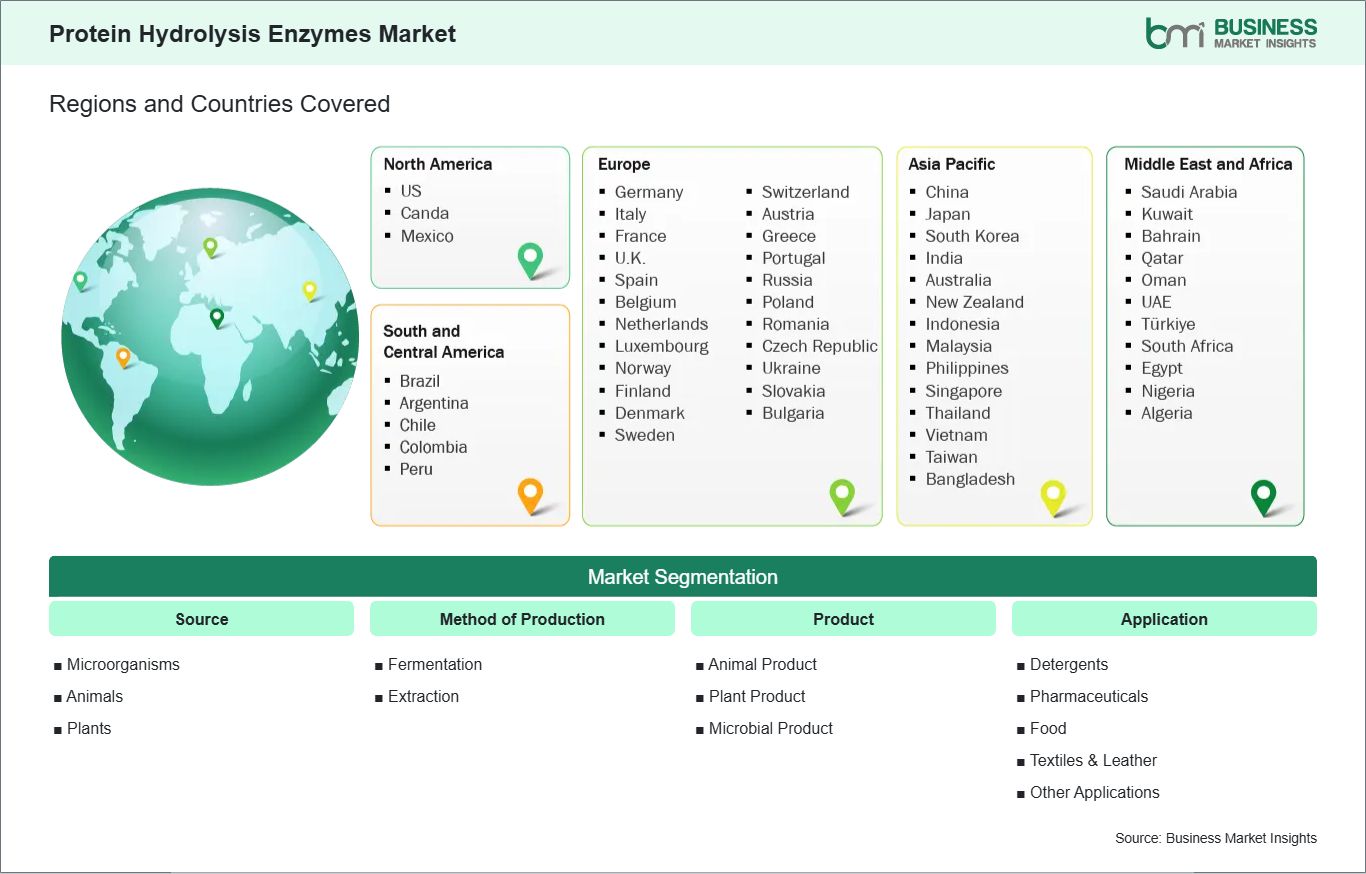
  • Source (Microorganisms, Animals, Plants)
  • Method of Production (Fermentation, Extraction)
  • Product (Animal Product, Plant Product, Microbial Product)
  • Application (Detergents, Pharmaceuticals, Food, Textiles & Leather, Other Applications)

No. of Pages: 421
Report Code: BMIPUB00034232
Category: Food and Beverages
Protein Hydrolysis Enzymes Market

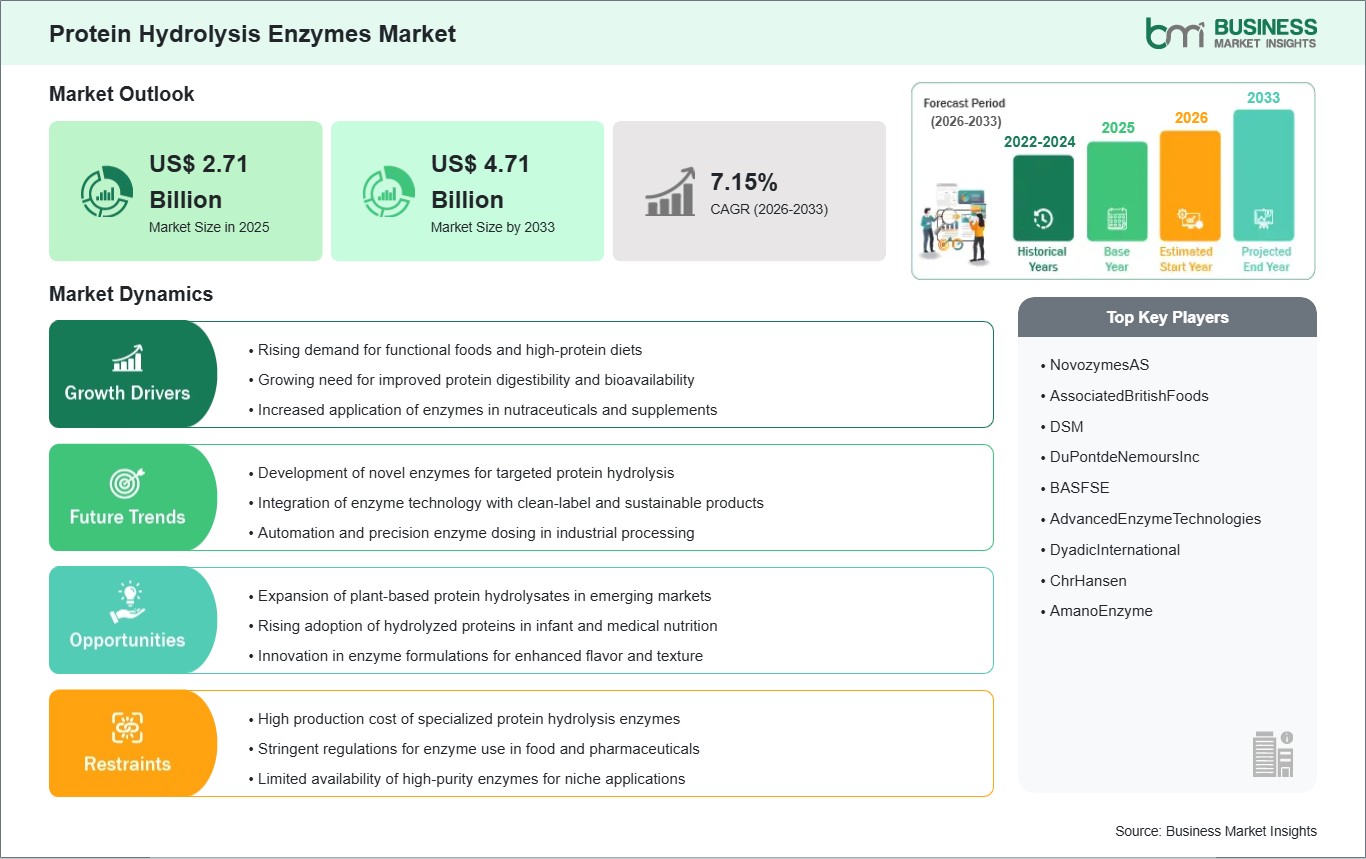
The Protein Hydrolysis Enzymes Market size is expected to reach US$ 4.71 billion by 2033 from US$ 2.71 billion in 2025. The market is estimated to record a CAGR of 7.15% from 2026 to 2033.

Executive Summary and Global Market Analysis:

The global protein hydrolysis enzymes market serves as an essential component for various industries because it allows them to manage protein breakdown into peptide and amino acid components. The enzymes that these industries utilize come from three different sources, which include microbial sources, plant sources and animal sources. The food and beverage industry uses protein hydrolysis enzymes to create hydrolysates, which provide products with better texture and umami flavor and essential nutrients for sports nutrition and infant formulae. Hydrolysis enzymes in animal feed help livestock to absorb nutrients better and use their feed more efficiently, which leads to better animal health and increased agricultural productivity.

The pharmaceutical and nutraceutical sectors use protein hydrolysis to create peptides, which scientists use in developing targeted drug delivery systems and dietary supplements that need specific molecular structures. High-protein products, which are simple to digest and free from common allergens, drive market growth because customers increasingly demand these products. Manufacturers now produce functional foods and beverages and dietary supplements that contain hydrolysates because consumers and aging adults seek products that enhance their metabolic health. The food processing industry requires protein hydrolysis because it helps create specialized ingredients that improve taste without adding excessive sodium or synthetic substances. The growing use of plant-based and insect protein alternatives has driven enzyme development because enzymes help create better products, which explains enzyme research to customers who want alternative proteins to conventional animal-based solutions. The market has various limitations that restrict its development.

The enzyme classification process becomes more complicated because it requires additional time to approve products and restricts regional development. Companies must spend money on compliance with different global regulatory rules, which require them to create documentation and conduct testing, which presents difficulties for small businesses and start-ups. The need to maintain specific enzyme types throughout production processes affects how companies set their prices and compete in the market.

The combination of ongoing biotechnology development with enzyme engineering progress creates new possibilities for businesses to create customized hydrolysis methods that satisfy changing market needs, showing how important biocatalysts are to global markets.

Protein Hydrolysis Enzymes Market - Strategic Insights:

global-market-strategic-framework
Get more information on this report

Protein Hydrolysis Enzymes Market Segmentation Analysis:

Key segments that contributed to the derivation of the protein hydrolysis enzymes market analysis are source, method of production, product, and application.

  • By source, the protein hydrolysis enzymes market is segmented into microorganisms, animals, plants. The microorganisms segment dominated the market in 2025.
  • Based on method of production, the protein hydrolysis enzymes market is categorized into fermentation, extraction. The fermentation segment dominated the market in 2025.
  • On the basis of product, the protein hydrolysis enzymes market is categorized into animal product, plant product, microbial product. The microbial product segment dominated the market in 2025.
  • In terms of application, the protein hydrolysis enzymes market is categorized into detergents, pharmaceuticals, food, textiles & leather, other applications. The pharmaceuticals segment dominated the market in 2025.

Protein Hydrolysis Enzymes Market Drivers and Opportunities:

Rising demand for functional foods and high-protein diets

The global protein hydrolysis enzymes market is experiencing significant expansion because more people are discovering functional foods and high-protein diets. Manufacturers of products for muscle health, weight control and total well-being have created protein hydrolysate-based solutions that people around the world demand. Protein hydrolysis enzymes function as essential tools that enable the breakdown of complex proteins into bioavailable peptides and amino acids while they improve digestibility and nutritional content without changing the product's flavor and texture.

The food and beverage industry extensively uses these enzymes to create specialized ingredients that manufacturers use in ready-to-drink protein shakes, fortified snacks and health bars. Enzymatic hydrolysis enables manufacturers to decrease allergenic proteins, which results in products that people with sensitivities or intolerances can safely use.

Protein hydrolysis enzymes now find increasing use in the processing of plant-based proteins from soy, pea and rice to decrease bitterness and enhance solubility. North America and Europe show increasing adoption of vegetarian and flexitarian diets because consumers in these regions value both health and sustainability. Enzyme adoption across global markets exists because functional foods and high-protein diets currently drive their development.

Expansion of plant-based protein hydrolysates in emerging markets

Emerging markets are presenting significant opportunities for the protein hydrolysis enzymes market, particularly in regions like Asia Pacific, Latin America, and parts of the Middle East. As consumer awareness of health, nutrition, and plant-based diets rises, manufacturers are increasingly incorporating plant protein hydrolysates into functional foods, beverages, and supplements. Enzymatic hydrolysis helps improve solubility, digestibility, and sensory characteristics, allowing these products to compete effectively with traditional animal protein-based offerings.

Countries like China, India, and Brazil are witnessing a surge in demand for high-protein snacks, meal replacements, and fortified beverages, which drives investment in local enzyme production and tailored formulations. Additionally, plant-based protein hydrolysates are gaining traction in infant nutrition, medical nutrition, and clinical dietary applications, where digestibility and hypoallergenic properties are crucial.

The expansion of plant-based protein hydrolysates also intersects with sustainability goals. Companies are leveraging enzymatic solutions to reduce waste, enhance yield, and create cost-effective plant-protein ingredients that meet both nutritional and environmental expectations. As emerging markets adopt healthier and sustainable food options, plant-based protein hydrolysates represent a dynamic opportunity for global enzyme producers.

Protein Hydrolysis Enzymes Market Size and Share Analysis:

The protein hydrolysis enzymes market demonstrates steady growth, with size and share analysis highlighting evolving trends and competitive dynamics among key players. The report examines subsegments categorized within source, method of production, product, and application, offering insights into their contribution to overall market performance.

By source, the microorganisms subsegment dominated the market in 2025, driven by their cost-effective production, high enzyme yield, and adaptability for various industrial applications.

Based on method of production, the fermentation subsegment dominated the market in 2025, driven by its ability to produce enzymes at large scale with consistent quality and efficiency.

On the basis of product, the microbial product subsegment dominated the market in 2025, driven by its versatility and widespread use across multiple industries requiring protein hydrolysis.

In terms of application, the pharmaceuticals subsegment dominated the market in 2025, driven by growing demand for high-purity enzymes in drug formulation and therapeutic applications.

Protein Hydrolysis Enzymes Market Report Highlights:

Report Attribute Details
Market size in 2025 US$ 2.71 Billion
Market Size by 2033 US$ 4.71 Billion
Global CAGR (2026 - 2033)7.15%
Historical Data 2022-2024
Forecast period 2026-2033
Segments Covered By Source
  • Microorganisms
  • Animals
  • Plants
By Method of Production
  • Fermentation
  • Extraction
By Product
  • Animal Product
  • Plant Product
  • Microbial Product
By Application
  • Detergents
  • Pharmaceuticals
  • Food
  • Textiles & Leather
  • Other Applications
Regions and Countries Covered
North America US, Canada, Mexico
Europe Belgium, Austria, Finland, Denmark, Greece, Poland, Romania, Russia, Ukraine, Czech Republic, Slovakia, Bulgaria, Italy, Luxembourg, Germany, Switzerland, France, Netherlands, Norway, Portugal, Spain, Sweden, United Kingdom
Asia-Pacific Australia, China, India, Japan, South Korea, Indonesia, Malaysia, Philippines, Singapore, Thailand, Vietnam, Bangladesh, New Zealand, Taiwan
South and Central America Brazil, Argentina, Peru, Chile, Colombia
Middle East and Africa Bahrain, Kuwait, Oman, Qatar, Saudi Arabia, United Arab Emirates, Turkiye, South Africa, Egypt, Algeria, Nigeria
Market leaders and key company profiles
  • NovozymesAS
  • AssociatedBritishFoods
  • DSM
  • DuPontdeNemoursInc
  • BASFSE
  • AdvancedEnzymeTechnologies
  • DyadicInternational
  • ChrHansen
  • AmanoEnzyme
Get more information on this report

Protein Hydrolysis Enzymes Market Report Coverage and Deliverables:

The "Protein Hydrolysis Enzymes Market Size and Forecast (2022 - 2033)" report provides a detailed analysis of the market covering below areas:

  • Protein Hydrolysis Enzymes Market size and forecast at global, regional, and country levels for all the key market segments covered under the scope
  • Protein Hydrolysis Enzymes Market trends, as well as drivers, restraints, and opportunities
  • Protein Hydrolysis Enzymes Market analysis covering key trends, global and regional framework, major players, regulations, and recent developments
  • Industry landscape and competition analysis covering market concentration, heat map analysis, prominent players, and recent developments for the Protein Hydrolysis Enzymes Market
  • Detailed company profiles, including SWOT analysis

Protein Hydrolysis Enzymes Market Geographic Insights:

The geographical scope of the Protein Hydrolysis Enzymes Market report is divided into North America, Asia Pacific, Europe, Middle East & Africa, and South & Central America. North America held the largest share in 2025.

North America leads the worldwide protein hydrolysis enzymes market because of its food processing and nutraceutical sectors, together with its extensive research and development facilities and its population health awareness drive market growth.

The United States and Canada maintain established markets that sell protein hydrolysates through functional foods, sports nutrition, medical nutrition and dietary supplements. Enzymatic hydrolysis enables regional manufacturers to develop animal and plant protein products that have better protein digestibility, lower allergen content and improved flavor. North American markets benefit from regulatory systems that protect consumers and their trust in enzyme products, which lead to the creation of new peptide products and valuable specialized materials.

European markets maintain a position as established markets because their strict food safety requirements and environmental sustainability objectives promote protein hydrolysis enzyme use in functional foods, nutraceuticals and specialty beverages. Germany, France and the U.K. lead in developing enzyme solutions that create clean-label products that contain fewer allergens and better digestive properties.

The Asia Pacific region functions as a rapidly expanding market because food processing and dairy and dietary supplement sectors continue to grow in China, India, Japan and South Korea. Local enzyme manufacturers now produce affordable hydrolysis products to satisfy various industrial requirements, which results from rising consumer health awareness and the growing middle-class demand for protein-enriched products that offer digestible and functional benefits.

The Middle East and Africa have established themselves as emerging market which requires food processing equipment, dietary supplements and animal nutrition products to meet growing demand, but infrastructure limitations and regulatory complexities make it difficult to establish these requirements.

The South and Central American region shows continuous development in protein hydrolysate usage within functional foods and beverages and animal feed across Brazil, Mexico and Argentina, which stems from their growing industrial and agricultural sectors. The market across all regions depends on sustainability, process optimization and product innovation, while North America maintains its position as the leading market for protein hydrolysis enzyme solutions through its industrial capabilities, regulatory framework and innovative ecosystem.

global-market-geography
Get more information on this report

Protein Hydrolysis Enzymes Market Research Report Guidance:

  • The report includes qualitative and quantitative data in the Protein Hydrolysis Enzymes Market across source, method of production, product, application and geography.
  • The report starts with the key takeaways (chapter 2), highlighting key trends and outlook of the Protein Hydrolysis Enzymes Market.
  • Chapter 3 focuses on the research methodology of the study.
  • Chapter 4 includes ecosystem analysis.
  • Chapter 5 highlights the major industry dynamics in the Protein Hydrolysis Enzymes Market, including factors that are driving the market, prevailing deterrents, potential opportunities, as well as future trends. Impact analysis of these drivers and restraints is also covered in this section.
  • Chapter 6 discusses the Protein Hydrolysis Enzymes Market scenario, in terms of historical market revenues, and forecast till the year 2033.
  • Chapters 7 to 11 cover Protein Hydrolysis Enzymes Market segments by source, method of production, product, application and geography across North America, Asia Pacific, Europe, Middle East & Africa, and South & Central America. They cover the market revenue forecast and factors driving the market.
  • Chapter 12 describes the competitive analysis along with the heat map analysis for the key players operating in the market.
  • Chapter 13 describes the industry landscape analysis. It provides detailed descriptions of business activities such as market initiatives, new developments, mergers, and joint ventures globally, along with a competitive landscape.
  • Chapter 14 provides detailed profiles of the major companies operating in the Protein Hydrolysis Enzymes Market. Companies have been profiled on the basis of their key facts, business descriptions, products, financial overview, SWOT analysis, and key developments.
  • Chapter 15, i.e., the appendix, is inclusive of a brief overview of the company, a list of abbreviations, and a disclaimer.

Protein Hydrolysis Enzymes Market News and Key Development:

The Protein Hydrolysis Enzymes Market is evaluated by gathering qualitative and quantitative data post primary and secondary research, which includes important corporate publications, association data, and databases. A few of the key developments in the protein hydrolysis enzymes market are:

  • In December 2023, Novozymes and Chr. Hansen announced that they completed their planned merger to form a new global biosolutions company named Novonesis, combining their enzyme and microbial technologies to better serve markets including food, beverage, and industrial applications. This strategic consolidation aims to strengthen innovation and global reach across enzyme solutions.
  • In June 2024, BASF announced that it sold its San Diego‑based bioenergy enzymes business, including the Spartec® enzyme product portfolio and related technologies, to Lallemand’s subsidiaries Danstar Ferment AG and Lallemand Specialties Inc., broadening Lallemand’s enzyme capabilities in fermentation and biofuel sectors. This divestment reflects shifts in enzyme business strategy for both companies.

Key Sources Referred:

  • World Health Organization (WHO)
  • Organisation for Economic Cooperation and Development (OECD)
  • The World Bank Group
  • Worldometer
  • The Lancet
  • International Bar Association
  • International Trade Administration
The List of Companies - Protein Hydrolysis Enzymes Market
  • NovozymesAS
  • AssociatedBritishFoods
  • DSM
  • DuPontdeNemoursInc
  • BASFSE
  • AdvancedEnzymeTechnologies
  • DyadicInternational
  • ChrHansen
  • AmanoEnzyme
Frequently Asked Questions
How big is the Protein Hydrolysis Enzymes Market?

The Protein Hydrolysis Enzymes Market is valued at US$ 2.71 Billion in 2025, it is projected to reach US$ 4.71 Billion by 2033.

What is the CAGR for Protein Hydrolysis Enzymes Market by (2026 - 2033)?

As per our report Protein Hydrolysis Enzymes Market, the market size is valued at US$ 2.71 Billion in 2025, projecting it to reach US$ 4.71 Billion by 2033. This translates to a CAGR of approximately 7.15% during the forecast period.

What segments are covered in this report?

The Protein Hydrolysis Enzymes Market report typically cover these key segments-

  • Source (Microorganisms, Animals, Plants)
  • Method of Production (Fermentation, Extraction)
  • Product (Animal Product, Plant Product, Microbial Product)
  • Application (Detergents, Pharmaceuticals, Food, Textiles & Leather, Other Applications)

What is the historic period, base year, and forecast period taken for Protein Hydrolysis Enzymes Market?

The historic period, base year, and forecast period can vary slightly depending on the specific market research report. However, for the Protein Hydrolysis Enzymes Market report:

  • Historic Period : 2022-2024
  • Base Year : 2025
  • Forecast Period : 2026-2033
  • Who are the major players in Protein Hydrolysis Enzymes Market?

    The Protein Hydrolysis Enzymes Market is populated by several key players, each contributing to its growth and innovation. Some of the major players include:

  • NovozymesAS
  • AssociatedBritishFoods
  • DSM
  • DuPontdeNemoursInc
  • BASFSE
  • AdvancedEnzymeTechnologies
  • DyadicInternational
  • ChrHansen
  • AmanoEnzyme
  • Who should buy this report?

    The Protein Hydrolysis Enzymes Market report is valuable for diverse stakeholders, including:

    • Investors: Provides insights for investment decisions pertaining to market growth, companies, or industry insights. Helps assess market attractiveness and potential returns.
    • Industry Players: Offers competitive intelligence, market sizing, and trend analysis to inform strategic planning, product development, and sales strategies.
    • Suppliers and Manufacturers: Helps understand market demand for components, materials, and services related to concerned industry.
    • Researchers and Consultants: Provides data and analysis for academic research, consulting projects, and market studies.
    • Financial Institutions: Helps assess risks and opportunities associated with financing or investing in the concerned market.

    Essentially, anyone involved in or considering involvement in the Protein Hydrolysis Enzymes Market value chain can benefit from the information contained in a comprehensive market report.

    Available Report Formats

    pdf-format excel-format pptx-format
    Buy Now
    Sales Assistance
    +1 646 791 7070 (US & UK)
    Customization Form

    Please tell us your area of interest
    (Market Segments/ Regions and Countries/ Companies)