
Bakery Enzymes Market Outlook: Size, Share, Trends, Growth Analysis, Competitive Landscape & Forecast, 2026-2033

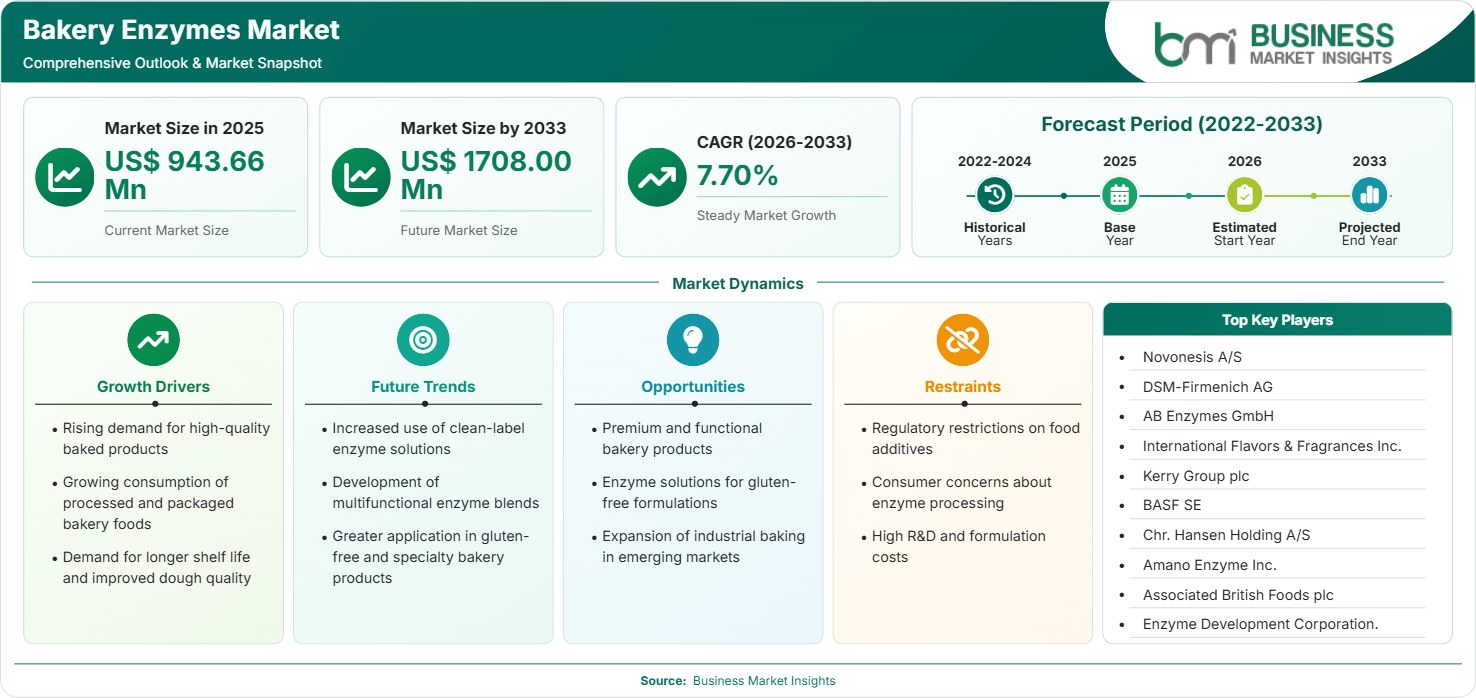
The Bakery Enzymes Market size was valued at US$ 943.66 Million in 2025 and is projected to reach US$ 1708.00 Million by 2033, growing at a CAGR of 7.70% during 2026–2033. Rising demand for clean-label bakery formulations, premium baked products, extended shelf life, enzyme-enabled process optimization, and innovation in microbial biotechnology continue creating attractive opportunities across industrial and artisan baking operations worldwide.

Report Coverage
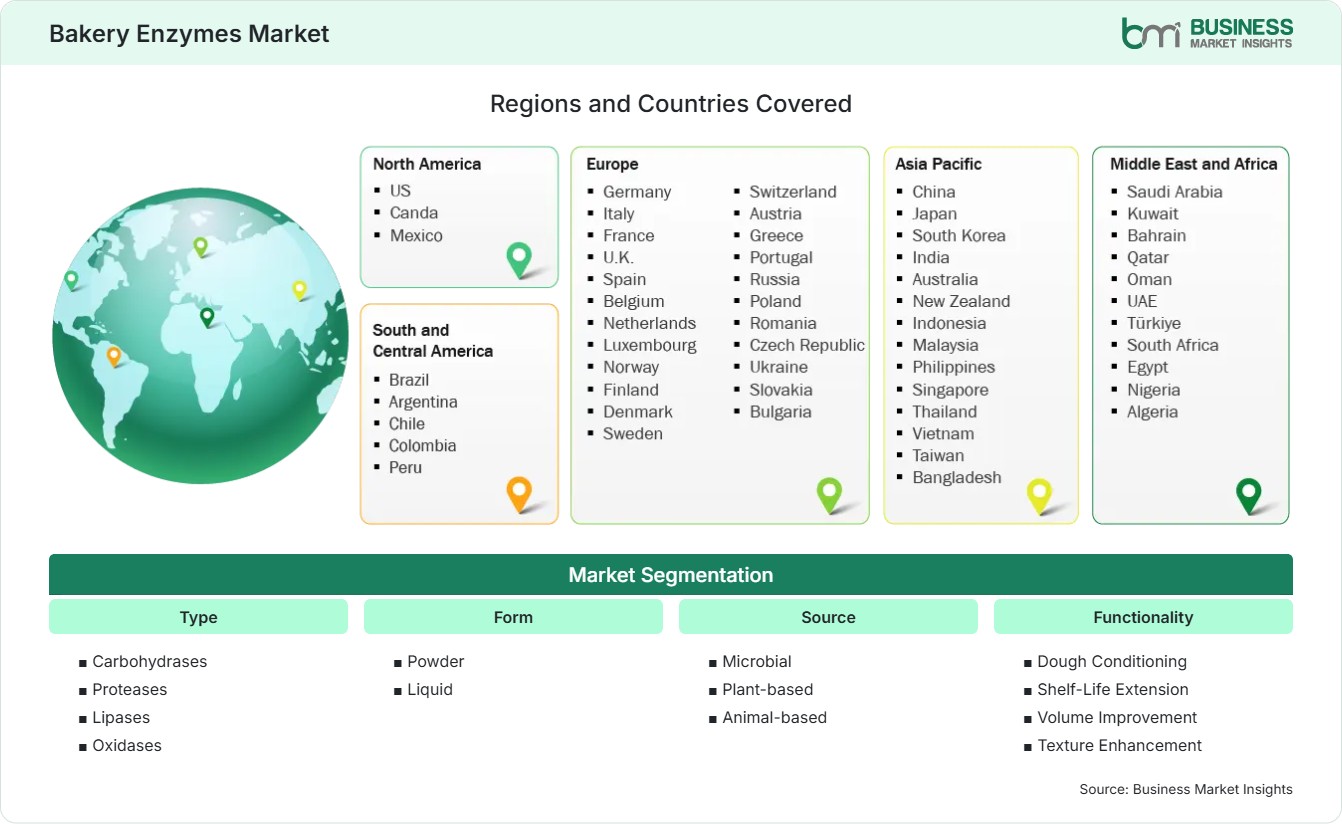
  • Type: Carbohydrases, Proteases, Lipases, Oxidases
  • Form: Powder, Liquid
  • Source: Microbial, Plant-based, Animal-based
  • Functionality: Dough Conditioning, Shelf-Life Extension, Volume Improvement, Texture Enhancement
  • Application: Bread, Cakes & Pastries, Biscuits & Cookies, Rolls & Buns
US$ 943.66 Mn Market size in 2025
US$ 1708.00 Mn Market Size by 2033
7.70% CAGR, 2026 - 2033
2026-2033 Forecast Period

AI Overview

Bakery Enzymes Market Summary

  • North America Region: North America holds 34%–37% market share in 2025, growing at a 6.8%–7.3% CAGR during 2026–2033, supported by commercial bakery automation, clean-label formulations, premium bread demand, enzyme innovation, sustainable processing, food waste reduction initiatives, and expanding frozen bakery production across retail and foodservice sectors. The U.S. market benefits from advanced enzyme adoption, large industrial bakeries, strong retail bakery demand, and is projected to expand at 6.9%–7.4% CAGR through 2033.
  • Fastest Growing Region: Asia Pacific accounts for 26%–29% market share in 2025 and is anticipated to register a 9.1%–9.8% CAGR during 2026–2033, driven by urbanization, westernized food preferences, bakery chain expansion, higher disposable income, food manufacturing investments, premium product launches, and accelerating industrial baking modernization throughout emerging economies.
  • Leading Segment: Carbohydrases represent 36%–39% market share in 2025 while advancing at a 7.4%–7.9% CAGR during 2026–2033, supported by improved dough machinability, enhanced loaf volume, extended freshness, optimized flour utilization, commercial baking efficiency, and increasing demand for consistent production quality across industrial facilities worldwide.
  • High Growth Segment: Microbial source enzymes account for 56%–60% market share in 2025 and are expected to grow at 8.4%–9.0% CAGR during 2026–2033, encouraged by scalable fermentation technologies, regulatory acceptance, clean-label compatibility, higher enzyme stability, sustainable production methods, and expanding commercial adoption across multiple bakery applications globally.
  • Key Market Opportunity: Growing investment in customized enzyme blends for gluten reduction, clean-label formulations, frozen dough stability, premium artisan products, sustainable manufacturing, and digital bakery processing platforms creates strong long-term commercial opportunities across global food industries.
  • Major Market Players: Novonesis A/S, DSM-Firmenich AG, AB Enzymes GmbH, International Flavors & Fragrances Inc., Kerry Group plc, BASF SE, Chr. Hansen Holding A/S, Amano Enzyme Inc., Associated British Foods plc, and Enzyme Development Corporation.
Strategic Insights

Bakery Enzymes Market: Strategic Insights

Bakery Enzymes Market Strategic Framework
FREE PDF
Request your free sample
Request free sample
Stakeholder View

Key Takeaways

  • Integration is increasing in the value chain as enzyme producers work together with flour millers, ingredient providers, bakery machinery providers, and industrial bakeries to achieve efficient and sustainable processing.
  • Industrial bakeries present great business prospects due to the need for good dough handling, extended shelf life, optimal ingredient use, and minimized production losses.
  • Innovation is geared towards multifunctional enzyme mixes which help in improving dough performance, texture, volume, freshness, and processing tolerance while allowing clean label formulation.
  • The Asia Pacific region presents an interesting market to invest in due to expansion of bakery retail driven by growing disposable incomes, urbanization, premium consumption, and food processing investments.
  • Companies are increasing investments in acquisitions, biotechnology partnerships, fermentation capacity, and regional technical centers to accelerate bakery enzyme innovation and commercialization.
  • Sustainability is a critical aspect in competition, with the enzyme technologies reducing energy usage and wastage, improving flour utilization, extending the shelf life, and making production environmentally friendly.
Geographic Outlook

Bakery Enzymes Market Regional Highlights

North America Bakery Enzymes Market

North America accounted for 34%–37% of global revenue in 2025 and is projected to expand at a 6.8%–7.3% CAGR through 2033. The region benefits from mature commercial bakery infrastructure, strong consumer demand for clean-label products, and continuous investment in food processing automation. The Bakery Enzymes Market share remains the highest globally due to extensive adoption by industrial bakeries seeking improved dough consistency, longer shelf life, and reduced production costs.

  • Large industrial bakeries are replacing traditional chemical improvers with enzyme-based solutions to improve consistency, simplify formulations, support sustainability, and produce premium bread.
  • Demand for preservative-free and clean-label bakery products is driving adoption of multifunctional enzymes that improve softness, freshness, and quality while maintaining cost efficiency.
  • Automation, digital quality monitoring, and precision ingredient dosing improve enzyme effectiveness, reduce waste, increase yields, and enhance bakery productivity.
  • Growing investment in frozen dough and ready-to-bake products is increasing demand for enzymes that improve dough stability, fermentation tolerance, and product quality during extended distribution.

US Bakery Enzymes Market

The United States represents 78%–82% of the North American Bakery Enzymes Market and is forecast to grow at a 6.9%–7.4% CAGR during 2026–2033. Large sales of packaged bakery products, efficient food processing technology, and continuous efforts to develop novel ingredients make this country a top revenue generator. Modern bakeries rely on enzymes in standard baking procedures. This ensures efficiency, quality and meets consumer expectations for natural bakery products.

  • National bakery manufacturers are investing in customized enzyme blends for artisan bread, premium loaves, and frozen bakery products requiring consistent quality and extended freshness.
  • Growing demand for healthier bakery products is driving enzyme-based formulations that reduce additives while maintaining texture, volume, and sensory quality.
  • Investment in biotechnology research and fermentation infrastructure is strengthening domestic production and accelerating innovative bakery ingredient development.
  • Expanding foodservice bakeries and convenience retail formats are creating steady demand for high-performance enzymes that improve production flexibility and consistency.

Europe Bakery Enzymes Market

Europe accounted for approximately 28%–31% of global revenue in 2025 and is anticipated to register a 6.9%–7.5% CAGR through 2033. The region maintains a strong position due to established bakery traditions, advanced biotechnology expertise, and rigorous food quality standards. Germany remains the leading regional market, while Poland demonstrates the fastest expansion with a projected CAGR of 8.0%–8.6%, supported by food processing investments and increasing packaged bakery consumption.

  • Strict ingredient transparency regulations are encouraging bakeries to replace synthetic dough improvers with naturally derived enzymes for clean-label products.
  • Germany benefits from strong industrial baking capacity, advanced ingredient manufacturing, and research collaboration supporting enzyme innovation.
  • Poland is modernizing its bakery sector through automation and organized retail expansion, increasing demand for advanced baking ingredients.
  • Rising demand for premium artisan and specialty breads is driving adoption of customized enzyme blends that improve texture, freshness, and consistency.

Asia Pacific Bakery Enzymes Market

Asia Pacific represented 26%–29% of worldwide revenue in 2025 and is expected to achieve the fastest regional expansion with a 9.1%–9.8% CAGR during 2026–2033. Rapid urbanization, changing dietary preferences, organized retail growth, and rising disposable incomes continue expanding commercial bakery production. China remains the largest regional market, while India records the highest growth trajectory with an estimated 10.2%–10.8% CAGR, supported by expanding food processing capacity and premium bakery consumption.

  • Large investments in commercial bakeries across China are increasing demand for enzymes that improve production efficiency, dough stability, and consistency.
  • India’s organized bakery sector is expanding through urban retail growth, rising premium bakery demand, and increased food manufacturing investment.
  • Global bakery ingredient suppliers are establishing technical centers across Asia Pacific to support localized enzyme development and customized formulations.
  • Growing consumption of convenience foods, frozen bakery products, and premium confectionery is driving enzyme adoption to improve quality and reduce processing costs.

Rest of World Bakery Enzymes Market

The Rest of World region accounted for 8%–11% of global revenue in 2025 and is forecast to expand at a 7.8%–8.5% CAGR through 2033. South & Central America benefit from expanding packaged bakery demand and modernization of commercial baking operations, while Middle East & Africa experience rising consumption driven by urbanization, tourism, and foodservice expansion. Brazil leads South & Central America, whereas Saudi Arabia demonstrates the fastest regional growth supported by food manufacturing diversification initiatives.

  • Brazil’s expanding packaged food industry and supermarket penetration are increasing enzyme use in industrial bread and pastry production.
  • Saudi Arabia’s food diversification initiatives and domestic bakery investments are driving adoption of advanced ingredients for premium bakery products.
  • Tourism, hospitality, and quick-service restaurant growth are increasing demand for standardized bakery products requiring consistent enzyme-supported production.
  • International ingredient suppliers are strengthening regional distribution and technical support to improve access to specialized bakery enzyme solutions.
Global Market Geography
FREE PDF
Request your free sample
Request free sample
Segment Analysis

Bakery Enzymes Market Segmentation

Type

The type segment remains a critical determinant of enzyme adoption, with Carbohydrases accounting for 36%–39% share in 2025 and expanding at a 7.4%–7.9% CAGR between 2026–2034. Enzyme choice is determined by the bakery formulation specifications, processing conditions, and intended product features. According to Bakery Enzymes Market trends, demand is growing for multifunctional enzymes that will contribute to improved dough quality, shelf life, and production efficiency.

  • Carbohydrases: Widely used to improve dough handling, fermentation, softness, and consistency in bread, rolls, and specialty bakery products.
  • Proteases: Help control gluten strength, improve machinability, and optimize texture in crackers, biscuits, and other bakery products.
  • Lipases: Improve crumb structure, flavor retention, and shelf stability while supporting cleaner-label formulations.
  • Oxidases: Strengthen dough and improve processing stability, making them valuable for industrial bakeries requiring consistent production.

Form

The form segment demonstrates strong commercial importance, with Powder formulations representing 62%–66% share in 2025 and growing at a 7.1%–7.6% CAGR between 2026–2034. Powder enzymes remain preferred due to storage stability, transportation advantages, and easier integration into large-scale bakery operations.

  • Powder: Powder enzymes are widely adopted by industrial bakeries because of longer shelf life, simplified handling, improved stability during storage, and compatibility with automated ingredient blending systems.
  • Liquid: Liquid enzyme formulations support precise dosing, faster incorporation, and reduced mixing requirements. They are increasingly preferred in advanced bakery facilities using automated production technologies.

Source

The source segment highlights increasing preference for sustainable biotechnology solutions, with Microbial enzymes accounting for 56%–60% Bakery Enzymes Market share in 2025 and achieving an 8.4%–9.0% CAGR between 2026–2034. Microbial production offers scalability, quality, and compatibility with clean-label needs. However, plant-based and animal-based ingredients continue to serve unique uses, although their availability and formulation options are limited.

  • Microbial: Microbial enzymes represent the most commercially scalable source due to controlled fermentation processes, consistent enzyme activity, regulatory acceptance, and suitability for high-volume bakery manufacturing.
  • Plant-based: Plant-derived enzymes attract demand from manufacturers focusing on natural ingredient positioning. They support specialty bakery applications but experience limitations in supply consistency and processing efficiency.
  • Animal-based: Animal-based enzymes maintain niche usage in selected bakery formulations. However, demand growth remains limited due to consumer preference shifts toward plant-derived and fermentation-based alternatives.

Functionality

The functionality segment reflects diverse bakery performance requirements, with Dough Conditioning accounting for 32%–35% Bakery Enzymes Market share in 2025 and progressing at a 7.3%–7.8% CAGR between 2026–2034. Enzymes that increase production efficiency, texture, freshness, and consistency are now gaining importance among manufacturers. Increasing industrial bakery applications will drive the demand for application-specific enzymes.

  • Dough Conditioning: Dough conditioning enzymes improve elasticity, machinability, fermentation tolerance, and production consistency, making them essential for large-scale bread and bakery manufacturing operations.
  • Shelf-Life Extension: Shelf-life extension solutions address food waste concerns by maintaining freshness and texture over longer distribution periods, supporting packaged bakery product growth.
  • Volume Improvement: Volume improvement enzymes enhance loaf expansion and product appearance, supporting premium bakery positioning and consumer expectations for high-quality baked goods.
  • Texture Enhancement: Texture enhancement enzymes improve crumb softness, mouthfeel, and sensory attributes, enabling manufacturers to differentiate products within competitive bakery categories.

Application

The application segment remains closely connected with changing consumer preferences and bakery innovation. Bread applications accounted for 38%–42% Bakery Enzymes Market share in 2025 and are estimated to grow at a 7.5%–8.0% CAGR between 2026–2034 due to widespread global consumption and extensive industrial production. Rising demand for premium bread varieties and packaged bakery products continues supporting enzyme adoption.

  • Bread: Bread manufacturers extensively utilize enzymes for improved volume, softness, freshness, and processing efficiency across white bread, whole grain, and specialty formulations.
  • Cakes & Pastries: Cakes and pastries increasingly incorporate enzymes to enhance texture, moisture retention, and quality consistency in premium bakery and foodservice applications.
  • Biscuits & Cookies: Biscuits and cookies utilize enzymes to optimize dough properties, improve texture, and maintain product stability during extended storage and distribution.
  • Rolls & Buns: Rolls and buns benefit from enzyme technologies that support softness, fermentation control, and consistent product quality across retail and restaurant supply chains.

End-Use

The end-use segment reflects diverse bakery production models, with Industrial Bakeries accounting for 58%–62% Bakery Enzymes Market share in 2025 and growing at a 7.6%–8.1% CAGR between 2026–2034. Large-scale producers increasingly depend on enzyme technologies to improve productivity, minimize waste, and maintain uniform product standards. Artisan bakeries and foodservice operators are adopting specialized solutions for premium product differentiation.

  • Industrial Bakeries: Industrial bakeries represent the largest consumption base due to high-volume production requirements, automation adoption, and demand for consistent product performance.
  • Artisan Bakeries: Artisan bakeries increasingly adopt selected enzyme solutions to improve quality control while preserving traditional baking characteristics and premium product positioning.
  • Foodservice: Foodservice operators utilize bakery enzymes to maintain consistency across distributed operations, improve product freshness, and support efficient preparation processes.
Market Forces

Bakery Enzymes Market Dynamics

Key Market Drivers

Rising Demand for Clean-Label Bakery Products

Consumer acceptance of naturally derived ingredients and clear product labeling are driving the use of enzymes in the bread-making industry. This market growth will be enabled due to the shift on the part of manufacturers from using artificial dough improvers to enzymes-based ones that offer the same or even better performance. The Bakery Enzymes Market trends demonstrate growing investment in microbial enzymes because they align with sustainability objectives, improve processing efficiency, and support regulatory compliance.

Expansion of Industrial Bakery Manufacturing

Industrial bakery expansion remains a major growth catalyst as manufacturers require technologies that enhance production efficiency and minimize operational variability. Large bakeries make use of enzymes in order to enhance the tolerance of the dough, control fermentation, maintain uniformity of texture, and increase the shelf life of the products. An increased demand for packaged breads, frozen dough, and ready-to-eat bakery products requires better ingredients technologies to be used.

Advancements in Enzyme Biotechnology

Continuous innovation in fermentation technology and enzyme engineering is improving performance characteristics of bakery enzymes. Modern advancements in biotechnology have allowed for the creation of highly specialized enzyme systems that exhibit improved stability and efficiency as well as flexibility of application. Research efforts aim to develop multifunctional systems that improve multiple quality parameters of bakery products, including texture, freshness, and dough workability.

Key Market Opportunities

Growth of Premium and Specialty Bakery Products

High-end bakery segments present numerous business prospects for enzymes producers since there is a trend towards the demand of high quality and healthy bakery products. There is a development of enzymes that provide improved texture, flavor stability, freshness, and improved aesthetics in specialty bakery products, pastries, and bakery items with functional value. Increased demand for high-end products in cities promotes custom enzyme formulation innovations.

Increasing Adoption in Emerging Markets

Emerging economies provide attractive expansion opportunities due to urbanization, changing dietary patterns, and growing organized bakery retail networks. Countries across Asia Pacific, Latin America, and the Middle East are witnessing increased investment in commercial bakery infrastructure. The Bakery Enzymes Market Forecasts indicate that rising bakery consumption in developing markets will encourage manufacturers to introduce advanced ingredient technologies supporting efficient production and improved product quality.

Sustainable Food Processing Solutions

Sustainable manufacturing provides opportunities in enzyme technologies that enable the reduction of waste, efficient use of resources, and sustainable production. Baking companies are now using enzymes to increase the shelf life of products, prevent loss of ingredients, and achieve efficient processes. Firms with technology solutions geared towards sustainable practices gain competitive advantage in the food industry.

Market Restraints and Challenges

High Development and Production Costs

Factor: Advanced enzyme research, fermentation optimization, and specialized production processes require significant investment in biotechnology infrastructure. Impact: High costs of development tend to make the products expensive, which makes them unaffordable by small and medium-scale bakeries with limited budgets. The manufacturers need to strike a balance between innovation and cost so that they can stay competitive in the market. However, high costs do not affect industrial-scale bakeries.

Regulatory Complexity Across Regions

Factor: Different regulatory frameworks governing food enzymes create compliance challenges for manufacturers operating across multiple international markets. Impact: Product commercialization can take longer due to lengthy approval processes, documentation requirements, and local requirements. It is critical for firms to have adequate knowledge of the relevant regulations.

Company Analysis

Competitive Landscape

The Bakery Enzymes Market analysis highlights a competitive environment shaped by biotechnology innovation, application-specific enzyme development, strategic partnerships, and global distribution capabilities. Leading companies are focusing on microbial enzyme technologies, customized formulations, and sustainable ingredient solutions to strengthen their positions across industrial baking applications.

Company Name

Overview

Products and Services relevant to this market

Novonesis A/S

Global biosolutions company specializing in enzyme and microbial technologies for food, agriculture, and industrial applications.

Bakery enzyme solutions for dough conditioning, freshness improvement, texture enhancement, and optimized baking processes.

DSM-Firmenich AG

Global nutrition, health, and bioscience company offering advanced ingredient solutions for food manufacturers.

Enzymes supporting bread quality, dough stability, shelf-life extension, and clean-label bakery formulations.

AB Enzymes GmbH

German biotechnology company focused on enzyme development for food and industrial applications.

Bakery enzymes designed for improved dough handling, volume enhancement, and consistent product performance.

International Flavors & Fragrances Inc.

U.S.-based ingredients company providing food, beverage, and specialty ingredient solutions worldwide.

Enzyme-based bakery ingredients supporting texture optimization, freshness, and functional food applications.

Kerry Group plc

Global taste and nutrition company serving food manufacturers with integrated ingredient solutions.

Bakery enzyme systems supporting improved texture, processing efficiency, and consumer-focused bakery innovation.

BASF SE

Multinational chemical and biotechnology company developing specialty ingredients and industrial solutions.

Enzyme technologies and functional ingredients supporting bakery processing performance and product quality.

Chr. Hansen Holding A/S

Biotechnology company specializing in microbial solutions and natural ingredient technologies.

Microbial-based enzyme solutions for bakery applications, fermentation support, and food quality improvement.

Amano Enzyme Inc.

Japanese enzyme manufacturer specializing in industrial and food enzyme applications.

Specialty bakery enzymes improving dough properties, texture, and manufacturing efficiency.

Associated British Foods plc

International food and retail group with ingredient manufacturing capabilities.

Baking ingredients and enzyme-related solutions through advanced food ingredient operations.

Enzyme Development Corporation

U.S.-based enzyme producer focused on customized enzyme solutions for food industries.

Food enzymes supporting bakery processing, dough modification, and functional ingredient applications.

Trust & Transparency

Research Methodology

The market analysis combines proprietary research with secondary data from government agencies, company disclosures, regulatory filings, industry databases and expert interviews. Market estimates are validated through data triangulation, cross-market benchmarking and analyst review.

View Full Research Methodology

Questions Answered

Frequently Asked Questions

What is the future outlook for bakery enzyme technologies?

Future development will focus on multifunctional enzyme blends, precision fermentation, sustainable production methods, and customized solutions designed for premium, functional, and clean-label bakery products.

How are emerging markets influencing bakery enzyme adoption?

Emerging markets are supporting adoption through urbanization, expanding bakery retail networks, rising packaged food consumption, and increased investment in modern food processing infrastructure.

Why are microbial enzymes preferred by bakery manufacturers?

Microbial enzymes offer scalable production, consistent activity, regulatory acceptance, and compatibility with sustainable manufacturing practices, making them suitable for large-volume bakery applications worldwide.

Which enzyme type holds the leading position in bakery applications?

Carbohydrases represent the leading enzyme category because they improve dough performance, and freshness across bread, rolls, and multiple industrial bakery products.

What factors are driving demand for bakery enzymes globally?

Demand is increasing due to clean-label preferences, industrial bakery expansion, automation adoption, improved shelf-life requirements, and growing demand for consistent texture, volume, and processing efficiency in commercial bakery production.

Access the Full Bakery Enzymes Market Report

Get segment-level forecasts, regional estimates, competitive benchmarking, company profiles and downloadable Excel datasets.

Access the full Bakery Enzymes Market Report
350 pages PDF & Excel | 2026-08-26