Alternative Protein Market Outlook (2022-2033)

Historic Data: 2022-2024   |   Base Year: 2025   |   Forecast Period: 2026-2033
Report Content: Market Scope, Market Segmentation, Market Dynamics, and Competitive Analysis

Report Coverage:
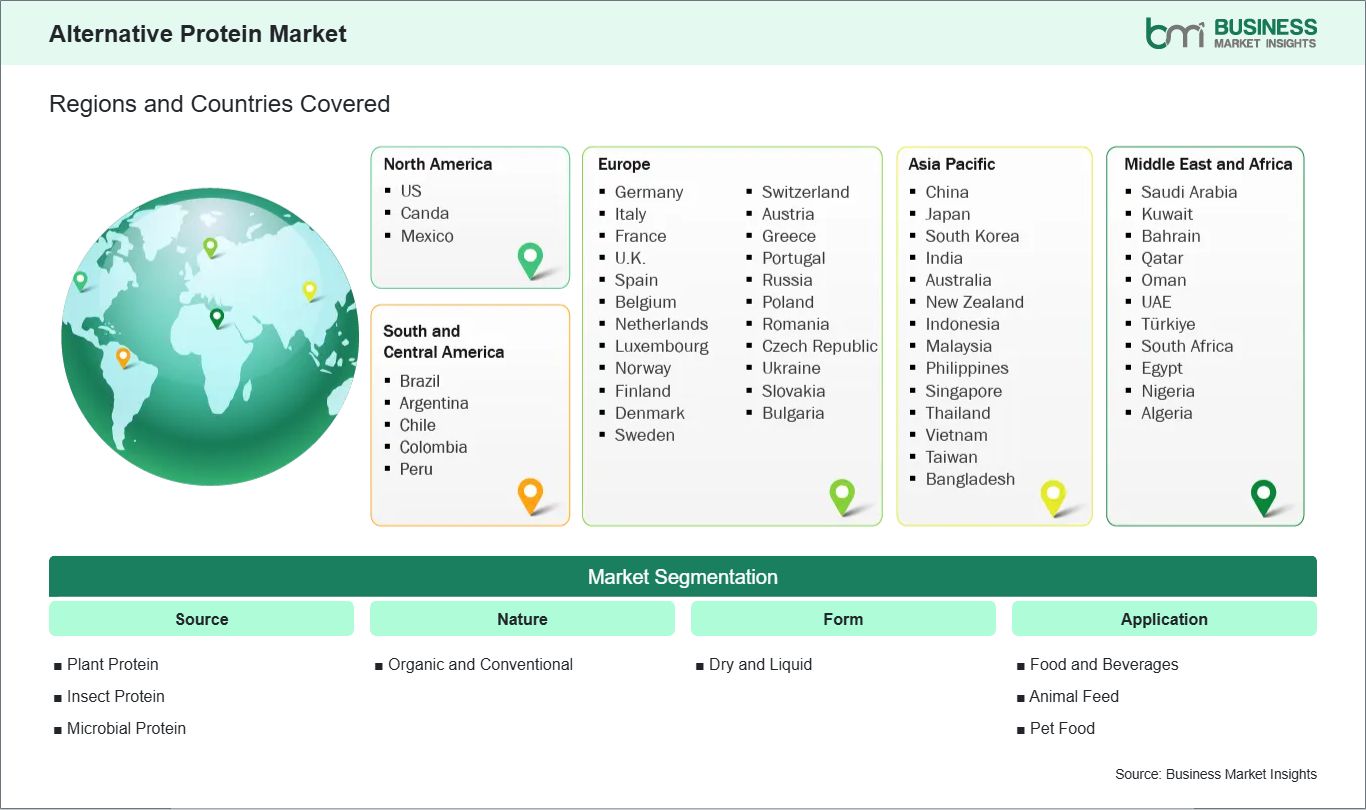
  • Source (Plant Protein, Insect Protein, and Microbial Protein)
  • Nature (Organic and Conventional)
  • Form (Dry and Liquid)
  • Application (Food and Beverages, Animal Feed, and Pet Food)

No. of Pages: 400
Report Code: BMIPUB00033408
Category: Food and Beverages
Alternative Protein Market
Buy Now

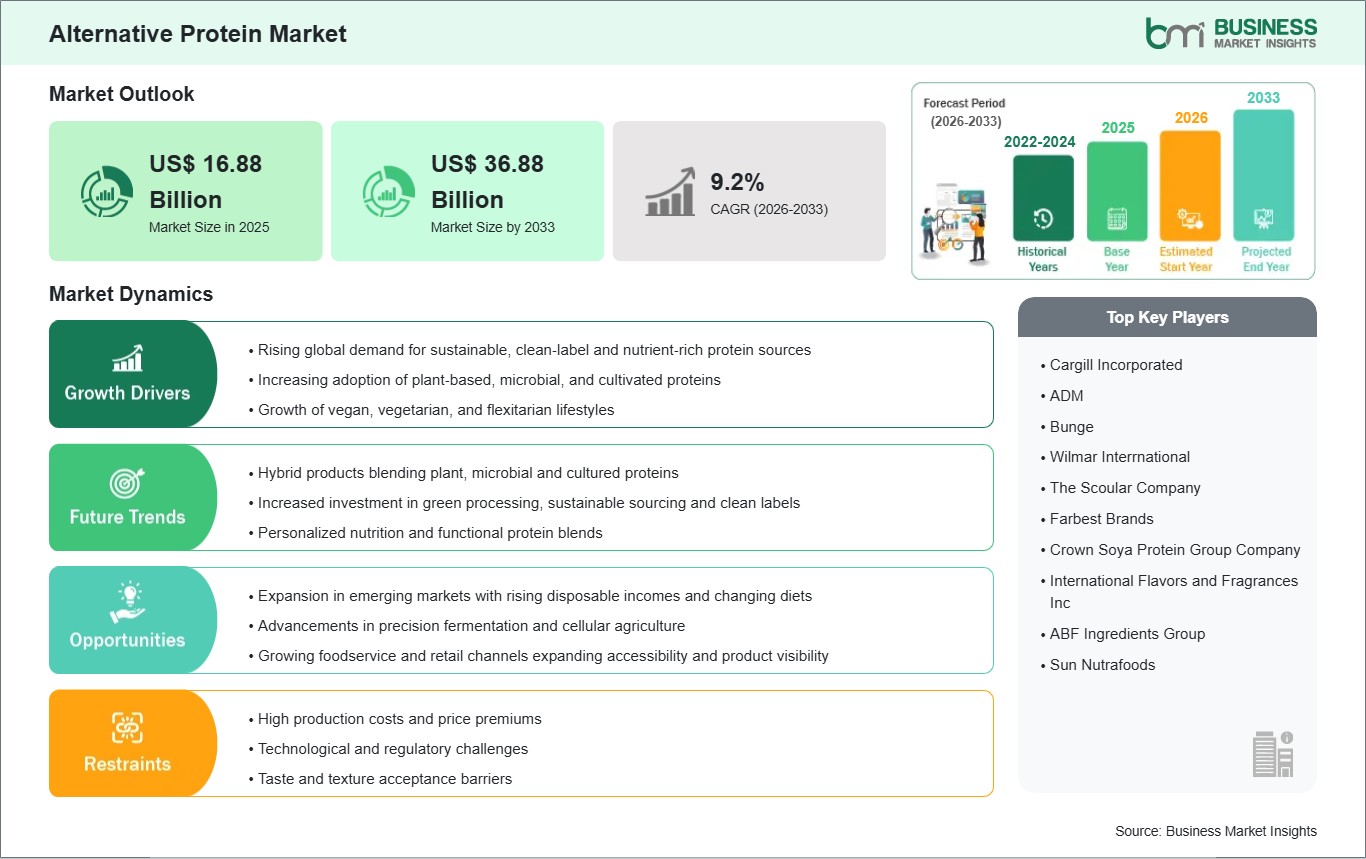
The alternative protein market size is expected to reach US$ 36.88 billion by 2033 from US$ 16.88 billion in 2025. The market is estimated to record a CAGR of 9.2% from 2026 to 2033.

Executive Summary and Global Market Analysis:

The alternative protein market is emerging as a vital part of the global food system. It focuses on sustainability, health, and food security. This market includes plant-based proteins, proteins from fermentation, and cultivated meat, providing alternatives to traditional animal-based products. Consumers are increasingly becoming aware of the environmental impact of livestock farming. This includes concerns regarding emissions, land use, and water use, which are driving adoption in both developed and emerging markets. At the same time, the growing demand for protein-rich diets, urbanization, and shifts in lifestyle are changing food consumption habits. Food manufacturers and fast-food restaurants are increasing their alternative protein options, making them more visible and accessible.

The market is evolving as the quality, taste, and texture of products improve owing to progress in food processing, biotechnology, and ingredient development. However, factors like cost, regulatory approval times, and different levels of consumer acceptance affect adoption rates. Investment from major food companies, venture capitalists, and public institutions is speeding up innovation and expanding capacity. In the medium to long term, greater efficiency, clearer regulations, and a wider variety of uses beyond meat substitutes—like dairy alternatives, functional ingredients, and hybrid products—are likely to enhance the role of alternative proteins in achieving global nutrition and sustainability goals.

Alternative Protein Market - Strategic Insights:

global-market-strategic-framework
Get more information on this report

Alternative Protein Market Segmentation Analysis:

Key segments that contributed to the derivation of the alternative protein market analysis are source, nature, form, and application.

  • By source, the market is segmented into plant protein, insect protein, and microbial protein. The plant protein segment accounted for the largest market share in 2025.
  • By nature, the market is bifurcated into organic and conventional. The conventional segment held a larger market share in 2025.
  • By form, the market is bifurcated into dry and liquid. The dry segment dominated the market in 2025.
  • By application, the market is segmented into food and beverages, animal feed, and pet food. The animal feed segment accounted for the largest market share in 2025.

Alternative Protein Market Drivers and Opportunities:

Sustainability and Resource Efficiency

A major factor driving the alternative protein market is the growing emphasis on sustainability and the efficient use of natural resources in food production. Traditional livestock farming has been linked to high greenhouse gas emissions, large land demands, and heavy water and energy use. As global awareness of environmental issues like climate change, deforestation, and water shortages increases, consumers, policymakers, and food manufacturers seek protein sources with a lower environmental impact.

Alternative proteins, including plant-based, microbial, and insect-derived options, are becoming viable solutions to help minimize the ecological footprint of food production. These protein sources need fewer natural resources, produce fewer emissions, and often promote more circular production systems. Moreover, changes in eating habits, such as the rise of flexitarian, vegetarian, and plant-based diets, are driving consumer demand for sustainable protein alternatives. Corporate sustainability efforts and government regulations that promote eco-friendly sourcing are also supporting this trend. Together, these elements are leading to consistent growth in the alternative protein market in both developed and emerging areas, creating lasting opportunities for companies focused on sustainable production.

Technological Advancements and Product Innovation

A significant growth opportunity in the alternative protein market comes from technology improvements and ongoing product innovation. These changes are boosting consumer acceptance. New methods in protein extraction, precision fermentation, and formulation are helping manufacturers enhance taste, nutritional quality, and other important properties of alternative protein products. These improvements tackle long-standing issues like taste, texture, and solubility, which have held back the adoption of these proteins compared to traditional animal sources.

In addition, new production technologies are lowering manufacturing costs, making alternative proteins more competitive and accessible to a broader range of consumers. Product innovation is also driving diversity in applications, including functional foods, beverages, dietary supplements, animal feed, and pet nutrition. This expansion into various markets allows companies to explore new revenue sources and strengthen their market presence. Furthermore, collaborations between food technology startups, research institutions, and established food manufacturers are speeding up the development of new protein solutions and encouraging growth through innovation. As technology continues to improve and production scales up, alternative proteins are set for wider use, supporting ongoing market growth in the years ahead.

Alternative Protein Market Size and Share Analysis:

The alternative protein market demonstrates steady growth, with size and share analysis revealing evolving trends and competitive positioning among key players. The report further examines subsegments categorized within source, nature, form, and application, offering insights into their contribution to overall market performance. By source, the plant protein subsegment dominates the market due to its wide availability, cost efficiency, and strong consumer acceptance in food, beverage, and animal nutrition applications. Plant proteins are widely used in meat alternatives, dairy substitutes, and nutritional products, which helps maintain their strong market position. Growth in this segment is driven by increasing health awareness, growing vegan and flexitarian populations, and improvements in plant-based protein extraction and processing technologies.

Alternative Protein Market Report Highlights:

Report Attribute Details
Market size in 2025 US$ 16.88 Billion
Market Size by 2033 US$ 36.88 Billion
Global CAGR (2026 - 2033)9.2%
Historical Data 2022-2024
Forecast period 2026-2033
Segments Covered By Source
  • Plant Protein
  • Insect Protein
  • Microbial Protein
By Nature
  • Organic and Conventional
By Form
  • Dry and Liquid
By Application
  • Food and Beverages
  • Animal Feed
  • Pet Food
Regions and Countries Covered North America
  • US
  • Canada
  • Mexico
Europe
  • Belgium
  • Austria
  • Finland
  • Denmark
  • Greece
  • Poland
  • Romania
  • Russia
  • Ukraine
  • Czech Republic
  • Slovakia
  • Bulgaria
  • Italy
  • Luxembourg
  • Germany
  • Switzerland
  • France
  • Netherlands
  • Norway
  • Portugal
  • Spain
  • Sweden
  • United Kingdom
Asia-Pacific
  • Australia
  • China
  • India
  • Japan
  • South Korea
  • Indonesia
  • Malaysia
  • Philippines
  • Singapore
  • Thailand
  • Vietnam
  • Bangladesh
  • New Zealand
  • Taiwan
South and Central America
  • Brazil
  • Argentina
  • Peru
  • Chile
  • Colombia
Middle East and Africa
  • Bahrain
  • Kuwait
  • Oman
  • Qatar
  • Saudi Arabia
  • United Arab Emirates
  • Turkiye
  • South Africa
  • Egypt
  • Algeria
  • Nigeria
Market leaders and key company profiles
  • Cargill Incorporated
  • ADM
  • Bunge
  • Wilmar Interrnational
  • The Scoular Company
  • Farbest Brands
  • Crown Soya Protein Group Company
  • International Flavors and Fragrances Inc
  • ABF Ingredients Group
  • Sun Nutrafoods
Get more information on this report

Alternative Protein Market Report Coverage and Deliverables:

The " Alternative Protein Market Size and Forecast (2022–2033)" report provides a detailed analysis of the market covering below areas:

  • Alternative protein market size and forecast at global, regional, and country levels for all the key market segments covered under the scope
  • Alternative protein market trends, as well as market dynamics such as drivers, restraints, and key opportunities
  • Alternative protein market analysis covering key market trends, global and regional framework, major players, regulations, and recent market developments
  • Industry landscape and competition analysis covering market concentration, heat map analysis, prominent players, and recent developments for the alternative protein market
  • Detailed company profiles, including SWOT analysis

Alternative Protein Market Geographic Insights:

The geographical scope of the alternative protein market report is divided into five regions: North America, Asia Pacific, Europe, the Middle East & Africa, and South & Central America. The alternative protein market in Asia Pacific is expected to grow significantly during the forecast period.

This growth is propelled by several factors, including a rising population, increased urbanization, and higher disposable incomes. These trends are driving demand for high-protein, convenient, and sustainable food options. Countries like China, India, and Japan are undergoing a noticeable change in dietary habits, with more consumers choosing plant-based, flexitarian, and health-focused diets. Additionally, greater awareness of environmental sustainability and food security is pushing both consumers and governments to favor alternative protein sources over traditional animal-based proteins.

The region is also experiencing a rapid rise in food technology startups and investments in research and development, especially in plant-based, microbial, and insect-derived protein products. This fosters innovation and scalability. Moreover, the growing middle-class population and increasing acceptance of packaged and processed foods create a strong market for alternative protein products across various applications, including food and beverages, animal feed, and pet nutrition. These factors position Asia Pacific as a key growth area for the alternative protein market in the coming years.

global-market-geography
Get more information on this report

Alternative Protein Market Research Report Guidance:

  • The report includes qualitative and quantitative data in the alternative protein market across source, nature, form, application, and geography.
  • The report starts with the key takeaways (chapter 2), highlighting the key trends and outlook of the alternative protein market.
  • Chapter 3 includes the research methodology of the study.
  • Chapter 4 further includes ecosystem analysis.
  • Chapter 5 highlights the major industry dynamics in the alternative protein market, including factors that are driving the market, prevailing deterrents, potential opportunities, as well as future trends. Impact analysis of these drivers and restraints is also covered in this section.
  • Chapter 6 discusses the alternative protein market scenario in terms of historical market revenues and forecast till the year 2033.
  • Chapters 7 to 10 cover the alternative protein market segments by source, nature, form, application, and geography across North America, Europe, Asia Pacific, the Middle East and Africa, and South and Central America. They cover the market revenue, forecast, and factors driving the market.
  • Chapter 11 describes the competitive analysis along with the heat map analysis for the key players operating in the market.
  • Chapter 12 describes the industry landscape analysis. It provides detailed descriptions of business activities such as market initiatives, new developments, mergers, and joint ventures globally, along with a competitive landscape.
  • Chapter 13 provides detailed profiles of the major companies operating in the alternative protein market. Companies have been profiled on the basis of their key facts, business descriptions, products and services, financial overview, SWOT analysis, and key developments.
  • Chapter 14, i.e., the appendix, is inclusive of a brief overview of the company, a list of abbreviations, and a disclaimer.

Alternative Protein Market News and Key Development:

The alternative protein market is evaluated by gathering qualitative and quantitative data post-primary and secondary research, which includes important corporate publications, association data, and databases. A few of the key developments in the alternative protein market are:

  • In June 2025, Austrian startup Revo Foods teamed up with Slovenian company Juicy Marbles to launch Kinda Cod, a 3D-printed plant-based fish fillet made from mycoprotein and high-throughput printing technology. The product debuted direct-to-consumer in the US, with plans to expand into the UK and EU. This move shows a growing effort to bring innovative plant-based seafood options to market.
  • In April 2025, Beyond Meat launched the Beyond Burger Jalapeño in the Netherlands. This spicy plant-based burger added variety to its European product lineup and became available in major retail outlets to cater to consumers looking for bold, sustainable alternatives to traditional meat burgers while boosting the company's presence in the region.

Key Sources Referred:

  • World Bank – Global Trade Indicators
  • World Trade Organization (WTO)
  • International Monetary Fund (IMF)
  • International Trade Administration (ITA)
  • Company Websites
  • Company Annual Reports
  • Company Investor Presentations
  • Good Food Institute (GFI)
  • Plant-Based Foods Association (PBFA)
  • Protein Innovation Center (PIC)
  • International Alliance for Alternative Proteins (IAAP)

The List of Companies - Alternative Protein Market

Frequently Asked Questions
How big is the Alternative Protein Market?

The Alternative Protein Market is valued at US$ 16.88 Billion in 2025, it is projected to reach US$ 36.88 Billion by 2033.

What is the CAGR for Alternative Protein Market by (2026 - 2033)?

As per our report Alternative Protein Market, the market size is valued at US$ 16.88 Billion in 2025, projecting it to reach US$ 36.88 Billion by 2033. This translates to a CAGR of approximately 9.2% during the forecast period.

What segments are covered in this report?

The Alternative Protein Market report typically cover these key segments-

  • Source (Plant Protein, Insect Protein, and Microbial Protein)
  • Nature (Organic and Conventional)
  • Form (Dry and Liquid)
  • Application (Food and Beverages, Animal Feed, and Pet Food)

What is the historic period, base year, and forecast period taken for Alternative Protein Market?

The historic period, base year, and forecast period can vary slightly depending on the specific market research report. However, for the Alternative Protein Market report:

  • Historic Period : 2022-2024
  • Base Year : 2025
  • Forecast Period : 2026-2033
  • Who are the major players in Alternative Protein Market?

    The Alternative Protein Market is populated by several key players, each contributing to its growth and innovation. Some of the major players include:

  • Cargill Incorporated
  • ADM
  • Bunge
  • Wilmar Interrnational
  • The Scoular Company
  • Farbest Brands
  • Crown Soya Protein Group Company
  • International Flavors and Fragrances Inc
  • ABF Ingredients Group
  • Sun Nutrafoods
  • Who should buy this report?

    The Alternative Protein Market report is valuable for diverse stakeholders, including:

    • Investors: Provides insights for investment decisions pertaining to market growth, companies, or industry insights. Helps assess market attractiveness and potential returns.
    • Industry Players: Offers competitive intelligence, market sizing, and trend analysis to inform strategic planning, product development, and sales strategies.
    • Suppliers and Manufacturers: Helps understand market demand for components, materials, and services related to concerned industry.
    • Researchers and Consultants: Provides data and analysis for academic research, consulting projects, and market studies.
    • Financial Institutions: Helps assess risks and opportunities associated with financing or investing in the concerned market.

    Essentially, anyone involved in or considering involvement in the Alternative Protein Market value chain can benefit from the information contained in a comprehensive market report.

    Available Report Formats

    pdf-format excel-format pptx-format
    Buy Now

    Customization Form

    Please tell us your area of interest
    (Market Segments/ Regions and Countries/ Companies)