
Product Life Cycle Management Market Outlook: Size, Share, Trends, Growth Analysis, Competitive Landscape & Forecast, 2026-2033

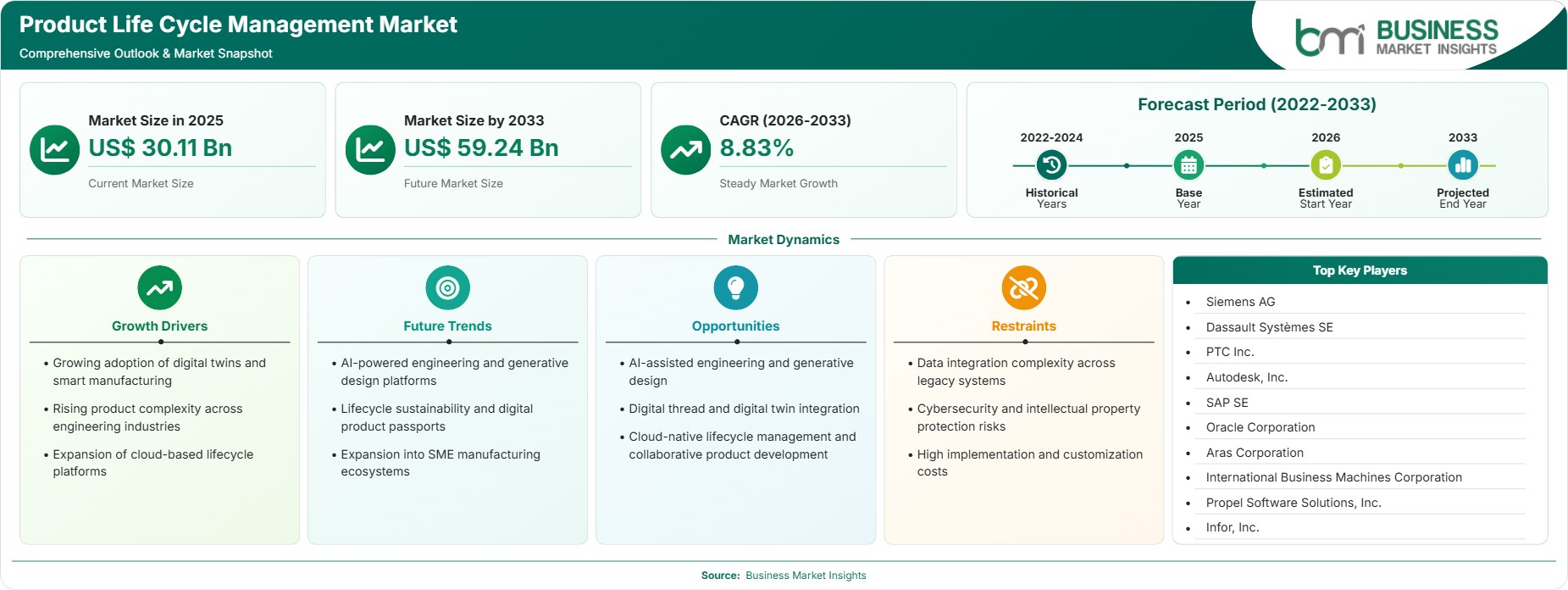
The Product Life Cycle Management Market size was valued at US$ 30.11 Billion in 2025 and is projected to reach US$ 59.24 Billion by 2033, growing at a CAGR of 8.83% during 2026–2033. Growth is supported by digital thread adoption, cloud deployment, digital twin integration, engineering collaboration requirements, compliance management needs, AI-enabled product development workflows, and increasing smart manufacturing investments globally.

Report Coverage
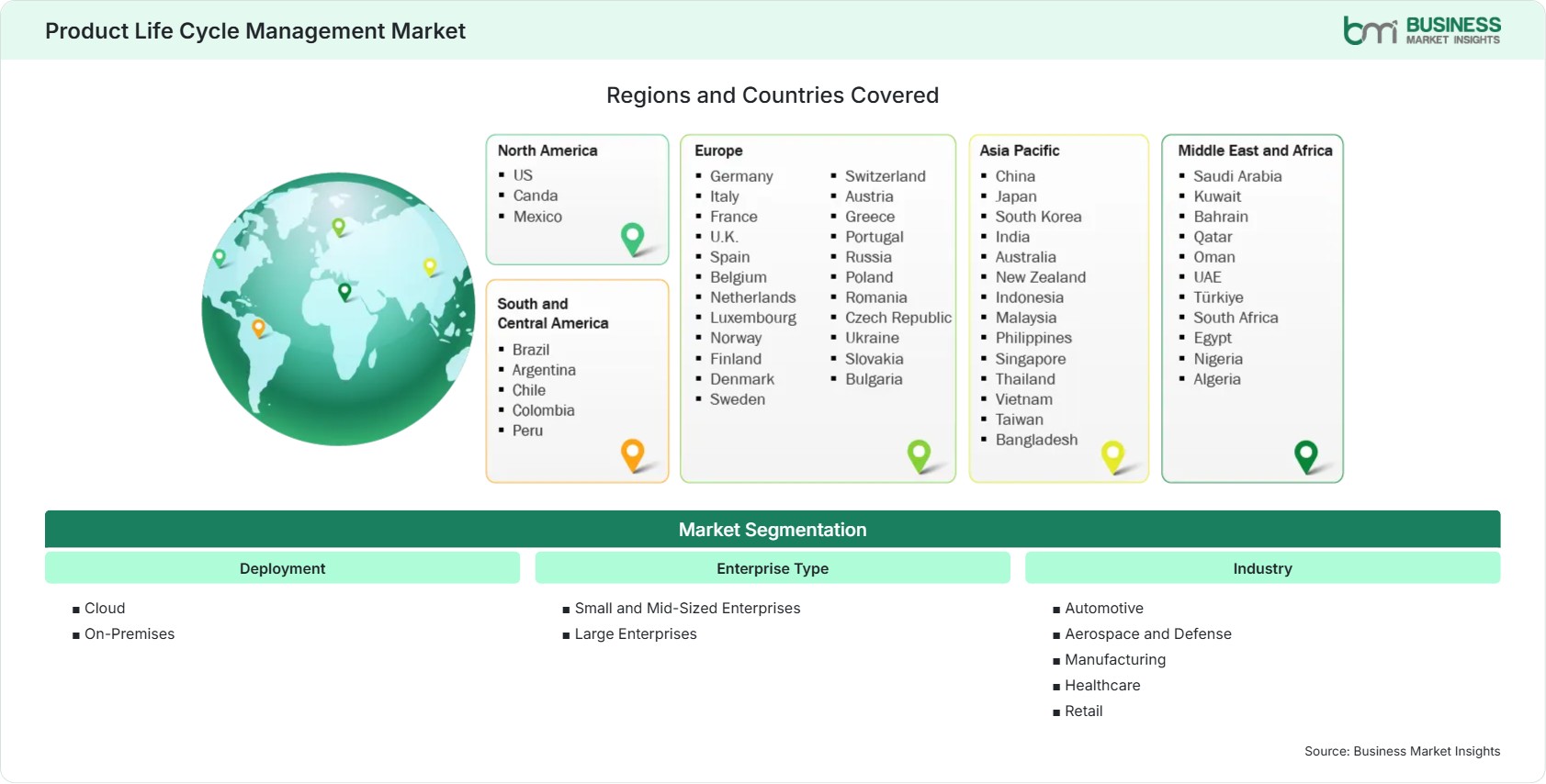
  • Deployment: Cloud, On-Premises
  • Enterprise Type: Small and Mid-Sized Enterprises, Large Enterprises
  • Industry: Automotive, Aerospace and Defense, Manufacturing, Healthcare, Retail
US$ 30.11 Bn Market size in 2025
US$ 59.24 Bn Market Size by 2033
8.83% CAGR, 2026 - 2033
2026-2033 Forecast Period

AI Overview

Product Life Cycle Management Market Summary

  • North America Region: North America holds a market share of 34%–37% in 2025, growing at a CAGR of 7.8%–8.4% during 2026–2033. Growth is supported by advanced manufacturing digitization, digital twin deployment, aerospace engineering modernization, cloud-based lifecycle platforms, supplier collaboration investments, compliance management requirements, and expanding AI-enabled product development ecosystems. US market remains dominant due to strong enterprise software adoption, manufacturing innovation, and estimated CAGR of 7.9%–8.5%.
  • Fastest Growing Region: Asia Pacific holds a market share of 27%–30% in 2025, growing at a CAGR of 10.2%–10.8% during 2026–2033. Growth is supported by industrial automation programs, electronics manufacturing expansion, rising cloud adoption, government digitalization initiatives, engineering software investments, smart factory deployment, and growing product innovation activity.
  • Leading Segment: Large Enterprises hold a market share of 63%–66% in 2025, growing at a CAGR of 8.3%–8.9% during 2026–2033. Adoption is driven by complex global supply chains, multi-site engineering operations, stringent compliance mandates, digital transformation spending, lifecycle visibility requirements, and enterprise-scale product portfolio management strategies.
  • High Growth Segment: Cloud holds a market share of 46%–49% in 2025, growing at a CAGR of 10.5%–11.2% during 2026–2033. Expansion reflects lower ownership costs, scalability advantages, remote collaboration requirements, subscription-based software models, rapid implementation timelines, AI integration capabilities, and enhanced supplier connectivity.
  • Key Market Opportunity: Manufacturers increasingly connect PLM platforms with industrial IoT, digital twins, sustainability reporting, and generative AI applications, creating opportunities for lifecycle intelligence, predictive engineering, cross-functional collaboration, and innovation acceleration.
  • Major Market Players: Siemens AG, Dassault Systèmes SE, PTC Inc., Autodesk, Inc., SAP SE, Oracle Corporation, Aras Corporation, International Business Machines Corporation, Propel Software Solutions, Inc., and Infor, Inc.
Strategic Insights

Product Life Cycle Management Market: Strategic Insights

Product Life Cycle Management Market Strategic Framework
FREE PDF
Request your free sample
Request free sample
Stakeholder View

Key Takeaways

  • The ecosystem is evolving toward unified digital thread architectures connecting design, simulation, manufacturing execution, quality, and service management across complex industrial value chains.
  • Cloud deployments and SME adoption present the strongest volume expansion opportunities as implementation barriers and infrastructure constraints continue declining.
  • AI-assisted engineering, generative design, and digital twin technologies are becoming central innovation priorities for leading software providers.
  • Asia Pacific offers the most compelling regional opportunity due to expanding manufacturing capacity, electronics production, and government-backed industrial digitalization programs.
  • Strategic acquisitions increasingly focus on simulation, analytics, sustainability, and cloud-native engineering capabilities, strengthening platform-based competition.
  • Demand for traceability and compliance management is widening adoption across healthcare, aerospace, and regulated manufacturing environments.
Geographic Outlook

Product Life Cycle Management Market Regional Highlights

North America Product Life Cycle Management Market

North America accounts for 34%–37% Product Life Cycle Management Market share in 2025 and is projected to register a CAGR of 7.8%–8.4% through 2033. Regional leadership stems from strong aerospace, automotive, industrial equipment, and software industries. Large enterprises continue investing in digital engineering environments that connect product design and manufacturing operations. Cloud migration, AI-enabled development tools, and increasing digital twin implementation support sustained adoption across engineering-intensive sectors.

  • Aerospace manufacturers emphasize lifecycle traceability, systems engineering, compliance documentation, and supplier collaboration across complex global programs.
  • Strong software ecosystems support integration between PLM, ERP, manufacturing execution, and quality management environments.
  • Digital twin investments enhance simulation accuracy and shorten product development cycles.
  • Enterprises continue replacing fragmented legacy systems with connected lifecycle environments.

US Product Life Cycle Management Market

The United States represents 74%–78% of North American revenue and is expected to expand at a CAGR of 7.9%–8.5%. Advanced manufacturing initiatives, defense modernization programs, and engineering software investments sustain market momentum. Product complexity in automotive electrification, aerospace, and medical technology supports demand for lifecycle management platforms capable of delivering traceability, security, and collaboration.

  • Defense contractors increasingly adopt digital engineering frameworks to improve program management efficiency.
  • Medical technology companies utilize lifecycle software to strengthen regulatory compliance and documentation.
  • Automotive manufacturers integrate lifecycle systems with connected vehicle development processes.
  • AI-enabled engineering workflows improve productivity across large product portfolios.

Europe Product Life Cycle Management Market

Europe holds 26%–29% share in 2025 and is projected to achieve a CAGR of 8.0%–8.7% through 2033. Germany remains the leading market due to its manufacturing base, while Eastern European economies demonstrate faster software adoption. Sustainability regulations and digital product passport initiatives are encouraging lifecycle data management investments across automotive and industrial sectors.

  • Germany leads regional revenue generation with strong automotive and industrial automation industries.
  • Poland and Czech Republic emerge as high-growth manufacturing digitization markets.
  • Sustainability compliance requirements increase demand for lifecycle transparency.
  • Aerospace innovation programs support advanced engineering platform adoption.
  • Cloud deployment accelerates among medium-sized manufacturers.

Asia Pacific Product Life Cycle Management Market

Asia Pacific holds 27%–30% share in 2025 while recording the highest CAGR of 10.2%–10.8% through 2033. China leads regional demand, supported by manufacturing expansion and industrial automation programs. India demonstrates rapid adoption across automotive, electronics, and industrial sectors. Increased investments in smart factories and engineering modernization continue accelerating platform deployment.

  • China remains the largest contributor due to extensive manufacturing and electronics production capacity.
  • India records among the region's fastest growth rates through digital manufacturing initiatives.
  • Japan maintains strong demand for advanced engineering and product innovation software.
  • Smart factory development supports integrated lifecycle management adoption.
  • Rising cloud acceptance expands accessibility among regional enterprises.

Rest of World Product Life Cycle Management Market

Rest of World accounts for 9%–11% share in 2025 and is expected to grow at a CAGR of 8.7%–9.4% through 2033. Brazil and Mexico lead Latin American adoption through automotive and industrial manufacturing investments.

Middle Eastern markets increasingly deploy digital engineering platforms to support industrial diversification. Saudi Arabia and the UAE demonstrate strong modernization activity influencing software adoption.

  • Brazil leads regional manufacturing digitization initiatives.
  • Mexico benefits from automotive supply chain integration and industrial investments.
  • Saudi Arabia advances industrial transformation under diversification strategies.
  • UAE enterprises accelerate adoption of cloud-based engineering technologies.
  • Infrastructure expansion supports long-term lifecycle platform deployment.
Global Market Geography
FREE PDF
Request your free sample
Request free sample
Segment Analysis

Product Life Cycle Management Market Segmentation

Deployment

Deployment generated significant demand as organizations balance security, cost, scalability, and collaboration objectives. The segment accounts for approximately 100% market coverage, with cloud solutions holding 46%–49% share and recording 10.5%–11.2% CAGR. Product Life Cycle Management Market scope continues expanding as enterprises prioritize connected digital operations.

  • Cloud: Increasing adoption reflects scalability, reduced infrastructure expenditure, simplified upgrades, remote engineering collaboration, AI integration capabilities, and support for distributed product development environments.
  • On-Premises: Preferred by highly regulated organizations requiring maximum control, customized deployment architectures, proprietary data management, and extensive integration across legacy engineering environments.

Enterprise Type

Enterprise type segmentation highlights stronger revenue concentration among large organizations. Large enterprises represent 63%–66% share and are expected to grow at 8.3%–8.9% CAGR, supported by global engineering operations, compliance requirements, and product portfolio complexity.

  • Small and Mid-Sized Enterprises (SMEs): Adoption expands through subscription-based deployment models, reduced implementation barriers, cloud accessibility, and increasing focus on product innovation and collaboration efficiencies.
  • Large Enterprises: Dominant users due to extensive product portfolios, regulatory obligations, complex supplier networks, and broader investment capacity for digital transformation initiatives.

Industry

Industry adoption remains strongest in manufacturing-intensive sectors requiring product traceability, engineering collaboration, and lifecycle visibility. Product Life Cycle Management Market trends indicate rising penetration across regulated industries and digitally transforming production environments.

  • Automotive: Electric vehicle programs, software-defined vehicles, component traceability, and supplier collaboration requirements drive strong platform demand.
  • Aerospace and Defense: Long development cycles, certification requirements, systems engineering complexity, and digital engineering programs sustain investment.
  • Manufacturing: Smart factory initiatives encourage lifecycle integration across design, production, quality, and service functions.
  • Healthcare: Regulatory compliance, product documentation, and design traceability improve adoption among medical device manufacturers.
  • Retail: Private-label product development, sourcing visibility, and sustainability tracking enhance lifecycle software utilization.
Market Forces

Product Life Cycle Management Market Dynamics

Key Market Drivers

Growing Adoption of Digital Twins and Smart Manufacturing

Digital twins are now commonly used by manufacturers in an effort to enhance the accuracy of their designs, cut down on costs associated with prototyping, and make production more efficient. Companies adopting Industry 4.0 solutions aim for holistic product data management systems that unite engineering and operations. The Product Life Cycle Management Market growth trajectory is strengthened by rising investments in connected factories and data-driven product innovation. Automotive, aerospace, and industrial equipment sectors continue expanding digital engineering programs, creating sustained demand for platforms capable of delivering unified lifecycle visibility and collaboration capabilities.

Rising Product Complexity Across Engineering Industries

Modern vehicles, aircraft, medical devices, and electronics increasingly combine software, electronics, and mechanical components. The need to coordinate the design revisions, compliance tracking, and collaborative activities with suppliers is necessitated by this complexity. Lifecycle software allows organizations to gain control of their development process while maintaining product integrity during commercialization stages. The growing regulatory pressure is another factor that drives the need for lifecycle governance frameworks. The product innovation cycles are continually getting shorter within all industries, driving the need for improved technology platforms.

Expansion of Cloud-Based Lifecycle Platforms

Cloud architectures improve accessibility, scalability, and deployment flexibility for organizations pursuing digital transformation strategies. The integration of design, simulation, manufacturing, and quality processes can be done in enterprises without huge infrastructural costs. Subscription models help to promote these solutions in mid-size companies and also help them collaborate internationally. Better access to product data by different stakeholders makes decision-making and innovation more efficient. With the integration of analytics, AI, and workflow automation into cloud platforms by software vendors, adoption is rising.

Key Market Opportunities

AI-Powered Engineering and Generative Design Platforms

Engineers will benefit from the ability of artificial intelligence to revolutionize engineering work by providing automated design suggestions, simulation optimizations, and predictions about the lifecycle of the products. Companies that implement artificial intelligence in their lifecycle platforms can improve their efficiency in the development of their products as well as the commercialization of these products. Product Life Cycle Management Market Forecasts indicate expanding enterprise budgets for AI-enabled engineering solutions. Opportunities extend across aerospace, automotive, industrial manufacturing, and healthcare sectors, where complex product development environments create strong demand for data-driven innovation and decision support capabilities.

Lifecycle Sustainability and Digital Product Passports

Environmental regulations and sustainability reporting requirements encourage organizations to improve lifecycle transparency. Solution providers need to offer solutions that will be able to track materials, emissions, recyclability, and compliance data throughout the value chain. Some markets are already offering digital product passport programs that would enable investments in the structured product data management system. Sustainability analysis and compliance automation software providers will be able to create an edge in their competition.

Expansion into SME Manufacturing Ecosystems

Small and mid-sized manufacturers represent a significant underserved opportunity. Implementation of cloud-based applications minimizes the complexity and cost involved in the implementation process. This helps to make sophisticated engineering platforms available to more companies. Digital tools have become essential in SMEs in their efforts to innovate products, collaborate with suppliers, and manage quality. Pricing of software using subscriptions makes it possible for software vendors to enlarge their customer base and generate revenue continuously.

Market Restraints and Challenges

Data Integration Complexity Across Legacy Systems

Factor: Many organizations operate fragmented engineering, ERP, quality, and manufacturing software environments developed over decades. Impact: Integration challenges lead to higher costs, longer schedules, and lower achievement of anticipated benefits. It is quite challenging for companies to consolidate information on products and standardize processes within their international operations. Increased customization needs raise the level of risk and investment needed. Even though the initiative holds much strategic significance, its implementation remains a significant barrier due to its complexity.

Cybersecurity and Intellectual Property Protection Risks

Factor: Lifecycle platforms store sensitive product designs, engineering specifications, supplier information, and proprietary research data. Impact: The issues surrounding security could hinder the uptake of the software and increase costs of compliance. The companies that operate in the defense industry, the aerospace sector, the healthcare industry, and the manufacturing industries are those that have the most rigorous data protection needs. Cloud uptake increases the need for governance with respect to access control and cyber resilience.

Company Analysis

Competitive Landscape

Product Life Cycle Management Market analysis indicates competition is centered on digital thread capabilities, cloud innovation, simulation integration, and industry-specific lifecycle functionality.

Company Name

Overview

Products and Services relevant to this market

Siemens AG

Global industrial software leader serving manufacturing, automotive, aerospace, and industrial enterprises with advanced lifecycle solutions.

Teamcenter, Teamcenter X, digital twin software, engineering collaboration, product data management, lifecycle analytics.

Dassault Systèmes SE

Major provider of 3DEXPERIENCE-based engineering and lifecycle platforms supporting complex product development.

ENOVIA, 3DEXPERIENCE platform, collaboration tools, digital continuity, simulation integration capabilities.

PTC Inc.

Strong presence in digital engineering and connected product development environments.

Windchill, Arena PLM, digital thread, software lifecycle integration, product data management.

Autodesk, Inc.

Engineering software provider expanding cloud-based product development solutions.

Fusion lifecycle solutions, cloud collaboration tools, product information management capabilities.

SAP SE

Enterprise software company integrating product lifecycle processes with business operations.

SAP PLM solutions, enterprise integration, compliance management, product governance functionality.

Oracle Corporation

Provider of enterprise lifecycle and product innovation management technologies.

Oracle Agile PLM, product governance, product data management, process optimization tools.

Aras Corporation

Specialist vendor known for flexible and extensible lifecycle platforms.

Aras Innovator, digital thread tools, engineering change management, collaboration solutions.

International Business Machines Corporation

Enterprise technology provider supporting lifecycle data, analytics, and AI initiatives.

Engineering lifecycle management, AI integration, requirements management, systems engineering tools.

Propel Software Solutions, Inc.

Cloud-native lifecycle specialist focused on modern product organizations.

Propel PLM platform, quality management, product management, supplier collaboration capabilities.

Infor, Inc.

Enterprise software company serving manufacturing-intensive sectors globally.

Product lifecycle management tools, manufacturing integration, compliance workflows, product data management.

Trust & Transparency

Research Methodology

The market analysis combines proprietary research with secondary data from government agencies, company disclosures, regulatory filings, industry databases and expert interviews. Market estimates are validated through data triangulation, cross-market benchmarking and analyst review.

View Full Research Methodology

Questions Answered

Frequently Asked Questions

What does a Product Life Cycle Management Market Report typically evaluate?

A Product Life Cycle Management Market Report generally assesses market size, technology trends, competition, deployment models, end-use industries, regional opportunities, and long-term growth dynamics.

How do digital twins support lifecycle initiatives?

Digital twins provide virtual representations of products and systems, helping organizations simulate performance, reduce prototyping costs, and improve operational decision-making.

What role does AI play in lifecycle management software?

AI supports design optimization, predictive analytics, engineering automation, data discovery, workflow recommendations, and improved product development productivity across the lifecycle.

Why are cloud deployments gaining importance?

Cloud deployments reduce infrastructure costs, improve scalability, enable remote collaboration, simplify updates, and accelerate implementation compared with traditional software architectures.

Which industries generate the highest demand for lifecycle management platforms?

Automotive, aerospace and defense, industrial manufacturing, healthcare devices, and electronics industries generate the strongest demand because of product complexity, compliance requirements, and the need for engineering collaboration.

Access the Full Product Life Cycle Management Market Report

Get segment-level forecasts, regional estimates, competitive benchmarking, company profiles and downloadable Excel datasets.

Access the full Product Life Cycle Management Market Report
350 pages PDF & Excel | 2026-08-31