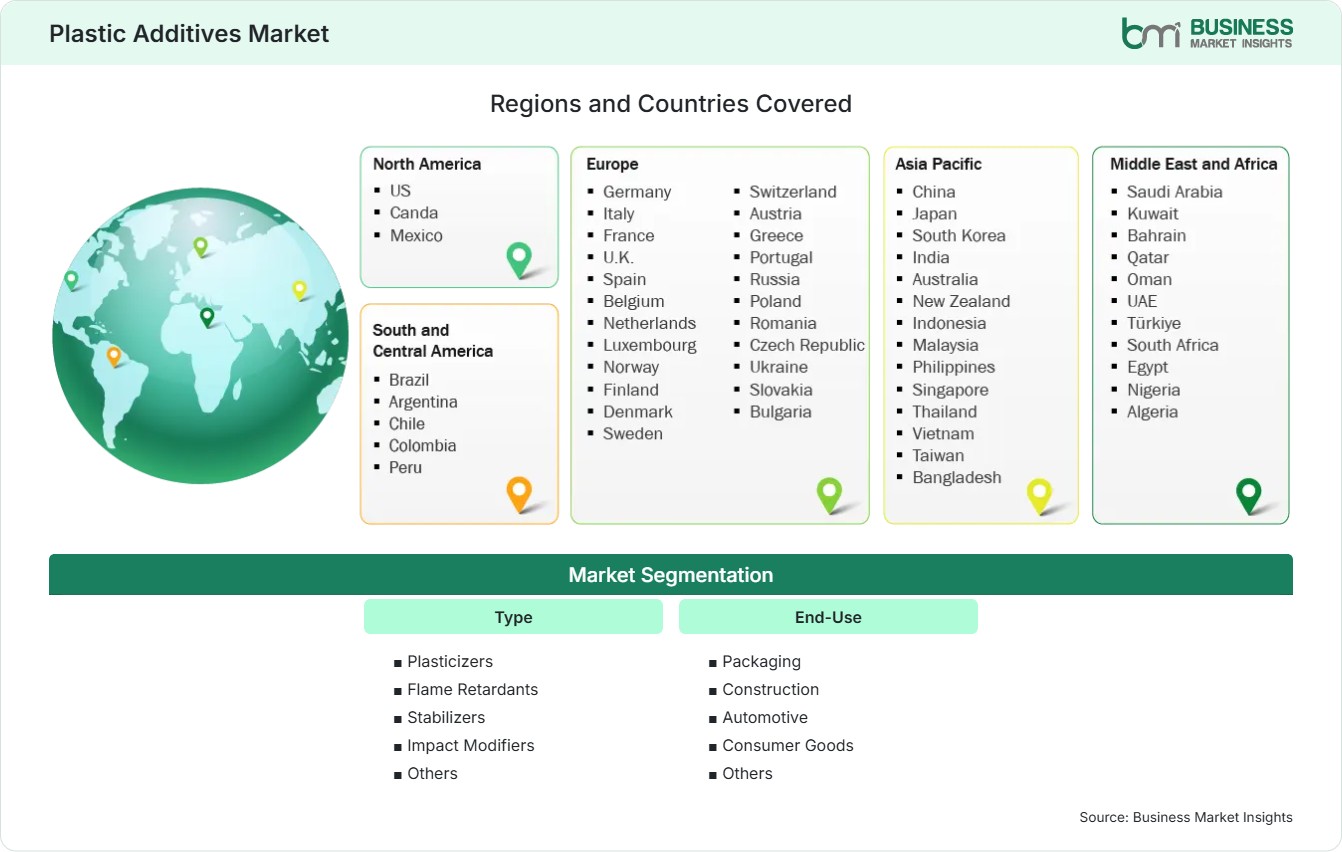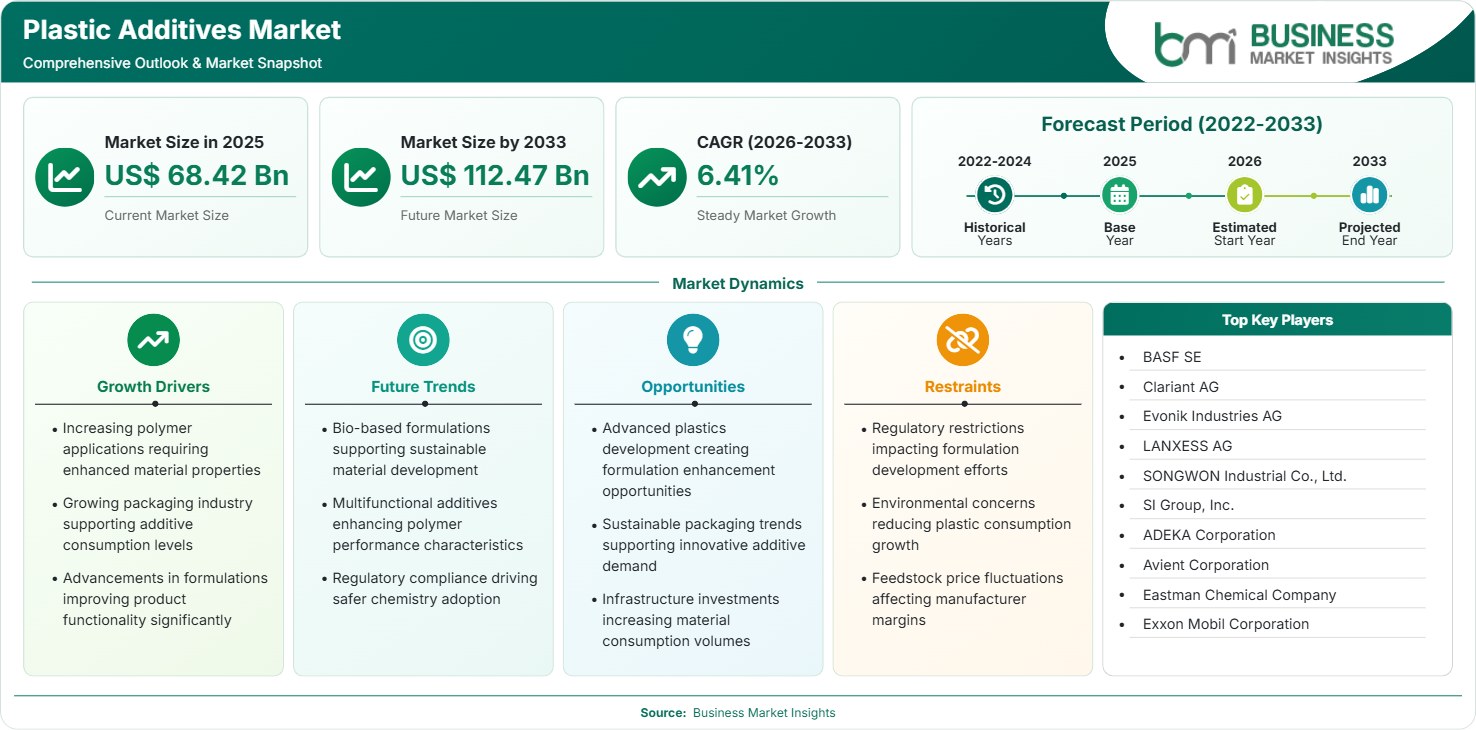
Plastic Additives Market Regional Highlights
North America Plastic Additives Market
North America represented 25%–28% of global Plastic Additives Market revenue in 2025 and is projected to expand at a 5.9%–6.3% CAGR through 2033. The region benefits from established polymer production, sophisticated compounding, packaging conversion, automotive applications, construction demand, and advanced recycling infrastructure. The US accounts for 70%–74% of regional revenue and is supported by domestic manufacturing, engineering plastics, flexible packaging, and electric-vehicle applications. Suppliers increasingly prioritize high-performance stabilizers and regulatory-compliant formulations as converters seek longer product life and improved recycled-content performance.
- Advanced recycling initiatives are increasing demand for stabilization packages that compensate for thermal and oxidative degradation during repeated processing cycles. BASF and SONGWON both market solutions specifically addressing recycled-polymer performance.
- Automotive applications continue favoring impact modifiers, flame retardants, UV stabilizers, and antioxidants as manufacturers reduce component weight while retaining dimensional stability and surface quality.
- Packaging converters are seeking additive combinations that improve film processing, clarity, oxidation resistance, and service life without compromising food-contact or recycling requirements.
- Construction demand supports durable formulations for pipes, profiles, insulation, flooring, sealants, and wire and cable systems exposed to heat, moisture, and sunlight.
US Plastic Additives Market
The US accounted for 70%–74% of North American revenue in 2025 and is projected to register a 6.0%–6.4% CAGR through 2033. Domestic demand reflects extensive plastics conversion across packaging, automotive, construction, consumer products, and electrical applications. Producers also benefit from sophisticated formulation capabilities and strong relationships with compounders and OEMs. Higher-performance additive systems are gaining relevance as manufacturers address durability, recycled-content integration, flame resistance, and material efficiency requirements across demanding applications.
- US demand increasingly favors additive systems capable of maintaining polymer performance after mechanical recycling, particularly in polypropylene and polyethylene applications.
- Electric-vehicle production supports demand for flame-retardant, thermally stable, lightweight engineering-plastic formulations used in electrical and structural components.
- Packaging manufacturers are prioritizing lower-migration formulations and stabilizer systems compatible with regulatory requirements and recycled-resin integration.
Europe Plastic Additives Market
Europe represented 21%–24% of global revenue in 2025 and is forecast to grow at a 5.7%–6.1% CAGR through 2033 in the Plastic Additives Market. Germany remains the leading country, while Spain and Italy provide comparatively strong growth opportunities through automotive, construction, packaging, and industrial conversion. Regulatory requirements increasingly influence product selection, encouraging low-migration plasticizers, non-halogenated flame retardants, and additives that improve recycled-polymer quality. European producers also compete through formulation expertise, technical service, specialty chemistry, and sustainability-oriented product development.
- Germany benefits from a broad automotive and industrial manufacturing base requiring stabilizers, impact modifiers, flame retardants, and specialty additive packages.
- Spain is supported by packaging conversion, construction activity, and expanding automotive supply-chain requirements, creating demand for durable and process-efficient polymer formulations.
- Italy's plastics-processing ecosystem supports specialty additives for packaging, consumer goods, construction components, and flexible PVC applications.
- European regulatory pressure accelerates substitution toward lower-migration and environmentally preferable chemistries, increasing demand for differentiated additive technologies.
Asia Pacific Plastic Additives Market
The Asia Pacific region is estimated to hold 39%- 42% market share in 2025 and is anticipated to grow at a 7.0%–7.5% CAGR from 2026 to 2033, making it the fastest-growing region in the Plastic Additives Market. China continues to dominate, while India and Southeast Asian nations have significant growth potential through increased manufacturing, packaging, infrastructure development, and vehicle production. The capacity and requirements of advanced polymers are being met by the increased production capacity of specialty additives.
- China maintains a large addressable base across packaging, automotive, electronics, construction, and consumer goods, supporting broad demand for additive formulations across commodity and engineering plastics.
- India is attracting localized production and supply-chain investment as automotive, packaging, infrastructure, and consumer-goods manufacturing expand. BASF localized specialty engineering-plastic supply in India in 2025.
- Southeast Asia benefits from manufacturing diversification, especially in packaging, electronics, automotive components, and consumer products requiring stable polymer processing.
- Japanese and Korean producers continue emphasizing high-performance stabilization, flame retardancy, transparency, and specialty formulations for sophisticated polymer applications.
Rest of World Plastic Additives Market
South and Central America Plastics Additives Market made up some of the Rest of the World share, at 10%–13% in 2025, with regional demand driven by the packaging, agriculture, construction, automotive parts, and consumer goods industries. Brazil remains the major market, while Mexico is an essential manufacturing hub linked to North American supply chains. Middle Eastern & African countries drive additional demand across construction, packaging, infrastructure, and industrial sectors, with certain Gulf countries benefiting from petrochemicals and polymer processing.
- Brazil's packaging and agricultural-film industries create demand for UV stabilizers, antioxidants, impact modifiers, and processing aids suited to demanding outdoor conditions.
- Mexico's automotive and industrial manufacturing base supports specialty additives used in engineering plastics, interior components, cables, and durable molded applications.
- Gulf economies benefit from integrated petrochemical value chains and investments aimed at increasing downstream polymer conversion and specialty-material production.
- African markets provide longer-term opportunities through urbanization, infrastructure development, packaging consumption, and improving local plastics-processing capacity.