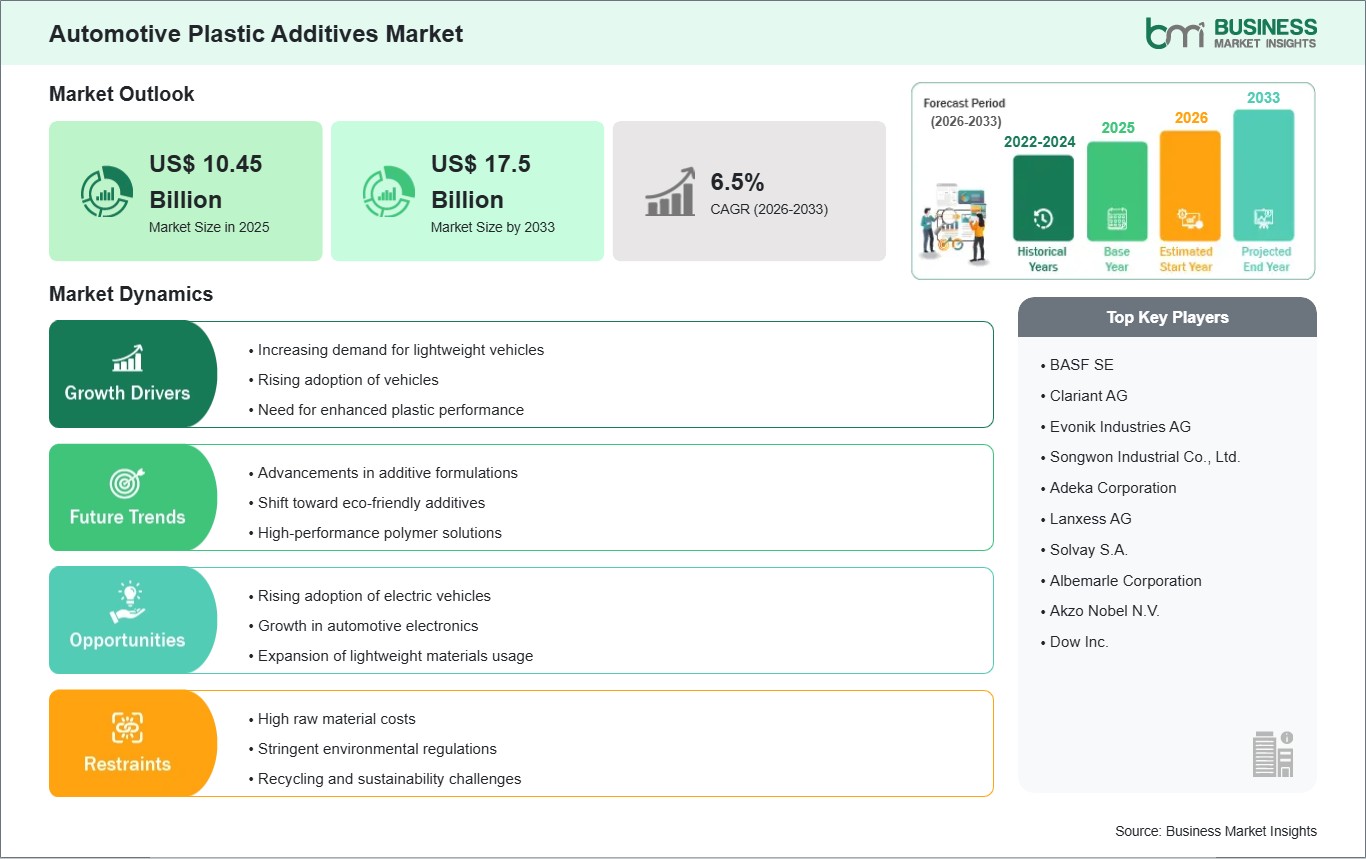
The Automotive Plastic Additives Market size is expected to reach US$ 17.5 Billion by 2033 from US$ 10.45 Billion in 2025 .The market is estimated to record a CAGR of 6.5% from 2026 to 2033.
The global automotive plastic additives market is defined by the increasing use of plastics in vehicle manufacturing to enhance performance, reduce weight, and improve durability. Plastic additives are incorporated into polymer materials to enhance properties such as strength, heat resistance, UV stability, and surface finish. These additives play a critical role in ensuring that automotive components meet stringent safety, performance, and aesthetic standards.
The market is experiencing steady growth driven by the automotive industry’s focus on lightweighting to improve fuel efficiency and reduce emissions. Plastics, enhanced with specialized additives, are increasingly replacing traditional materials such as metal in both interior and exterior components. Additionally, the rise of electric vehicles (EVs) is further accelerating demand for advanced plastic materials that offer insulation, thermal stability, and design flexibility.
Competitive dynamics are centered on innovation in additive formulations, regulatory compliance, and sustainability. Manufacturers are developing eco-friendly additives with reduced environmental impact while maintaining high performance. Strategic collaborations with automotive OEMs and polymer producers are enabling customized solutions tailored to specific vehicle applications. Technological advancements in additive chemistry and processing techniques are also shaping the competitive landscape.

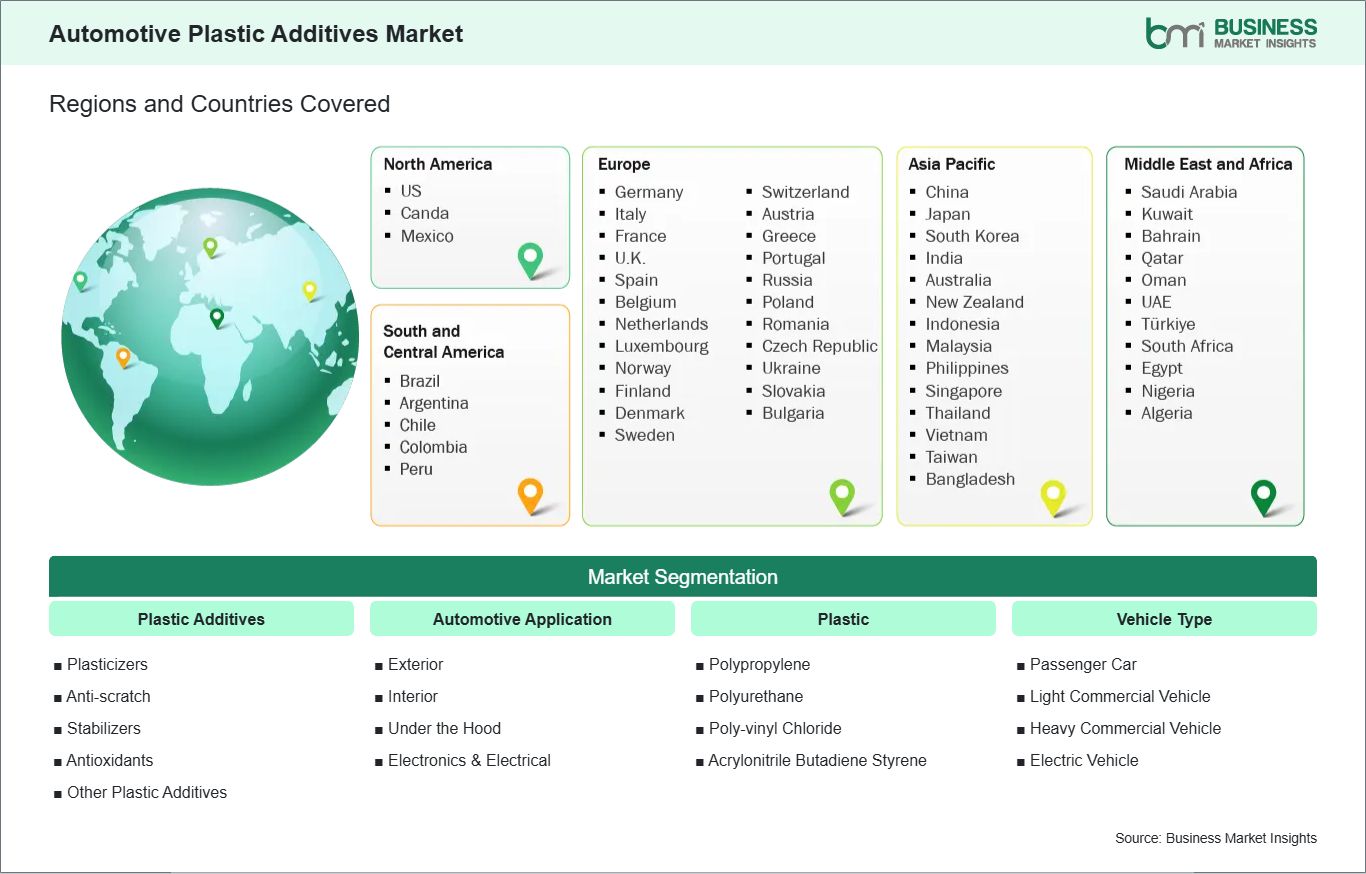
Key segments that contributed to the derivation of the automotive plastic additives market analysis are plastic additives, automotive application, plastic, and vehicle type.
Due to the increase in demand for lighter vehicles, the automotive plastic additives market is growing. Manufacturers must find ways to increase fuel economy and decrease emissions, which makes reducing the weight of the vehicle a top priority. By using a plastic as the primary material, manufacturers can produce vehicles that are lighter while allowing for design flexibility and cost savings.
However, a simple plastic does not necessarily have the physical properties to stand up to the rigors of an automobile. This is why the role of plastic additives is very important. By adding plastic additives, a manufacturer can improve the properties of a product (i.e., scratch resistance, UV stability, flame retardant properties, and impact resistance), thus making the plastic components suitable for use in both the inside and outside of a vehicle.
The under-the-hood parts of the vehicle must also withstand high temperatures and exposure to chemicals, and therefore benefit from using advanced plastic additives to ensure long-lasting reliability.
Improvements in polymer technology are leading to high-performance plastics, which are being used more frequently in the automotive industry. As government regulations continue to tighten around emissions, manufacturers are continuing to adopt lighter materials that are made with plastic additives to meet the performance requirements of their vehicles.
The automotive plastic additives market will continue to grow rapidly because of manufacturers developing innovative solutions for performance, safety, and sustainability.
As the electric vehicle (EV) sector continues to grow rapidly, it is also creating avenues for the automotive plastics additives industry. EVs use specialty materials that provide electrical insulation, manage thermal loads and reduce weight to enhance their performance and safety. Plastic additives are a key part of this, and as a result they will play an integral role in the manufacture of EVs. The major areas of application of plastic additives will be batteries, battery enclosures, battery connectors, battery charging systems and electronic control units (ECUs). All of these components require high performance plastic parts reinforced with plastic additives, including flame-retardant additives, stabilizers, and antioxidants. These plastic additives enable the safe operation of EVs in high-voltage environments through the use of durable and efficient material solutions.
The expansion of electronic systems in EVs such as infotainment systems and advanced driver-assistance systems (ADAS) is also one of the factors contributing to the growing requirement for high-quality plastic components. The trend toward sustainability also supports the development of eco-friendly plastic additives, recyclable materials and therefore contributes to sustaining or conserving the environment. With the emphasis placed on creating cleaner forms of transportation by both governments and consumers, the adoption of EVs is expected to increase throughout the world. Consequently, the anticipated expansion in the EV sector will create expanded opportunities for suppliers of innovative plastics additives and will enable them to create advanced solutions to satisfy the changing needs of electric mobility. By combining sustainability, technology and electric propulsion, the use of plastic additives will be necessary to provide enabling solutions to support the transition to electric vehicles.

The Automotive Plastic Additives Market demonstrates steady growth, with size and share analysis highlighting evolving trends and competitive dynamics among key players. The report examines subsegments categorized within plastic additives, automotive application, plastic, and vehicle type, offering insights into their contribution to overall market performance.
By plastic additives, the stabilizers subsegment dominated the market in 2025, driven by their ability to enhance durability and resistance to environmental factors.
Based on automotive application, the interior subsegment dominated the market in 2025, driven by extensive use of plastics in dashboards, panels, and seating components.
In terms of plastic, the polypropylene (PP) subsegment dominated the market in 2025, driven by its lightweight properties and cost-effectiveness.
By vehicle type, the passenger car subsegment dominated the market in 2025, driven by high production volumes and widespread adoption of plastic components.
| Report Attribute | Details |
|---|---|
| Market size in 2025 | US$ 10.45 Billion |
| Market Size by 2033 | US$ 17.5 Billion |
| Global CAGR (2026 - 2033) | 6.5% |
| Historical Data | 2022-2024 |
| Forecast period | 2026-2033 |
| Segments Covered | By Plastic Additives
|
|
Regions and Countries Covered
| |
| North America | US, Canada, Mexico |
| Europe | Belgium, Austria, Finland, Denmark, Greece, Poland, Romania, Russia, Ukraine, Czech Republic, Slovakia, Bulgaria, Italy, Luxembourg, Germany, Switzerland, France, Netherlands, Norway, Portugal, Spain, Sweden, United Kingdom |
| Asia-Pacific | Australia, China, India, Japan, South Korea, Indonesia, Malaysia, Philippines, Singapore, Thailand, Vietnam, Bangladesh, New Zealand, Taiwan |
| South and Central America | Brazil, Argentina, Peru, Chile, Colombia |
| Middle East and Africa | Bahrain, Kuwait, Oman, Qatar, Saudi Arabia, United Arab Emirates, Turkiye, South Africa, Egypt, Algeria, Nigeria |
| Market leaders and key company profiles |
|
The "Automotive Plastic Additives Market Size and Forecast (2022 - 2033)" report provides a detailed analysis of the market covering below areas:
The geographical scope of the Automotive Plastic Additives Market report is divided into North America, Asia Pacific, Europe, Middle East & Africa, and South & Central America. North America held the largest share in 2025.
The adoption and demand for automotive plastic additives vary across regions, influenced by automotive production, regulatory standards, and technological advancements. In North America, the market is driven by strong automotive manufacturing capabilities and increasing adoption of advanced materials to meet fuel efficiency and emission standards.
In Europe, stringent environmental regulations and a strong focus on sustainability are encouraging the use of lightweight and recyclable materials in vehicles. The region is also witnessing significant growth in electric vehicle adoption, further boosting demand for advanced plastic additives.
Asia Pacific is the dominant and fastest-growing region, supported by large-scale automotive production and rising demand for passenger vehicles. Countries such as China, India, and Japan are key contributors to market growth due to expanding automotive industries and increasing investments in electric mobility.
The Middle East & Africa and South & Central America are experiencing moderate growth, driven by increasing vehicle demand and gradual industrial development. Across all regions, evolving automotive technologies and regulatory frameworks continue to shape market dynamics.

The Automotive Plastic Additives Market is evaluated by gathering qualitative and quantitative data post primary and secondary research, which includes important corporate publications, association data, and databases. A few of the key developments in the automotive plastic additives market are:
The Automotive Plastic Additives Market is valued at US$ 10.45 Billion in 2025, it is projected to reach US$ 17.5 Billion by 2033.
As per our report Automotive Plastic Additives Market, the market size is valued at US$ 10.45 Billion in 2025, projecting it to reach US$ 17.5 Billion by 2033. This translates to a CAGR of approximately 6.5% during the forecast period.
The Automotive Plastic Additives Market report typically cover these key segments-
The historic period, base year, and forecast period can vary slightly depending on the specific market research report. However, for the Automotive Plastic Additives Market report:
The Automotive Plastic Additives Market is populated by several key players, each contributing to its growth and innovation. Some of the major players include:
The Automotive Plastic Additives Market report is valuable for diverse stakeholders, including:
Essentially, anyone involved in or considering involvement in the Automotive Plastic Additives Market value chain can benefit from the information contained in a comprehensive market report.
Please tell us your area of interest
(Market Segments/ Regions and Countries/ Companies)