
PFAS Alternatives Market Outlook: Size, Share, Trends, Growth Analysis, Competitive Landscape & Forecast, 2026-2033

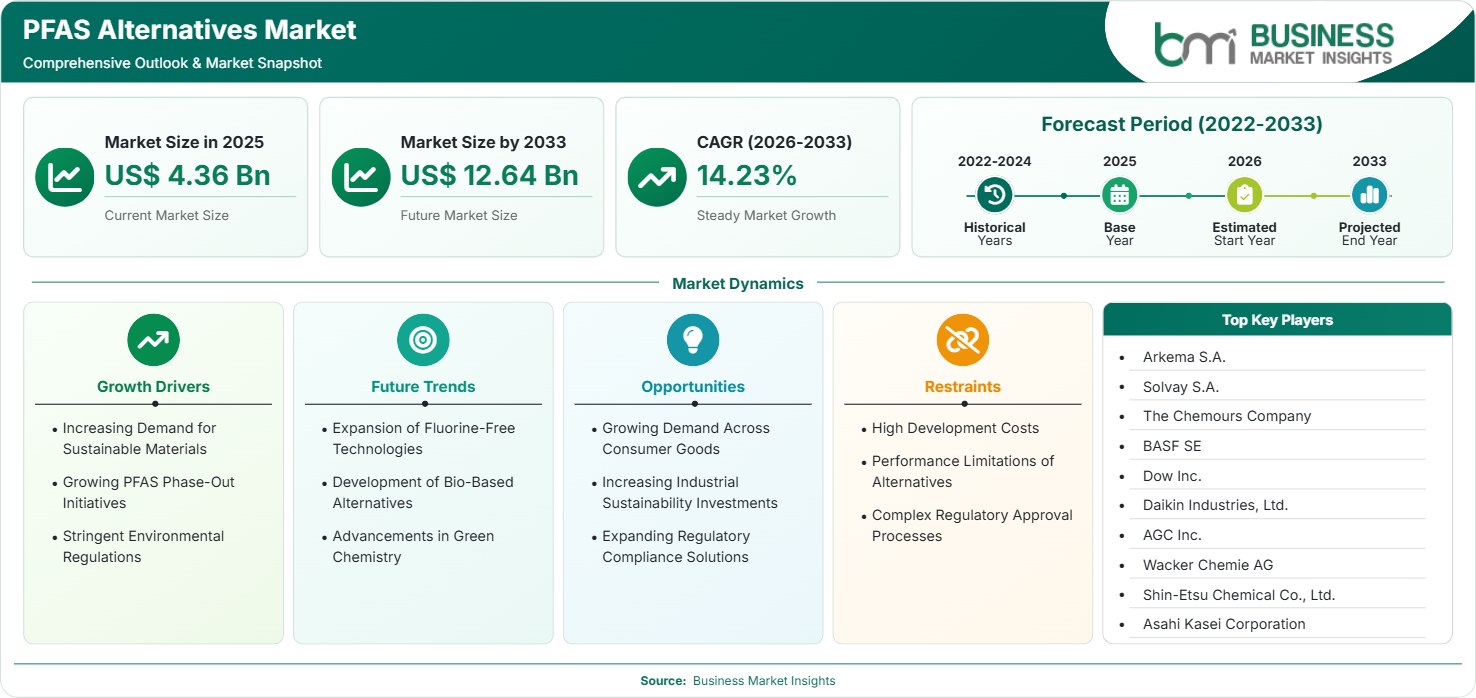
The PFAS Alternatives Market size was valued at US$ 4.36 Billion in 2025 and is projected to reach US$ 12.64 Billion by 2033, growing at a CAGR of 14.23% during 2026–2033, driven by regulatory restrictions, sustainability initiatives, demand for safer chemicals, and expanding adoption across packaging, coatings, textiles, and industrial applications.

Report Coverage
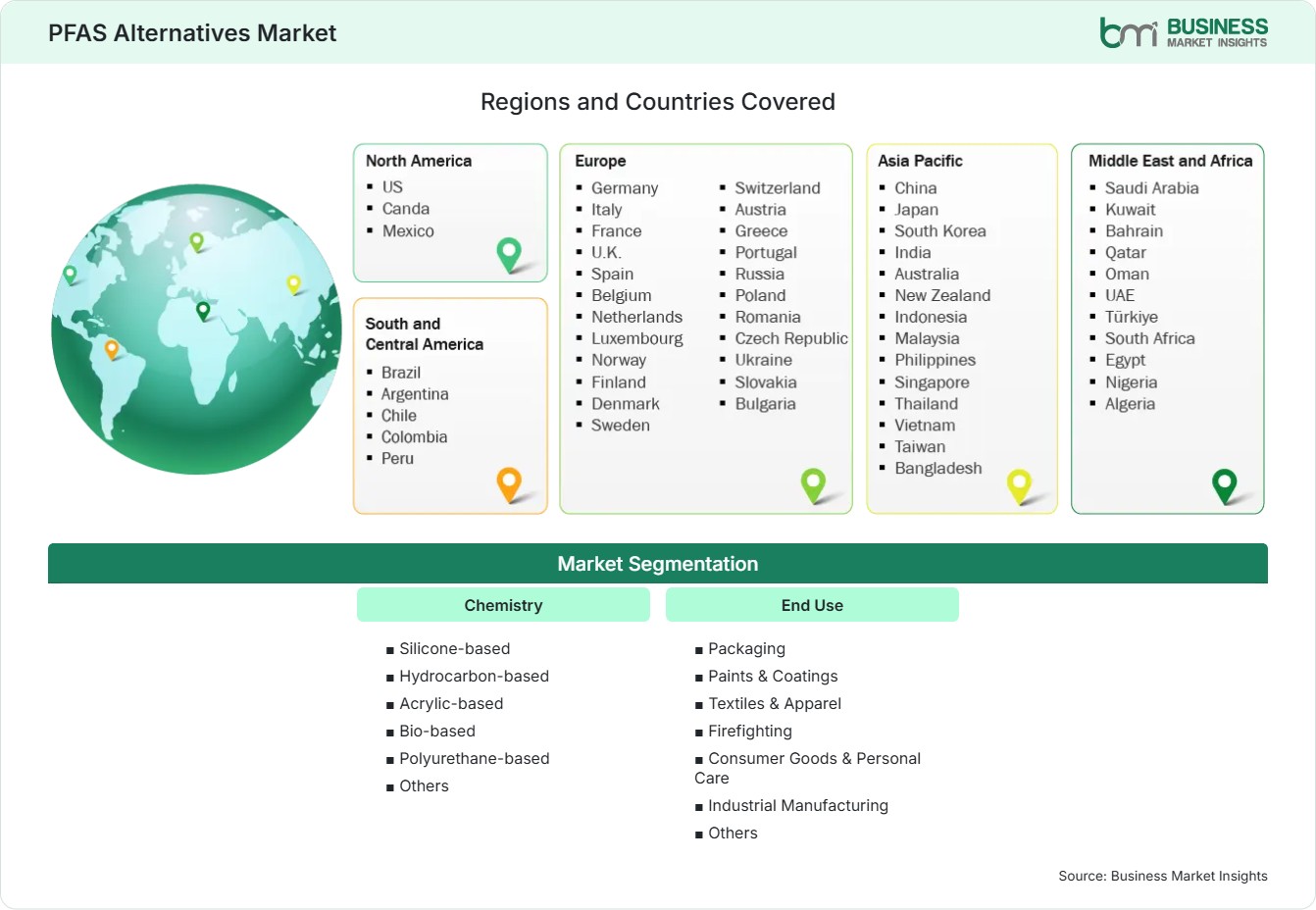
  • Chemistry: Silicone-based, Hydrocarbon-based, Acrylic-based, Bio-based, Polyurethane-based, Others
  • End Use: Packaging, Paints & Coatings, Textiles & Apparel, Firefighting, Consumer Goods & Personal Care, Industrial Manufacturing, Others
US$ 4.36 Bn Market size in 2025
US$ 12.64 Bn Market Size by 2033
14.23% CAGR, 2026 - 2033
2026-2033 Forecast Period

01 AI Overview

PFAS Alternatives Market Summary

  • North America Region: North America holds 36%–39% share in 2025, growing at a CAGR of 13.8%–14.3%, supported by regulatory enforcement, sustainable material adoption, chemical innovation, and replacement demand across industries. The U.S. market expands at 14.0%–14.5% CAGR due to federal and state-level PFAS restrictions, industrial transition programs, and advanced material investments.
  • Fastest Growing Region: Asia Pacific represents 24%–27% share in 2025 and is expanding at a CAGR of 15.2%–15.8%, supported by manufacturing growth, environmental compliance requirements, technology adoption, and increasing investments in sustainable chemical solutions across emerging economies.
  • Leading Segment: Packaging applications account for 32%–35% share in 2025, growing at a CAGR of 14.5%–15.0%, driven by food safety requirements, sustainable packaging transitions, regulatory pressure, and development of PFAS-free barrier coatings for consumer products.
  • High Growth Segment: Bio-based chemistry demonstrates 16%–19% share in 2025 with a CAGR of 16.0%–16.6%, supported by renewable feedstock innovation, corporate sustainability targets, environmental regulations, and increasing demand for low-impact chemical alternatives.
  • Key Market Opportunity: Growing demand for environmentally responsible materials creates opportunities across packaging, textiles, coatings, and consumer products as industries seek high-performance substitutes that meet evolving regulatory standards and sustainability objectives.
  • Major Market Players: Arkema S.A., Solvay S.A., The Chemours Company, BASF SE, Dow Inc., Daikin Industries, Ltd., AGC Inc., Wacker Chemie AG, Shin-Etsu Chemical Co., Ltd., and Asahi Kasei Corporation.
02 Strategic Insights

PFAS Alternatives Market: Strategic Insights

PFAS Alternatives Market Strategic Framework
FREE PDF
Request your free sample
Request free sample
03 Stakeholder View

Key Takeaways

  • The value chain will be moving away from traditional fluorinated chemicals manufacturers to more diversified ecosystems of specialty chemicals featuring bio-materials developers, coating producers, and industrial application specialists providing safer substitutes.
  • Packaging and coating applications offer great business opportunities since food producers, brands, and industrial end users are looking for barriers with desired properties and reduced reliance on chemicals restricted by regulations.
  • Materials innovation is becoming crucial for competition as firms develop cutting-edge polymer chemistry, renewable sources, and customized materials for various application fields.
  • Asia Pacific offers an attractive expansion opportunity due to manufacturing concentration, growing environmental awareness, and increasing adoption of sustainable chemical solutions across China, India, Japan, and South Korea.
  • The number of partnerships, technology licensing, and portfolio expansion is growing as chemical manufacturers try to secure their presence in promising sustainable materials markets.
  • Regulatory considerations and sustainability analysis have become important criteria for decision making.
04 Geographic Outlook

PFAS Alternatives Market Regional Highlights

North America PFAS Alternatives Market

North America accounted for 36%–39% of the global PFAS Alternatives Market share in 2025 and is projected to grow at a CAGR of 13.8%–14.3% during 2026–2033. Strong regulatory actions, including restrictions on PFAS usage in multiple states, are accelerating industrial replacement programs. The region benefits from advanced chemical manufacturing capabilities, high sustainability investments, and strong demand from packaging, coatings, and consumer industries seeking compliant alternatives.

  • Regulatory developments across the United States encourage manufacturers to accelerate adoption of fluorine-free chemical solutions and improve sustainable material development strategies.
  • Leading chemical companies are expanding research activities to create high-performance alternatives capable of replacing PFAS-based properties in demanding industrial applications.
  • Consumer brands are increasing procurement of sustainable packaging materials due to environmental commitments and changing regulatory expectations.
  • Canada is supporting adoption through environmental protection initiatives and increasing investments in safer chemical technologies.

US PFAS Alternatives Market

The United States represented approximately 82%–85% of North American revenue in 2025 and is expected to register a CAGR of 14.0%–14.5% through 2033. The country maintains strong demand due to regulatory restrictions, industrial sustainability programs, and increasing investments in specialty chemical innovation. Federal and state initiatives encourage companies to redesign materials and adopt safer alternatives across packaging, firefighting, textiles, and industrial applications.

  • State-level PFAS restrictions are accelerating adoption of alternative materials among manufacturers seeking regulatory compliance and reduced environmental liabilities.
  • Advanced research institutions and chemical companies are developing innovative formulations supporting replacement across multiple industrial applications.
  • Growing corporate sustainability commitments are encouraging businesses to integrate PFAS-free materials into supply chains.
  • The United States continues attracting investment due to strong specialty chemical infrastructure and technology development capabilities.

Europe PFAS Alternatives Market

Europe accounted for 29%–32% of the global PFAS Alternatives Market share in 2025 and is estimated to expand at a CAGR of 14.4%–14.9% during 2026–2033. The region demonstrates strong adoption due to stringent chemical regulations, sustainability policies, and growing corporate commitments toward eliminating persistent substances. Germany, France, and the United Kingdom represent leading markets, supported by advanced chemical industries, environmental legislation, and increasing demand for sustainable solutions across industrial applications.

  • European regulatory frameworks, including chemical safety initiatives, are encouraging manufacturers to redesign formulations and develop compliant alternatives with improved environmental profiles.
  • Germany maintains strong adoption through advanced specialty chemical production capabilities, industrial research investments, and strong demand from automotive, packaging, and manufacturing sectors.
  • France and the United Kingdom are accelerating sustainable material adoption through environmental policies and corporate commitments focused on reducing hazardous chemical usage.
  • Textile manufacturers across Europe are increasingly adopting fluorine-free treatments to meet consumer expectations and regulatory requirements.
  • Collaboration between chemical producers, research institutions, and end-use industries supports innovation in sustainable polymer technologies and alternative coating solutions.

Asia Pacific PFAS Alternatives Market

Asia Pacific represented 24%–27% of global revenue in 2025 and is projected to achieve the fastest CAGR of 15.2%–15.8% through 2033. The region benefits from expanding manufacturing activities, rising environmental awareness, increasing chemical production capabilities, and growing investments in sustainable materials. China remains the largest regional market, while India, Japan, and South Korea demonstrate strong growth potential due to industrial modernization and regulatory advancement.

  • China leads regional demand through extensive chemical manufacturing infrastructure, increasing environmental compliance measures, and growing investments in sustainable material technologies.
  • India is witnessing accelerated adoption due to expanding manufacturing sectors, government sustainability initiatives, and increasing demand for environmentally responsible industrial materials.
  • Japan and South Korea continue investing in advanced polymer research, supporting development of high-performance PFAS replacement solutions.
  • Growing packaging and consumer goods industries across Southeast Asia are creating additional opportunities for sustainable coating and barrier technologies.
  • Regional manufacturers are strengthening partnerships with global chemical companies to improve technology access and expand alternative material production.

Rest of World PFAS Alternatives Market

The Rest of World region accounted for 8%–10% of global revenue in 2025 and is expected to grow at a CAGR of 12.8%–13.4% through 2033. South and Central America are gradually adopting sustainable chemical solutions due to increasing environmental awareness and industrial modernization. The Middle East and Africa are developing opportunities through manufacturing expansion, regulatory improvements, and sustainability-focused industrial investments.

Brazil leads South and Central America adoption, while Gulf countries demonstrate increasing interest in environmentally compliant industrial materials.

  • Brazil is expanding sustainable material adoption through packaging modernization, industrial development, and increasing environmental responsibility among manufacturers.
  • Middle Eastern countries are investing in industrial diversification strategies that encourage adoption of advanced chemical alternatives.
  • Africa presents emerging opportunities as infrastructure development increases demand for sustainable coatings, packaging materials, and industrial solutions.
  • International partnerships are supporting technology transfer and improving availability of PFAS-free alternatives in developing markets.
  • Growing environmental regulations across emerging economies are encouraging industries to transition toward safer chemical formulations.
Global Market Geography
FREE PDF
Request your free sample
Request free sample
05 Segment Analysis

PFAS Alternatives Market Segmentation

Chemistry

Chemistry represents a critical segment of the market, accounting for 68%–71% share in 2025 and expanding at a CAGR of 14.0%–14.5% during 2026–2033. Manufacturers are investing in diverse chemical platforms to replicate PFAS performance characteristics while improving environmental compatibility. The PFAS Alternatives Market scope continues expanding as industries evaluate application-specific solutions based on durability, safety, and sustainability requirements.

  • Silicone-based: Silicone alternatives provide water repellency, flexibility, and thermal resistance, supporting applications in coatings, textiles, and industrial materials requiring durable surface performance.
  • Hydrocarbon-based: Hydrocarbon formulations offer cost-effective replacement options for several PFAS applications, particularly where moderate barrier properties and improved environmental profiles are required.
  • Acrylic-based: Acrylic alternatives support coating applications through customizable formulations, adhesion properties, and compatibility with packaging and industrial surface treatments.
  • Bio-based: Bio-based chemistry gains attention through renewable feedstocks, lower environmental impact, and increasing demand from companies pursuing sustainable material strategies.
  • Polyurethane-based: Polyurethane alternatives provide performance benefits including abrasion resistance and flexibility, enabling adoption across coatings, textiles, and industrial manufacturing applications.

End Use

End-use applications represent a major adoption driver, accounting for 29%–32% share in 2025 for packaging and related applications, with overall segment growth supported by regulatory pressure and sustainability objectives. Increasing demand for compliant materials across industries strengthens adoption opportunities as companies redesign products and supply chains. PFAS Alternatives Market trends indicate broader implementation across consumer and industrial sectors.

  • Packaging: Packaging applications are expanding due to food safety requirements, sustainable packaging initiatives, and demand for fluorine-free barrier coatings with reliable performance.
  • Paints & Coatings: Paint and coating manufacturers are developing alternatives that provide water resistance, durability, and environmental compliance for industrial and consumer applications.
  • Textiles & Apparel: Textile producers are adopting PFAS-free treatments to deliver stain resistance and water repellency while meeting sustainability expectations from brands and consumers.
  • Firefighting: Firefighting applications are exploring alternative formulations to reduce environmental concerns associated with traditional fluorinated foams.
  • Consumer Goods & Personal Care: Consumer industries are adopting safer materials to improve product sustainability and meet increasing regulatory requirements.
  • Industrial Manufacturing: Industrial users are implementing alternative materials in manufacturing processes requiring performance consistency and regulatory compliance.
06 Market Forces

PFAS Alternatives Market Dynamics

Key Market Drivers

Increasing Demand for Sustainable Materials

The rise of awareness regarding environmental issues and sustainability in companies is resulting in increasing demand for safer chemicals. The PFAS Alternatives Market trends are driven by producers’ need for materials having lower environmental impact yet retaining functionality. The market growth is driven by the increasing investments into renewable feedstocks and environmentally friendly formulation of products. Companies in packaging, textiles, and coatings industries are changing their products’ design to meet the sustainability objectives.

Growing PFAS Phase-Out Initiatives

Regulatory efforts aimed at PFAS compounds are generating robust demand for replacements from several different industries. Regulatory efforts that include limitations on the use of certain PFAS compounds in products are encouraging companies to develop alternative products. Phase-out efforts impact product development processes through increased focus on research, testing, and deployment of alternatives. Firms are focusing on developing alternatives with comparable performance properties but no chemical persistence issues.

Stringent Environmental Regulations

Environmental regulations are now emerging as a significant driver for the uptake of alternative materials because regulatory bodies are increasingly implementing stringent safety measures for chemicals. Regulatory bodies are now giving more attention to persistent compounds, and industries are now urged to explore safer compositions. Manufacturers are spending resources on developing products to meet the new compliance demands in different regions. Such regulations will drive the demand for novel chemistry platforms that can substitute PFAS.

Key Market Opportunities

Growing Demand Across Consumer Goods

Manufacturers of consumer goods are now investigating PFAS alternatives to make their products more sustainable and to meet shifting consumer demands. The opportunities in this field are increasing not only in personal care products but also in other products like home products, packaging, and clothing products, which require safer chemistry options. Businesses adopting environmentally-friendly formulation can capitalize on consumers who want their brands to be more sustainable. There is growing commercial value of the market for PFAS alternatives as predicted by the PFAS Alternatives Market Forecasts.

Increasing Industrial Sustainability Investments

Increased investments are being made by industrial manufacturers in the development of sustainable production processes that have opened up avenues for the emergence of alternative chemical producers. Various industries like automobiles, electronics, construction, and manufacturing are investigating alternative materials that do not harm the environment while maintaining efficiency at work. Growing interest in the use of green manufacturing concepts, environmental policies within organizations, and lifecycle assessments has opened up avenues for alternative chemistry.

Expanding Regulatory Compliance Solutions

Growing regulations in the chemical sector present chances for companies providing solutions in terms of compliance, testing, and alternative chemicals. There is a need for help from providers in the identification of the right substitutes and confirmation of their effectiveness and compliance. Firms that provide complete solutions, which consist of materials, technical advice, and application knowledge, may improve their competitive position. The growing number of regulations in the chemical industry is promoting cooperation between the producers of chemicals and industries using the chemicals.

Market Restraints and Challenges

High Development Costs

Factor: Developing PFAS alternatives requires significant investment in research, testing, and performance validation, increasing costs for chemical manufacturers. Impact: High development costs can affect the time frame of commercialization and also restrict participation of small companies with limited budgets for research. The new materials need to be tested thoroughly to ensure their longevity, safety, and suitability. It is difficult for companies to strike a balance between their costs of innovation and pricing pressures from industries using these materials.

Performance Limitations of Alternatives

Factor: Some alternative materials may not fully replicate PFAS characteristics such as extreme durability, chemical resistance, and long-term stability. Impact: Performance constraints can limit use in more demanding applications that need specific characteristics. There is a need for strict testing in industries like firefighting, industrial coatings, and manufacturing, prior to substituting traditional materials. Manufacturers still need to improve their product formulations through research and engineering.

07 Company Analysis

Competitive Landscape

The PFAS Alternatives Market analysis highlights increasing competition among specialty chemical manufacturers focusing on sustainable formulations, advanced polymer technologies, and application-specific replacement solutions. Leading companies are expanding product portfolios through research investments, partnerships, and sustainable material development strategies.

Company Name

Overview

Products and Services relevant to this market

Arkema S.A.

Global specialty chemicals company developing advanced materials and sustainable solutions for industrial applications.

Provides specialty polymers, coatings materials, and innovative chemical solutions supporting PFAS replacement applications.

Solvay S.A.

International chemical producer focused on sustainable materials and high-performance specialty solutions.

Develops advanced polymers, fluorine-free technologies, and specialty materials for industrial and consumer applications.

The Chemours Company

Chemical manufacturer specializing in advanced materials, performance solutions, and sustainable chemistry initiatives.

Offers specialty materials and replacement technologies supporting industrial coatings and chemical applications.

BASF SE

Global chemical company providing sustainable solutions across multiple industries and application sectors.

Supplies coatings materials, specialty chemicals, and innovative formulations supporting environmental transition goals.

Dow Inc.

Materials science company developing polymers, coatings, and sustainable material technologies.

Provides silicone technologies, specialty polymers, and industrial solutions for PFAS-free applications.

Daikin Industries, Ltd.

Diversified technology company involved in chemical products and advanced material development.

Develops fluorochemical technologies, alternative materials, and performance-based chemical solutions.

AGC Inc.

Global materials company specializing in glass, chemicals, and advanced functional materials.

Provides specialty chemical products and material technologies for industrial applications.

Wacker Chemie AG

Specialty chemical manufacturer focused on silicone-based and polymer solutions.

Offers silicone materials and sustainable chemical technologies for coatings and industrial uses.

Shin-Etsu Chemical Co., Ltd.

Chemical company producing advanced materials for electronics, industrial, and consumer markets.

Supplies silicone products, specialty polymers, and performance materials for replacement applications.

Asahi Kasei Corporation

Diversified chemical company developing sustainable materials and advanced industrial solutions.

Provides polymers, functional materials, and environmentally focused chemical technologies.

10 Trust & Transparency

Research Methodology

The market analysis combines proprietary research with secondary data from government agencies, company disclosures, regulatory filings, industry databases and expert interviews. Market estimates are validated through data triangulation, cross-market benchmarking and analyst review.

View Full Research Methodology

11 Questions Answered

Frequently Asked Questions

What information is included in the PFAS Alternatives Market Report?

The market Report provides analysis of market size, segmentation, competitive landscape, regional trends, growth factors, challenges, and future opportunities across major applications.

What factors influence selection of PFAS alternative materials?

Performance requirements, regulatory compliance, cost efficiency, durability, and application-specific needs influence material selection decisions across industries.

How does technology innovation influence PFAS replacement development?

Technology innovation supports development of advanced polymers, bio-based materials, and customized formulations designed to provide comparable performance while improving environmental compatibility.

Why are companies transitioning away from traditional PFAS materials?

Companies are transitioning due to environmental concerns, regulatory restrictions, and increasing customer expectations for sustainable products with reduced chemical impact.

What industries are driving adoption of PFAS alternatives?

Packaging, textiles, coatings, consumer goods, and industrial manufacturing industries are leading adoption due to regulatory pressure, sustainability commitments, and demand for safer chemical solutions.

Access the Full PFAS Alternatives Market Report

Get segment-level forecasts, regional estimates, competitive benchmarking, company profiles and downloadable Excel datasets.

Access the full PFAS Alternatives Market Report
350 pages PDF & Excel | 2026-08-12