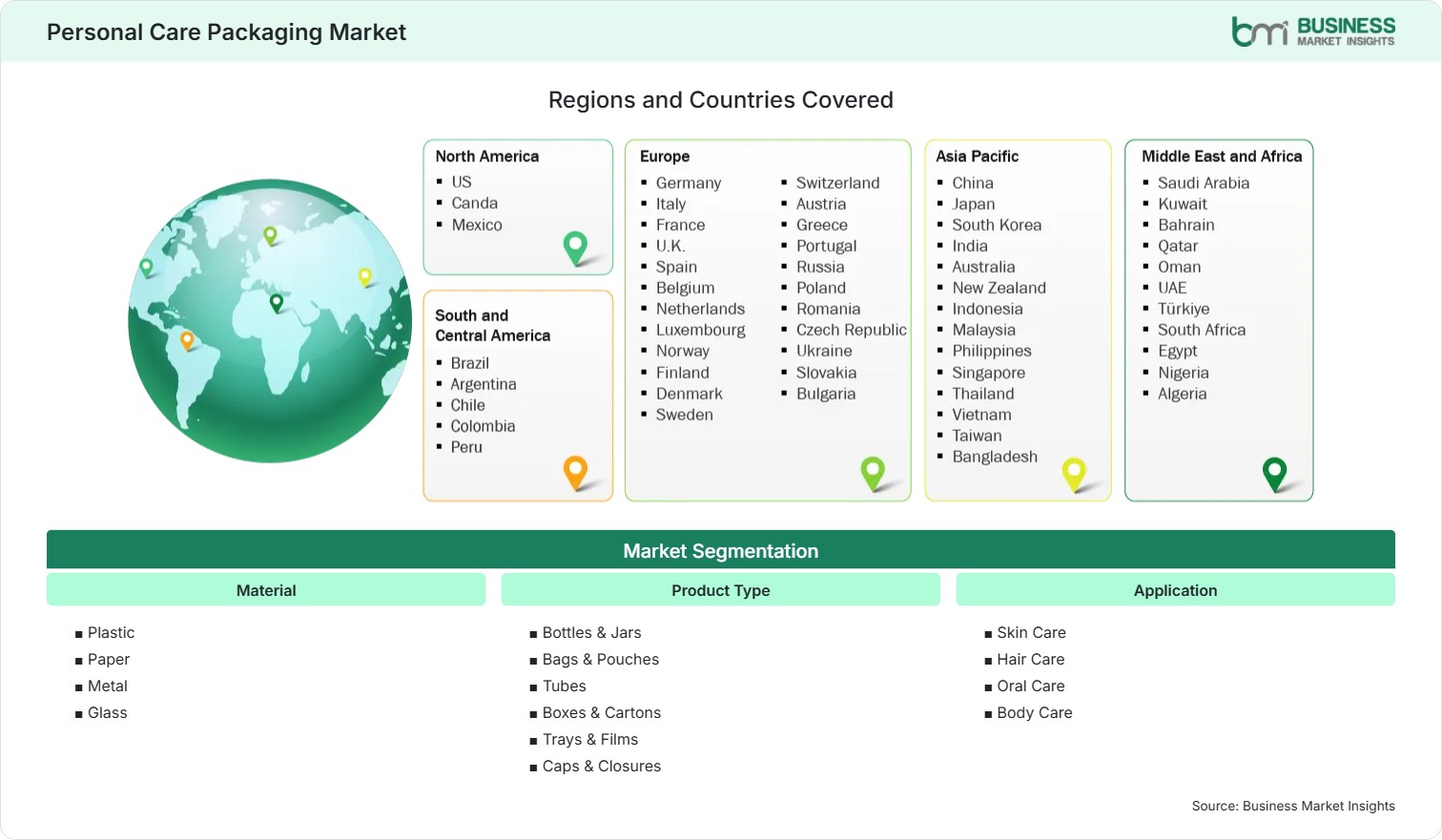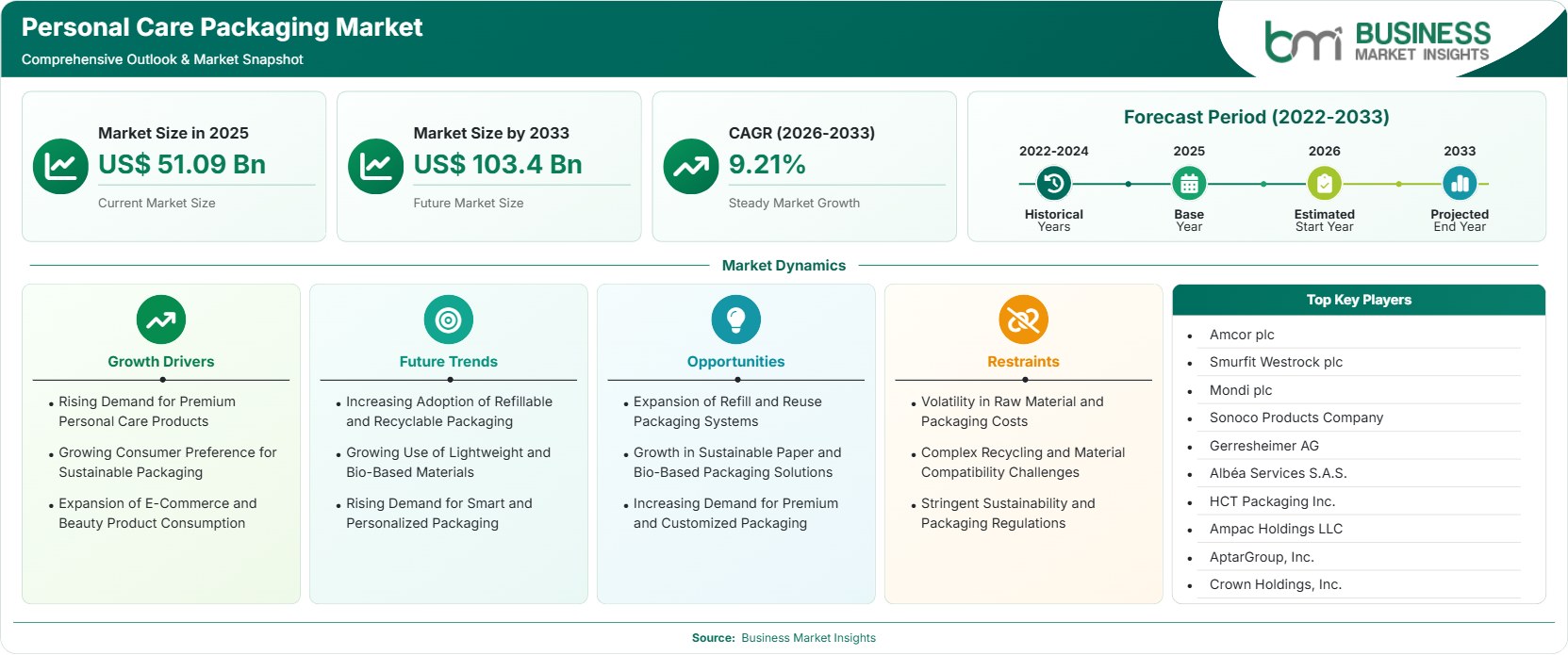
Personal Care Packaging Market Regional Highlights
North America Personal Care Packaging Market
North America accounts for 34%–37% Personal Care Packaging Market share in 2025 and is projected to expand at 8.2%–8.8% CAGR through 2033. Premium beauty categories, sustainability regulations, strong personal care brand presence, and investments in dispensing innovation support regional performance. Demand remains strongest for recyclable plastics, refillable formats, and premium packaging solutions. E-commerce fulfillment requirements and increasing incorporation of post-consumer recycled content further influence procurement decisions among leading consumer goods companies.
- Sustainability commitments are accelerating adoption of PCR plastics, refill systems, and recyclable dispensing components.
- Prestige beauty categories continue increasing demand for premium decoration and functional packaging.
- Direct-to-consumer sales channels require durable and lightweight transportation-friendly solutions.
- Brand owners prioritize packaging transparency, recyclability labeling, and regulatory compliance.
US Personal Care Packaging Market
The US Personal Care Packaging Market represents approximately 78%–82% of regional revenue and is expected to grow at 8.3%–8.9% CAGR. Strong innovation activity among beauty brands encourages adoption of airless systems, smart packaging, and refillable packaging concepts. Demand remains particularly strong in skincare, wellness, and dermocosmetic categories. Domestic production capabilities and advanced packaging technology ecosystems support competitiveness.
- Premium skincare brands increasingly adopt airless packaging to improve formulation protection.
- Sustainable packaging commitments stimulate investment in recycled-content materials.
- Independent beauty brands fuel demand for customized short-run production.
- Growth of wellness-oriented products supports premium packaging formats.
Europe Personal Care Packaging Market
Europe holds 25%–28% share in 2025 and is expected to advance at 8.7%–9.4% CAGR. Regulatory focus on packaging circularity and waste reduction drives innovation. Germany and France lead regional demand, while Eastern European markets exhibit faster expansion. Refillability, paper-based solutions, and recyclable flexible packaging formats are gaining momentum. Consumer preference for environmentally responsible products supports long-term adoption.
- Germany remains the leading market, supported by advanced packaging manufacturing capabilities.
- France benefits from strong cosmetics production and premium beauty exports.
- Recyclable mono-material formats are replacing complex multi-layer structures.
- Regulatory frameworks continue prioritizing circular packaging design.
Asia Pacific Personal Care Packaging Market
Asia Pacific captures 28%–31% Personal Care Packaging Market share in 2025 and records the fastest expansion at 10.8%–11.5% CAGR. China remains the largest market while India demonstrates the strongest growth trajectory. Rising incomes, urbanization, online beauty retailing, and local brand development strengthen demand. Manufacturers continue investing in cost-efficient, sustainable, and premium packaging solutions targeting expanding middle-class consumers.
- China leads regional production and consumption volumes for beauty packaging.
- India records rapid expansion supported by growing cosmetic penetration.
- E-commerce channels accelerate demand for lightweight packaging solutions.
- Premium skincare launches encourage adoption of high-value dispensing formats.
- Sustainable packaging initiatives gain traction among multinational and local brands.
Rest of World Personal Care Packaging Market
Rest of World accounts for 8%–11% of market revenue and is projected to grow at 9.0%–9.8% CAGR through 2033. South & Central America benefit from expanding beauty product consumption and localized manufacturing. Middle East & Africa are supported by rising premium personal care demand and retail modernization. Brazil leads regional activity, while GCC countries demonstrate stronger growth rates.
- Brazil remains a significant beauty products manufacturing and consumption hub.
- GCC countries support premium packaging demand through luxury beauty spending.
- Localization strategies increase regional production investments.
- Flexible packaging gains traction due to affordability and distribution efficiency.