
Green Packaging Market Outlook: Size, Share, Trends, Growth Analysis, Competitive Landscape & Forecast, 2026-2033

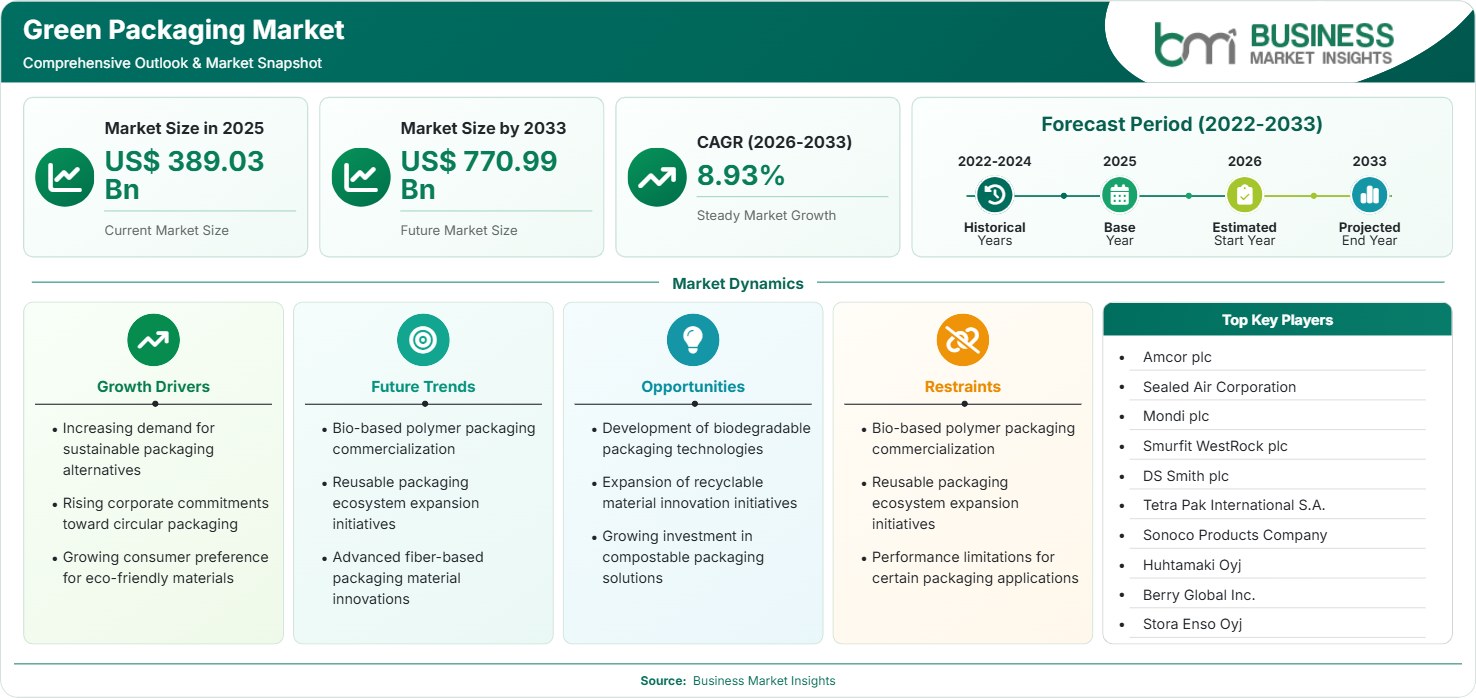
The Green Packaging Market size was valued at US$ 389.03 billion in 2025 and is projected to reach US$ 770.99 billion by 2033, growing at a CAGR of 8.93% during 2026–2033. Increasing demand for sustainable packaging alternatives, rising corporate commitments toward circular packaging, and growing consumer preference for eco-friendly materials continue accelerating industry expansion across global end-use sectors.

Report Coverage
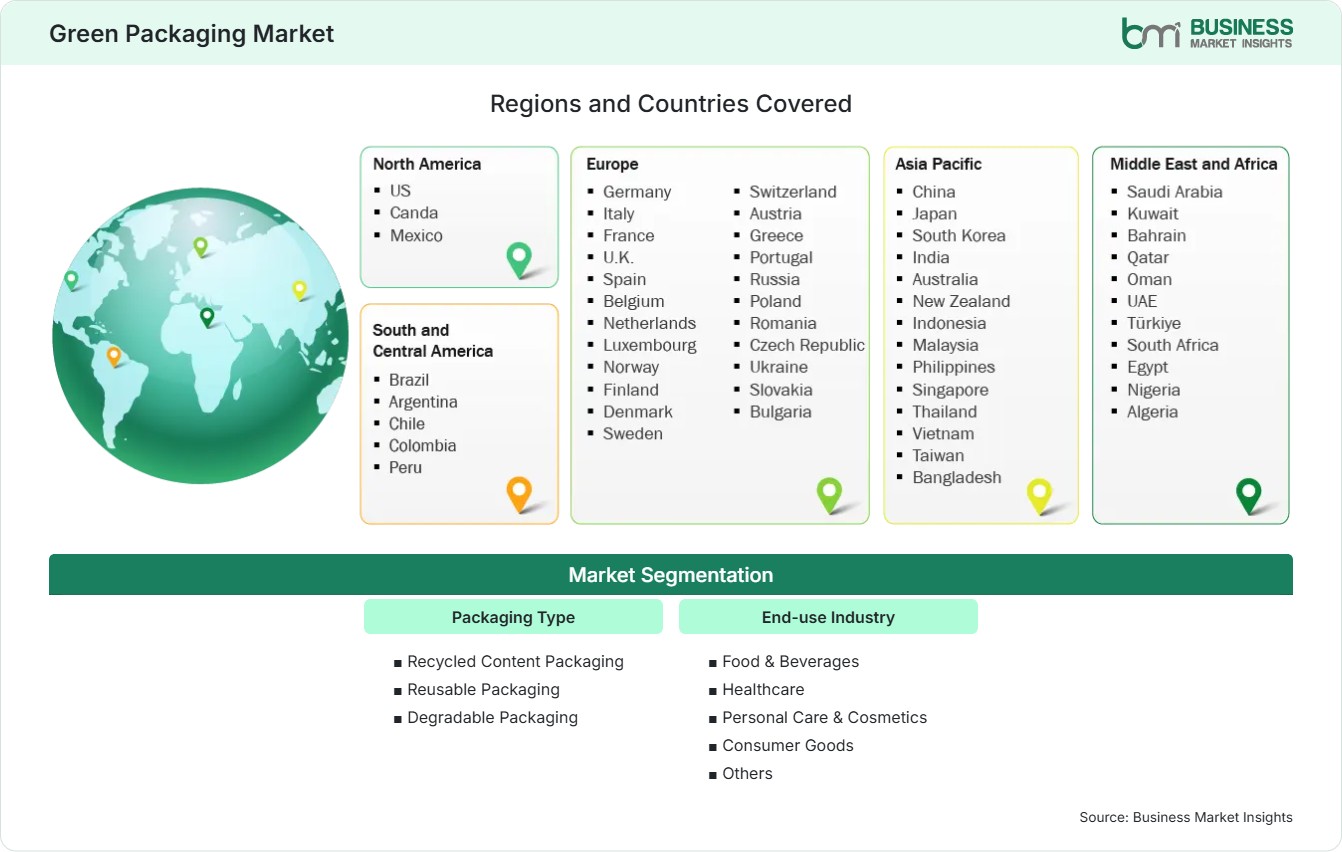
  • Packaging Type: Recycled Content Packaging, Reusable Packaging, Degradable Packaging
  • End-use Industry: Food & Beverages, Healthcare, Personal Care & Cosmetics, Consumer Goods, Others
US$ 389.03 Bn Market size in 2025
US$ 770.99 Bn Market Size by 2033
8.93% CAGR, 2026 - 2033
2026-2033 Forecast Period

AI Overview

Green Packaging Market Summary

  • North America Region: North America accounts for 30%–33% market share in 2025 and is projected to expand at a CAGR of 8.4%–8.9% during 2026–2033. Regulatory support for sustainable packaging, corporate environmental commitments, and strong consumer awareness continue driving regional adoption. The U.S. remains the largest contributor with a CAGR of 8.5%–9.0%, supported by investments in recyclable materials and circular economy initiatives.
  • Fastest Growing Region: Asia Pacific represents 36%–39% market share in 2025 and is expected to register a CAGR of 9.6%–10.2%, driven by expanding manufacturing activities, government sustainability policies, rising packaged food consumption, and increasing investment in environmentally responsible packaging solutions.
  • Leading Segment: Paper & Paperboard accounts for 42%–45% market share in 2025 and is anticipated to expand at a CAGR of 9.0%–9.5%, supported by widespread recyclability, renewable sourcing, and increasing substitution of conventional plastic packaging.
  • High Growth Segment: Recycled Content Packaging captures 37%–40% market share in 2025 and is projected to record a CAGR of 9.8%–10.4%, benefiting from stricter environmental regulations, corporate sustainability targets, and improvements in recycling infrastructure.
  • Key Market Opportunity: Continuous innovation in biodegradable materials, recyclable packaging technologies, and circular economy business models is creating significant long-term opportunities across multiple end-use industries.
  • Major Market Players: Amcor plc, Sealed Air Corporation, Mondi plc, Smurfit WestRock plc, DS Smith plc, Tetra Pak International S.A., Sonoco Products Company, Huhtamaki Oyj, Berry Global Inc., and Stora Enso Oyj.
Strategic Insights

Green Packaging Market: Strategic Insights

Green Packaging Market Strategic Framework
FREE PDF
Request your free sample
Request free sample
Stakeholder View

Key Takeaways

  • Circular economy initiatives are transforming packaging value chains, encouraging manufacturers to increase recycled content while improving collection, sorting, and material recovery systems.
  • Food and beverage companies remain the largest adopters of sustainable packaging as environmental regulations and consumer purchasing preferences continue reshaping product packaging strategies.
  • Material innovation is accelerating through investments in biodegradable polymers, fiber-based packaging, lightweight packaging formats, and recyclable multilayer structures.
  • Asia Pacific presents the strongest long-term investment opportunity due to expanding industrial production, supportive government policies, and increasing sustainability commitments across manufacturing industries.
  • Strategic partnerships among packaging manufacturers, recycling companies, and consumer goods brands continue strengthening circular packaging ecosystems and improving material recovery efficiency.
  • Digital traceability technologies and lifecycle assessment tools are increasingly supporting packaging optimization, regulatory compliance, and corporate sustainability reporting.
Geographic Outlook

Green Packaging Market Regional Highlights

North America Green Packaging Market

North America accounts for 30%–33% Green Packaging Market share in 2025 and is projected to register a CAGR of 8.4%–8.9% during 2026–2033. Strong environmental regulations, high recycling awareness, and corporate sustainability commitments continue supporting regional demand. Packaging manufacturers are investing in recyclable materials, lightweight packaging designs, and circular economy initiatives to meet changing regulatory requirements and consumer expectations.

  • Food manufacturers increasingly replace conventional packaging with recyclable and renewable material alternatives.
  • Corporate sustainability commitments continue accelerating investment in recyclable packaging technologies.
  • Circular economy policies strengthen collection, recycling, and material recovery infrastructure.
  • Brand owners increasingly prioritize lightweight packaging to reduce transportation emissions and material consumption.

US Green Packaging Market

The United States contributes 82%–85% of North American revenue and is expected to expand at a CAGR of 8.5%–9.0% during the forecast period. Growing investment in sustainable packaging innovation, advanced recycling technologies, and environmentally responsible manufacturing continues supporting long-term industry expansion.

  • Consumer preference for environmentally responsible products continues encouraging adoption of recyclable packaging.
  • Retailers increasingly establish sustainable packaging targets throughout supply chains.
  • Investments in advanced recycling technologies improve recycled material availability.
  • Food and healthcare industries remain key users of sustainable packaging solutions.

Europe Green Packaging Market

Europe represents 28%–31% market share in 2025 and is anticipated to grow at a CAGR of 8.5%–9.0% during 2026–2033. Regulatory frameworks including the European Green Deal and packaging waste reduction policies continue supporting adoption of recyclable, reusable, and compostable packaging solutions. Germany leads regional demand, while Poland records the fastest growth through expanding sustainable manufacturing investments.

  • Extended producer responsibility regulations encourage higher recycled content across packaging products.
  • Investments in fiber-based packaging continue replacing conventional plastic applications.
  • Consumer demand for environmentally friendly packaging strengthens premium product adoption.
  • Recycling infrastructure improvements increase availability of high-quality secondary materials.

Asia Pacific Green Packaging Market

Asia Pacific holds 36%–39% market share in 2025 and is expected to register the fastest 9.6%–10.2% CAGR through 2026–2033. Rapid industrialization, expanding packaged food production, supportive environmental policies, and increasing investments in recycling infrastructure continue driving regional market expansion. China remains the largest regional market, while India records the fastest growth supported by expanding manufacturing capacity and sustainability initiatives.

  • Government policies increasingly encourage sustainable packaging adoption across manufacturing industries.
  • Expanding packaged food consumption continues increasing demand for recyclable packaging materials.
  • Investment in recycling facilities improves circular economy development throughout the region.
  • International consumer brands accelerate sustainable packaging implementation across Asian markets.

Rest of World Green Packaging Market

The Rest of World region accounts for 5%–8% market share in 2025 and is projected to expand at a CAGR of 8.6%–9.2% during 2026–2033. Growing environmental awareness, improving recycling infrastructure, and increasing adoption of sustainable packaging solutions continue supporting demand across Latin America, the Middle East, and Africa.

  • Brazil leads regional adoption through expanding sustainable consumer goods manufacturing.
  • GCC countries continue investing in environmentally responsible packaging and recycling infrastructure.
  • Food and beverage manufacturers increasingly introduce recyclable packaging formats.
  • Government sustainability programs encourage greater use of renewable and recyclable packaging materials.
Global Market Geography
FREE PDF
Request your free sample
Request free sample
Segment Analysis

Green Packaging Market Segmentation

Material

The material segment remains the largest contributor as packaging manufacturers increasingly adopt renewable, recyclable, and resource-efficient materials to meet sustainability goals and regulatory requirements. It accounted for 42%–45% market share in 2025 and is projected to register a CAGR of 9.0%–9.5% during 2026–2033. Continuous material innovation, improved recyclability, and broader industrial adoption continue expanding the Green Packaging Market scope across food, healthcare, personal care, and consumer goods industries.

  • Paper & Paperboard: Lead the segment due to high recyclability, renewable sourcing, lightweight characteristics, and growing substitution of conventional plastic packaging across food, beverage, and e-commerce applications.
  • Plastic: Continues maintaining significant demand through recyclable, recycled-content, and bio-based plastic solutions that balance product protection, lightweight performance, and sustainability objectives across multiple industries.
  • Metal: Gains steady adoption because of its durability, excellent barrier properties, and nearly infinite recyclability, making it suitable for beverage, food, pharmaceutical, and specialty packaging applications.
  • Others: Includes emerging sustainable materials such as molded fiber, bamboo, bagasse, seaweed-based materials, and other renewable packaging substrates developed to reduce environmental impact and improve circularity.

Packaging Type

Packaging type continues evolving as manufacturers prioritize circular economy principles and resource efficiency across product portfolios. This segment represented 37%–40% market share in 2025 and is expected to expand at a CAGR of 9.8%–10.4% during 2026–2033. Ongoing investments in recycling technologies, reusable packaging systems, and compostable materials continue strengthening Green Packaging Market trends across global supply chains.

  • Recycled Content Packaging: Represents the leading category as manufacturers increase recycled resin and fiber utilization to reduce virgin material consumption while meeting sustainability targets and regulatory requirements.
  • Reusable Packaging: Continues gaining momentum across industrial logistics, retail distribution, and food service applications through durable packaging systems designed for repeated use and extended product life cycles.
  • Degradable Packaging: Experiences strong demand due to increasing development of biodegradable and compostable materials capable of reducing landfill waste while supporting environmentally responsible disposal practices.

End-use Industry

Demand across end-use industries continues expanding as organizations integrate sustainable packaging into environmental strategies and brand positioning. The segment accounted for 41%–44% market share in 2025 and is projected to register a CAGR of 9.1%–9.7% through 2026–2033. Growing regulatory compliance, consumer awareness, and corporate sustainability initiatives continue supporting adoption across multiple industrial sectors.

  • Food & Beverages: Remains the largest end-use sector as manufacturers increasingly adopt recyclable, renewable, and lightweight packaging to improve sustainability while maintaining product protection and shelf-life performance.
  • Healthcare: Demand continues rising with increasing use of recyclable medical packaging, pharmaceutical containers, and sterile packaging solutions designed to meet stringent regulatory and safety standards.
  • Personal Care & Cosmetics: Brands increasingly invest in refillable, recyclable, and premium sustainable packaging to strengthen environmental commitments while enhancing product differentiation and consumer appeal.
  • Consumer Goods: Sustainable packaging adoption continues expanding across household products, electronics, and retail merchandise as manufacturers pursue circular economy goals and reduce packaging waste.
  • Others: Industrial products, e-commerce, agriculture, and specialty manufacturing continue incorporating environmentally responsible packaging solutions to improve operational sustainability and comply with evolving environmental regulations.
Market Forces

Green Packaging Market Dynamics

Key Market Drivers

Increasing demand for sustainable packaging alternatives

Growing environmental awareness among consumers, governments, and businesses is accelerating the shift toward sustainable packaging materials across global industries. Companies are switching from traditional packaging to more sustainable forms such as recyclable, biodegradable, and renewable packaging in order to minimize their impact on the environment as well as adhere to strict waste management regulations. The EU PPWR policy and other similar policies around the world have spurred this trend. Packaging manufacturers are also investing in lightweight materials and recyclable product designs that improve resource efficiency while maintaining product protection. These developments continue supporting Green Packaging Market growth across food, healthcare, consumer goods, and e-commerce industries.

Rising corporate commitments toward circular packaging

Leading consumer brands are strengthening sustainability strategies by increasing the use of recycled materials, improving packaging recyclability, and reducing dependence on virgin resources. Numerous multinationals have set measurable goals on the use of recyclable, reusable, or biodegradable packaging. This has motivated a sustainable partnership between packaging firms, recycling firms, and raw material providers. Technology investments for improved recycling processes as well as closed loop packaging remain key enablers of the transition towards the adoption of circular economy models.

Growing consumer preference for eco-friendly materials

Customers are becoming more conscious about the effect of their purchases on the environment while buying packaged products, thus putting pressure on companies to use eco-friendly packaging. The demand for packages made from paper, organic materials, and recycled materials is still growing for food products, beverages, cosmetics, and home care products. Manufacturers are expanding sustainable product portfolios while improving packaging functionality, durability, and aesthetics. These product innovations continue influencing Green Packaging Market trends, encouraging broader adoption across premium and mass-market consumer product categories.

Key Market Opportunities

Development of biodegradable packaging technologies

Innovations in the field of material science provide opportunities for manufacturers of packages to produce biodegradable packaging that will be able to decrease plastic waste and still be effective. Studies of bio-polymer based materials, cellulose materials, algae packaging, and agro-fibers packaging keep opening up new commercial prospects. Advances in barrier properties, mechanical properties, and biodegradability allow biodegradable packaging to move into more advanced applications including food and medical industry. Green Packaging Market Forecasts indicate that continued innovation in biodegradable materials will create attractive growth opportunities for companies investing in sustainable packaging technologies and next-generation material development.

Expansion of recyclable material innovation initiatives

Manufacturers are investing heavily in recyclable packaging structures that improve material recovery while maintaining product quality and operational efficiency. The popularity of mono-material flexible packaging, recyclable barrier films, light weight packaging, and better fiber-based packaging solutions is increasing greatly. The partnership of the packaging manufacturers, consumer goods companies, and recycling companies is speeding up the pace of innovations and developing infrastructure for circular economy. It will help improve the process of recycling and increase the supply of quality secondary raw materials.

Growing investment in compostable packaging solutions

Increasing restrictions on single-use plastics are encouraging investment in compostable packaging for food service, retail, agriculture, and consumer goods applications. Compostable products, which meet international environmental standards and have adequate strength and protection for the goods inside, are being developed by manufacturers. Industrial composting facilities and favorable government policies make the prospects of commercialization even better. With the constant development of sustainability rules, compostable packages will gain more significance as an element of environmentally-friendly packaging systems.

Market Restraints and Challenges

Bio-based polymer packaging commercialization

Commercial adoption of bio-based polymers remains constrained by production capacity, raw material availability, and relatively high manufacturing costs. Factor: Inadequate manufacturing capacity and irregular supply of raw materials hinder the availability of competitive bio-packaging materials due to their high cost and limited availability. Impact: Manufacturers are still using traditional or recycled material because bio-packaging material is costlier and not readily available, thus inhibiting its commercial success.

Reusable packaging ecosystem expansion initiatives

Reusable packaging systems require coordinated logistics, efficient collection networks, cleaning infrastructure, and standardized return processes to operate successfully across supply chains. Factor: Lack of sufficient infrastructure, along with varying levels of engagement from retailers, logistics firms, and consumers, present some obstacles to running a program of reusable packaging on a large scale. Impact: This could lead to higher implementation costs, greater logistical complexities, and lower return rates, which might render such schemes less commercially viable in some cases.

Company Analysis

Competitive Landscape

The competitive environment is characterized by continuous investments in recyclable materials, fiber-based packaging, circular economy initiatives, and low-carbon manufacturing technologies. Green Packaging Market analysis indicates that leading companies are expanding sustainable product portfolios, strengthening recycling partnerships, and investing in advanced packaging technologies to meet evolving regulatory requirements and consumer demand. Strategic acquisitions, innovation in renewable materials, and capacity expansion remain key competitive priorities across the global packaging industry.

Company Name

Overview

Products and Services Relevant to this Market

Amcor plc

Global packaging leader providing flexible and rigid packaging solutions with a strong focus on sustainability and circular packaging innovation.

Recyclable flexible packaging, recycled-content packaging, lightweight packaging, food packaging, healthcare packaging, and sustainable material solutions.

Sealed Air Corporation

Develops protective and food packaging solutions emphasizing resource efficiency, product protection, and sustainability.

Barrier packaging, recyclable packaging, protective packaging systems, food packaging solutions, and automated packaging technologies.

Mondi plc

International packaging and paper company specializing in sustainable packaging materials and circular economy solutions.

Paper packaging, flexible packaging, recyclable materials, industrial packaging, and fiber-based packaging products.

Smurfit WestRock plc

Global supplier of paper-based packaging solutions formed through the combination of Smurfit Kappa and WestRock.

Corrugated packaging, containerboard, paper packaging, recyclable packaging solutions, and customized sustainable packaging products.

DS Smith plc

Leading provider of fiber-based packaging with expertise in circular design and sustainable packaging innovation.

Corrugated packaging, recycled paper packaging, retail-ready packaging, industrial packaging, and recycling services.

Tetra Pak International S.A.

Global food processing and packaging company focused on renewable and recyclable carton packaging technologies.

Aseptic cartons, beverage cartons, food packaging systems, packaging equipment, and recycling support solutions.

Sonoco Products Company

Manufactures diversified consumer, industrial, healthcare, and protective packaging solutions worldwide.

Paperboard packaging, rigid paper containers, flexible packaging, protective packaging, and recycled material packaging solutions.

Huhtamaki Oyj

Develops sustainable foodservice and consumer packaging products using renewable and recyclable materials.

Fiber packaging, molded fiber products, flexible packaging, foodservice packaging, and recyclable packaging solutions.

Berry Global Inc.

Global manufacturer of plastic packaging products with increasing investments in recycled-content and circular packaging solutions.

Recyclable plastic packaging, containers, closures, flexible films, recycled resin packaging, and sustainable packaging technologies.

Stora Enso Oyj

Renewable materials company specializing in fiber-based packaging and sustainable material innovation.

Paperboard packaging, renewable packaging materials, molded fiber packaging, wood-based packaging, and circular packaging solutions.

Trust & Transparency

Research Methodology

The market analysis combines proprietary research with secondary data from government agencies, company disclosures, regulatory filings, industry databases and expert interviews. Market estimates are validated through data triangulation, cross-market benchmarking and analyst review.

View Full Research Methodology

Questions Answered

Frequently Asked Questions

What does the Green Packaging Market Report include?

The Market Report provides comprehensive insights into market dynamics, regional performance, competitive landscape, segmentation, technological advancements, sustainability initiatives, investment opportunities, and long-term industry outlook.

Which region is expected to experience the fastest growth?

Asia Pacific is projected to record the fastest growth owing to expanding manufacturing activities, rising packaged food consumption, supportive environmental policies, growing recycling investments, and increasing demand for sustainable packaging solutions.

Why is recycled content packaging gaining importance?

Recycled content packaging reduces dependence on virgin raw materials, supports circular economy objectives, lowers carbon emissions, and helps companies comply with evolving sustainability regulations while improving environmental performance.

Which material segment holds the largest market share?

Paper & Paperboard represents the leading material segment because of its high recyclability, renewable sourcing, lightweight properties, strong consumer acceptance, and broad application across food, beverage, and consumer goods packaging.

What is driving the Green Packaging Market?

The market is driven by growing environmental awareness, increasing regulatory support for sustainable packaging, rising corporate sustainability commitments, expanding recycling infrastructure, and higher consumer demand for environmentally responsible packaging materials.

Access the Full Green Packaging Market Report

Get segment-level forecasts, regional estimates, competitive benchmarking, company profiles and downloadable Excel datasets.

Access the full Green Packaging Market Report
350 pages PDF & Excel | 2026-08-18
Similar Research

Related Market Reports