
Cosmetic Packaging Market Outlook: Size, Share, Trends, Growth Analysis, Competitive Landscape & Forecast, 2026-2033

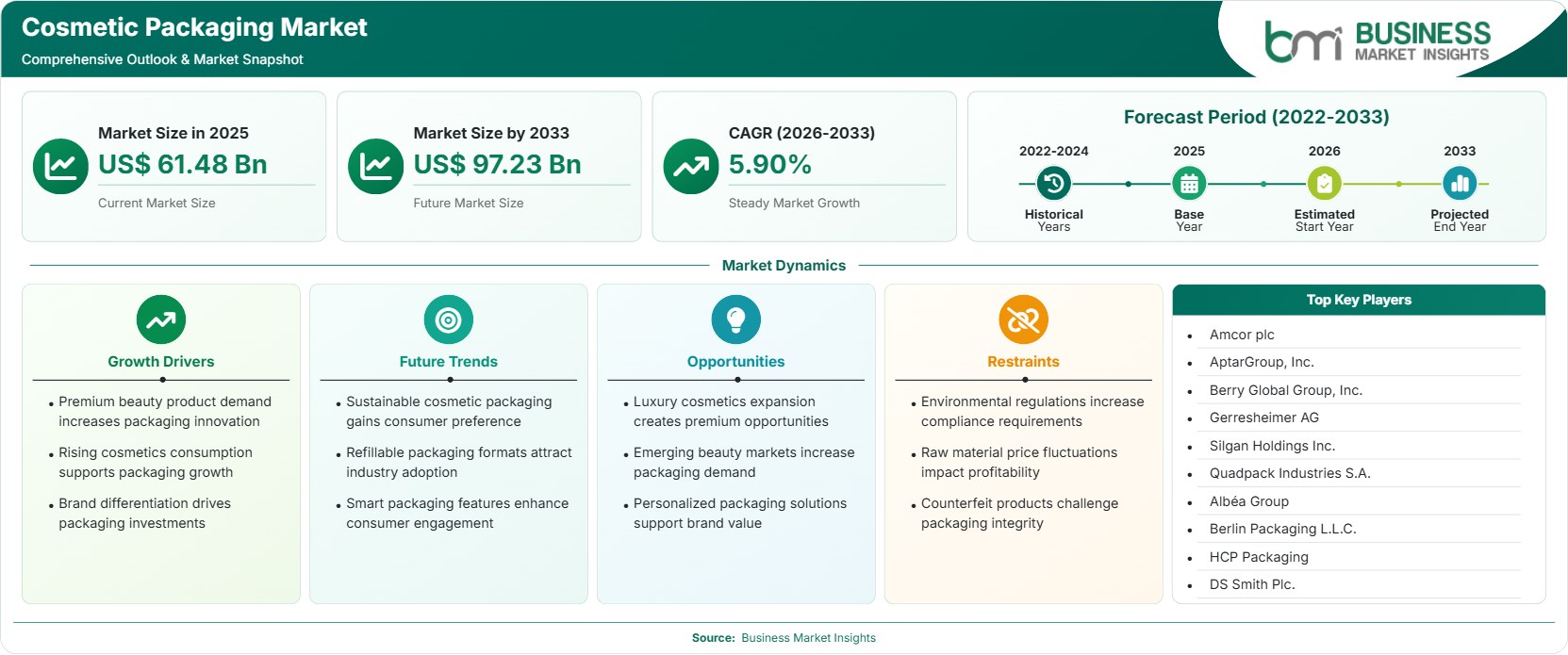
The Cosmetic Packaging Market size was valued at US$ 61.48 Billion in 2025 and is projected to reach US$ 97.23 Billion by 2033, growing at a CAGR of 5.9% during 2026–2033. Key drivers include premium beauty demand, sustainable material adoption, e-commerce expansion, refillable formats, digital decoration technologies, and rising skincare consumption across emerging economies.

Report Coverage
  • Material: Plastic , Paper & Paperboard, Glass, Metal, Others
  • Product Type: Jars & Containers, Tubes, Bottles, Pumps & Dispensers, Sachets & Stick Packs, Aerosol Cans, Blisters, Folding Cartons, Others
  • Capacity: Less than 50 ml, 50-100 ml, 101-200 ml, 201-500 ml, Above 500 ml
  • Application: Skincare, Haircare, Makeup
US$ 61.48 Bn Market size in 2025
US$ 97.23 Bn Market Size by 2033
5.90% CAGR, 2026 - 2033
2026-2033 Forecast Period

AI Overview

Cosmetic Packaging Market Summary

  • North America Region: North America holds a Cosmetic Packaging Market share of 34%–37% in 2025, growing with a CAGR of 4.8%–5.3% during 2026–2033. Growth is supported by premium beauty spending, sustainable packaging mandates, refillable cosmetics adoption, omnichannel retail expansion, advanced dispensing technologies, strong brand innovation pipelines, and increasing demand for recyclable formats. US market remains the regional anchor, supported by prestige skincare launches and packaging innovation, with a CAGR of 4.9%–5.4%.
  • Fastest Growing Region: Asia Pacific holds market share of 29%–32% in 2025, growing with a CAGR of 6.8%–7.4% during 2026–2033. Key momentum comes from urbanization, expanding beauty e-commerce, rising disposable incomes, local brand proliferation, premium skincare demand, manufacturing investments, and sustainability-focused packaging transitions.
  • Leading Segment: Plastic holds a Cosmetic Packaging Market share of 42%–46% in 2025, growing with a CAGR of 5.2%–5.8% during 2026–2033. Lightweight properties, cost efficiency, design flexibility, barrier performance, decoration compatibility, recycled resin integration, and large-scale manufacturing capabilities continue supporting widespread adoption globally.
  • High Growth Segment: Skincare holds market share of 39%–43% in 2025, growing with a CAGR of 6.4%–7.0% during 2026–2033. Expansion is driven by premium formulations, serum adoption, anti-aging products, airless packaging demand, refill concepts, ingredient-sensitive products, and growing wellness-oriented consumer purchasing behavior.
  • Key Market Opportunity: Refillable and reusable beauty packaging platforms create long-term value through waste reduction, regulatory compliance, premium positioning, circular economy alignment, stronger consumer loyalty, and lower lifecycle packaging material requirements.
  • Major Market Players: Amcor plc, AptarGroup, Inc., Berry Global Group, Inc., Gerresheimer AG, Silgan Holdings Inc., Quadpack Industries S.A., Albéa Group, Berlin Packaging L.L.C., HCP Packaging, and DS Smith Plc.
Strategic Insights

Cosmetic Packaging Market: Strategic Insights

Cosmetic Packaging Market Strategic Framework
FREE PDF
Request your free sample
Request free sample
Stakeholder View

Key Takeaways

  • Packaging value creation increasingly depends on integrated supply chains linking resin producers, converters, decoration specialists, filling partners, and beauty brands, strengthening collaboration across the packaging ecosystem.
  • Refillable skincare formats, premium pumps, dispensers, and sustainable material solutions represent the strongest commercial opportunities due to rising environmental awareness and premium beauty spending.
  • Innovation priorities are shifting toward mono-material designs, post-consumer recycled content, lightweight structures, and smart packaging solutions capable of improving consumer engagement.
  • India, Indonesia, Vietnam, and Gulf countries offer compelling investment cases due to expanding beauty consumption, manufacturing capacity growth, and improving retail penetration.
  • Strategic acquisitions remain focused on sustainability technologies, decorative capabilities, dispensing solutions, and regional manufacturing expansion, helping suppliers enhance market reach and customer proximity.
  • Beauty brands increasingly prioritize packaging partners capable of delivering regulatory compliance, ESG performance metrics, customization, and accelerated product development cycles.
Geographic Outlook

Cosmetic Packaging Market Regional Highlights

North America Cosmetic Packaging Market

North America accounted for a 34%–37% share in 2025 and is projected to expand at 4.8%–5.3% CAGR through 2033. The region benefits from sophisticated beauty retail networks, strong demand for prestige cosmetics, and rapid adoption of refillable solutions. The Cosmetic Packaging Market share remains supported by regulatory focus on circular packaging systems and advanced dispensing technologies. Major suppliers continue introducing post-consumer recycled materials and lightweight formats to support sustainability objectives while maintaining premium aesthetics and performance requirements.

  • Premium skincare and prestige cosmetics continue creating demand for airless dispensers, recyclable containers, and differentiated brand packaging experiences.
  • Retailers increasingly prioritize sustainable packaging compliance, encouraging adoption of recycled plastics, paperboard solutions, and refillable systems.
  • E-commerce growth strengthens demand for durable, lightweight, and protective formats suitable for omnichannel beauty distribution.
  • Automation and digital decoration technologies improve production efficiency while enabling greater personalization and shorter launch cycles.

US Cosmetic Packaging Market

The United States accounted for about 78%-82% of regional demand in 2025 and is projected to grow at a CAGR of 4.9%-5.4%. A preference for luxury skincare, clean beauty products, and sustainable packaging options is driving the product design approach. There is a growing trend of collaboration between brand owners and packaging experts to achieve recycling goals while maintaining shelf appeal. The advanced manufacturing landscape and robust innovation ecosystems drive innovations in dispensers, refill systems, and material science.

  • Prestige beauty launches continue supporting strong demand for customized bottles, pumps, compact packaging, and decorative technologies.
  • Sustainability commitments among major beauty brands accelerate investment in recycled and renewable packaging materials.
  • Growth in direct-to-consumer brands encourages agile manufacturing and short-run packaging customization capabilities.
  • Regulatory focus on packaging recovery and recyclability supports innovation across material formats and product designs.

Europe Cosmetic Packaging Market

The Europe region held a share of 26%–29% in 2025 and is projected to expand at a CAGR of 5.2%–5.8% between 2026 and 2033. Regulations on sustainability and the circular economy continue to play a vital role in influencing market growth. Germany leads demand in the region for the Cosmetic Packaging market, and Eastern Europe has a higher rate of expansion. Refillable solutions, paper, and recycled plastics have become popular with brands targeting their environmental objectives. Strong luxury cosmetics production also sustains demand for premium packaging materials and high-value decoration technologies.

  • France and Germany remain major consumers due to established beauty industries and strong premium cosmetics production.
  • Poland records one of the strongest regional expansion rates, supported by manufacturing investments and export-oriented growth.
  • EU packaging regulations encourage lightweighting, recyclability enhancements, and greater use of recycled content.
  • Luxury beauty brands continue adopting premium glass formats and advanced decorative packaging solutions.
  • Digital product traceability and sustainability reporting gain importance across regional packaging supply chains.

Asia Pacific Cosmetic Packaging Market

The Asia Pacific region had a market share of 29%-32% in 2025 and is expected to grow at a rate of 6.8%-7.4% CAGR, making it the fastest-growing region. China remains the largest market, while India and Southeast Asia drive accelerated growth. There are many growth prospects, including increased beauty usage, a growing middle class, and evolving retail infrastructure. The development of manufacturing capacity to meet increased demand is seen in the region. Strong Cosmetic Packaging Market growth across skincare categories further supports investment in innovative packaging formats.

  • China leads regional consumption through large beauty manufacturing ecosystems and significant domestic brand development.
  • India demonstrates rapid expansion supported by premiumization, digital commerce penetration, and growing personal care expenditure.
  • South Korea drives innovation through advanced beauty trends and sophisticated packaging design requirements.
  • Southeast Asia benefits from young consumer demographics and expanding online cosmetics sales.
  • Regional manufacturers increasingly invest in recycled-content packaging and localized production capabilities.

Rest of World Cosmetic Packaging Market

South and Central America account for a meaningful portion of regional demand, supported by Brazil's strong beauty industry. Middle East and Africa Cosmetic Packaging Market continues expanding through premium personal care consumption and retail modernization. Combined regions are forecast to grow at 5.5%–6.1% CAGR through 2033, supported by urbanization and growing product accessibility.

The region contributes 8%–11% share in 2025 and offers increasing opportunities for international packaging suppliers seeking growth beyond mature markets.

  • Brazil remains the largest market, supported by robust personal care consumption and domestic beauty manufacturing.
  • Saudi Arabia and the UAE demonstrate strong premium beauty demand and luxury packaging adoption patterns.
  • Mexico benefits from expanding manufacturing investments and proximity to North American supply chains.
  • Sustainability initiatives slowly gain traction, supporting gradual adoption of recyclable packaging solutions.
  • International beauty brands continue increasing regional presence through localized packaging and marketing strategies.
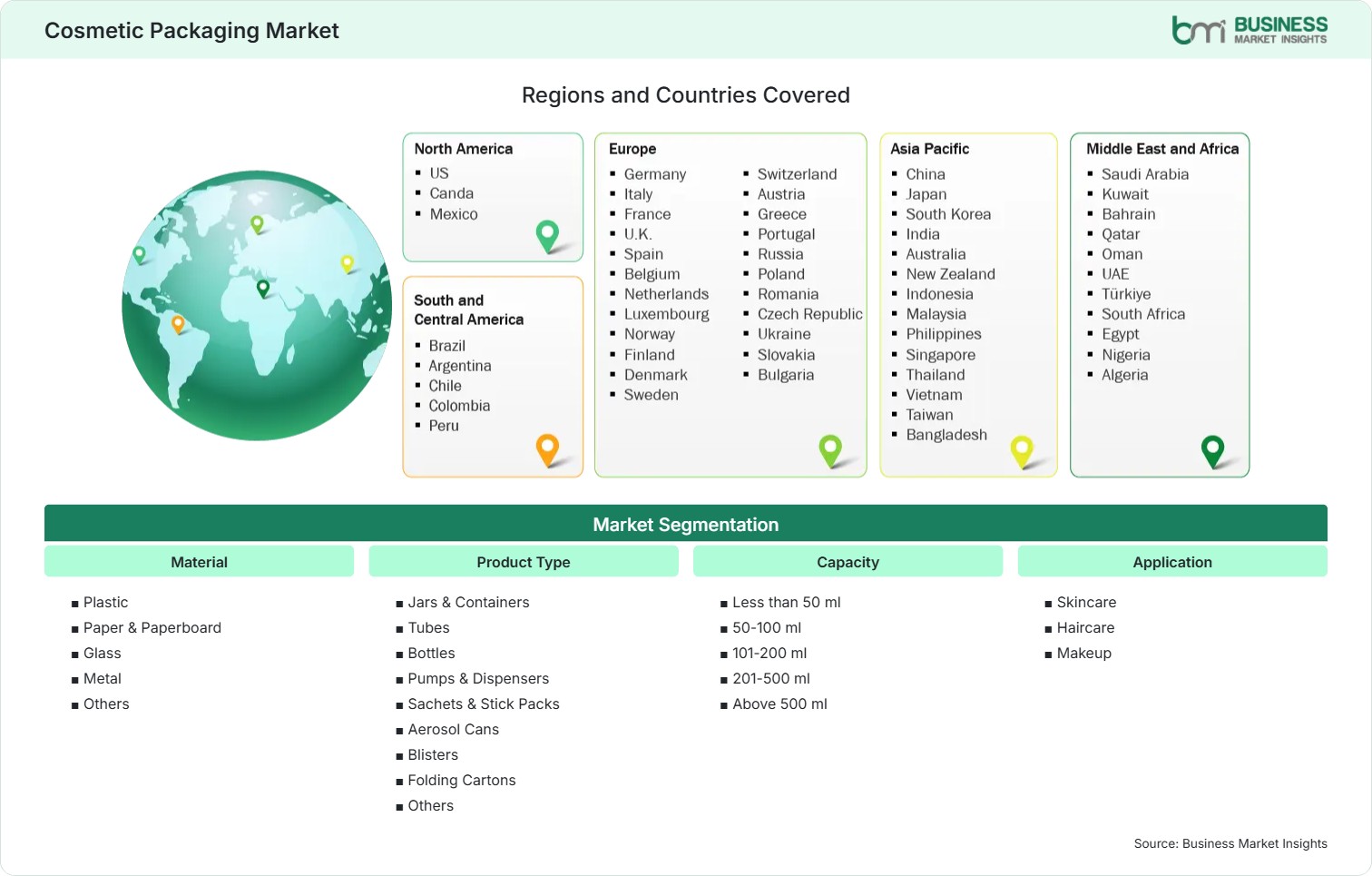
Global Market Geography
FREE PDF
Request your free sample
Request free sample
Segment Analysis

Cosmetic Packaging Market Segmentation

Material

The material segment is the backbone of the packaging performance and sustainability approach. This constituted a major revenue source in the industry, as plastics had the highest market share, at 42%-46% in 2025, and were growing at a CAGR of 5.2%-5.8%. The scope of the Cosmetic Packaging Market will continue to grow through recyclable polymers, lightweight materials, high-end glass, and sustainable paperboard.

  • Polypropylene (PP): Widely used in closures, jars, and caps due to durability, chemical resistance, lightweight characteristics, and compatibility with recycling initiatives.
  • Polyethylene terephthalate (PET): Preferred for transparent bottles requiring strong appearance, barrier performance, and increasing recycled-content incorporation.
  • Polyethylene (PE): Commonly utilized in tubes and squeezable formats owing to flexibility, cost-effectiveness, and broad product compatibility.
  • Polyvinyl Chloride (PVC): Applied in selected specialty packaging applications requiring protective performance and decorative flexibility despite sustainability challenges.
  • Paper & Paperboard: Growing adoption driven by sustainability objectives, premium carton presentation, and improved structural performance.
  • Glass: Favored for luxury skincare and fragrance applications because of premium appearance, recyclability, and excellent product protection.
  • Metal: Utilized for aerosol formats and premium packaging solutions requiring durability, recyclability, and aesthetic differentiation.

Product Type

Product type selection depends on the compatibility of the formulation, dispensing method, sustainability goals, and brand image positioning. The segment is steadily gaining traction in beauty products owing to rising demands for a unique consumer experience and premium packaging function.

  • Jars & Containers: Widely adopted across skincare categories, offering product visibility, premium aesthetics, and compatibility with diverse formulations.
  • Tubes: Popular for creams and gels due to portability, hygiene benefits, and controlled dispensing functionality.
  • Bottles: Essential across personal care and beauty applications, supporting multiple material choices and decorative capabilities.
  • Pumps & Dispensers: Increasingly favored for premium skincare and hygiene-focused products requiring precise dosage control.
  • Sachets & Stick Packs: Support affordability, sampling programs, travel convenience, and emerging-market product accessibility.
  • Aerosol Cans: Commonly used for sprays requiring controlled product delivery and extended shelf stability.
  • Blisters: Provide protection and presentation benefits for selected cosmetic accessories and specialty products.
  • Folding Cartons: Important secondary packaging format supporting branding, information display, and sustainability objectives.

Capacity

Capacity segmentation is based on consumers' usage habits, portability needs, and the products' positioning strategy. Medium-sized containers remain in high demand; however, the popularity of portable and large formats increases.

  • Less than 50 ml: Supported by sampling programs, travel formats, premium serums, and convenience-focused applications.
  • 50-100 ml: Common across skincare and personal care products, balancing portability and consumer value.
  • 101-200 ml: Preferred for daily-use products requiring moderate purchasing frequency and practical usage volumes.
  • 201-500 ml: Widely adopted in haircare and family-oriented personal care packaging formats.
  • Above 500 ml: Growing in professional, salon, and value-oriented applications emphasizing reduced packaging frequency.

Application

Application demand will be dominated by skincare, which will capture a 39%–43% share in 2025, with a CAGR of 6.4%–7.0%. The rising emphasis on wellness and the efficacy of ingredients and formulations encourages innovation in packaging. The Cosmetic Packaging Market trends are inclined towards refillable and disposable container formats tailored to application-specific needs.

  • Skincare: Strong demand for airless systems, premium containers, and refillable formats supports ongoing packaging innovation.
  • Haircare: Benefits from growing premium product adoption, sustainable packaging initiatives, and specialized dispensing requirements.
  • Makeup: Driven by aesthetics, customization, portability, and consumer demand for visually distinctive packaging solutions.
Market Forces

Cosmetic Packaging Market Dynamics

Key Market Drivers

Premium Beauty Consumption and Skincare Product Expansion

Increasing global consumer interest in luxury skincare, clean beauty, and dermatologist-inspired makeup has kept packaging innovation going strong. Customers prefer skincare products with high-end dispensers, airless packaging, and a high-end look and feel, prompting companies to develop high-end packaging solutions. With increasing interest in serums, anti-aging products, and multi-tasking skincare items, there is a need for packaging that improves product protection and dosing precision. The growth in prestige beauty categories in North America, Europe, China, South Korea, and India further supports increased utilization of custom packaging solutions. Given that skincare is the largest category, packaging firms can always benefit from the ongoing demand for high-end packaging solutions.

Sustainability Regulations and Circular Packaging Adoption

Government policies, along with companies' sustainability pledges, are driving a shift towards recyclable, reusable, and refillable packaging. Cosmetic companies are increasingly adopting post-consumer recycled plastic, paper-based packaging, and mono-material packaging to achieve environmental objectives. Extended producer responsibility policies, along with packaging waste reduction targets, are affecting packaging designs in leading consumer markets. The suppliers are increasingly deploying lightweighting technologies, sustainable materials, and recycling processes to improve compliance and competitiveness. Increased consumer preference for eco-friendly goods is driving demand for sustainable cosmetic packaging. Sustainability has become one of the major growth drivers in the market.

Expansion of E-commerce and Direct-to-Consumer Beauty Channels

The rapid growth of online beauty retail has transformed packaging requirements across cosmetic categories. Products sold through e-commerce channels require improved durability, leak resistance, product protection, and shipping efficiency. The current trends in packaging include lightweight packaging, tamper-proof closures, and dispensing systems specifically designed for omnichannel distribution. Moreover, consumer-oriented beauty products require smaller production batches, personalized packaging, and rapid product introduction. Various technologies, such as digital printing and labeling, are increasingly used by companies to better connect with customers. All these trends continue to create new opportunities for packaging service providers.

Key Market Opportunities

Accelerating Demand for Refillable Beauty Packaging Systems

The idea of refillable packaging is an attractive one for packaging providers and the cosmetic industry in the long run. The demand for sustainable packaging that generates no waste while offering convenience and appeal is on the rise among consumers. Premium skincare products, perfumes, and cosmetics benefit from customer loyalty regarding sustainable packaging. With good primary packaging and relatively inexpensive refill packs, waste could be reduced. According to Cosmetic Packaging Market forecasts, circular packaging business models are likely to attract significant investment over the next decade to meet environmental targets and differentiate themselves through sustainable product strategies in the decade ahead.

Growth Potential Across Emerging Beauty Manufacturing Hubs

Emerging economies in Asia Pacific, the Middle East, Latin America, and Africa present attractive opportunities for packaging suppliers. Rapid urbanization, rising disposable incomes, growing middle-class populations, and increasing beauty awareness are driving cosmetic product consumption. Beauty brands in local markets are expanding production capacity and seeking packaging providers capable of delivering innovation, sustainability, and cost efficiency. The creation of regional manufacturing plants may help with greater flexibility, reduced logistics expenses, and a localization strategy. Foreign companies engaged in beauty packaging are investing in these markets.

Smart Packaging and Digital Consumer Engagement Solutions

The use of digital technology in beauty packaging adds value for both brands and consumers. Connected labels, QR-enabled packaging, and authentication and traceability functions create more opportunities for customer engagement and support transparency initiatives. Connected packaging can help companies communicate information about ingredients, sustainability, loyalty programs, and even marketing experiences. Consumer concern about product authenticity and supply chain transparency is another factor driving the adoption of these technologies. Packaging companies that combine material and digital innovation will secure more valuable contracts from leading cosmetics manufacturers.

Market Restraints and Challenges

Volatile Raw Material Costs and Supply Chain Pressure

Factor: Prices of polymers, specialty resins, aluminum, glass, inks, and decorative materials remain vulnerable to energy costs, geopolitical disruptions, and supply-demand imbalances. Impact: Packaging manufacturers face margin pressure, procurement uncertainty, and challenges in maintaining stable pricing structures for beauty brands. Cost fluctuations complicate long-term planning and may delay investments in new packaging technologies. Smaller manufacturers are particularly exposed because they have limited purchasing power and lower flexibility in passing cost increases to customers. Continued volatility across global supply chains can affect production schedules, inventory management, and overall profitability throughout the cosmetic packaging value chain.

Complex Recycling Infrastructure and Material Compatibility Issues

Factor: Despite increasing sustainability targets, many packaging formats still face recycling limitations due to mixed materials, decorative coatings, pumps, dispensers, and multi-component designs. Impact: Achieving circular economy objectives becomes more challenging, increasing redesign costs and compliance burdens for manufacturers. Brands must balance product protection, aesthetics, functionality, and recyclability while meeting evolving regulatory requirements. Infrastructure gaps in developing regions further constrain large-scale recycling outcomes. These technical and operational challenges may slow adoption of certain sustainable packaging solutions and require significant investments in material science, product redesign, and recycling ecosystem development.

Company Analysis

Competitive Landscape

The competitive environment remains fragmented, with innovation, sustainability, and customization driving differentiation. Recent Cosmetic Packaging Market analysis indicates suppliers are expanding recycled-content portfolios, dispensing technologies, and regional manufacturing capabilities.

Company Name

Overview

Products and Services relevant to this market

Amcor plc

Global packaging leader with extensive sustainability programs and strong beauty packaging footprint.

PET containers, recyclable packaging, tubes, closures, specialty cosmetic packaging solutions.

AptarGroup, Inc.

Major dispensing technology specialist serving global beauty and personal care brands.

Pumps, dispensers, airless systems, aerosol components, beauty packaging technologies.

Berry Global Group, Inc.

Diversified producer of plastic packaging solutions with global manufacturing reach.

Cosmetic jars, containers, closures, sustainable packaging materials.

Gerresheimer AG

Premium packaging provider focused on glass and specialty containers.

Glass bottles, jars, luxury cosmetic packaging and decoration services.

Silgan Holdings Inc.

Packaging manufacturer supporting consumer goods and personal care sectors.

Closures, dispensing systems, containers, customized packaging components.

Quadpack Industries S.A.

Beauty packaging specialist focused on innovation and sustainable materials.

Airless solutions, skincare packaging, wooden components, refillable systems.

Albéa Group

Leading beauty packaging company with strong global manufacturing network.

Tubes, lipstick packaging, compacts, pumps, skincare packaging solutions.

Berlin Packaging L.L.C.

Hybrid packaging supplier providing design and sourcing capabilities.

Cosmetic containers, bottles, jars, closures and packaging consulting.

HCP Packaging

Specialist in prestige cosmetics packaging and decorative solutions.

Color cosmetics packaging, compacts, mascaras, luxury beauty containers.

DS Smith Plc

Sustainable packaging company emphasizing fiber-based packaging innovation.

Folding cartons, paperboard solutions, secondary cosmetic packaging products.

Trust & Transparency

Research Methodology

The market analysis combines proprietary research with secondary data from government agencies, company disclosures, regulatory filings, industry databases and expert interviews. Market estimates are validated through data triangulation, cross-market benchmarking and analyst review.

View Full Research Methodology

Questions Answered

Frequently Asked Questions

What does this Cosmetic Packaging Market Report highlight for investors?

The Market Report highlights sustainability-driven innovation, regional manufacturing expansion, premium beauty demand, refillable packaging adoption, and investment opportunities across emerging economies and advanced dispensing technologies.

Which application area offers the strongest long-term potential?

Skincare presents the strongest opportunity due to premium product growth, consumer wellness focus, airless packaging demand, and increasing adoption of refill concepts.

How are regulations influencing packaging innovation?

Extended producer responsibility programs, recycling targets, and circular economy regulations encourage adoption of recyclable materials, lightweight formats, and greater use of post-consumer recycled content.

Which material category remains dominant in cosmetic packaging?

Plastic remains dominant because it combines lightweight characteristics, design flexibility, cost efficiency, strong barrier performance, and compatibility with large-scale manufacturing operations.

What factors are accelerating adoption of refillable beauty packaging?

Brands are pursuing refillable systems to reduce material consumption, comply with sustainability regulations, strengthen customer retention, and support premium product positioning while reducing lifecycle environmental impacts.

Access the Full Cosmetic Packaging Market Report

Get segment-level forecasts, regional estimates, competitive benchmarking, company profiles and downloadable Excel datasets.

Access the full Cosmetic Packaging Market Report
350 pages PDF & Excel | 2026-08-28
Similar Research

Related Market Reports