
Circular Packaging Market Outlook: Size, Share, Trends, Growth Analysis, Competitive Landscape & Forecast, 2026-2033

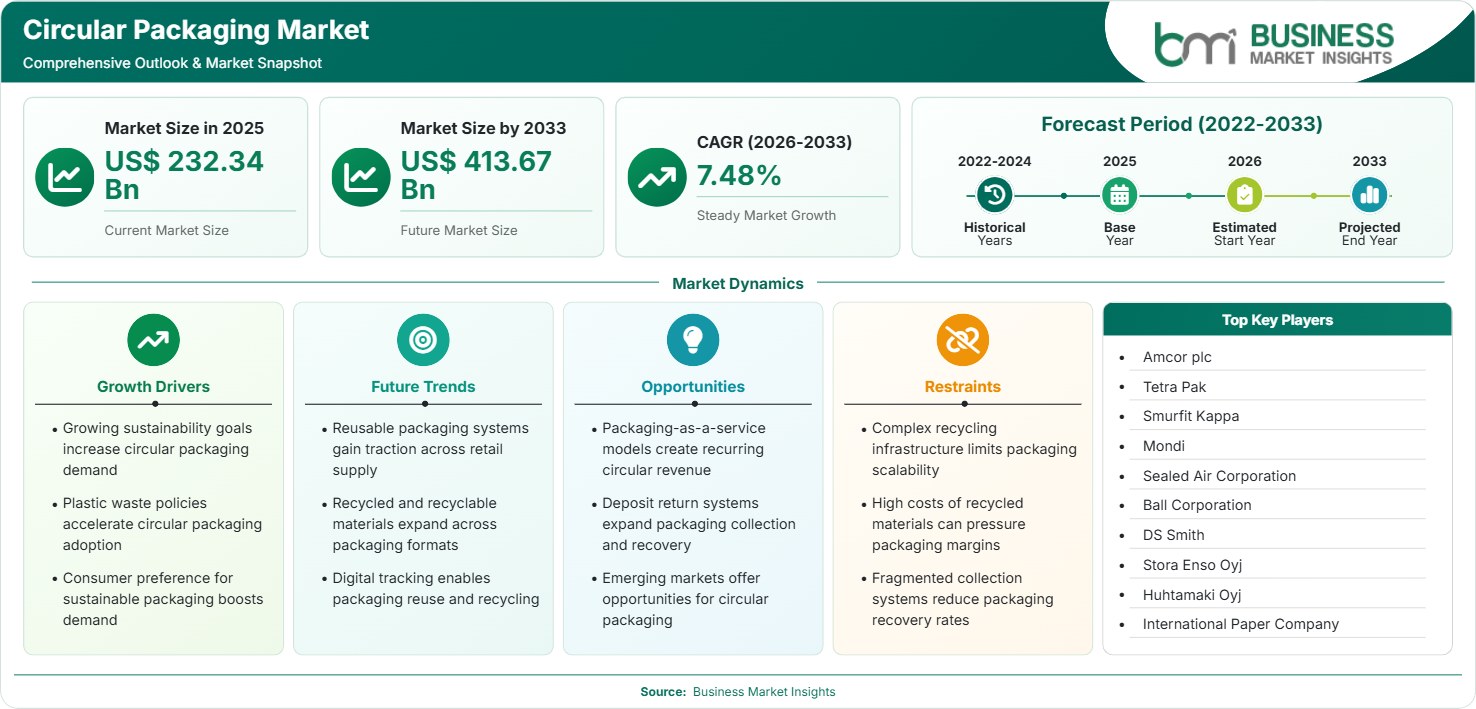
The Circular Packaging Market size was valued at US$ 232.34 Billion in 2025 and is projected to reach US$ 413.67 Billion by 2033, growing at a CAGR of 7.48% during 2026–2033, driven by recycled materials, packaging regulations, light weighting, reusable formats, circular design, recycling infrastructure, and sustainable procurement.

Report Coverage
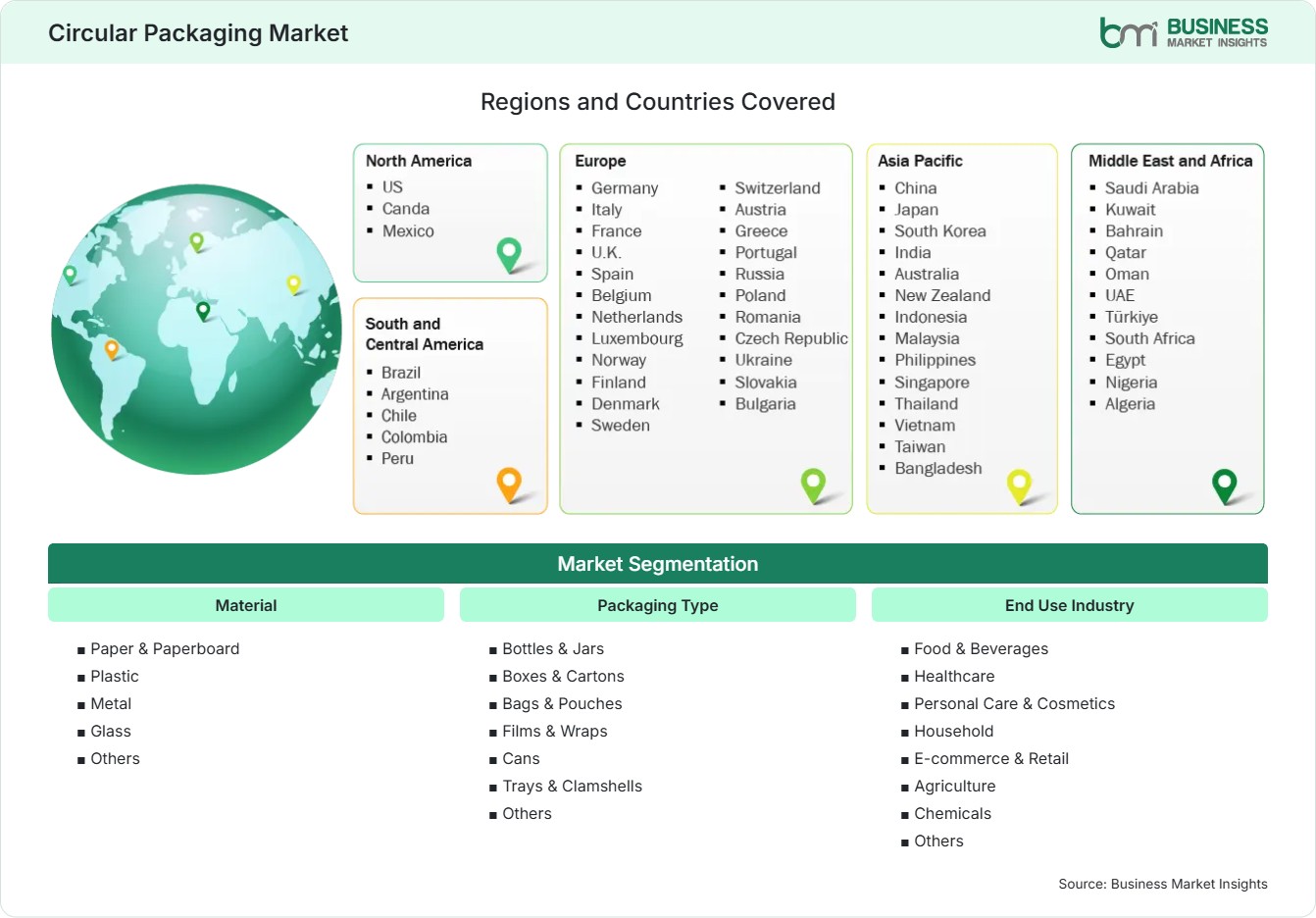
  • Material: Paper & Paperboard, Plastic, Metal, Glass, Others
  • Packaging Type: Bottles & Jars, Boxes & Cartons, Bags & Pouches, Films & Wraps, Cans, Trays & Clamshells, Others
  • End Use Industry: Food & Beverages, Healthcare, Personal Care & Cosmetics, Household, E-commerce & Retail, Agriculture, Chemicals, Others
US$ 232.34 Bn Market size in 2025
US$ 413.67 Bn Market Size by 2033
7.48% CAGR, 2026 - 2033
2026-2033 Forecast Period

AI Overview

Circular Packaging Market Summary

  • North America Region: North America held a 26%–30% share in 2025, with a 6.9%–7.7% CAGR during 2026–2033, supported by recycled-content adoption, packaging redesign, producer-responsibility initiatives, recycling investments, light weighting, and sustainability commitments. The US remains the principal contributor, with food, beverage, healthcare, household, and e-commerce packaging sustaining demand.
  • Fastest Growing Region: Asia Pacific held a 34%–38% share in 2025, with an 8.1%–8.9% CAGR during 2026–2033, driven by urbanization, packaged-food consumption, e-commerce, recycling investment, environmental regulation, expanding manufacturing capacity, and increasing adoption of paper, recyclable plastics, metal, and glass packaging.
  • Leading Segment: Paper & Paperboard held a 39%–43% circular packaging market share in 2025, with a 7.6%–8.2% CAGR during 2026–2033, supported by renewable fiber, established recycling pathways, e-commerce demand, light weighting, carton applications, and substitution of difficult-to-recycle packaging structures.
  • High Growth Segment: Bags & Pouches held a 13%–17% share in 2025, with an 8.2%–9.0% CAGR during 2026–2033, supported by light weighting, material efficiency, convenience, recyclable mono-material structures, improved barrier technologies, and growing demand for flexible packaging.
  • Key Market Opportunity: Packaging manufacturers can capture value through recyclable mono-materials, fiber-based alternatives, recycled-content integration, reusable systems, digital traceability, closed-loop procurement, advanced recycling, and collection partnerships.
  • Major Market Players: Amcor plc, Tetra Pak, Smurfit Kappa, Mondi, Sealed Air Corporation, Ball Corporation, DS Smith, Stora Enso Oyj, Huhtamaki Oyj, and International Paper Company.
Strategic Insights

Circular Packaging Market: Strategic Insights

Circular Packaging Market Strategic Framework
FREE PDF
Request your free sample
Request free sample
Stakeholder View

Key Takeaways

  • Circular packaging involves the collaboration of material manufacturers, converters, packaging manufacturers, brands, retailers, collectors, recyclers, and material recovery facilities. The availability of secondary feedstocks is increasingly impacting the economics of products.
  • Paper and paperboard provide significant opportunities wherever fiber recovery is present, whereas recyclable mono-material plastics are still important for flexible, barrier, durable, and lightweight applications.
  • Packaging innovation will involve designing packaging as mono-material, lightweight, recyclable coated, recycled content, identifiable through digital means, better barrier performance, refilling, and design to be recovered via existing systems.
  • Asia Pacific represents a promising market for investments as consumer packaging, food processing, e-commerce, urbanization, and recycling infrastructure development happen all at the same time.
  • Investments are being directed into recycling capacity, recovered material sourcing, packaging conversion, reusability, material testing, sorting, and collaborations between packaging producers and recyclers.
  • Worldwide brands start evaluating their suppliers according to measurable criteria, such as recycled content, recyclability, material savings, reusability, traceability, and recyclability within regional waste streams.
Geographic Outlook

Circular Packaging Market Regional Highlights

North America Circular Packaging Market

North America represented a 26%–30% share in 2025 and is projected to grow at a 6.9%–7.7% CAGR during 2026–2033. The market is defined by high consumer packaging demand coupled with recycling, recycled content, lightweight, and packaging design innovations. The United States drives the regional demand, with Canada adding value through fiber packaging, extended producer responsibility schemes, recycling and sustainable sourcing. Food, beverages, healthcare, personal care, home care, and e-commerce segments continue to dominate.

  • Businesses are designing their packaging with the principles of reducing materials, using recycled materials, recycling their own products and packaging that works with current systems.
  • E-commerce is generating need for right-sized cartons, recyclable protection packaging, reusable shipping methods and packaging that reduces material use.
  • Food and beverage companies are significant purchasers since large amounts of packaging allow them to see real reductions in material use.
  • There are many opportunities in Canada for fiber-based packaging, recycling systems, producer responsibility programs and sustainable packaging purchasing.

US Circular Packaging Market

The US represented approximately 22%–25% of North America's 2025 share, with a modeled 6.8%–7.6% CAGR during 2026–2033. The demand for recycling is driven by packaging redesign, recycling targets, commitments to sustainability, e-commerce, food consumption and investment in collection and recycling infrastructure. Packaging manufacturers are juggling circularity with product protection, shelf life, food safety, costs and logistics efficiency. The needs mentioned above will reward providers of scalability in materials and manufacturing.

  • Recyclable formats, recycling content, and lighter package designs are being demanded for beverages, foodstuffs, household products, and personal care products.
  • E-commerce provides opportunities to incorporate recyclable cartons, reuseable transport packaging, right-sizing, and fiber-based protective packaging.
  • Investment in recycling infrastructure will provide more secondary feedstock and improved supply chain relations between recycling facilities and package producers.

Europe Circular Packaging Market

Europe represented an estimated 28%–32% share in 2025, expanding at a 7.3%–8.1% CAGR during 2026–2033. Regulation remains a central competitive factor because producers face requirements covering recyclability, waste prevention, recycled content, reuse, and producer responsibility. The EU Packaging and Packaging Waste Regulation applies broadly across packaging materials and establishes requirements for manufacturing, composition, reusable characteristics, recoverability, waste management, and prevention. Germany, France, the UK, Italy, and the Netherlands remain important markets.

  • Germany provides opportunities in fiber packaging, recycling, reusable formats, and packaging engineered around established collection and recovery infrastructure.
  • France offers opportunities through reuse systems, producer-responsibility mechanisms, packaging reduction initiatives, and recyclable packaging development.
  • The UK provides demand for recyclable paperboard, recycled plastics, reusable transport packaging, and packaging aligned with evolving producer-responsibility requirements.
  • The Netherlands remains an important innovation environment for circular materials, recycling, reuse, and packaging redesign.

Asia Pacific Circular Packaging Market

Asia Pacific represented a 34%–38% share in 2025, with the fastest modeled growth of 8.1%–8.9% CAGR during 2026–2033. China, India, Japan, South Korea, Australia, and Southeast Asia contribute through packaged-food demand, e-commerce, urbanization, manufacturing capacity, and expanding waste-management investment. India and China offer particularly strong opportunities because consumer packaging volumes are expanding while regulatory and corporate initiatives increasingly emphasize collection, recycling, recycled materials, and packaging reduction.

  • China combines extensive packaging manufacturing capacity with growing recycling investment and demand for recyclable consumer and industrial packaging.
  • India offers opportunities across paperboard, recyclable plastics, reusable transport packaging, recycling infrastructure, and sustainable packaging for expanding consumer categories.
  • Japan emphasizes resource efficiency, packaging reduction, light weighting, high-quality material recovery, and technically advanced packaging systems.
  • Southeast Asia provides opportunities as packaged-food consumption, retail modernization, tourism, e-commerce, and urbanization increase packaging demand.

Rest of World Circular Packaging Market

Rest of World represented approximately 14%–18% share in 2025, with a modeled 7.0%–7.9% CAGR during 2026–2033. Latin America provides opportunities through recycling investment, producer-responsibility programs, food processing, retail expansion, and paper packaging adoption. Brazil and Mexico are particularly relevant because of their large consumer markets and manufacturing bases. Chile and Colombia are developing circular-economy frameworks supporting packaging recovery and redesign.

Middle Eastern and African markets offer longer-term opportunities as urbanization, food processing, retail modernization, waste-management investment, and sustainability programs increase. Suppliers can benefit from local recycling infrastructure, regional converting capacity, and demand for sustainable consumer packaging.

  • Brazil offers opportunities in paperboard, recycled plastics, beverage packaging, recycling systems, and sustainable packaging conversion.
  • Mexico benefits from manufacturing, food and beverage production, export-oriented packaging demand, and improving material-recovery initiatives.
  • Gulf markets provide opportunities for premium packaging, food applications, retail formats, recycling infrastructure, and circular-material procurement.
  • African markets offer emerging opportunities as collection systems, recycling capacity, urban consumption, and packaging manufacturing expand.
Global Market Geography
FREE PDF
Request your free sample
Request free sample
Segment Analysis

Circular Packaging Market Segmentation

Material

Paper & Paperboard represented an estimated 39%–43% share in 2025, growing at 7.6%–8.2% CAGR during 2026–2033. Fiber availability, recycling compatibility, e-commerce demand, and plastic substitution support adoption. The Circular Packaging Market scope increasingly includes paperboard innovation, recycled fiber, barrier coatings, lightweight cartons, and recyclable corrugated structures.

  • Paper & Paperboard: Supports cartons, corrugated boxes, bags, and fiber formats through renewable feedstocks, established recovery systems, e-commerce demand, and plastic-substitution initiatives.
  • Plastic: Remains important where flexibility, durability, barrier performance, and lightweighting are required, with circularity supported by mono-material structures and recycled content.
  • Metal: Benefits from durability, established recycling pathways, recycled content, beverage applications, and repeated material recovery.
  • Glass: Supports beverages, food, cosmetics, and premium packaging through reuse potential, collection systems, and established remelting capabilities.
  • Others: Includes emerging materials and specialized structures designed to reduce resource consumption or improve end-of-life recovery.

Packaging Type

Bags & Pouches represented an estimated 13%–17% share in 2025, expanding at 8.2%–9.0% CAGR during 2026–2033. Lightweighting, convenience, material efficiency, and recyclable flexible structures support adoption. The Circular Packaging Market trends increasingly favor mono-material films, improved barriers, reduced material usage, and recovery-compatible flexible packaging.

  • Bottles & Jars: Demand recyclable PET, HDPE, glass, and reusable formats across beverages, food, cosmetics, healthcare, and household applications.
  • Boxes & Cartons: Benefit from paper recycling, e-commerce shipments, food applications, lightweighting, and fiber-based substitution.
  • Bags & Pouches: Provide material efficiency and convenience while shifting toward recyclable mono-material structures and improved barrier technologies.
  • Films & Wraps: Require advances in mono-material construction, downgauging, recycled content, and collection infrastructure to improve circularity.
  • Cans: Benefit from metal recovery, recycled content, lightweighting, durability, and established recycling systems.
  • Trays & Clamshells: Support food and retail protection while shifting toward recyclable plastics, fiber alternatives, and lower material intensity.
  • Others: Covers specialized packaging structures serving specific protection, logistics, convenience, and circularity requirements.

End-use Industry

Food & Beverages represented an estimated 40%–44% share in 2025, expanding at 7.4%–8.1% CAGR through 2033. High packaging volumes, regulatory attention, consumer visibility, and retailer commitments make this application important. The Circular Packaging Market share within food and beverages benefits from recyclable bottles, cartons, cans, trays, pouches, and fiber-based alternatives.

  • Food & Beverages: Drives high packaging volumes and demand for recyclable bottles, cartons, cans, trays, pouches, and fiber-based structures.
  • Healthcare: Requires hygienic and protective packaging while exploring recyclable materials and lower-material solutions compatible with performance requirements.
  • Personal Care & Cosmetics: Supports refillable systems, recycled materials, recyclable containers, lightweight formats, and premium sustainable packaging.
  • Household: Creates opportunities for recyclable containers, refill systems, concentrated products, recycled plastics, and packaging designed for recovery.
  • E-commerce & Retail: Encourages right-sizing, recyclable shipping materials, reusable transport packaging, fiber protection, and reduced packaging intensity.
  • Agriculture: Uses films, bags, containers, and transport packaging, creating opportunities for collection systems and recovered-material adoption.
  • Chemicals: Requires high-performance packaging while adopting reusable transport packaging, recycled materials, and recovery-oriented designs.
  • Others: Includes specialized applications adopting circular materials where regulatory, environmental, and supply-chain benefits justify redesign.
Market Forces

Circular Packaging Market Dynamics

Key Market Drivers

Regulatory requirements accelerate circular packaging design

Regulation is strengthening demand for recyclable, reusable, recoverable, and recycled-content packaging. The Circular Packaging Market growth outlook is therefore increasingly connected to compliance-oriented redesign, packaging data, recyclability assessment, material reduction, and producer-responsibility requirements. Packaging suppliers providing packaging solutions for countries in multiple regions are developing standard packaging platforms which would be able to meet more stringent regional regulations. These new regulations increase the requirements for testing and certification as well as technical advisory. Packaging suppliers who are able to provide evidence of recyclability can enhance their position in front of multinational brand owners. According to Ellen MacArthur Foundation, recyclability of packaging should be defined as successful collection, sorting, and recycling in practice and at scale.

Brand commitments increase demand for measurable circularity

Large consumer brands are increasingly integrating packaging performance into procurement and sustainability programs. This demonstrates both progress and a substantial opportunity gap. Circular Packaging Market trends are consequently moving beyond simple material substitution toward measurable outcomes involving recycled content, recyclability, reuse, lightweighting, and recovery. Supplier responses include innovations in materials, design of packages, closed loop arrangements, and data reporting. The need for brands to prove that the package redesign maintains product performance while lowering its environmental impact favors packaging firms that have all these disciplines combined.

E-commerce and consumer packaging amplify material-efficiency needs

E-commerce and packaged-product consumption are increasing the commercial importance of right-sizing, lightweighting, protective efficiency, and recyclable shipping materials. The Circular Packaging Market growth opportunity is strongest where packaging companies can reduce material use without compromising product protection, shelf life, transportation efficiency, and consumer convenience. Corrugated boxes, protective paper-based packaging, recyclable films, reusable transport packaging, and fiber-based structures have been gaining recognition in logistics-heavy supply chains. Redesigning packaging can also lead to increased transportation efficiency by virtue of reduced weight or size, which would decrease shipment volume. The potential lies in packaging identification as well, since more effective identification will help to enhance sorting and recycling. For this reason, packaging is increasingly being assessed by brands and retailers from a systems perspective that incorporates product design, distribution, consumer use, and end-of-life treatment.

Key Market Opportunities

Mono-material structures enable flexible-packaging redesign

Mono-material solutions present an opportunity for flexible packaging, as they help simplify materials without sacrificing flexibility and barriers. Innovation in polymers, coatings, adhesives, print, and high barrier films makes this possible. Such an opportunity applies especially to packaging for food, pet food, household, agriculture, and personal care products. Manufacturers will be able to develop differentiators through downgauging with recycled content and recycle-ready packaging structure. Material and recycling testing will also be essential since technical recyclability needs to be converted into practical recyclability. Those manufacturers who achieve a proper balance between barrier, packaging, cost, and recyclability will be able to build partnerships with major consumer brands globally.

Reuse models can create recurring packaging-service revenues

The potential of reusable packaging exists to design business models around collection, washing, redistribution, tracking of assets, and packaging-as-a-service. Such a model is more commercially viable if return logistics are concentrated, e.g., food delivery, beverages, grocery chains, industrial logistics, and controlled retail networks. The Ellen MacArthur Foundation sees an opportunity in reuse and stresses the importance of sharing of infrastructures, standardization of packaging, and collaborative approach. Packaging firms may collaborate with retailers, logistic companies, food service companies, and tech companies to create pools of reusable packages. Digital identification might enhance visibility and returns of assets. While reverse logistics and cleaning will bring additional cost, the benefits come from high frequency of circulation, which leads to utilization improvements. It is possible to generate predictable revenues rather than rely only on sales of single-use packages.

Recovered-material supply chains support strategic investment

Access to dependable sources of secondary materials is now a strategic priority as the demands on recycled content are increasing. This provides investment opportunities in terms of collection, sorting, washing, reprocessing, recovering fibers, quality control, certification, and traceability. The packaging companies will be able to lock-in their sources through contractual arrangements with the recyclers or investing in the recovery capabilities. Such closed-loop approaches will also ensure more reliable quality of material supply while lowering risks of volatility of the secondary materials market. Advanced recycling can potentially augment mechanical recycling for some selected raw materials while taking into account economic viability, energy needs, regulatory approval, and output quality.

Market Restraints and Challenges

Factor: Fragmented recycling infrastructure limits actual recovery

Factor: Collection, sorting, recycling, and reprocessing capabilities vary substantially by geography and material. Impact: Packaging that is designed for being recycled might not get into recovery pathways that will be able to process it effectively. Flexible plastics, multi-layered materials, contaminated packaging, and small-scale formats of packaging are some examples of packaging that might struggle with collection and sorting issues. The Ellen MacArthur Foundation states that infrastructure might be one of the biggest opportunities and obstacles to moving towards circularity. In that way, packaging companies cannot rely only on design in order to move towards circularity. Packaging companies have to collaborate with cities, recyclers, retailers, producer responsibility organizations, and waste companies. The investments in infrastructure might make costs higher until enough amounts are collected.

Factor: Recycled-feedstock volatility affects packaging economics

Factor: Recycled-material availability and quality can fluctuate according to collection rates, contamination, processing capacity, commodity prices, and regional infrastructure. Impact: The packaging producers may face variability in material characteristics, high procurement prices, and difficulties with the maintenance of their recycled content specifications. Food contact packaging brings its own set of quality standards and compliance rules. The use of virgin materials may prove more consistent in terms of supply, characteristics, and processing, especially for complex applications. The producers should look for diversity in supply sources, qualification of suppliers, testing of materials, procurement agreements, and traceability. Additional investments in sorting, purification, and closed-loop systems will improve consistency, but they will also demand capital. This problem with costs may slow the implementation of the technology in packaging segments where price is a factor.

Company Analysis

Competitive Landscape

Circular Packaging Market analysis indicates that competition increasingly depends on material innovation, conversion technology, recycled-content integration, recycling compatibility, supply-chain control, and the ability to deliver sustainable packaging at commercial scale.

Company Name

Overview

Products and Services relevant to this market

Amcor plc

Global packaging producer serving food, beverage, healthcare, personal care, and consumer markets.

Flexible and rigid packaging, recycle-ready films, recycled-content solutions, containers, and packaging innovation.

Tetra Pak

Global food-processing and packaging company with strong carton-based food and beverage capabilities.

Paperboard cartons, packaging materials, filling systems, recycling solutions, and sustainable packaging technologies.

Smurfit Kappa

Major paper-based packaging producer with extensive corrugated packaging capabilities.

Corrugated boxes, paper packaging, displays, bags, recycling, and fiber-based circular solutions.

Mondi

International packaging and paper company providing flexible and fiber-based packaging solutions.

Paper bags, corrugated packaging, flexible packaging, paper alternatives, and recyclable structures.

Sealed Air Corporation

Packaging technology company serving food, healthcare, e-commerce, and industrial applications.

Protective packaging, flexible films, food packaging, paper solutions, and material-efficiency technologies.

Ball Corporation

Major metal packaging manufacturer focused strongly on beverage packaging.

Aluminum cans, bottles, lightweighting, recycled aluminum, and circular metal-packaging solutions.

DS Smith

Fiber-based packaging company focused on sustainable packaging and recycling systems.

Corrugated packaging, cartons, paper products, recycling, design, and fiber-based packaging solutions.

Stora Enso Oyj

Renewable-materials company producing packaging board and renewable packaging solutions.

Packaging board, paperboard, renewable materials, fiber products, and recyclable packaging applications.

Huhtamaki Oyj

Global packaging company serving foodservice, retail, and consumer markets.

Paperboard packaging, molded fiber, flexible packaging, food packaging, and sustainable solutions.

International Paper Company

Major fiber-based packaging and recovered-material producer with recycling capabilities.

Corrugated packaging, paperboard, recycling services, recovered materials, and fiber-based packaging.

Trust & Transparency

Research Methodology

The market analysis combines proprietary research with secondary data from government agencies, company disclosures, regulatory filings, industry databases and expert interviews. Market estimates are validated through data triangulation, cross-market benchmarking and analyst review.

View Full Research Methodology

Questions Answered

Frequently Asked Questions

What will influence Circular Packaging Market Forecasts?

Regulation, recycled-material availability, recycling infrastructure, packaging redesign, consumer-brand commitments, e-commerce, reusable systems, material prices, technological innovation, and regional waste-management investment will shape future development.

Can reusable packaging compete with recyclable packaging?

Yes, where return logistics, cleaning infrastructure, standardized formats, and high circulation rates are economically practical. Reuse can be particularly attractive in concentrated distribution systems.

What makes flexible packaging difficult to recycle?

Multilayer constructions can combine polymers, films, coatings, adhesives, inks, and barrier materials that complicate sorting and recycling. Mono-material structures aim to reduce this complexity while maintaining product protection.

Why is paper and paperboard a leading material?

Paper and paperboard benefit from renewable fiber, established recycling pathways, strong e-commerce applications, carton demand, and opportunities to replace selected difficult-to-recycle structures.

What is the market report used for?

The Circular Packaging Market Report helps packaging manufacturers, material suppliers, recyclers, brands, investors, and procurement teams evaluate demand patterns, regional opportunities, material preferences, application growth, competitive positioning, and investment priorities.

Access the Full Circular Packaging Market Report

Get segment-level forecasts, regional estimates, competitive benchmarking, company profiles and downloadable Excel datasets.

Access the full Circular Packaging Market Report
350 pages PDF & Excel | 2026-09-03