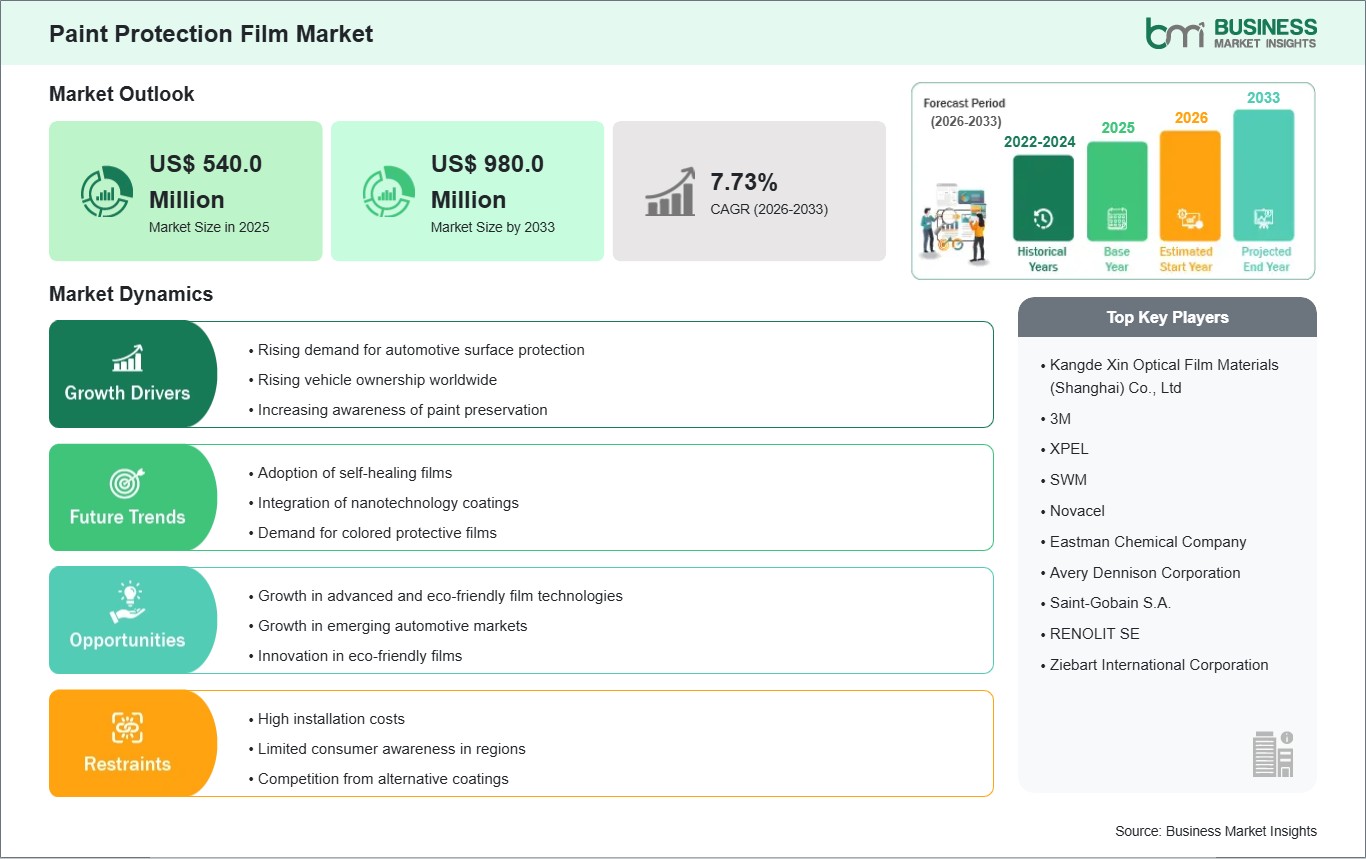
The Paint Protection Film Market size is expected to reach US$ 980.0 Million by 2033 from US$ 540.0 Million in 2025. The market is estimated to record a CAGR of 7.73% from 2026 to 2033.
The paint protection film (PPF) market is seeing significant growth due to the increasing rate of automotive production, consumer interest in vehicle appearance, and the expansion of customization services. Paint protection film, made of a transparent urethane-based film, is applied over the vehicle surface and provides an important layer of protection. The increasing trend towards vehicle resale value, along with the premiumization of vehicles, is driving the paint protection film market. Innovation is an important factor in the paint protection film market, with manufacturers focusing on multi-functional films with self-healing, hydrophobic, and anti-yellowing benefits. Technology has played an important role in the development of paint protection films, with improvements in durability and application. Advances in the cutting and pre-mask of paint protection films ensure precise application, reducing labor costs and increasing consumer convenience. The environment has also played an important role in the paint protection film market, with manufacturers focusing on the use of environmentally friendly materials. There is a shift toward eco-friendly and solvent-free adhesive systems, reducing VOC emissions during production and installation.
Moreover, increasing awareness of sustainable practices among end-users is prompting manufacturers to optimize film recyclability and minimize waste across the supply chain. The competitive landscape is characterized by consolidation and strategic collaborations. Global PPF leaders are expanding their presence through partnerships with automotive OEMs, dealerships, and service centers, while niche players focus on regional markets with customized offerings. Market growth is also fueled by rising e-commerce and online distribution channels for DIY PPF kits, broadening consumer access beyond professional installers. Overall, the PPF market is defined by a convergence of advanced material science, consumer-driven demand for vehicle protection, and sustainability-oriented innovation. Manufacturers that can deliver high-performance, environmentally conscious, and user-friendly films are well-positioned to capture growth opportunities in both OEM and aftermarket segments.

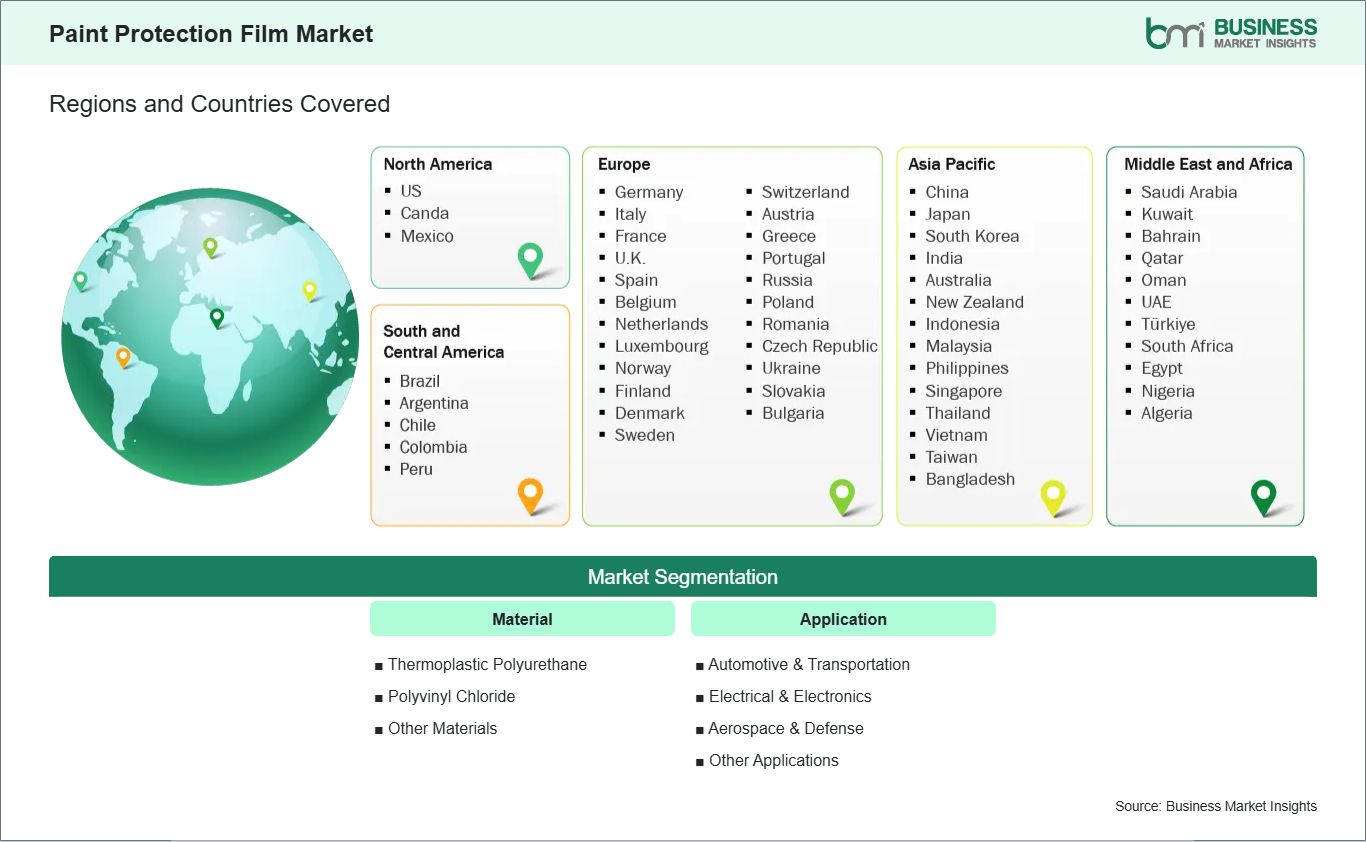
Key segments that contributed to the derivation of the paint protection film market analysis are material and application.
The use of paint protection films is on the rise due to the increase in demand for solutions that protect vehicle finishes and appearance. Paint protection films offer resistance to scratches, stone chips, UV damage, and environmental contaminants. This is making paint protection films an integral part of vehicle maintenance. The focus on vehicle appearance and resale value is making paint protection films an integral aspect of new and used vehicles.
Technological developments are making paint protection films better and easier to use. New paint protection films offer better optical clarity and self-healing characteristics, making them easier to integrate with vehicle surfaces. The use of paint protection films is being increasingly marketed and promoted by vehicle manufacturers and other industry players. The use of paint protection films is not only for vehicles but is also on the rise for other applications, including motorcycles, boats, and fleet vehicles.
Consumer awareness and premiumization are also driving the market. Car owners are looking for professional-grade protection products that require low maintenance and have a high aesthetic appeal. Paint protection films have now become available in different finishes, such as gloss, matte, and texture, to suit individual tastes. Innovation and marketing activities are driving the adoption of paint protection films across different segments of the automobile industry, thereby sustaining the growth trend.
New innovations in advanced paint protection films provide new opportunities in this industry. Films such as self-healing capabilities, UV protection, and hydrophobic coatings provide better longevity and application efficiency. Manufacturers of these products are working towards developing products that offer better application ease, longevity, and surface applicability. These innovations in paint protection films provide better opportunities in this industry.
One of the major trends in this industry is eco-friendly film technology. Manufacturers of these products are working towards developing products that offer better biodegradability/recyclability of these products and water-based adhesives. This trend is in alignment with other sustainability initiatives in the automotive industry. These eco-friendly products offer better opportunities in this industry. Consumers of these products are now more concerned about the environmental implications of these products.
Research and development activities are focused on increasing the versatility of paint protection films. Colored paint protection films, textured paint protection films, and multi-functional paint protection films are some of the innovations that have made paint protection films more versatile. The blend of high-performance paint protection films and the green movement has increased the potential of the paint protection film industry. As the paint protection film industry grows, paint protection films, especially the green paint protection films, are expected to become the standard in the industry, satisfying the needs of the customers as well as the industry itself.
The paint protection film market demonstrates steady growth, with size and share analysis highlighting evolving trends and competitive dynamics among key players. The report examines subsegments categorized within material and application, offering insights into their contribution to overall market performance.
By Material, the thermoplastic polyurethane (TPU) subsegment dominated the market in 2025, driven by its superior flexibility and protective properties.
Based on Application, the automotive & transportation subsegment dominated the market in 2025, supported by growing demand for vehicle surface protection solutions.
| Report Attribute | Details |
|---|---|
| Market size in 2025 | US$ 540.0 Million |
| Market Size by 2033 | US$ 980.0 Million |
| Global CAGR (2026 - 2033) | 7.73% |
| Historical Data | 2022-2024 |
| Forecast period | 2026-2033 |
| Segments Covered | By Material
|
|
Regions and Countries Covered
| |
| North America | US, Canada, Mexico |
| Europe | Belgium, Austria, Finland, Denmark, Greece, Poland, Romania, Russia, Ukraine, Czech Republic, Slovakia, Bulgaria, Italy, Luxembourg, Germany, Switzerland, France, Netherlands, Norway, Portugal, Spain, Sweden, United Kingdom |
| Asia-Pacific | Australia, China, India, Japan, South Korea, Indonesia, Malaysia, Philippines, Singapore, Thailand, Vietnam, Bangladesh, New Zealand, Taiwan |
| South and Central America | Brazil, Argentina, Peru, Chile, Colombia |
| Middle East and Africa | Bahrain, Kuwait, Oman, Qatar, Saudi Arabia, United Arab Emirates, Turkiye, South Africa, Egypt, Algeria, Nigeria |
| Market leaders and key company profiles |
|
The "Paint Protection Film Market Size and Forecast (2022 - 2033)" report provides a detailed analysis of the market covering below areas:
The geographical scope of the Paint Protection Film Market report is divided into North America, Asia Pacific, Europe, Middle East & Africa, and South & Central America. North America held the largest share in 2025.
Regional-level dynamics in the paint protection film market reveal distinct demand patterns shaped by automotive industry maturity, consumer preferences, regulatory environments, and aftermarket development. North America emerges as the dominant market, driven by a well-established automotive sector, high disposable incomes, and strong adoption of aftermarket customization services. The United States and Canada show significant demand for luxury and mid-range vehicles, where consumers prioritize paint preservation, aesthetic appeal, and resale value. A mature installation infrastructure, combined with widespread availability of DIY PPF kits through online retail channels, further reinforces the market’s dominance. Regulatory adherence to environmental standards also encourages the use of eco-friendly adhesive systems, positioning North America as a leader in innovation and high-performance product adoption.
Europe represents a mature and quality-driven market, with Germany, France, and Italy leading in both OEM integration and aftermarket solutions. Consumers in the region demand high-performance, self-healing, and UV-resistant films to maintain premium vehicle finishes. Additionally, stringent environmental regulations incentivize solvent-free and recyclable films, shaping the development of eco-conscious products. Professional installation networks and a strong luxury vehicle base further drive market growth.
Asia Pacific is witnessing rapid expansion, spearheaded by China, Japan, and India, driven by rising automotive production, urbanization, and growing awareness of vehicle aesthetics and protection. The luxury and premium vehicle segments are expanding, increasing demand for high-performance PPF. Local manufacturers are upgrading production technologies to balance quality standards with cost-sensitive consumer requirements, while aftermarket adoption continues to grow alongside the rise of automotive service networks.
Middle East & Africa is an emerging market, characterized by growing premium vehicle ownership and exposure to harsh climatic conditions, such as intense sunlight and sandstorms, which increase the need for UV- and scratch-resistant films. Adoption is concentrated in urbanized areas with developed dealership and service infrastructure, with market expansion tied to both OEM partnerships and aftermarket services.
South & Central America exhibits steady growth, primarily led by Brazil and Mexico. Rising automotive production, urbanization, and increasing consumer awareness are driving PPF adoption. Cost sensitivity and limited professional installation infrastructure moderate market penetration; however, expanding premium vehicle sales and rising disposable incomes are gradually enhancing demand for high-quality films.

The Paint Protection Film Market is evaluated by gathering qualitative and quantitative data post primary and secondary research, which includes important corporate publications, association data, and databases. A few of the key developments in the paint protection film market are:
The Paint Protection Film Market is valued at US$ 540.0 Million in 2025, it is projected to reach US$ 980.0 Million by 2033.
As per our report Paint Protection Film Market, the market size is valued at US$ 540.0 Million in 2025, projecting it to reach US$ 980.0 Million by 2033. This translates to a CAGR of approximately 7.73% during the forecast period.
The Paint Protection Film Market report typically cover these key segments-
The historic period, base year, and forecast period can vary slightly depending on the specific market research report. However, for the Paint Protection Film Market report:
The Paint Protection Film Market is populated by several key players, each contributing to its growth and innovation. Some of the major players include:
The Paint Protection Film Market report is valuable for diverse stakeholders, including:
Essentially, anyone involved in or considering involvement in the Paint Protection Film Market value chain can benefit from the information contained in a comprehensive market report.
Please tell us your area of interest
(Market Segments/ Regions and Countries/ Companies)