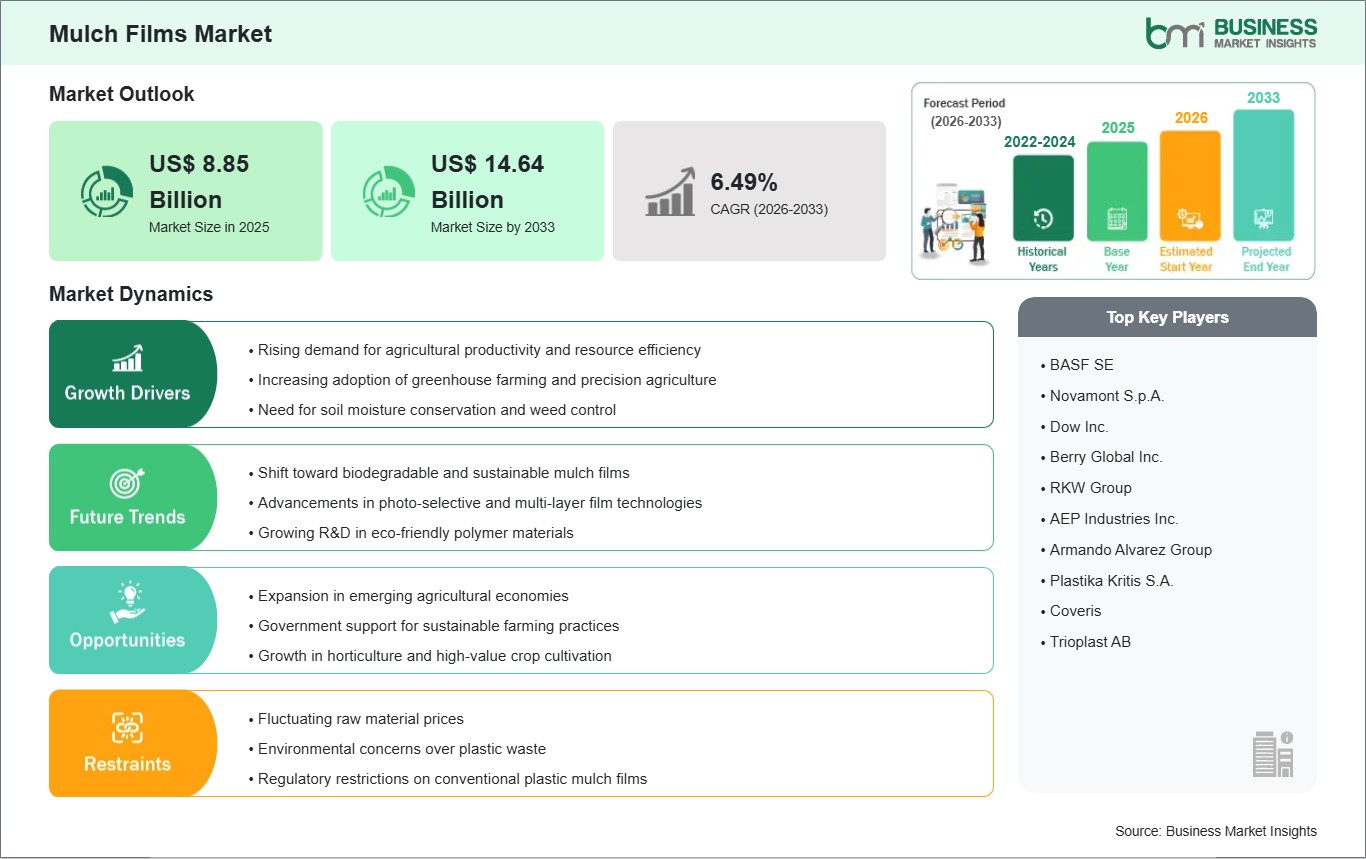
The Mulch Films Market size is expected to reach US$ 14.64 Billion by 2033 from US$ 8.85 Billion in 2025. The market is estimated to record a CAGR of 6.49% from 2026 to 2033.
The mulch films market is witnessing strong and sustained growth, driven by the increasing global emphasis on agricultural efficiency, food security, and sustainable farming practices. Mulch films are widely used in agriculture and horticulture to improve crop productivity by conserving soil moisture, regulating soil temperature, and reducing weed growth. These functional benefits make mulch films an essential component of modern agricultural systems, particularly in regions facing water scarcity and declining arable land.
The growing global population has intensified the demand for higher agricultural output, prompting farmers and agribusinesses to adopt advanced cultivation techniques. Mulch films contribute significantly to yield improvement by creating a controlled microclimate for crops, enabling faster germination and better plant health. Additionally, they help reduce reliance on herbicides and pesticides, aligning with the increasing shift toward environmentally sustainable farming practices.
From a material standpoint, conventional polyethylene-based mulch films such as LLDPE and LDPE continue to dominate the market due to their cost-effectiveness, durability, and widespread availability. However, rising environmental concerns regarding plastic waste accumulation are driving the adoption of biodegradable alternatives such as PLA and PHA. These materials offer the advantage of decomposing naturally in soil, eliminating the need for removal and disposal after use.
Technological advancements are further shaping the market, with innovations such as photo-selective mulch films enabling crop-specific light transmission and improved productivity. The market is also benefiting from supportive government policies and subsidies promoting sustainable agriculture. Despite challenges such as fluctuating raw material prices and disposal concerns, the mulch films market is expected to maintain steady growth, supported by innovation, sustainability trends, and increasing agricultural demand globally.

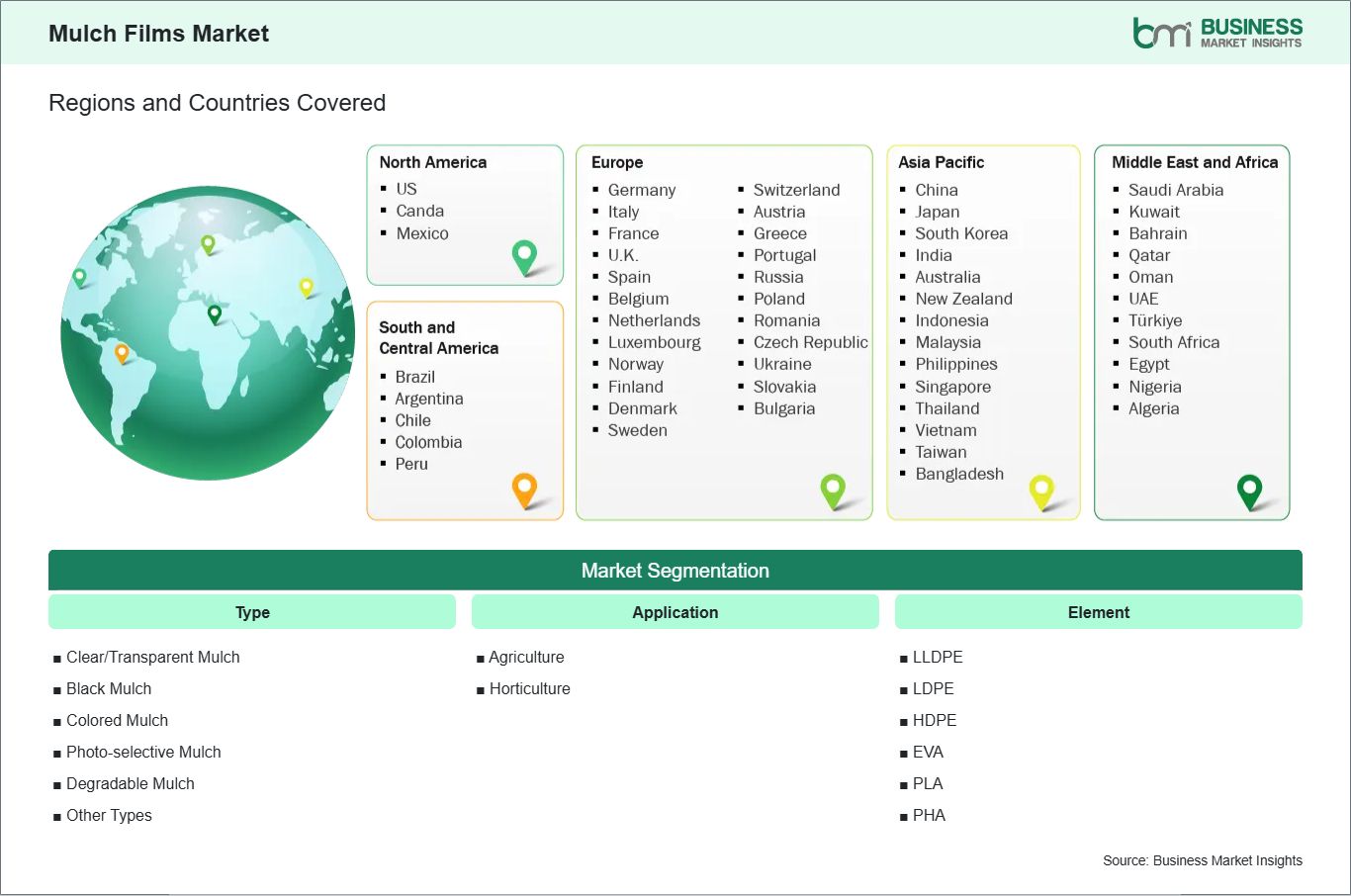
Key segments that contributed to the derivation of the mulch films market analysis are type, application, and element.
The demand for mulch films is driven largely by the increasing need to enhance agricultural productivity throughout the world due to the continued growth of the world’s population. These two factors create intense pressure on the agricultural sector to produce more food on a limited amount of land and water.
Mulch films are helping to address these challenges by improving soil conditions thus optimizing crop yield. Mulch films reduce evaporation therefore conserving soil moisture. This becomes especially helpful to farmers in areas with limited or scarce water. Therefore, mulch films enable farmers to reduce their need for irrigation, reducing water use and expense. In addition, mulch films help regulate soil temperature, creating suitable conditions for seed germination and plant growth. All of these benefits create greater crop yields and improve the quality of agricultural outputs.
Another major benefit that mulch films provide is weed suppression. By blocking sunlight from reaching the ground, mulch films will effectively stop weed growth and reduce the need for chemical herbicides. This lowers input costs and creates a more environmentally sustainable farming operation. Furthermore, mulch films help to reduce soil erosion and nutrient loss; therefore improving soil health over the long term.
Mulch films are also increasing in demand as farmers adopt greenhouse farming and precision agriculture technology. Farmers are investing more into these technologies and will need mulch films to protect their investments in these areas.
The mulch films marketplace has a significant opportunity to innovate, specifically with regards to designing biodegradable and high-performing products. Traditional plastic mulch works well; however, they are not good for the environment as they cannot decompose and are difficult to get rid of after they are used. Due to this fact, more and more regulations are becoming available and overall demand for sustainable products is increasing.
Biodegradable mulch films made from PLA, PHA, etc. are getting more interest because they can be broken down by microbes in the soil. This means that there is no need to take them off and no need to throw them away, which leads to reduced labour costs and less environmental damage. The adoption of biodegradable mulch films is being promoted through government regulations and sustainability programs that want to reduce the amount of plastic used in agriculture.
Besides biodegradable products, manufacturers are designing new mulch films that have enhanced abilities. An example of this would be the development of photo-selective mulch films which allow for the best light to be transmitted to plants to improve photosynthesis and yield to support growth. Another example is the creation of multi-layer films which improve durability, strength, and environmental resistance (e.g. UV radiation and temperature).
There is also a significant amount of R&D occurring to improve the overall performance of biodegradable films to that of traditional plastics. Technology within polymer science, can now make these products; therefore, innovations will continue to happen.

The Mulch Films Market demonstrates steady growth, with size and share analysis highlighting evolving trends and competitive dynamics among key players. The report examines subsegments categorized within type, application, and material composition, offering insights into their contribution to overall market performance.
By Type, the black mulch subsegment dominated the market in 2025, driven by its effectiveness in weed control and soil temperature regulation.
On the Basis of Application, the agriculture subsegment dominated the market in 2025, propelled by widespread adoption in large-scale farming practices.
By Element, the LLDPE subsegment dominated the market in 2025, owing to its flexibility, strength, and cost efficiency.
| Report Attribute | Details |
|---|---|
| Market size in 2025 | US$ 8.85 Billion |
| Market Size by 2033 | US$ 14.64 Billion |
| Global CAGR (2026 - 2033) | 6.49% |
| Historical Data | 2022-2024 |
| Forecast period | 2026-2033 |
| Segments Covered | By Type
|
|
Regions and Countries Covered
| |
| North America | US, Canada, Mexico |
| Europe | Belgium, Austria, Finland, Denmark, Greece, Poland, Romania, Russia, Ukraine, Czech Republic, Slovakia, Bulgaria, Italy, Luxembourg, Germany, Switzerland, France, Netherlands, Norway, Portugal, Spain, Sweden, United Kingdom |
| Asia-Pacific | Australia, China, India, Japan, South Korea, Indonesia, Malaysia, Philippines, Singapore, Thailand, Vietnam, Bangladesh, New Zealand, Taiwan |
| South and Central America | Brazil, Argentina, Peru, Chile, Colombia |
| Middle East and Africa | Bahrain, Kuwait, Oman, Qatar, Saudi Arabia, United Arab Emirates, Turkiye, South Africa, Egypt, Algeria, Nigeria |
| Market leaders and key company profiles |
|
The "Mulch Films Market Size and Forecast (2022 - 2033)" report provides a detailed analysis of the market covering below areas:
The geographical scope of the Mulch Films Market report is divided into North America, Asia Pacific, Europe, Middle East & Africa, and South & Central America. North America held the largest share in 2025.
Regional dynamics in the mulch films market reveal diverse growth patterns influenced by agricultural practices, technological adoption, and regulatory frameworks. North America represents the largest and most mature market, driven by the widespread adoption of advanced farming techniques and strong awareness of sustainable agricultural practices. The region benefits from high investment in precision agriculture, well-established agribusiness infrastructure, and the presence of leading market players. Farmers in North America increasingly utilize mulch films to improve crop yield, conserve water, and reduce chemical usage, supporting the region’s dominant position.
Europe closely follows with strict environmental laws to promote sustainability. The region has been a leader in the approval of biodegradable mulch films, thanks to policies to reduce plastic waste. Countries like Germany, France and the UK promote environmentally friendly farming solutions, resulting in steady growth in the market.
Asia Pacific is rapidly growing due to large-scale agricultural production, population growth and increased food demand. China and India are increasing their use of mulch films due to government incentives to adopt modern farming practices and conserve water.
Gradual growth is taking place in the Middle East and Africa as investments in agriculture increase and the demand for efficient water management in dry climates increases. As a result, South and Central America are seeing moderate growth in mulch film usage due to increased agricultural production in Brazil and Mexico.
Despite the significant growth of volume in these regions, North America is still the largest market due to its technological sophistication, high level of adoption and strong regulatory framework to encourage sustainable agriculture.

The Mulch Films Market is evaluated by gathering qualitative and quantitative data post primary and secondary research, which includes important corporate publications, association data, and databases. A few of the key developments in the mulch films market are:
The Mulch Films Market is valued at US$ 8.85 Billion in 2025, it is projected to reach US$ 14.64 Billion by 2033.
As per our report Mulch Films Market, the market size is valued at US$ 8.85 Billion in 2025, projecting it to reach US$ 14.64 Billion by 2033. This translates to a CAGR of approximately 6.49% during the forecast period.
The Mulch Films Market report typically cover these key segments-
The historic period, base year, and forecast period can vary slightly depending on the specific market research report. However, for the Mulch Films Market report:
The Mulch Films Market is populated by several key players, each contributing to its growth and innovation. Some of the major players include:
The Mulch Films Market report is valuable for diverse stakeholders, including:
Essentially, anyone involved in or considering involvement in the Mulch Films Market value chain can benefit from the information contained in a comprehensive market report.
Please tell us your area of interest
(Market Segments/ Regions and Countries/ Companies)