Market Summary
Executive Summary and Global Market Analysis
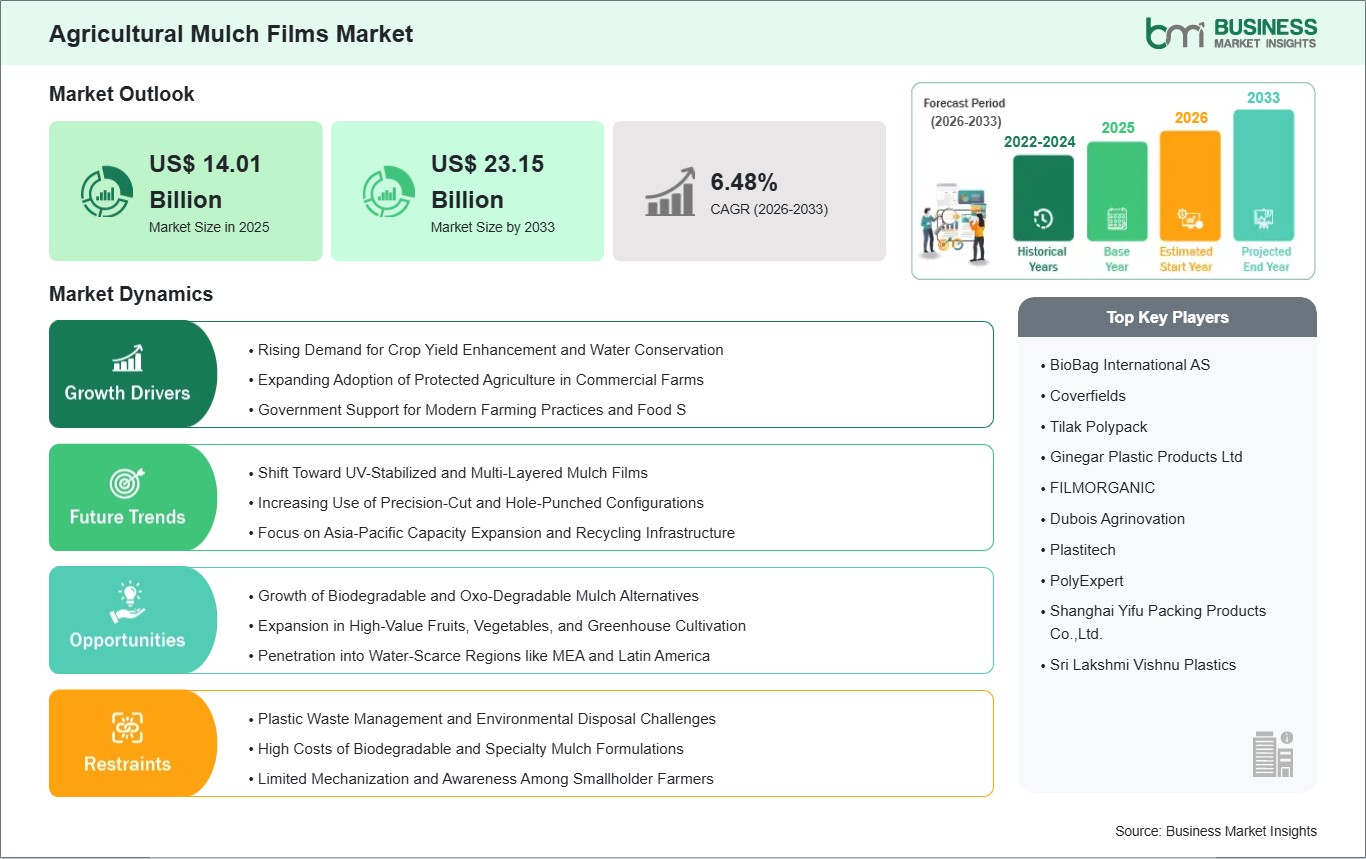
Agricultural mulch films have become a critical component of modern farming systems, serving as engineered materials designed to enhance crop productivity, optimize resource utilization, and support effective soil management. Applied directly to the soil surface, these films help regulate soil temperature, retain moisture, suppress weed growth, and improve overall crop yield and quality. Mulch films are widely used across open-field cultivation, greenhouse production, and controlled-environment agriculture for fruits, vegetables, grains, horticultural varieties, and plantation crops. As a core element of advanced agricultural practices, they significantly improve water‑use efficiency, nutrient retention, and root‑zone protection. They also enable earlier harvest cycles and extended growing seasons, which are particularly valuable in commercial farming. In large- and small-scale farming operations alike, mulch films contribute to higher yields per hectare, reduced reliance on herbicides, and more predictable crop performance. They also help protect crops against pests, soil erosion, and extreme weather events—key considerations in horticulture and specialty crop production. Their versatility is a major advantage: mulch films are easy to install, adaptable to a wide range of crops and climates, compatible with mechanized farming, and customizable in terms of thickness, color, and material composition to meet specific agronomic needs. Global demand is being driven by rising food requirements, the expansion of modern farming techniques, rapid growth in greenhouse and controlled-environment agriculture, and the need to maximize production on limited arable land with constrained water resources. Furthermore, advancements in biodegradable and bio‑based films, improved polymer formulations, and sustainability-focused farming practices are accelerating market growth worldwide. These developments are positioning mulch films as indispensable tools in achieving both high-efficiency agriculture and long-term environmental sustainability.
Though the future of agricultural mulch films is promising, the market faces a few challenges, such as variations in raw material prices, fear over the build-up of plastic waste, and reliance on the traditional petrochemical-based polymers. The adoption can be inhibited by stringent environmental regulations, increased cost of biodegradable substitutes, complexity of disposal and recycling of the used products, especially in the cost-sensitive farming areas. Nevertheless, the market has significant opportunities owing to rapid developments in biodegradable materials, growing awareness regarding sustainable farming practices, and increasing demand for environmentally friendly agricultural inputs.
Segment Analysis
Agricultural Mulch Films Market Segmentation
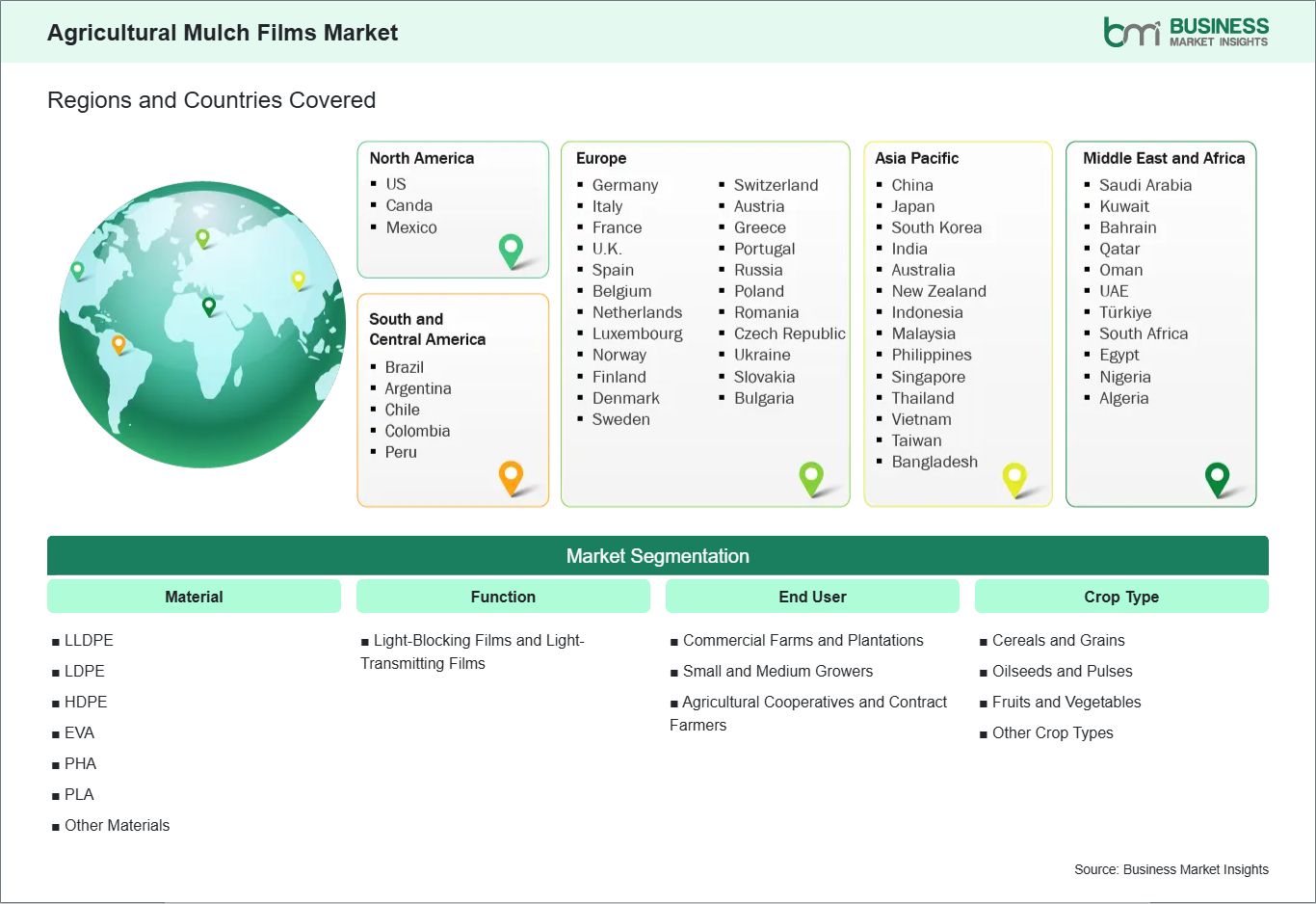
Key segments that contributed to the derivation of the agricultural mulch films market analysis are material, function, end user, and crop type.
- By material, the agricultural mulch films market is segmented into LLDPE, LDPE, HDPE, EVA, PHA, PLA, and other materials. The LLDPE segment dominated the market in 2025.
- By function, the market is bifurcated into light-blocking films and light-transmitting films. The light-blocking films segment dominated the market in 2025.
- By end user, the agricultural mulch films market is categorized into commercial farms and plantations, small and medium growers, and agricultural cooperatives and contract farmers. The commercial farms and plantations segment held the largest share of the market in 2025.
- By crop type, the agricultural mulch films market is categorized into cereals and grains, oilseeds and pulses, fruits and vegetables, and other crop types. The fruits and vegetables segment dominated the market in 2025. The cereals and grains segment is further sub-segmented into corn, wheat, rice, and other fruits and vegetables. The oilseeds and pulses segment is further sub-segmented into soybean, sunflower, and other oilseeds and pulses. The fruits and vegetables segment is further sub-segmented into root and tuber vegetables, leafy vegetables, pome fruits, berries, citrus fruits, and other fruits and vegetables.
Market Forces
Agricultural Mulch Films Market Drivers and Opportunities
Rising Adoption of Modern Agricultural Practices and Protected Cultivation
Mulch films play a critical role in improving crop yield and quality by regulating soil moisture and temperature, suppressing weed growth, and minimizing nutrient loss. As farmers face mounting pressure to maximize output from limited arable land, mulch films have emerged as a cost‑effective solution to enhance productivity and resource efficiency. These films are particularly valuable in regions experiencing water scarcity, where they significantly improve water‑use efficiency and support sustainable farming practices. Their adoption is especially strong in arid and semi‑arid zones. Additionally, the expansion of high‑value horticulture—such as fruits, vegetables, and other specialty crops—has increased the demand for controlled soil conditions and microclimates, which mulch films help create. Market adoption is further accelerated by government initiatives, including subsidy programs, training efforts, and broader support for modern agricultural inputs. This trend is particularly pronounced in emerging economies, where farm mechanization, cost optimization, and yield enhancement are key priorities for agricultural stakeholders.
Development of Biodegradable and Environmentally Friendly Mulch Films
Growing environmental concerns associated with conventional plastic mulch films—such as soil contamination, microplastic accumulation, and disposal challenges—are accelerating the shift toward biodegradable and eco‑friendly alternatives. Traditional polyethylene mulch films persist in the soil long after harvest, contributing to long‑term pollution and driving stricter global regulations and sustainability mandates. In response, manufacturers are increasing investments in biodegradable mulch films made from polylactic acid (PLA), starch blends, and other bio‑based polymers that decompose naturally in the soil. These sustainable solutions reduce labor costs by eliminating the need for post‑harvest film removal and align closely with broader industry priorities around sustainable agriculture and circular‑economy practices. Advances in material science are further improving the strength, durability, and controlled degradation profiles of biodegradable films, enabling them to compete more effectively with conventional products in both performance and cost-efficiency. As consumers and food producers place greater emphasis on environmentally responsible farming methods, demand for sustainable mulch films is expected to rise. This creates significant growth opportunities for companies developing innovative green materials and scalable production technologies.
Size and Share Analysis
Agricultural Mulch Films Market Size and Share Analysis
The Agricultural Mulch Films market demonstrates steady growth, with size and share analysis revealing evolving trends and competitive positioning among key players. The report further examines subsegments categorized within material, function, end user, and crop type, offering insights into their contribution to overall market performance.
Based on material, the LLDPE subsegment dominates the agricultural mulch films market. LLDPE is highly flexible, strong, and puncture-resistant, hence suitable for use in mulch film. It is cost-efficient, simple to process, and capable of coping with variations in crop and climatic conditions, owing to which it is the most preferred material for most manufacturers and farmers.
Report Coverage
Agricultural Mulch Films Market Report Coverage and Deliverables
The " Agricultural Mulch Films Market Size and Forecast (2022–2033)" report provides a detailed analysis of the market covering below areas:
- Agricultural Mulch Films market size and forecast at global, regional, and country levels for all the key market segments covered under the scope
- Agricultural Mulch Films market trends, as well as market dynamics such as drivers, restraints, and key opportunities
- Agricultural Mulch Films market analysis covering key market trends, global and regional framework, major players, regulations, and recent market developments
- Industry landscape and competition analysis covering market concentration, heat map analysis, prominent players, and recent developments for the agricultural mulch films market
- Detailed company profiles, including SWOT analysis
Geographic Insights
Agricultural Mulch Films Market Geographic Insights
The geographical scope of the Agricultural Mulch Films market report is divided into five regions: North America, Asia Pacific, Europe, Middle East & Africa, and South & Central America.
The Asia Pacific Agricultural Mulch Films Market is segmented into China, Japan, South Korea, India, Australia, New Zealand, Indonesia, Malaysia, the Philippines, Singapore, Thailand, Vietnam, Taiwan, Bangladesh, and the Rest of Asia Pacific. Asia Pacific has shown a high growth rate in the agricultural sector due to rising food demand, population, and adoption of new agricultural farming methods. It is currently a prime market for agricultural mulch films. This increase is further enhanced by increased fruit and vegetable cultivation, the development of covered agriculture, and a necessity to improve crop production, water use, and soil control within the context of scarce arable land.
Further, agricultural modernization, supportive government policies, and increased infrastructural development of greenhouse facilities, as well as the increased awareness of sustainable farming inputs, solidify the Asia Pacific as a key producer and consumer of agricultural mulch films.
Industry Activity
Recent Developments
The Agricultural Mulch Films market is evaluated by gathering qualitative and quantitative data post-primary and secondary research, which includes important corporate publications, association data, and databases. A few of the key developments in the agricultural mulch films market are:
- In January 2026, PerPlacsBio was launched by the University of Münster, the University of Applied Forest Sciences Rottenburg, and the Nova-Institute. It focuses on bio-based and biodegradable plastics in agriculture and forestry. Funded by the Agency for Renewable Resources (FNR), the project aims to address the negative impacts of microplastics on ecosystems by providing farmers and foresters with practical guidance on reducing plastic use and evaluating the environmental and technical feasibility of biodegradable alternatives.
- In July 2025, CSIR conducted a field trial of biobased and biodegradable agricultural mulch films on a pineapple farm in Peddie, Eastern Cape. The project, funded by the Department of Science, Technology, and Innovation through the South African Circular Economy Demonstration Fund, aims to promote sustainable agriculture and circular economy practices in South Africa.
Trust & Transparency
Research Methodology
The market analysis combines proprietary research with secondary data from government agencies, company disclosures, regulatory filings, industry databases and expert interviews. Market estimates are validated through data triangulation, cross-market benchmarking and analyst
review.
View Full Research Methodology
Key Sources Referred:
World Bank – Global Trade IndicatorsEuropean Chemicals AgencyInternational Council of Chemical AssociationsInternational Monetary Fund (IMF)World Trade Organization (WTO)International Trade Administration (ITA)Company WebsitesCompany Annual ReportsCompany Investor Presentations