
Oilseeds Market Outlook: Size, Share, Trends, Growth Analysis, Competitive Landscape & Forecast, 2026-2033

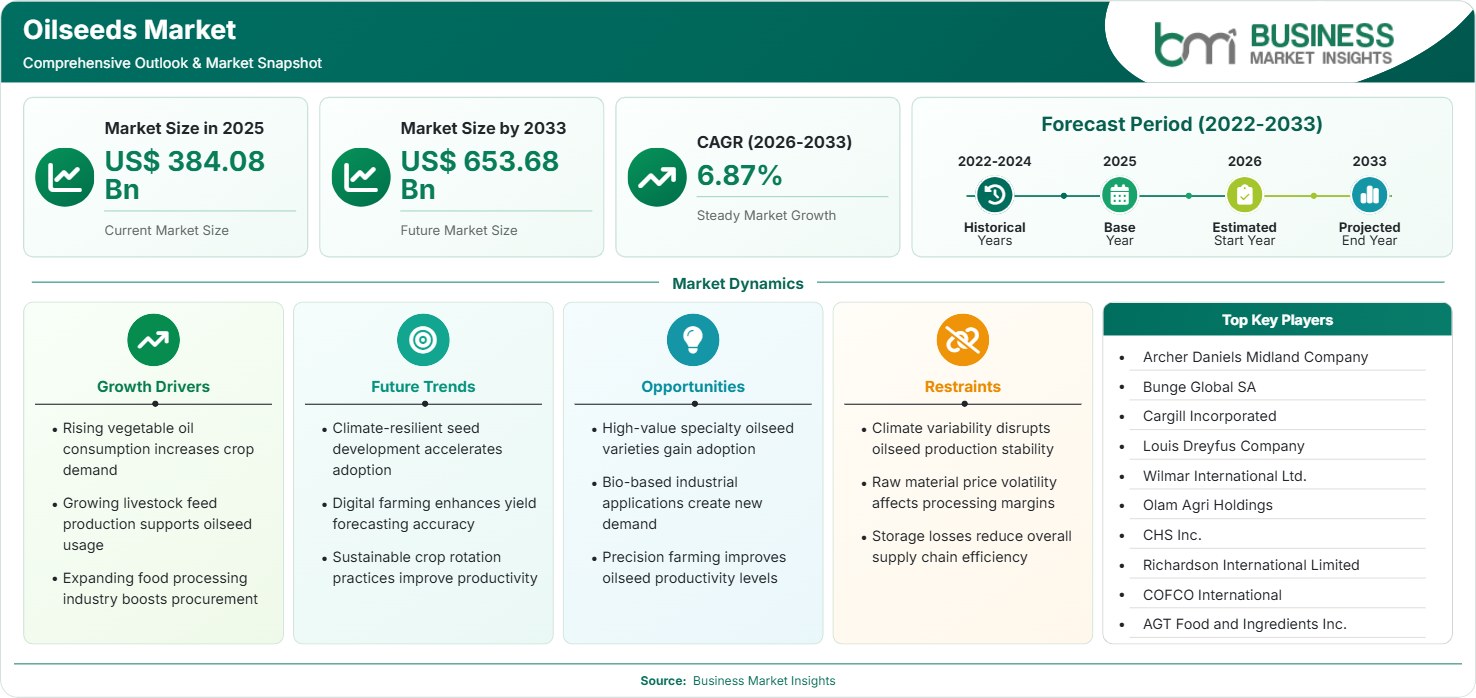
The Oilseeds Market size was valued at US$ 384.08 billion in 2025 and is projected to reach US$ 653.68 billion by 2033, growing at a CAGR of 6.87% during 2026–2033. Rising vegetable oil consumption, expanding livestock feed production, and increasing food processing activities continue strengthening global demand, while innovation in crop productivity and value-added oilseed applications creates new business opportunities.

Report Coverage
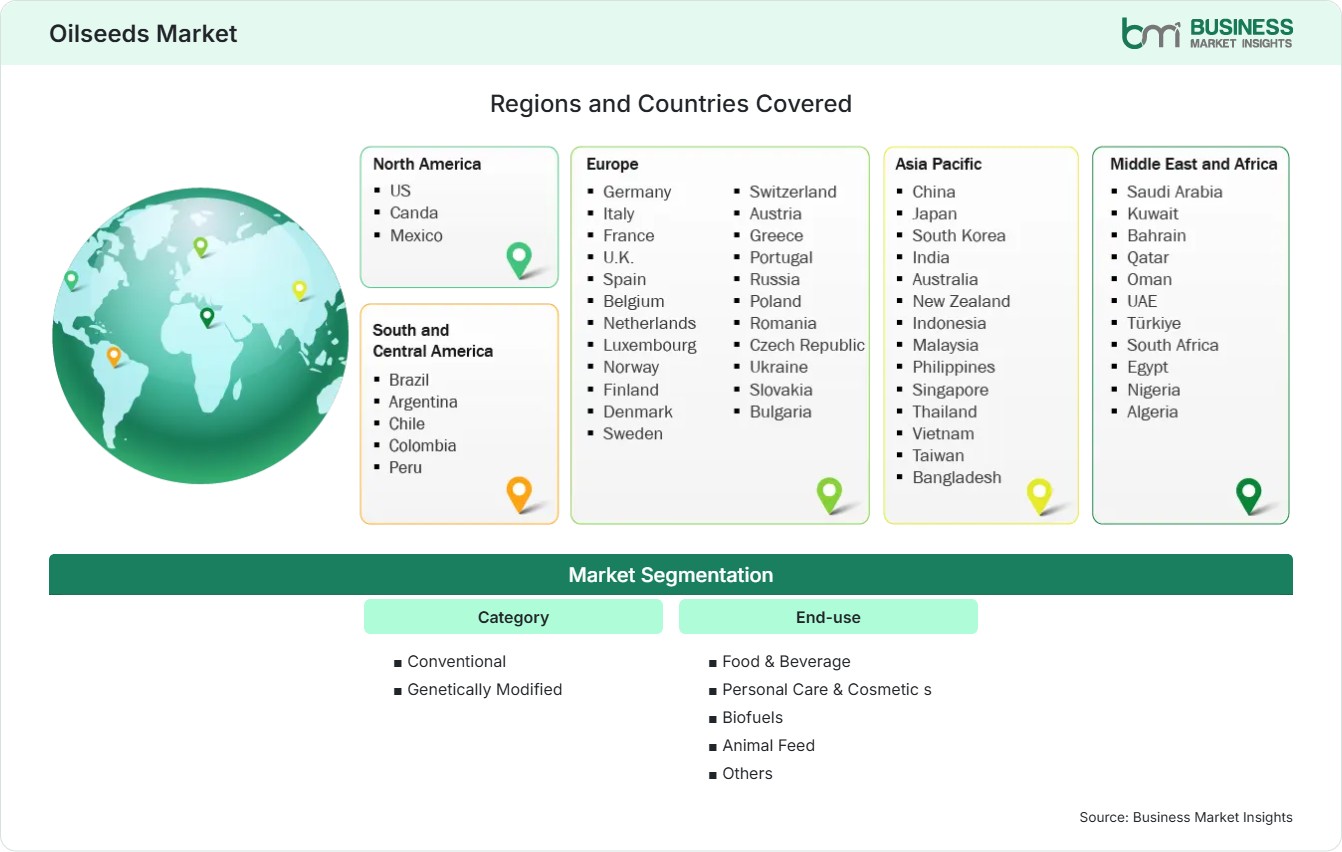
  • Category: Conventional, Genetically Modified
  • End-use: Food & Beverage, Personal Care & Cosmetic s,Biofuels, Animal Feed, Others
US$ 384.08 Bn Market size in 2025
US$ 653.68 Bn Market Size by 2033
6.87% CAGR, 2026 - 2033
2026-2033 Forecast Period

AI Overview

Oilseeds Market Summary

  • North America Region: North America holds 26%–29% market share in 2025 and is projected to expand at a CAGR of 6.4%–6.9% during 2026–2033. Strong soybean cultivation, advanced farming technologies, and expanding export demand continue supporting regional production. The U.S. remains the largest contributor with a CAGR of 6.5%–7.0%, benefiting from large-scale cultivation, modern processing infrastructure, and consistent international trade.
  • Fastest Growing Region: Asia Pacific accounts for 37%–40% market share in 2025 and is expected to register the fastest CAGR of 7.3%–7.8%. Rising edible oil consumption, expanding food processing capacity, increasing animal feed demand, and government support for agricultural modernization continue accelerating regional expansion.
  • Leading Segment: Soybean represents 44%–47% market share in 2025 and is forecast to grow at a CAGR of 7.0%–7.5%, supported by strong demand from edible oil manufacturers, livestock feed producers, and biofuel industries.
  • High Growth Segment: Food & Beverage captures 46%–49% market share in 2025 and is anticipated to expand at a CAGR of 7.1%–7.6%, driven by increasing consumption of processed foods, vegetable oils, and protein-rich ingredients.
  • Key Market Opportunity: Precision agriculture, specialty oilseed cultivation, sustainable bio-based applications, and digital farming technologies are creating long-term opportunities for producers, processors, and global agricultural supply chain participants.
  • Major Market Players: Archer Daniels Midland Company, Bunge Global SA, Cargill Incorporated, Louis Dreyfus Company, Wilmar International Limited, Olam Agri Holdings, CHS Inc., Richardson International Limited, COFCO International, and AGT Food and Ingredients Inc.
Strategic Insights

Oilseeds Market: Strategic Insights

Oilseeds Market Strategic Framework
FREE PDF
Request your free sample
Request free sample
Stakeholder View

Key Takeaways

  • Expanding global demand for vegetable oils, animal nutrition products, and renewable bio-based feedstocks continues strengthening investment opportunities across the oilseed value chain.
  • Soybean remains the dominant crop because of its broad application in edible oils, livestock feed, food ingredients, and industrial processing.
  • Precision agriculture technologies, satellite monitoring, and digital farm management systems are improving crop productivity while reducing operational costs and environmental impact.
  • Asia Pacific continues presenting the strongest long-term growth opportunity owing to increasing food consumption, expanding livestock production, and rising agricultural investments.
  • Processing companies continue strengthening vertical integration strategies to improve supply security, reduce procurement risks, and enhance profitability across international markets.
Geographic Outlook

Oilseeds Market Regional Highlights

North America Oilseeds Market

North America accounts for 26%–29% Oilseeds Market share in 2025 and is projected to register a CAGR of 6.4%–6.9% during 2026–2033. The region benefits from extensive soybean cultivation, advanced farm mechanization, efficient export infrastructure, and well-established oilseed processing facilities. Producers continue investing in precision agriculture, improved seed varieties, and sustainable farming practices that enhance crop yields while maintaining global competitiveness.

  • Advanced agricultural technologies continue improving productivity, crop monitoring, and farm resource optimization.
  • Strong export demand supports large-scale soybean cultivation and processing activities across the region.
  • Biofuel production continues increasing demand for oilseed-derived feedstocks and vegetable oils.
  • Integrated processing infrastructure strengthens supply chain efficiency and global market competitiveness.

US Oilseeds Market

The United States contributes 83%–86% of North American revenue and is expected to expand at a CAGR of 6.5%–7.0% during the forecast period. Strong agricultural productivity, export-oriented supply chains, and continued investments in biotechnology and sustainable farming continue supporting industry expansion.

  • Soybean production remains the foundation of domestic oilseed processing and export activities.
  • Precision farming technologies improve planting efficiency and crop yield performance.
  • Renewable diesel production continues increasing domestic oilseed demand.
  • Agricultural research programs support climate-resilient crop development and productivity improvements.

Europe Oilseeds Market

Europe represents 21%–24% market share in 2025 and is forecast to grow at a CAGR of 6.2%–6.7% through 2026–2033. Demand is supported by expanding rapeseed cultivation, increasing renewable fuel production, and rising consumer preference for sustainably sourced vegetable oils. Germany leads regional production, while Romania records the fastest growth due to increasing cultivation area and modernization of agricultural practices.

  • Sustainability regulations continue encouraging environmentally responsible agricultural production.
  • Biodiesel manufacturing supports steady demand for rapeseed and other oilseed crops.
  • Agricultural modernization improves productivity across major producing countries.
  • Food manufacturers increasingly prioritize certified and traceable oilseed supply chains.

Asia Pacific Oilseeds Market

Asia Pacific holds 37%–40% market share in 2025 and is projected to register the fastest 7.3%–7.8% CAGR during the forecast period. Population growth, expanding food processing industries, increasing edible oil consumption, and rising livestock production continue driving regional demand. China remains the largest market, while India records the fastest growth through expanding cultivation, processing investments, and government agricultural development programs.

  • Rising household consumption continues increasing vegetable oil demand across major economies.
  • Livestock production expansion strengthens demand for oilseed meal and feed ingredients.
  • Government support programs encourage farm modernization and improved crop productivity.
  • Investments in processing infrastructure strengthen regional value addition and export capabilities.

Rest of World Oilseeds Market

The Rest of World region accounts for 10%–13% market share in 2025 and is expected to grow at a CAGR of 6.6%–7.1% during 2026–2033. Expanding agricultural production, improving export infrastructure, and rising food processing activities continue supporting market development across Latin America, the Middle East, and Africa.

  • Brazil remains the leading producer through large-scale soybean cultivation and export expansion.
  • Argentina continues strengthening oilseed crushing and vegetable oil processing capacity.
  • Agricultural investments improve productivity across selected African farming regions.
  • Export-oriented farming continues supporting long-term production growth and international competitiveness.
Global Market Geography
FREE PDF
Request your free sample
Request free sample
Segment Analysis

Oilseeds Market Segmentation

Type

The type segment represents the largest revenue contributor as different oilseed crops support edible oil production, livestock nutrition, industrial processing, and renewable energy applications. It accounted for 44%–47% market share in 2025 and is projected to register a CAGR of 7.0%–7.5% during 2026–2033. Continued improvements in seed genetics, cultivation practices, and processing technologies are expanding the Oilseeds Market scope, enabling producers to meet growing global demand across diverse end-use industries.

  • Copra: Continues supporting coconut oil production for food processing, cosmetics, and industrial applications, particularly across tropical producing countries with well-established coconut cultivation industries.
  • Cottonseed: Remains an important source of edible oil and protein-rich meal, benefiting from integrated cotton production systems and expanding applications in livestock nutrition.
  • Palm Kernel: Maintains stable demand owing to its extensive use in food manufacturing, oleochemicals, personal care products, and specialty industrial applications requiring high-quality vegetable oils.
  • Rapeseed: Experiences steady growth due to increasing biodiesel production, edible oil consumption, and government initiatives promoting renewable energy and sustainable agricultural practices.
  • Soybean: Dominates global production and consumption because of its high oil content, protein-rich meal, extensive cultivation, and widespread utilization across food, feed, and biofuel industries.

Category

The category segment reflects the growing importance of productivity improvements and biotechnology within modern agriculture. It accounted for 72%–75% market share in 2025 and is anticipated to expand at a CAGR of 6.6%–7.1% during 2026–2033. Advancements in crop breeding, pest resistance, and sustainable farming continue supporting production efficiency while addressing rising global food demand.

  • Conventional: Continues representing the largest category due to broad consumer acceptance, established cultivation practices, regulatory compliance, and widespread adoption across domestic and international agricultural markets.
  • Genetically Modified: Records faster adoption in major producing countries because of improved yield potential, enhanced pest resistance, reduced crop losses, and greater operational efficiency for commercial farming operations.

End-use

The end-use segment highlights the broad commercial importance of oilseed crops across food, industrial, and agricultural value chains. It represented 46%–49% market share in 2025 and is projected to register a CAGR of 7.1%–7.6% during 2026–2033. Current Oilseeds Market trends indicate rising demand for vegetable oils, protein-rich feed ingredients, renewable biofuels, and plant-based industrial raw materials.

  • Food & Beverage: Accounts for the largest demand as vegetable oils remain essential ingredients in cooking oils, processed foods, bakery products, snacks, margarine, and other packaged food applications.
  • Personal Care & Cosmetics: Continues expanding through increasing utilization of natural vegetable oils in skincare, haircare, soaps, lotions, and premium cosmetic formulations.
  • Biofuels: Experiences sustained growth as governments promote renewable diesel and biodiesel production using sustainable vegetable oil feedstocks to reduce carbon emissions.
  • Animal Feed: Remains a major application because oilseed meal provides high-quality protein for poultry, dairy, aquaculture, and livestock nutrition while supporting commercial feed manufacturing
Market Forces

Oilseeds Market Dynamics

Key Market Drivers

Rising vegetable oil consumption increases crop demand

Global consumption of vegetable oils continues to rise due to population growth, changing dietary habits, and expanding food processing activities. Oil seeds such as soybeans, rapeseed, palm kernels, and many others continue to be important in the production of cooking oils, processed foods, bakery products, and the production of packaged food. As per Food and Agriculture Organization (FAO), the consumption of vegetable oils has experienced continuous growth in tandem with increased food consumption and urbanization. These factors continue supporting Oilseeds Market growth, encouraging investment across farming, storage, crushing, refining, and export infrastructure while strengthening global agricultural supply chains.

Growing livestock feed production supports oilseed usage

The expanding livestock industry is creating sustained demand for protein-rich oilseed meals used in poultry, dairy, aquaculture, and animal nutrition. Soybean, cottonseed, and rapeseed meals are still important feed materials owing to their balanced protein composition and support for healthy animal development. The growing demand for meat and dairy products in developing countries has spurred feed companies to purchase more raw materials from oilseeds. The advancements in technology for feed formulations and livestock production have increased the use of oilseed material. Growing investment in commercial animal farming continues supporting stable long-term demand for oilseed processing across global agricultural markets.

Expanding food processing industry boosts procurement

Food manufacturers continue increasing procurement of oilseed products to meet growing demand for packaged foods, edible oils, snacks, bakery products, sauces, confectionery, and plant-based ingredients. Increasing rates of urbanization, lifestyle changes among consumers, and growth in the distribution network of retail products have increased the consumption of processed foods globally. There are investments being made by oilseed processors in order to enhance production processes and product quality through state-of-the-art crushing, refining, and storage facilities. Expansion in food manufacturing capacity in Asia Pacific, Latin America, and Africa is influencing Oilseeds Market trends.

Key Market Opportunities

High-value specialty oilseed varieties gain adoption

The demand for superior quality oilseed varieties with enhanced nutritional content, high oil content, superior protein quality, and industrial traits is growing worldwide. Food processors, health-conscious customers, and manufacturers of premium edible oils are showing a growing preference for distinct varieties of crops which can add more value to their products. The use of agricultural biotechnology, advanced breeding techniques, and seed production are helping farmers produce these premium varieties of oilseeds. Oilseeds Market Forecasts indicate that value-added oilseed cultivation will become an important growth avenue as processors continue diversifying product portfolios and responding to evolving consumer preferences.

Bio-based industrial applications create new demand

Growing emphasis on sustainability and renewable raw materials is encouraging industries to increase the use of vegetable oils and oilseed derivatives in industrial applications. Oilseed sources are increasingly used to produce lubricants, biodegradable compounds, paints, adhesives, bioplastics, and renewable energy. Companies are conducting research to develop better processing methods and increase the value-added uses of these oils, thereby minimizing the use of petroleum sources. It is anticipated that more growth in the bioeconomy will provide additional revenues for oilseed businesses.

Precision farming improves oilseed productivity levels

Digital agriculture technologies are transforming oilseed cultivation by enabling producers to optimize planting, irrigation, fertilization, and harvesting operations. Satellite imaging, guided GPS technology, drone technology, artificial intelligence, and predictive analysis enable farmers to become more productive at lower cost and reduced environmental footprint. Precision agriculture is also useful for disease detection, yield prediction, and resource allocation during the cultivation period. With digitalization of the agricultural sector spreading internationally, there will be a further boost to the efficiency of oilseeds production.

Market Restraints and Challenges

Climate variability disrupts oilseed production stability

Oilseed cultivation remains highly dependent on stable weather conditions, making production vulnerable to droughts, floods, irregular rainfall, heatwaves, and other climate-related events. Factor: Climate variability reduces yields and creates uncertainty in the agricultural industry. Impact: Reduced harvests, increased price volatility, and supply chain disruptions make it more difficult for processors to purchase commodities and reduce farmers' profits. It is important to continue investing in climate-resilient agriculture and crop management.

Raw material price volatility affects processing margins

International oilseed prices are influenced by weather conditions, global trade policies, export restrictions, currency fluctuations, transportation costs, and changing demand from food, feed, and biofuel industries. Factor: Frequent fluctuations in agricultural commodity prices create uncertainty for processors, exporters, and manufacturers operating under long-term supply agreements. Impact: Volatile procurement costs compress operating margins, complicate production planning, and reduce pricing stability across the value chain. Companies continue strengthening supply diversification, contract farming, and inventory management strategies to minimize the financial impact of commodity price fluctuations.

Company Analysis

Competitive Landscape

Competition across the industry is characterized by integrated supply chains, global sourcing capabilities, processing capacity expansion, and investments in sustainable agriculture. Oilseeds Market analysis indicates that leading companies are strengthening their positions through strategic acquisitions, digital supply chain solutions, oilseed processing facilities, and partnerships with farmers to ensure consistent raw material availability. Investments in traceability, regenerative agriculture, and value-added oilseed products continue shaping long-term competitive strategies.

Company Name

Overview

Products and Services Relevant to this Market

Archer Daniels Midland Company

Global agricultural processing and nutrition company with extensive grain origination, processing, and international trading operations.

Oilseed procurement, soybean crushing, edible oils, vegetable proteins, animal nutrition ingredients, and agricultural supply chain services.

Bunge Global SA

Leading agribusiness company operating integrated oilseed processing, trading, storage, and food ingredient businesses worldwide.

Soybean processing, edible oils, oilseed trading, protein ingredients, grain storage, and export logistics services.

Cargill Incorporated

Multinational food and agricultural company with extensive operations across grain merchandising, oilseed processing, and food ingredient manufacturing.

Vegetable oils, soybean meal, oilseed processing, agricultural trading, animal feed ingredients, and food processing solutions.

Louis Dreyfus Company

Global merchant and processor specializing in agricultural commodities with a diversified international sourcing network.

Oilseed merchandising, crushing operations, edible oils, protein meals, logistics, and commodity trading services.

Wilmar International Limited

Integrated agribusiness group engaged in cultivation, processing, refining, and distribution of agricultural commodities.

Vegetable oils, palm kernel products, oilseed crushing, food ingredients, biodiesel feedstocks, and refining solutions.

Olam Agri Holdings

Global agribusiness company focused on sustainable sourcing, processing, and distribution of agricultural commodities.

Oilseed sourcing, grain trading, edible oil ingredients, agricultural supply chain management, and processing services.

CHS Inc.

Farmer-owned cooperative providing grain marketing, agronomy, energy, and agricultural processing solutions across North America.

Oilseed procurement, soybean processing, grain merchandising, crop inputs, storage, and transportation services.

Richardson International Limited

Canadian agribusiness company engaged in grain handling, oilseed processing, and food ingredient manufacturing.

Canola processing, vegetable oils, grain marketing, food ingredients, and export logistics services.

COFCO International

Global agricultural trading enterprise connecting international producers with food and feed markets worldwide.

Oilseed sourcing, commodity trading, grain logistics, processing operations, and integrated agricultural supply chain services.

AGT Food and Ingredients Inc.

International supplier of value-added agricultural products serving food manufacturers and global ingredient markets.

Specialty crops, oilseed ingredients, food processing solutions, agricultural exports, and plant-based ingredient products.

Trust & Transparency

Research Methodology

The market analysis combines proprietary research with secondary data from government agencies, company disclosures, regulatory filings, industry databases and expert interviews. Market estimates are validated through data triangulation, cross-market benchmarking and analyst review.

View Full Research Methodology

Questions Answered

Frequently Asked Questions

What does the Oilseeds Market Report include?

The Market Report provides comprehensive insights into market size, segmentation, regional performance, competitive landscape, technology developments, supply chain trends, investment opportunities, and future growth strategies across the global oilseed industry.

How does precision agriculture benefit oilseed production?

Precision farming technologies improve planting accuracy, optimize fertilizer and irrigation use, enhance yield forecasting, reduce production costs, and help farmers make data-driven decisions that increase operational efficiency and sustainability.

Why is Asia Pacific witnessing the fastest market growth?

The region benefits from rapid population growth, increasing edible oil consumption, expanding food processing industries, higher livestock production, and supportive government initiatives aimed at improving agricultural productivity and food security.

Which oilseed type holds the largest market share?

Soybean dominates the market due to its high oil and protein content, broad cultivation base, extensive use in edible oils, livestock feed, processed foods, and renewable fuel production.

What factors are driving the Oilseeds Market?

The market is driven by rising consumption of vegetable oils, expanding livestock feed production, growing food processing activities, increasing biofuel demand, and continued investments in agricultural productivity and sustainable farming practices.

Access the Full Oilseeds Market Report

Get segment-level forecasts, regional estimates, competitive benchmarking, company profiles and downloadable Excel datasets.

Access the full Oilseeds Market Report
350 pages PDF & Excel | 2026-08-17