
Oilseed Processing Market Outlook: Size, Share, Trends, Growth Analysis, Competitive Landscape & Forecast, 2026-2033

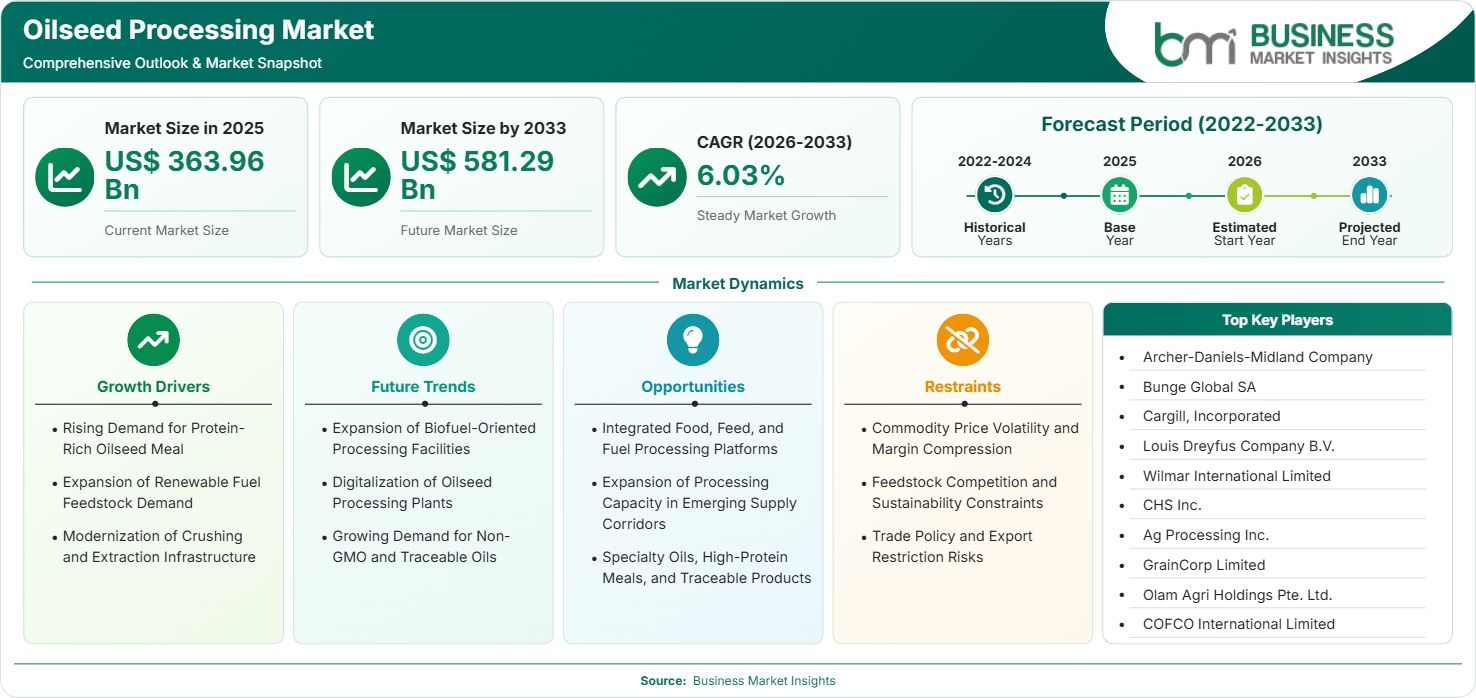
The Oilseed Processing Market size was valued at US$ 363.96 Billion in 2025 and is projected to reach US$ 581.29 Billion by 2033, growing at a CAGR of 6.03% during 2026–2033, driven by protein meal demand, vegetable oil consumption, biofuel feedstock needs, processing capacity expansion, and value-added product innovation.

Report Coverage
  • Oilseed Type: Soybean, Rapeseed/Canola, Sunflower, Cottonseed, Groundnut, Others
  • Product: Oil, Meal/Cake
  • Process Type: Mechanical, Chemical
  • End-Use: Food, Feed, Industrial
US$ 363.96 Bn Market size in 2025
US$ 581.29 Bn Market Size by 2033
6.03% CAGR, 2026 - 2033
2026-2033 Forecast Period

AI Overview

Oilseed Processing Market Summary

  • North America Region: North America holds oilseed processing market share of 27%–30% in 2025, growing with a CAGR of 5.4%–6.0% influenced by soybean crush expansion, renewable diesel feedstock demand, domestic meal consumption, logistics investments, and new processing capacity.
  • Fastest Growing Region: Asia Pacific holds market share of 34%–37% in 2025, growing with a CAGR of 6.8%–7.5% driven by rising edible oil consumption, expanding livestock production, crushing capacity additions, urbanization, import diversification, and demand for affordable protein-rich meal ingredients.
  • Leading Segment: Soybean holds market share of 46%–50% in 2025, growing with a CAGR of 6.0%–6.6% driven by high crushing volumes, integrated oil and meal economics, livestock feed demand, renewable fuels, established logistics, and broad food applications.
  • High Growth Segment: Industrial end-use holds market share of 17%–20% in 2025, growing with a CAGR of 7.0%–7.7% driven by renewable diesel, biodiesel, oleochemicals, bio-based materials, specialty oils, and expanding demand for lower-carbon industrial feedstocks.
  • Key Market Opportunity: Integrated crushing assets can capture value across oil, meal, renewable fuels, and specialty ingredients, while digital optimization and traceability improve margins, supply resilience, sustainability performance, and customer differentiation.
  • Major Market Players: Archer-Daniels-Midland Company, Bunge Global SA, Cargill, Incorporated, Louis Dreyfus Company B.V., Wilmar International Limited, CHS Inc., Ag Processing Inc., GrainCorp Limited, Olam Agri Holdings Pte. Ltd., and COFCO International Limited.
Strategic Insights

Oilseed Processing Market: Strategic Insights

Oilseed Processing Market Strategic Framework
FREE PDF
Request your free sample
Request free sample
Stakeholder View

Key Takeaways

  • The oilseed processing market is increasingly favoring integrated value chains spanning origination, storage, crushing, refining, logistics, and downstream markets, enabling processors to reduce commodity price volatility, improve operational efficiency, and strengthen long-term competitiveness.
  • Oilseed meals such as soybean meal provide promising growth prospects as high-quality protein sources in livestock, aquaculture, and specialty feed usage.
  • The deployment of technology to facilitate automation, monitoring, maintenance, and efficient energy-based extraction processes is aiding in enhancing oil recovery and traceability.
  • The most promising area for investment is Asia Pacific, where growth is being triggered by factors like urbanization, increased consumption of meat products, imported oilseeds, and development of food/feed infrastructure.
  • Global industry consolidation, exemplified by the merger of Bunge Global SA and Viterra, is redefining capabilities in processing, logistics, and origination.
  • Multifunctional processing plants capable of processing various kinds of oilseeds are becoming increasingly significant due to the growing competition between food, feed, and biofuel usage.
Geographic Outlook

Oilseed Processing Market Regional Highlights

North America Oilseed Processing Market

North America held a 27%–30% share in 2025 and is projected to expand at a 5.4%–6.0% CAGR through 2033. The region benefits from mature crushing infrastructure, extensive soybean production, integrated logistics, and strong renewable fuel demand. Regional market share is supported by established processors and sophisticated commodity trading networks, while oilseed processing market growth increasingly reflects domestic value addition rather than raw seed exports.

  • Greater production of renewable diesel will increase the demand for soybean and canola oils, and thereby will lead to improved extraction yields and longer term contract arrangements.
  • Increased crushing capacity in Midwestern states is resulting in increased utilization of soybeans within the domestic market, contributing towards favorable basis economics, efficient transportation, and meal availability.
  • Canada continues to be critical in the context of canola origination, crushing, refining and exports, thus improving the diversification of North America’s oilseeds sector.
  • The processors of North America are now increasingly moving towards an integrated approach that involves origination, merchandising, crushing, refining, storage, and transportation facilities.

US Oilseed Processing Market

The US accounted for 21%–24% of global oilseed processing market in 2025 activity and is projected to grow at a 5.5%–6.1% CAGR through 2033. Domestic soybean utilization is increasing as processors respond to meal demand and renewable fuel consumption.

  • The construction of new plants for the processing of soybeans and canola is increasing processing capacity in North Dakota, Nebraska, Wisconsin, Iowa, Kansas, and Ohio, thus minimizing dependency on export channels.
  • Due to the implementation of renewable diesel policies, the demand for soybean oil has increased, while livestock operations support demand for soybean meal.
  • Historic production of soybeans for 2026/27 and planting of more soybeans have ensured adequate feedstock availability.

Europe Oilseed Processing Market

Europe held a 20%–23% of oilseed processing market share in 2025 and is forecast to grow at a 4.8%–5.5% CAGR through 2033. Germany and France remain leading processing centers, while Poland and Romania represent high-growth opportunities at 5.7%–6.5% CAGR as regional feed and food industries expand. Sustainability regulation is shaping procurement decisions, increasing demand for documented supply chains and lower-carbon feedstocks across food, feed, and industrial applications.

  • Germany's mature crushing and refining base supports food oils, meal production, and industrial applications, with efficiency upgrades increasingly favored over purely capacity-led expansion.
  • France benefits from rapeseed production and established food processing industries, while tighter sustainability expectations encourage traceable procurement and optimized resource utilization.
  • Poland's processing ecosystem is expanding alongside poultry and livestock production, creating additional demand for protein meals and locally available feed ingredients.
  • European biofuel policies are increasing competition for vegetable oils, encouraging processors to improve feedstock efficiency and explore waste-based alternatives where regulations and economics permit.

Asia Pacific Oilseed Processing Market

Asia Pacific held a 34%–37% share in 2025 and is projected to record a 6.8%–7.5% CAGR through 2033, making it the fastest-growing regional opportunity. China remains the leading processing center, while India and Indonesia are high-growth countries at 7.2%–8.0% CAGR. Rising food consumption, livestock production, urbanization, and dependence on imported oilseeds are supporting investments in crushing, storage, refining, and logistics.

  • China combines large-scale crushing infrastructure with extensive demand from food and animal feed industries, making it a central destination for imported soybean processing.
  • India presents strong expansion potential as edible oil consumption rises and processors invest in supply security, domestic oilseed productivity, and modern extraction infrastructure.
  • Protein meal demand is expanding alongside poultry and aquaculture production, supporting diversified processing economics and greater interest in specialized meal formulations.

Rest of World Oilseed Processing Market

South and Central America represented 11%–14% of 2025 activity and are projected to grow at 6.2%–6.9% CAGR. Brazil and Argentina lead regional processing, while Paraguay and Uruguay offer higher-growth opportunities at 7.0%–7.8% CAGR. Expanding soybean production, export infrastructure, and domestic crushing are reinforcing regional competitiveness and increasing value-added processing capacity.

  • Brazil's soybean ecosystem benefits from abundant production and export logistics, while additional crushing capacity can capture more value domestically through meal and oil production.
  • Argentina oilseed processing market remains a major processing hub, supported by established crushing infrastructure and soybean availability, although currency and policy conditions influence investment timing.
  • Nigeria and Kenya offer growth potential through urbanization and food security initiatives, although financing, infrastructure, and reliable raw material supply remain critical investment considerations.
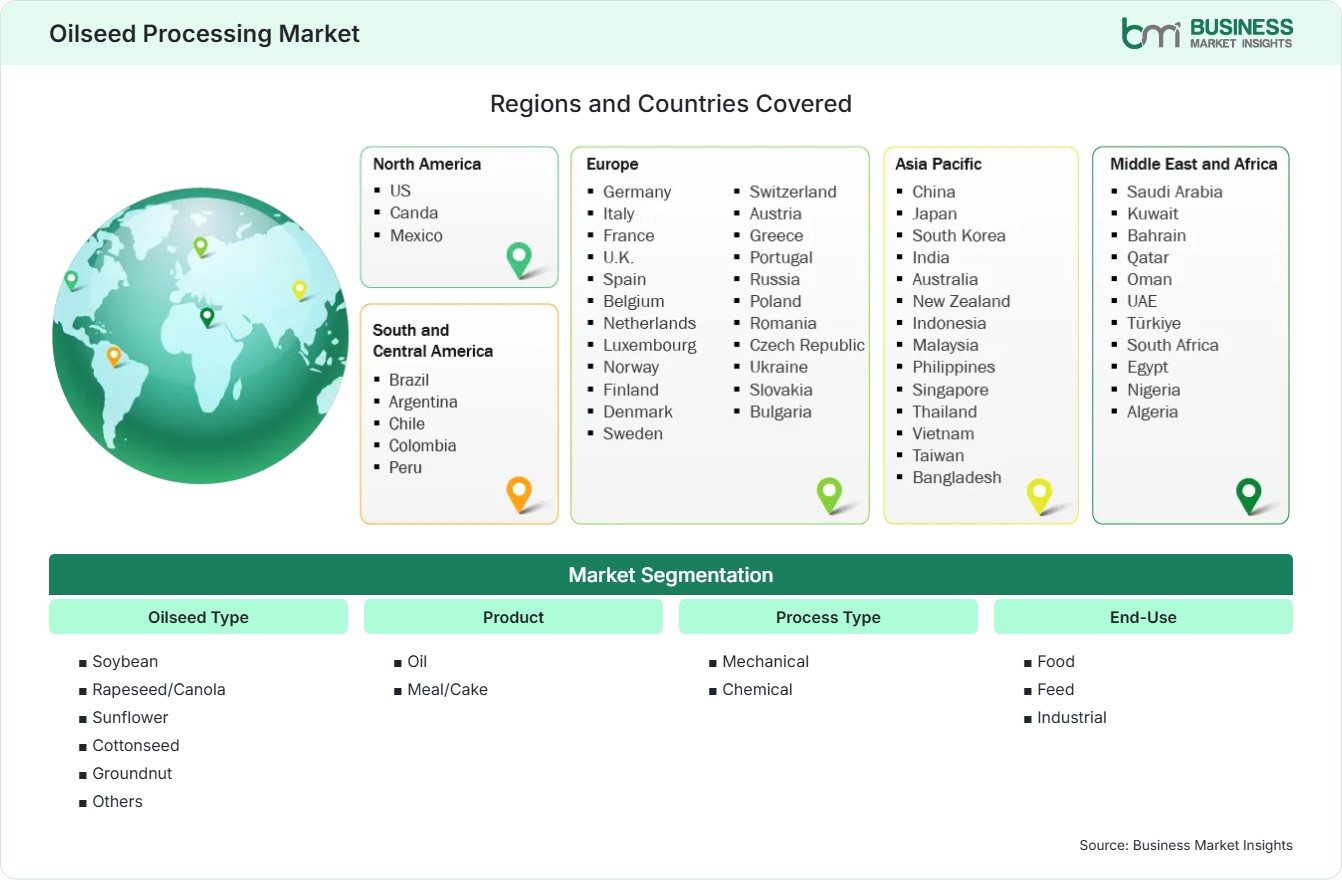
Global Market Geography
FREE PDF
Request your free sample
Request free sample
Segment Analysis

Oilseed Processing Market Segmentation

Oilseed Type

Soybean held 46%–50% share in 2025 and is projected to grow at a 6.0%–6.6% CAGR from 2026–2033, supported by integrated oil and meal economics. Oilseed Processing Market scope increasingly depends on flexible facilities capable of handling changing feedstock availability and customer requirements.

  • Soybean: Dominant due to high global availability, efficient crushing economics, strong protein meal demand, and broad oil applications spanning food, feed, and renewable fuel production.
  • Rapeseed/Canola: Benefits from established food oil demand, protein-rich meal applications, and growing renewable fuel utilization, particularly across North America and Europe.
  • Sunflower: Gains traction in edible oil markets and regional food applications, with processing activity influenced by Eastern European supply, trade flows, and geopolitical conditions.
  • Cottonseed: Supports specialized edible oil and livestock feed applications, providing processors with coproduct opportunities where cotton production creates accessible raw material streams.
  • Groundnut: Serves food, specialty oil, and protein applications, with demand supported by nutritional attributes and established consumption patterns across Asia and Africa.

Product

Oil accounted for 56%–60% share in 2025 and is projected to expand at a 5.8%–6.4% CAGR through 2033, while meal and cake benefit from livestock nutrition. Oilseed Processing Market trends increasingly favor integrated production because processors can balance food, feed, and industrial demand while optimizing the value of each crushed seed.

  • Oil: Demand spans edible oils, renewable fuels, oleochemicals, and specialty formulations, encouraging higher extraction efficiency and investments in refining and purification technologies.
  • Meal/Cake: Growth is supported by poultry, livestock, and aquaculture feed demand, with processors pursuing improved protein concentration, digestibility, consistency, and specialized nutritional performance.

Process Type

Chemical processing held 61%–65% share in 2025 and is projected to grow at a 6.1%–6.7% CAGR through 2033, supported by large-scale solvent extraction efficiency. Mechanical processing remains important for selected oilseeds and decentralized facilities, while technology investments increasingly focus on energy efficiency, safety, automation, and product quality.

  • Mechanical: Includes pressing and expeller technologies suited to smaller facilities and selected oilseeds, offering simpler operations, lower chemical dependence, and opportunities for specialty or cold-pressed products.
  • Chemical: Solvent extraction delivers high oil recovery at industrial scale, supporting large soybean and oilseed facilities where throughput, efficiency, and consistent product quality determine operating economics.

End-Use

Food remained the largest end-use at 55%–59% share in 2025 and is projected to grow at a 5.6%–6.2% CAGR through 2033. Feed remains structurally resilient, while industrial applications provide stronger expansion as renewable fuels and bio-based materials increase demand for vegetable oil feedstocks.

  • Food: Demand is supported by population growth, household consumption, processed foods, foodservice applications, and consumer preference for versatile vegetable oils with consistent quality characteristics.
  • Feed: Protein meal demand remains linked to poultry, swine, dairy, and aquaculture production, with processors improving meal specifications to serve increasingly specialized nutrition requirements.
  • Industrial: Renewable diesel, biodiesel, oleochemicals, coatings, lubricants, and bio-based materials are expanding applications, increasing competition for vegetable oils and strengthening demand for flexible processing capacity.
Market Forces

Oilseed Processing Market Dynamics

Key Market Drivers

Rising Demand for Protein-Rich Oilseed Meal

Livestock and aquaculture production are increasing the strategic value of oilseed meal, particularly soybean meal, because crushing creates simultaneous revenue from oil and protein coproducts. USDA projected US soybean crush at 2.65 billion bushels for 2025/26, reflecting strong demand for soybean products and attractive crush margins. This supports Oilseed Processing industry growth by improving processor economics even when edible oil prices fluctuate. Processors are responding by upgrading dehulling, separation, drying, and quality-control systems to improve protein concentration and digestibility. These investments support Oilseed Processing Market trends toward higher-value meal products and integrated facilities capable of serving multiple feed industries.

Expansion of Renewable Fuel Feedstock Demand

The manufacturing of renewable diesel and biodiesel is adding a strong push to the consumption of soybean, canola, and other vegetable oils, linking agriculture processing and energy policies. According to the IEA, vegetable oils, waste products, and residues have been facing a very high demand as feedstocks for renewable diesel, biodiesel, and biojet, while accelerated pathways require extra amounts of feedstock. The situation changes market dynamics by raising the importance of oil pressing capacity and by encouraging processors to secure their sources. In the U.S., the growth of crushing capacity is tightly connected with the higher use of soybean oil in biomass-based diesel manufacture.

Modernization of Crushing and Extraction Infrastructure

The factors that influence processing economics have shifted toward throughput, extraction rate, energy intensity, and downtime rather than capacity. Modern processing plants use automatic material handling, conditioning, flaking, solvent recovery, monitoring, and predictive maintenance systems. The above-listed changes may increase oil yields and decrease energy inputs per ton processed. The case of American soybean processing plants is a good example of this structural change: their locations tend to be closer to production sites and local consumers.

Key Market Opportunities

Integrated Food, Feed, and Fuel Processing Platforms

Processors can increase resilience by designing facilities around multiple revenue streams rather than depending on a single end-use. Integrated platforms can direct oil toward food or renewable fuel customers according to relative margins while supplying meal to livestock and aquaculture markets. This flexibility improves asset utilization and allows operators to respond to commodity cycles, policy changes, and regional demand shifts. Oilseed Processing Market Forecasts increasingly favor investments that connect crushing with refining, storage, logistics, and downstream conversion. The strongest opportunities are likely to emerge where processors can secure reliable raw material access and simultaneously reach food, feed, and industrial customers. Digital scheduling and real-time commodity analytics can further improve product allocation and working-capital management.

Expansion of Processing Capacity in Emerging Supply Corridors

New agricultural corridors provide an avenue to enhance the value chain, from seed exports to crushing and processing within the country. South America, Eastern Europe, South Asia, and some parts of Africa can take advantage of developments that integrate storage, transport, crushing, and port linkages. This type of development ensures that there are no inefficiencies in the logistics chain and creates an availability of edible oil and protein meal locally. This presents a very interesting opportunity if the government emphasizes food security, import substitution, agricultural transformation, and rural infrastructure.

Specialty Oils, High-Protein Meals, and Traceable Products

Applications in premium markets allow for the chance to shift from commodity processing to value-added products that offer better customer relations and perhaps greater profit margins. Specialty edible oils, high-protein meals, identity-preserved ingredients, and sustainability-certified feedstock may be offered to food processors, animal nutrition suppliers, and industry users looking for particular performance qualities. With more customers, whether in food, feed, or fuel, becoming increasingly concerned with carbon intensity and sourcing transparency, businesses that have systems in place to track this information will have a competitive advantage.

Market Restraints and Challenges

Commodity Price Volatility and Margin Compression

Factor: Prices of oilseeds depend on weather conditions, planting area, production levels, export regulations, foreign exchange rates, transportation charges, and geopolitical events, whereas oil and meal prices may be independent.

Impact: Processors are likely to encounter quick squeezes in crush margins when input costs increase more quickly than realized values of finished products, resulting in higher working capital needs and lower clarity regarding investments. The large integrated producers can hedge this effect to some extent through various instruments; however, smaller processors usually lack sufficient financial means to do so.

Feedstock Competition and Sustainability Constraints

Factor: Rising demand for vegetable oils from food, animal feed, renewable fuels, and industrial applications is intensifying competition for limited agricultural resources, while sustainability rules increasingly scrutinize land use and supply-chain emissions.

Impact: Processors face higher procurement complexity, stricter traceability requirements, and potential feedstock shortages in regions where expansion is constrained by land or environmental standards. Companies unable to document sourcing or adapt to evolving sustainability requirements may face customer exclusions, regulatory costs, and reduced access to premium markets.

Company Analysis

Competitive Landscape

The Oilseed Processing Market analysis indicates a competitive structure dominated by diversified agribusiness groups that combine origination, merchandising, logistics, crushing, refining, and downstream distribution. The leading companies compete through geographic scale, feedstock access, processing efficiency, customer relationships, and investments in renewable fuel and specialty ingredient value chains.

Company Name

Overview

Products and Services relevant to this market

Archer-Daniels-Midland Company

A major global agricultural processor with extensive oilseed origination, crushing, ingredient production, and logistics capabilities across key producing regions.

Soybean and other oilseed crushing, vegetable oils, protein meals, feed ingredients, specialty ingredients, storage, merchandising, and transportation services.

Bunge Global SA

A large agribusiness and food company with extensive oilseed processing, agricultural origination, logistics, and value-added capabilities following its Viterra combination.

Oilseed crushing, vegetable oils, protein meals, feed products, grain handling, merchandising, storage, logistics, and agricultural supply-chain services.

Cargill, Incorporated

A diversified agribusiness company operating across agricultural commodities, food ingredients, animal nutrition, and supply-chain services.

Soybean and oilseed processing, vegetable oils, protein meals, feed ingredients, commodity merchandising, logistics, and food ingredient solutions.

Louis Dreyfus Company B.V.

A global agricultural merchant with integrated origination, processing, logistics, and merchandising operations spanning major oilseed supply chains.

Oilseed crushing, edible oils, oilseed meals, commodity trading, storage, logistics, agricultural sourcing, and supply-chain management.

Wilmar International Limited

A major agribusiness group with extensive oilseed, edible oils, food processing, and downstream distribution activities across Asia and international markets.

Vegetable oils, oilseed processing, edible oil refining, food products, specialty fats, animal feed ingredients, and commodity merchandising.

CHS Inc.

A farmer-owned cooperative and agricultural enterprise involved in grain and oilseed handling, processing, energy, and food supply chains.

Oilseed processing, soybean products, vegetable oils, protein meal, grain handling, merchandising, logistics, and agricultural services.

Ag Processing Inc.

A cooperative-owned soybean processor focused on crushing, refining, and marketing oilseed-derived products for food, feed, and industrial customers.

Soybean meal, soybean oil, refined oils, biodiesel feedstocks, feed ingredients, and oilseed processing services.

GrainCorp Limited

An Australian agribusiness with extensive grain handling, storage, logistics, origination, and processing capabilities supporting regional agricultural supply chains.

Oilseed handling, crushing, edible oils, protein meals, grain storage, logistics, merchandising, and supply-chain services.

Olam Agri Holdings Pte. Ltd.

A global food and agriculture company with broad origination, processing, trading, and supply-chain operations across emerging and developed markets.

Oilseed sourcing, processing, vegetable oils, protein meals, commodity trading, logistics, food ingredients, and agricultural supply-chain solutions.

COFCO International Limited

A global agricultural supply-chain company connecting origination, trading, logistics, processing, and distribution across major commodity-producing and consuming regions.

Oilseed crushing, vegetable oils, protein meals, commodity merchandising, storage, logistics, and integrated agricultural supply-chain services.

Trust & Transparency

Research Methodology

The market analysis combines proprietary research with secondary data from government agencies, company disclosures, regulatory filings, industry databases and expert interviews. Market estimates are validated through data triangulation, cross-market benchmarking and analyst review.

View Full Research Methodology

Questions Answered

Frequently Asked Questions

Why is geographic diversification becoming important for processors?

Diversification reduces exposure to regional crop failures, logistics disruptions, trade restrictions, and policy changes. Companies with origination and processing assets across multiple producing regions can redirect sourcing and production flows more effectively, improving supply reliability for food, feed, and industrial customers during periods of commodity volatility.

What role does technology play in modern crushing facilities?

Automation and process analytics improve extraction efficiency, energy management, maintenance planning, and product consistency. Sensors and digital control systems allow processors to identify operational deviations earlier, reduce downtime, and optimize processing parameters across changing feedstocks, supporting stronger margins and more predictable product quality.

How are sustainability requirements changing processing operations?

Sustainability requirements are increasing demand for traceable sourcing, documented land-use practices, emissions accounting, and supply-chain transparency. Processors are investing in digital traceability, identity-preserved sourcing, and lower-energy technologies to meet customer requirements while protecting access to regulated food and renewable fuel markets.

What makes soybean processing strategically important?

Soybeans provide an attractive combination of oil and high-protein meal, enabling processors to serve food, animal nutrition, and industrial customers from the same raw material. Their extensive global production base, established logistics infrastructure, and broad downstream applications reinforce soybean's position as the core feedstock for large-scale crushing operations.

What are driver in the oilseed processing market report?

Demand is being driven by simultaneous growth in edible oil consumption, protein meal requirements, renewable fuel feedstock needs, and specialty industrial applications. This multi-output economics model improves the strategic value of crushing assets because processors can allocate oil and meal toward different end uses according to regional demand and relative pricing.

Access the Full Oilseed Processing Market Report

Get segment-level forecasts, regional estimates, competitive benchmarking, company profiles and downloadable Excel datasets.

Access the full Oilseed Processing Market Report
350 pages PDF & Excel | 2026-08-18
Similar Research

Related Market Reports