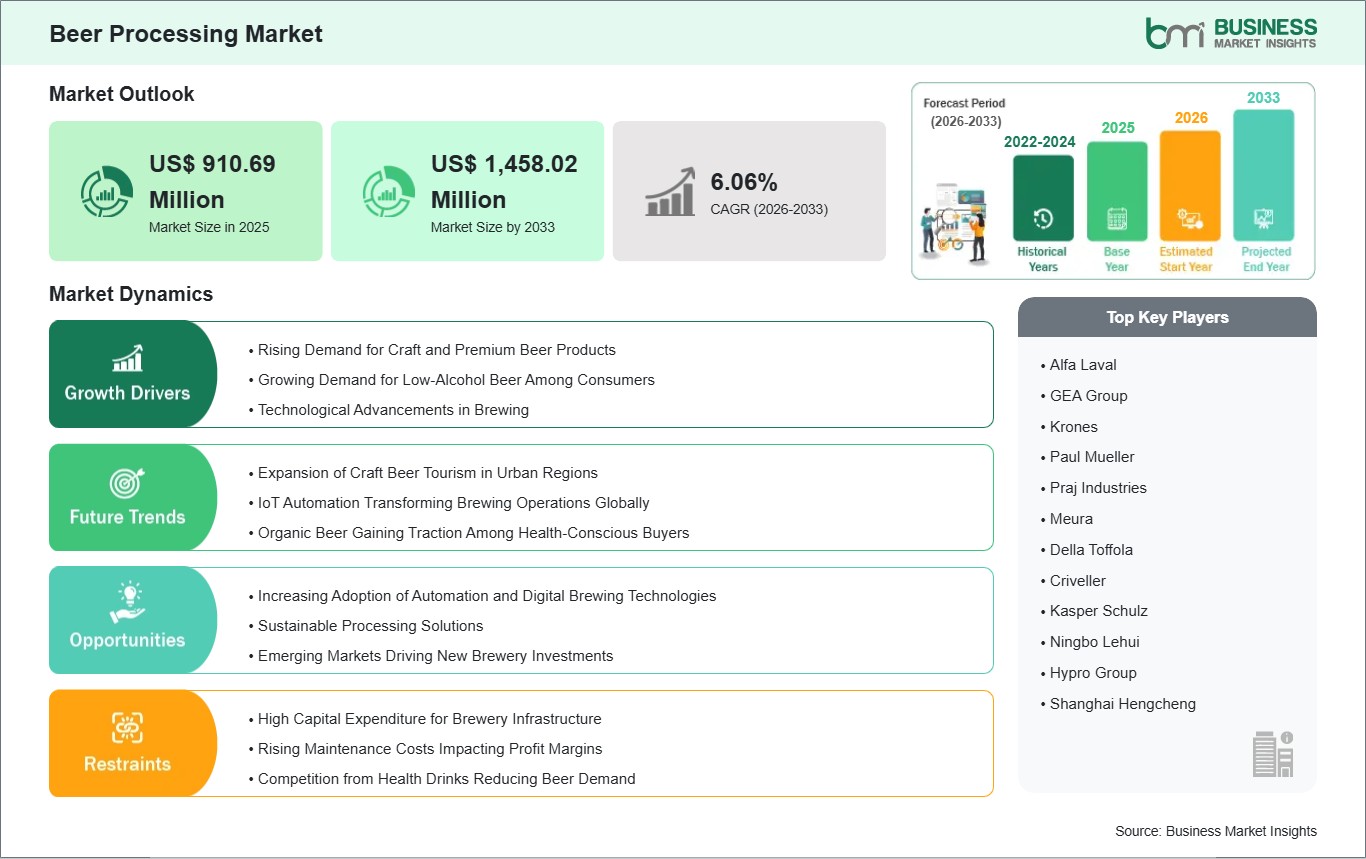
The Beer Processing Market size is expected to reach US$ 1,458.02 Million by 2033 from US$ 910.69 Million in 2025.The market is estimated to record a CAGR of 6.06% from 2026 to 2033.
Beer processing market represents a significant segment within the food and beverage manufacturing industry, driven by increasing global beer consumption, rising demand for premium and craft beverages, and continuous technological advancements in brewing and processing equipment. Beer processing involves various stages, including brewing, fermentation, filtration, carbonation, pasteurization, and packaging, all of which require specialized systems to ensure product quality, consistency, and operational efficiency.
The growing popularity of specialty beers, low-alcohol beverages, and organic beer products is encouraging breweries to modernize production facilities and invest in advanced processing technologies. In developed markets, consumer preference for unique taste profiles and artisanal brewing methods continues to drive expansion of small and regional breweries. Technological advancements are playing a critical role in market growth. Automation, IoT-enabled brewing systems, advanced heat exchangers, and digital monitoring solutions are improving production efficiency, reducing operational costs, and enhancing process consistency.
The growth of beer tourism and brewpub culture is further supporting market expansion. Consumers are increasingly visiting local breweries and participating in brewery experiences, which has led to rising investments in microbrewery infrastructure globally. Emerging economies are also witnessing increasing beer consumption due to urbanization, rising disposable incomes, and changing social lifestyles. Despite positive growth prospects, the market faces several challenges.
High capital investment requirements for brewery equipment installation and modernization remain a major barrier, particularly for small-scale breweries. Operational complexities, maintenance costs, and increasing competition from non-alcoholic and health-oriented beverages may limit market expansion in certain regions. Fluctuating raw material prices and stringent regulations related to alcohol production and distribution also impact industry profitability.

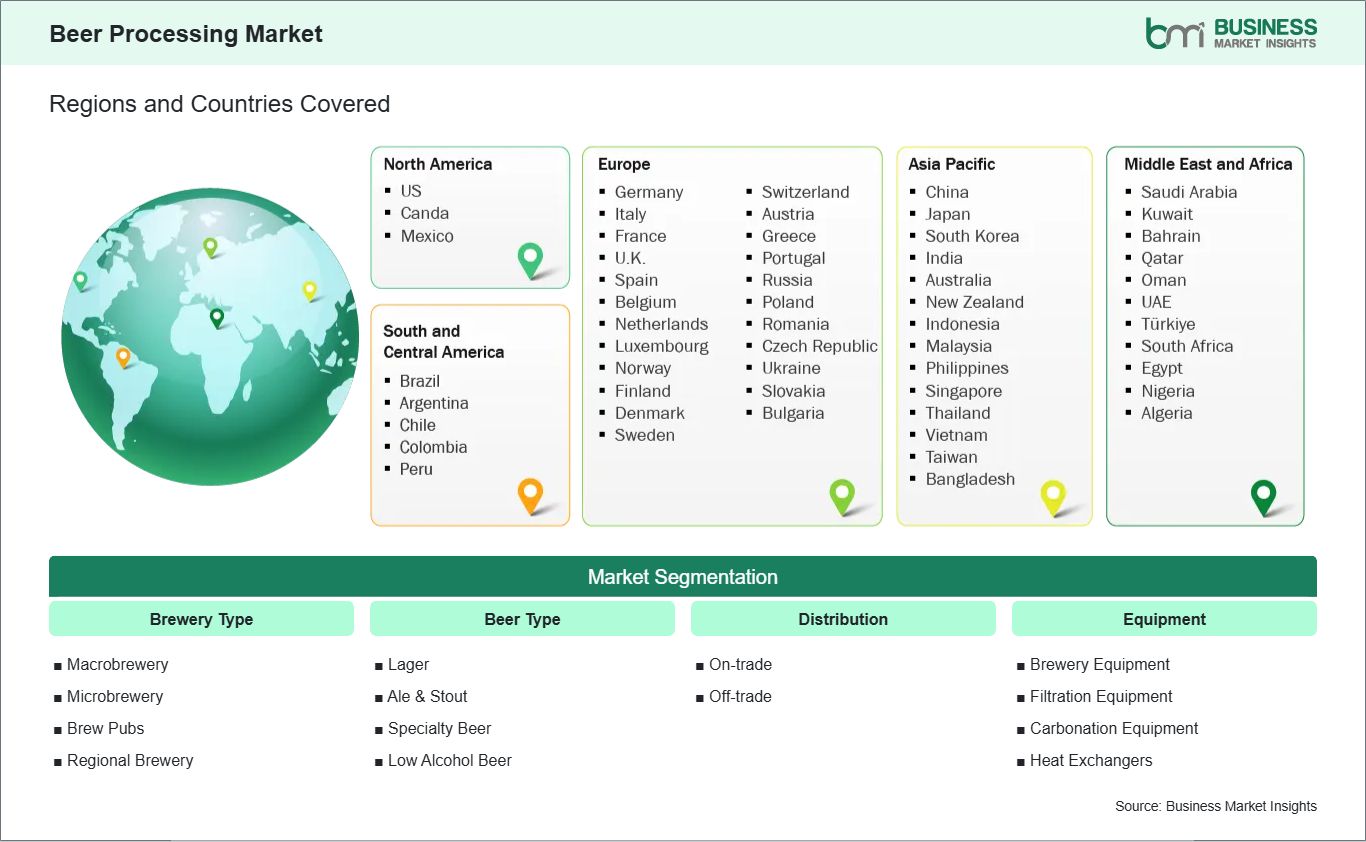
The beer processing market is segmented based on brewery type, beer type, distribution channel, and equipment, reflecting the growing demand for diversified beer production, advanced brewing technologies, and expanding global consumption of alcoholic beverages.
By Distribution
By Equipment
As an increasing number of consumers search for beer options with new flavors, artisanal methods of brewing and increasing levels of local production, there will be rising interest in craft and premium specialty beers. This has led consumers to increasingly demand that breweries increase the number of products they offer as well as improve their ability to produce these types of products.
The rapid expansion of microbreweries and brewpubs in North America, Europe, and Asia Pacific has created an increasing need for new, innovative equipment to brew and process beverages at a higher level. Investing in modern fermentation systems, filtration technologies, and automated brewing systems is becoming increasingly common for craft brewers looking to produce their products more effectively and ensure consistency across their brands of beer.
Brewing innovation is also being driven by an increasing number of low-alcohol and flavored beers becoming popular. Health-conscious drinkers want lower-alcohol beverages with all-natural ingredients, which creates opportunities for brewers to create new beverages and production processes.
Automation and digitalization are playing a critical role in expanding the global beer market through the integration of IoT-enabled brewing systems; automated process-control technologies; and digital monitoring systems. As a result, breweries are becoming more efficient, reducing their waste and utilizing their energy more effectively.
Advancements in brewing technology enable real-time monitoring of production processes; predictive maintenance; and improved quality assurance throughout the entire beer-brewing process. The use of automation additionally supports the scalability of large-scale breweries by providing a higher degree of consistency in taste, carbonation, and fermentation.
Continued investment in the implementation of Industry 4.0 technologies and sustainable manufacturing has further supported the acceptance of energy-efficient heat exchangers, water recycling systems, and automated cleaning technologies. As a result, both operational sustainability and profitability are expected to grow overall within the beer production industry.
The Beer Processing Market is projected to grow from US$ 910.69 Million in 2025 to US$ 1,458.02 Million by 2033 , registering a CAGR of 6.06% from 2026 to 2033.
By brewery type, macrobreweries account for a significant share as they support high-volume beer production, extensive distribution networks, and large-scale commercial operations. Microbreweries continue to grow with rising consumer preference for craft beer and unique flavor profiles, while brew pubs are gaining traction due to increasing demand for locally brewed beverages and experiential dining. Regional breweries are expanding steadily with strong demand for localized beer offerings and growing penetration in emerging markets.
By beer type, lager dominates the market owing to its widespread consumer acceptance, crisp flavor profile, and high production volumes across global breweries. Ale and stout segments continue to witness strong demand due to growing popularity of premium and craft beer varieties with rich taste characteristics. Specialty beer is gaining momentum with increasing consumer interest in flavored, seasonal, and experimental beer products, while low alcohol beer is expanding steadily as health-conscious consumers seek moderation and alternative alcoholic beverage options.
By distribution, off-trade channels account for a significant share as supermarkets, liquor stores, convenience stores, and e-commerce platforms provide broad product accessibility and retail convenience. On-trade distribution is witnessing steady growth driven by rising consumption in bars, pubs, restaurants, hotels, and entertainment venues that offer premium and social drinking experiences.
By equipment, brewery equipment dominates adoption as it forms the core infrastructure for brewing, fermentation, and production processes in beer manufacturing facilities. Filtration equipment continues to grow with increasing focus on beer clarity, stability, and shelf-life enhancement, while carbonation equipment is gaining traction for maintaining consistent texture and taste profiles across beer varieties. Heat exchangers are expanding steadily due to their critical role in temperature regulation, energy efficiency, and optimized brewing operations.
| Report Attribute | Details |
|---|---|
| Market size in 2025 | US$ 910.69 Million |
| Market Size by 2033 | US$ 1,458.02 Million |
| Global CAGR (2026 - 2033) | 6.06% |
| Historical Data | 2022-2024 |
| Forecast period | 2026-2033 |
| Segments Covered | By Brewery Type
|
|
Regions and Countries Covered
| |
| North America | US, Canada, Mexico |
| Europe | Germany, Italy, France, U.K., Spain, Belgium, Netherlands, Luxembourg, Norway, Finland, Denmark, Sweden, Switzerland, Austria, Greece, Portugal, Russia, Poland, Romania, Czech Republic, Ukraine, Slovakia, Bulgaria |
| Asia-Pacific | China, Japan, South Korea, India, Australia, New Zealand, Indonesia, Malaysia, Philippines, Singapore, Thailand, Vietnam, Taiwan, Bangladesh |
| South and Central America | Brazil, Argentina, Chile, Colombia, Peru |
| Middle East and Africa | Saudi Arabia, United Arab Emirates, Kuwait, Bahrain, Qatar, Oman, Turkiye, South Africa, Egypt, Nigeria, Algeria |
| Market leaders and key company profiles |
|
The "Beer Processing Market Size and Forecast (2022 - 2033)" report provides a detailed analysis of the market covering below areas:
The various levels of development in the beer processing industry appear to correlate closely with the various levels of technology, growth of craft or premium beer products, and the expansion of investments in the design and development of sustainable automated brewing systems.
North America has been characterized as the most for its level of technological development in brewing equipment as well as a mature craft beer market; therefore, it is able to offer major breweries with access to leading equipment manufacturers and an extensive craft brewing network. In these two countries (the United States and Canada), there is an unprecedented amount of investment made by breweries into state-of-the-art technologies such as automation, energy-saving devices, and digital monitoring systems. This investment enables North American breweries to improve their efficiencies, provide high-quality products, and support the innovation of craft and specialty beer production. Additionally, due to a growing industrial and consumer base in North America, there will be opportunities for widespread adoption of new and innovative beer processing equipment at both large and small breweries and brewpubs.
Asia Pacific is undergoing considerable growth due to the rapid growth of the beverage sector, urbanization of its cities, and higher disposable incomes across the board. Some of the countries in Asia-Pacific are China, India, Japan, and Vietnam where breweries are updating their facilities and applying high-tech equipment and processing methods. In Asia-Pacific, a few of the ways that companies are improving their brewing and packaging operations include increasing production capacity, developing more sustainable production processes, and encouraging innovative new products within the brewing industry.
The increase in premium beer consumption, increased consumer interest in craft beer, and greater levels of brewery automation investments are also positively impacting the overall beer processing market in Asia-Pacific. Additionally, advances in semiconductor and manufacturing technologies found in Japan and South Korea further support the use of smart monitoring and IoT-enabled manufacturing equipment for brewing processes.
While both North America and Asia-Pacific are experiencing significant growth within the beer processing market, North America leads the way in technological innovation and the culture surrounding craft beer, whereas Asia-Pacific currently has the highest overall volume and is anticipated to continue growing at an accelerated rate based on rising consumer demand and brewery expansions, as well as modernization of the brewery industry and processing facilities.

The beer processing market is evaluated by gathering qualitative and quantitative data post primary and secondary research, which includes important corporate publications, association data, and databases. A few of the key developments in the beer processing market are:
The Beer Processing Market is valued at US$ 910.69 Million in 2025, it is projected to reach US$ 1,458.02 Million by 2033.
As per our report Beer Processing Market, the market size is valued at US$ 910.69 Million in 2025, projecting it to reach US$ 1,458.02 Million by 2033. This translates to a CAGR of approximately 6.06% during the forecast period.
The Beer Processing Market report typically cover these key segments-
The historic period, base year, and forecast period can vary slightly depending on the specific market research report. However, for the Beer Processing Market report:
The Beer Processing Market is populated by several key players, each contributing to its growth and innovation. Some of the major players include:
The Beer Processing Market report is valuable for diverse stakeholders, including:
Essentially, anyone involved in or considering involvement in the Beer Processing Market value chain can benefit from the information contained in a comprehensive market report.
Please tell us your area of interest
(Market Segments/ Regions and Countries/ Companies)