Market Summary
Executive Summary and Global Market Analysis
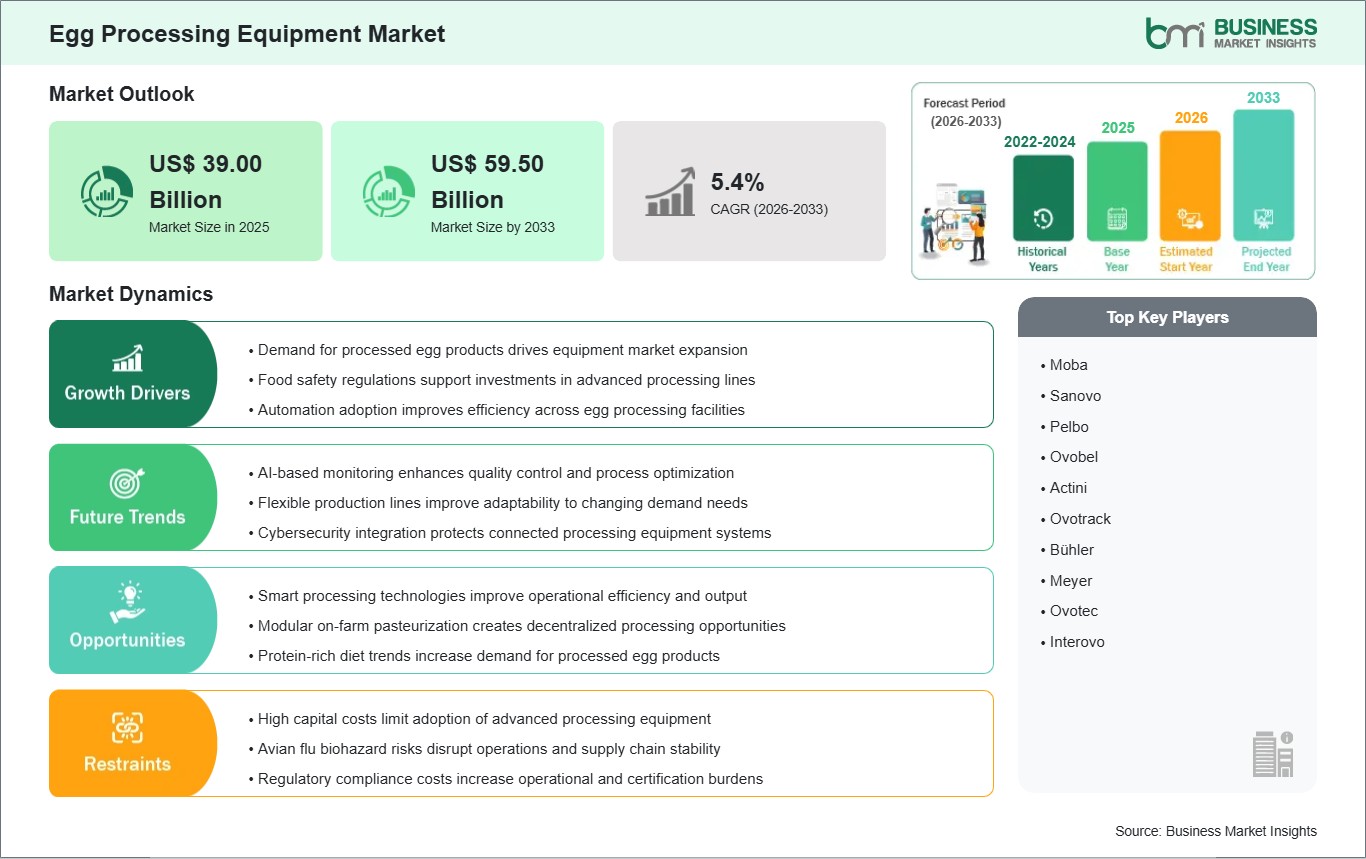
The egg processing equipment market encompasses the range of equipment that processes raw eggs to be converted into liquids, powders, and freeze-dried products for use in food applications. These egg processing machines incorporate egg breaker, separator, and homogenizer machinery that enhance processing efficiency, improve hygiene practices, and increase uniformity in the products produced. The equipment satisfies the demands of large-scale industrial food applications such as baked goods and confectionery.
Increasing consumer preference for convenience food items leads to increased adoption of processed eggs as an ingredient within the industrial food sector. Food processors now depend on processed eggs as they help maintain consistency in their products, ensuring that their products meet health and safety regulations. There is also an increase in food service industry operations and industrial baking, which creates more need for egg processing equipment.
Segmentation of the market occurs according to the type of machinery, final products, and users because of varying process requirements in food manufacturing operations. There is an extensive use of egg-breaking machines and separators in volume production operations, and homogenizers are used for uniformity purposes. The major processing products are liquid eggs, which have greater efficiency during processing operations, whereas drying and freezing help with storage and transportation. Major customers include egg product companies, bakeries, and confectioneries.
Advancements in technology through automation and sanitation processes impact the machinery design and operations in this industry. The use of control systems is encouraged to optimize yields and minimize the chances of contamination. Competitive strategies focus on equipment performance, processing speeds, and the ability to customize products.
Segment Analysis
Egg Processing Equipment Market Segmentation
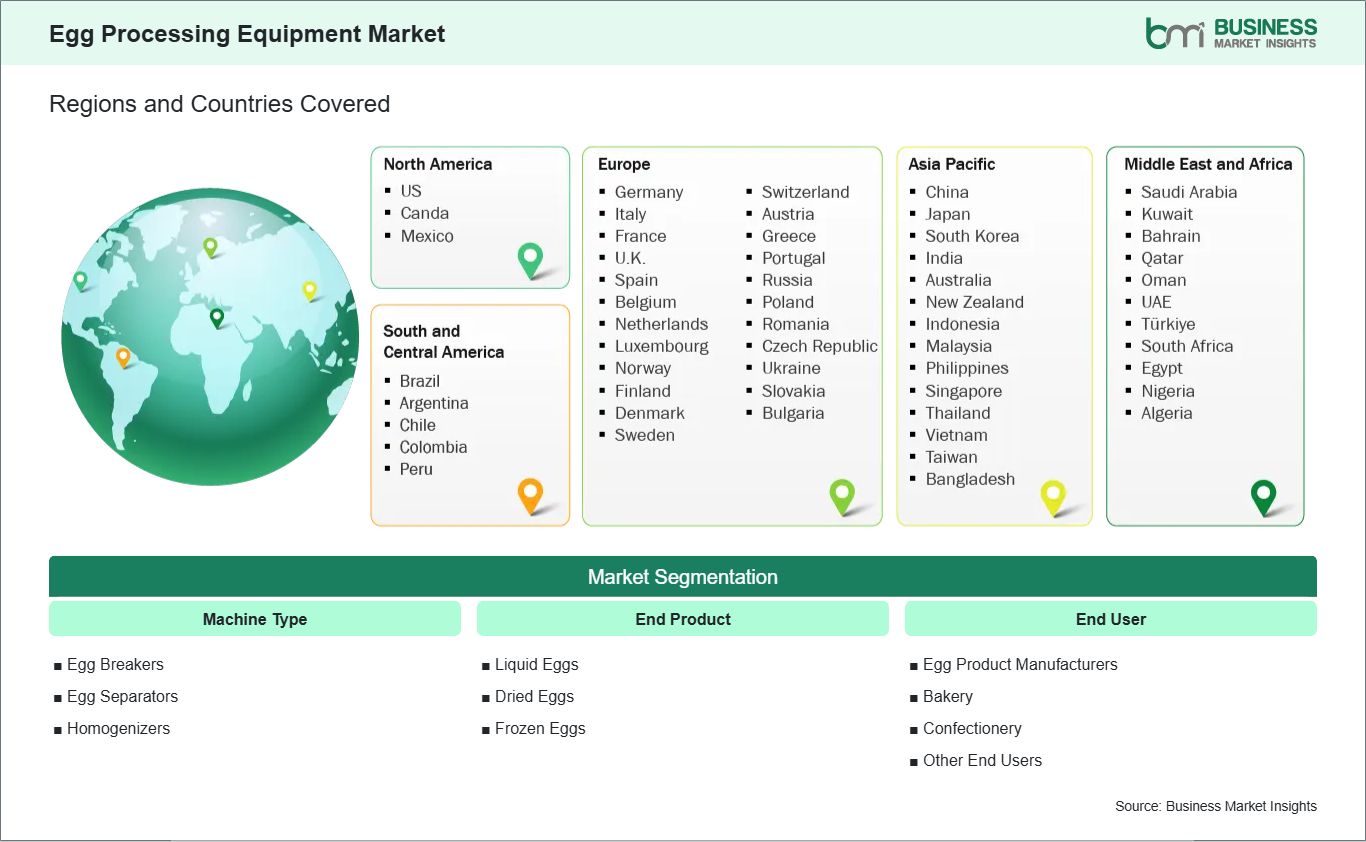
The egg processing equipment market is segmented based on machine type, end product, and end user, reflecting industrial requirements for efficient egg transformation, product consistency, and large-scale food manufacturing operations.
By Machine Type
- Egg Breakers – High-speed separation systems improve efficiency in large-scale egg cracking operations.
- Egg Separators – Advanced mechanisms ensure accurate yolk and white separation for industrial use.
- Homogenizers – Processing units maintain uniform texture and improve product stability in liquid applications.
By End Product
- Liquid Eggs – Widely used in baking and food processing due to operational flexibility.
- Dried Eggs – Long shelf-life products suitable for storage and transport efficiency.
- Frozen Eggs – Preserved formats used in industrial food production requiring extended usability.
By End User
- Egg Product Manufacturers – Large-scale processors focus on efficiency and output consistency.
- Bakery – Egg ingredients support texture, structure, and product quality in baked goods.
- Confectionery – Processed eggs enhance emulsification and stability in sweet food formulations.
- Other End Users – Diverse food industries utilize processed eggs for varied culinary applications.
Market Forces
Egg Processing Equipment Market Drivers and Opportunities
Rising demand for processed eggs
The increase in demand for ready-to-eat and packaged food products is boosting the demand for processed eggs in the food industry. The use of eggs in a processed form, such as in a liquid, dried, or frozen state, is preferred by food companies over the use of shell eggs owing to various benefits associated with them. The trend will favor greater investments in egg processing machinery, especially in large-scale production settings. Egg processing is also being adopted by bakeries and confectioners to ensure quality and save time.
Urbanization and growth in the food industry have made it imperative for food companies to rely on processed raw materials in food manufacturing. Processed eggs not only have an extended shelf-life but are also flexible enough to be used on a global basis. Increasing reliance on processed eggs is pushing food producers to adopt mechanized processes to improve productivity.
Smart processing technology
The latest innovations related to smart processing technology are offering growth avenues in the egg processing equipment market because of their ability to increase automation and monitor production processes. By using smart sensors and digital processing tools, egg manufacturers will be able to handle their products effectively and maximize their processing capabilities without compromising product quality. In addition, these technologies offer increased reliability and precision when processing eggs.
Future trends in the egg manufacturing industry may include increasing utilization of intelligent processing tools to help manufacturers optimize production and implement predictive maintenance. Moreover, smart processing equipment can contribute to better energy management practices within production plants. As food manufacturers face growing challenges related to food safety regulation, such technologies may play a vital role in maintaining compliance with safety requirements.
Size and Share Analysis
Egg Processing Equipment Market Size and Share Analysis
The egg processing equipment market is projected to grow from US$ 39.0 billion in 2025 to US$ 59.5 billion by 2033, registering a CAGR of 4.2% from 2026 to 2033.
By machine type, egg breakers account for a significant share due to their fundamental role as the first and most essential step in industrial egg processing. They are widely deployed in large-scale processing lines because they enable high-speed cracking of eggs with minimal breakage loss, making them indispensable for continuous production of liquid and processed egg products.
By end product, liquid eggs dominate the market as they offer high convenience, longer shelf stability, and ease of integration into large-scale food processing operations. They are extensively used in bakeries, food service, and industrial food manufacturing due to reduced labor requirements, improved hygiene, and consistent quality compared to shell eggs.
By end user, egg product manufacturers lead the market because they are the primary processors of raw shell eggs into value-added products such as liquid, frozen, and dried eggs. Their operations require specialized processing equipment at scale, making them the largest adopters of egg breaking, separation, and pasteurization systems globally.
Report Coverage
Egg Processing Equipment Market Report Coverage and Deliverables
The "Egg Processing Equipment Market Size and Forecast (2022–2033)" report provides a detailed analysis of the market covering below areas:
- Market size and forecast at global, regional, and country levels for all key market segments covered under the scope
- Market trends, along with market dynamics such as drivers, restraints, and key opportunities
- Market analysis covering key trends, global and regional frameworks, major players, regulations, and recent developments
- Industry landscape and competitive analysis covering market concentration, heat map analysis, prominent players, and recent developments
- Detailed company profiles, including SWOT analysis
Geographic Insights
Egg Processing Equipment Market Geographic Insights
In the egg processing equipment market, different regions adopt various trends depending on industrialization within their food industry, application of technologies, and changes in consumer preferences. There is growth in the market because of increased demand for processed food items and growing adoption of automated food processing systems throughout the globe.
North America has high adoption due to well-developed food processing systems and high demand for convenience foods. Both the United States and Canada have witnessed an increase in the use of automated egg processing systems in bakery, confectionary, and industrial food manufacturing. High food safety standards are responsible for increasing adoption.
Asia Pacific has shown continuous growth due to growing food processing industries and high consumption of processed food items. There has been a rise in the number of investments in countries like China, India, Japan, and South Korea in food manufacturing automation.
In Europe, there exists a well-developed market, which is backed by well-established industries for food processing, and regulation in terms of food safety and quality. Nations such as Germany, France, Italy, and the UK continue to embrace modern processing techniques. New markets such as those in Latin America and the Middle East are slowly embracing food processing technologies as their food manufacturing industry grows.
Industry Activity
Recent Developments
The egg processing equipment market is evaluated by gathering qualitative and quantitative data post primary and secondary research, which includes important corporate publications, association data, and databases. Recent developments and news in the market include:
- In February 2026, Sanovo Technology Group announced that it had introduced Vision Weighing technology as part of its next-generation high-capacity egg grading systems, strengthening its AI-based portfolio for automated egg quality detection, grading, and processing efficiency.
- In October 2025, Moba announced that it had deployed its MR60 automated palletizing system at Grafschafter Frischei, expanding downstream automation in egg packing and logistics handling.
Trust & Transparency
Research Methodology
The market analysis combines proprietary research with secondary data from government agencies, company disclosures, regulatory filings, industry databases and expert interviews. Market estimates are validated through data triangulation, cross-market benchmarking and analyst
review.
View Full Research Methodology
Key Sources Referred:
U.S. Food Safety and Inspection Service (FSIS) European Food Safety Authority (EFSA) European Commission Directorate-General for Health and Food Safety (DG SANTE) Food Safety and Standards Authority of India (FSSAI) International Egg Commission (IEC) American Egg Board United Egg Producers (UEP) Company Websites Company Annual Reports Company Investor Presentations