
Oil Gas EPC Market Outlook: Size, Share, Trends, Growth Analysis, Competitive Landscape & Forecast, 2026-2033

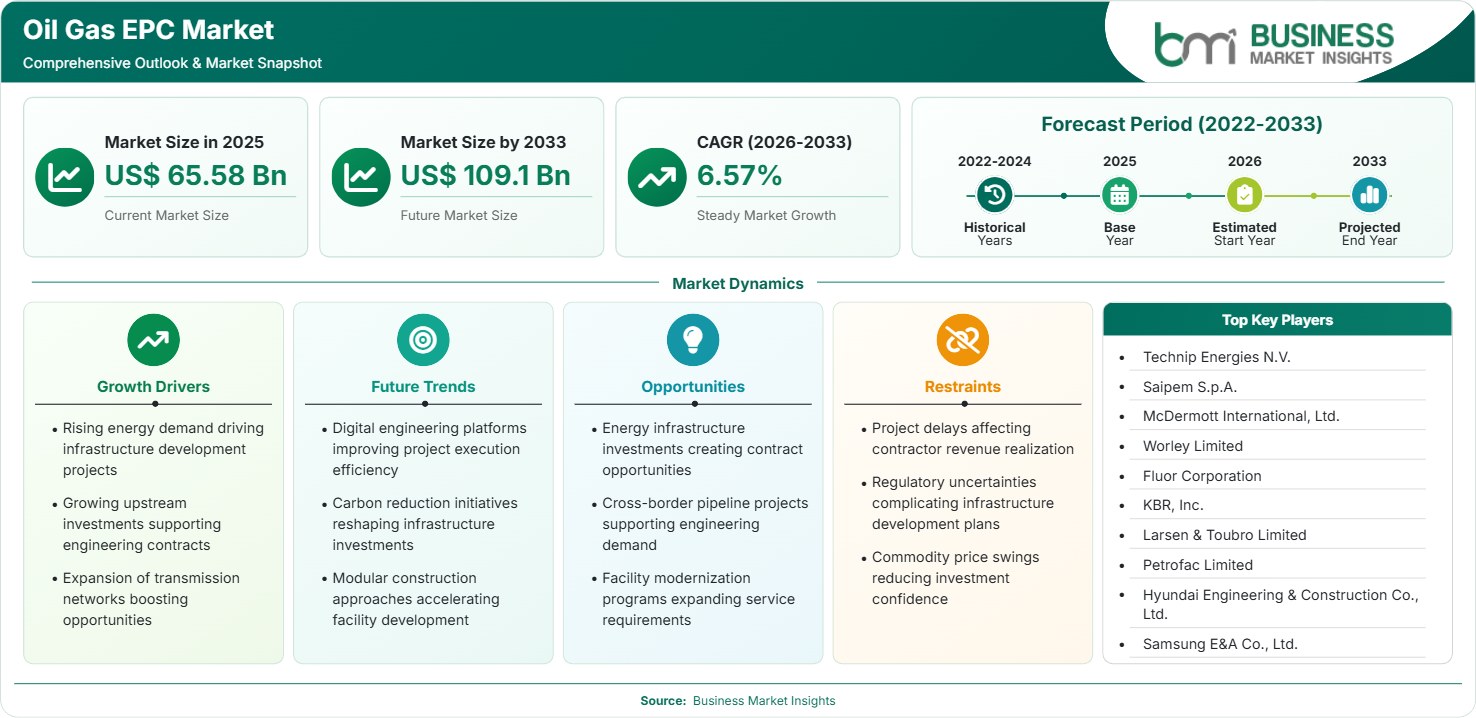
The Oil Gas EPC Market size was valued at US$ 65.58 Billion in 2025 and is projected to reach US$ 109.1 Billion by 2033, growing at a CAGR of 6.57% during 2026–2033, driven by LNG expansion, brownfield modernization, offshore development, refinery upgrades, and energy security investments.

Report Coverage
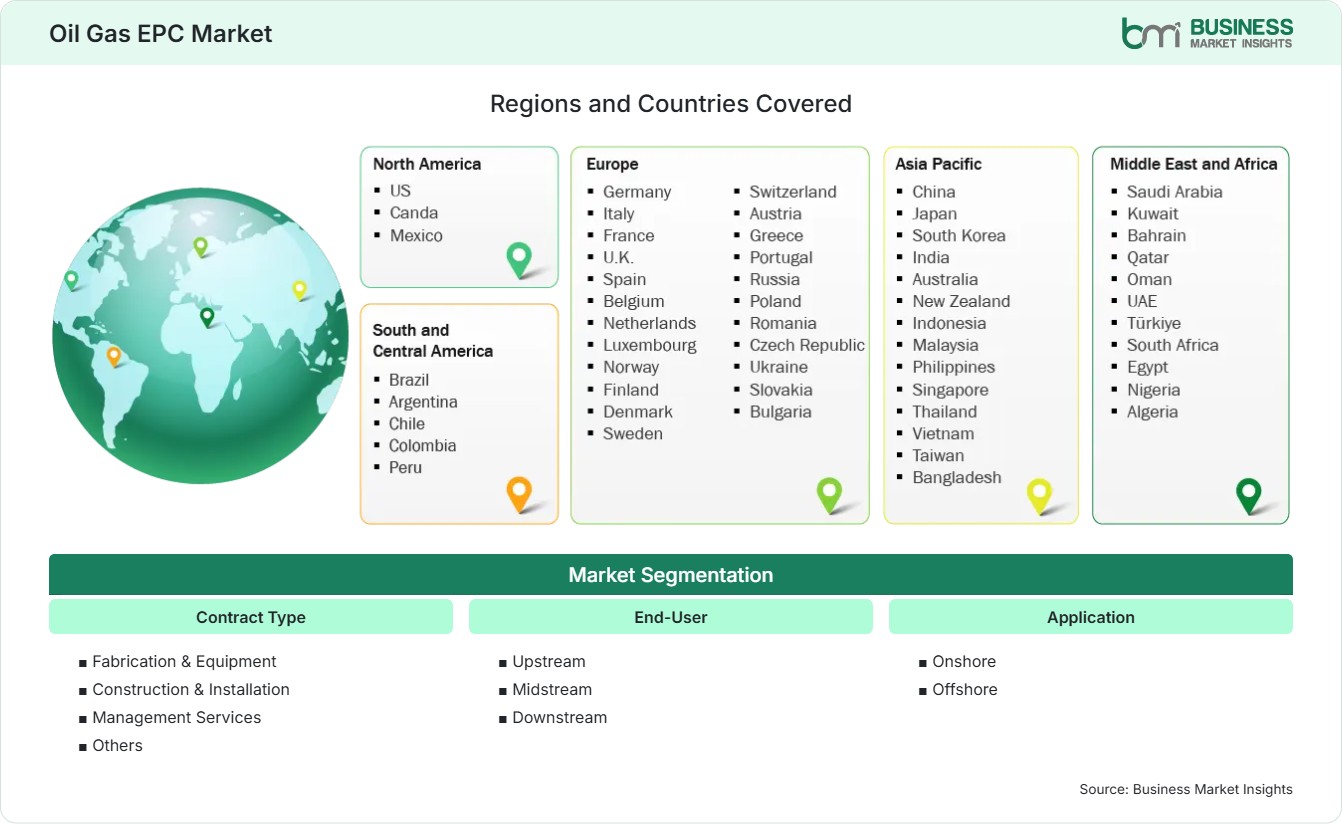
  • Contract Type: Fabrication & Equipment, Construction & Installation, Management Services, Others
  • End-User: Upstream, Midstream, Downstream
  • Application: Onshore, Offshore
US$ 65.58 Bn Market size in 2025
US$ 109.1 Bn Market Size by 2033
6.57% CAGR, 2026 - 2033
2026-2033 Forecast Period

AI Overview

Oil Gas EPC Market Summary

  • North America Region: North America holds a 7%–9% share in 2025, growing at a 5.8%–6.4% CAGR during 2026–2033, influenced by LNG capacity additions, shale infrastructure, pipeline modernization, refinery debottlenecking, digital engineering, and resilient domestic energy investment. US projects emphasize LNG export capacity, Gulf Coast infrastructure, brownfield upgrades, modular construction, and procurement localization amid cost pressures.
  • Fastest Growing Region: Asia Pacific holds a 13%–16% Oil Gas EPC Market share in 2025, expanding at a 7.2%–7.8% CAGR during 2026–2033, supported by refinery additions, LNG terminals, petrochemical integration, offshore exploration, national energy security strategies, and expanding industrial infrastructure.
  • Leading Segment: Fabrication & Equipment holds a 54%–58% share in 2025, advancing at a 6.4%–7.0% CAGR during 2026–2033, supported by modular fabrication, specialized equipment demand, standardized engineering, supply-chain localization, and complex offshore project requirements.
  • High Growth Segment: Upstream holds a 44%–48% share in 2025, expanding at a 6.4%–6.9% CAGR during 2026–2033, supported by offshore field development, brownfield recovery programs, subsea infrastructure, gas production, LNG feedstock requirements, and national production targets.
  • Key Market Opportunity: Integrated EPCIC delivery, LNG infrastructure, offshore brownfield modernization, modular fabrication, digital twins, lower-carbon processing, and localized procurement create opportunities for contractors combining engineering depth with execution capacity.
  • Major Market Players: Technip Energies N.V.; Saipem S.p.A.; McDermott International, Ltd.; Worley Limited; Fluor Corporation; KBR, Inc.; Larsen & Toubro Limited; Petrofac Limited; Hyundai Engineering & Construction Co., Ltd.; Samsung E&A Co., Ltd.
Strategic Insights

Oil Gas EPC Market: Strategic Insights

Oil Gas EPC Market Strategic Framework
FREE PDF
Request your free sample
Request free sample
Stakeholder View

Key Takeaways

  • The supply chain is shifting from fragmented engineering, procurement, fabrication, and installation packages toward integrated delivery models. Large operators increasingly value contractors that can coordinate design interfaces, equipment sourcing, fabrication, commissioning, and lifecycle support across geographically distributed projects.
  • Upstream and fabrication-intensive projects provide the strongest near-term upside because offshore developments, subsea tiebacks, gas-field expansion, and brownfield modifications require specialized engineering, heavy fabrication, installation expertise, and stringent project controls.
  • Technology investment is moving toward digital twins, automated design checking, modularization, predictive procurement, remote inspection, and data-linked construction management. These tools can improve schedule visibility and reduce rework on technically complex facilities.
  • Asia Pacific provides a compelling investment case because refinery expansion, petrochemical integration, LNG import infrastructure, offshore development, and industrialization are creating recurring EPC demand across India, China, Indonesia, Malaysia, and Australia.
  • Investment strategies increasingly favor contractors with strong backlogs, local execution capacity, specialized offshore assets, and disciplined contract selection. Partnerships and consortium structures are also gaining importance for megaprojects requiring complementary engineering, fabrication, and installation capabilities.
Geographic Outlook

Oil Gas EPC Market Regional Highlights

North America Oil Gas EPC Market

The North American region is anticipated to register an Oil Gas EPC Market Share of 7%-9% by 2025, with a CAGR growth rate of 5.8%-6.4% during the period from 2026 to 2033. LNG export terminals, shale processing, pipeline rehabilitation, refinery revamps, and offshore projects in the Gulf area will continue to keep the players engaged. While the US is the major consumer market, Canada will add its share through natural gas processing, oil sands plants, LNG, and pipelines.

  • US LNG expansion supports engineering, procurement, fabrication, commissioning, and terminal-related construction, while new liquefaction projects strengthen demand for specialized contractors and modular equipment.
  • Canada provides opportunities through gas processing, LNG infrastructure, oil sands maintenance, and pipeline-linked facilities, with project economics increasingly emphasizing schedule certainty and local procurement.
  • Offshore Gulf of Mexico investment remains concentrated in brownfield modifications, subsea tiebacks, production optimization, and asset-life extension rather than uniformly distributed greenfield development.
  • Digital project controls, automated engineering reviews, and procurement analytics are becoming important differentiators as contractors manage higher material costs and complex equipment lead times.

US Oil Gas EPC Market

The US presence in North America in 2025 would be between 78% and 82%, with a CAGR of 6.0%-6.6% in the Oil Gas EPC Market from 2026 to 2033. This market demand would come from the LNG terminals, gas processing, petrochemicals, refineries, pipeline systems, and offshore services. The Gulf Coast would continue to play a strategic role, with the industries providing raw material supply, exports, refining, petrochemical production, and other industries. As per IEA report, there is a very strong drive towards investments in LNG infrastructure, with 80 bcm/year in the US in 2025.

  • Gulf Coast LNG projects create extensive demand for cryogenic equipment, process engineering, storage, utilities, marine infrastructure, commissioning, and supporting pipeline connections.
  • Domestic procurement strategies are gaining importance because tariffs and supply-chain uncertainty can increase project costs, encouraging EPC firms to qualify alternate suppliers and expand local fabrication.
  • Brownfield refinery and petrochemical projects offer recurring work because operators can debottleneck existing assets faster than constructing entirely new complexes.

Europe Oil Gas EPC Market

The Europe region has a market share of 8% - 10% of the Oil & Gas EPC Market in 2025 with a CAGR of 5.4% - 6.0% from 2026 to 2033. Norway and the UK continue to be the top regions for projects in offshore maintenance, field developments, subsea tie backs, and platform modifications. Norway continues to deliver relatively strong projects in the upstream segment, while the UK delivers projects in mature basins and in decommissioning engineering. Netherlands and Germany provide projects in the downstream and gas infrastructure segments.

  • Norway remains a leading country for offshore development, with brownfield tiebacks and subsea projects supporting specialist fabrication, installation, and engineering demand.
  • The United Kingdom continues to generate opportunities from mature North Sea assets, decommissioning, offshore modifications, and infrastructure optimization despite tighter investment discipline.
  • The Netherlands supports downstream and low-carbon industrial projects where established ports, process clusters, and engineering capabilities facilitate complex facility development.
  • European procurement strategies increasingly emphasize emissions performance, energy efficiency, lifecycle cost, and compliance alongside traditional capital-cost considerations.

Asia Pacific Oil Gas EPC Market

Asia Pacific constitutes a share of 13% to 16% in 2025, which grows at a CAGR of 7.2% to 7.8% during 2026 to 2033 to become the fastest growing regional market. India, China, Australia, Indonesia, and Malaysia contribute to project pipelines in refining, LNG, offshore production, petrochemicals, pipelines, terminals, and gas processing. India sees growth in refineries and petrochemicals; Australia remains an important market for LNG and offshore oil and gas resources, while Indonesia and Malaysia contribute to gas processing projects.

  • India combines refinery expansion, petrochemical integration, LNG infrastructure, offshore development, and pipeline investment, creating a diversified EPC pipeline across upstream and downstream applications.
  • Australia remains a high-value market for LNG, offshore gas, subsea infrastructure, maintenance, and processing projects requiring stringent engineering and environmental controls.
  • Indonesia offers growth through gas monetization and offshore development, with the Abadi LNG project demonstrating continued demand for complex floating and subsea engineering.
  • China and Malaysia provide large industrial and refining ecosystems, supporting equipment fabrication, process engineering, construction, and integrated project delivery.

Rest of World Oil Gas EPC Market

The Rest of World captures a market share of 66% to 70% in 2025 with a CAGR of 6.8% to 7.3% in the Oil Gas EPC Market during the period 2026 to 2033. The Middle East projects have a strong presence due to Saudi Arabia, Qatar, the UAE, and Oman, while South & Central America will receive a boost from offshore projects in Brazil and Guyana. Additionally, Africa offers prospects for LNG and gas processing facilities in Mozambique. Resource investment, LNG expansion, offshore drilling, and refinery upgrade investments are some of the major factors that contribute to the demand for contractors in the region.

In South & Central America, the growth in offshore production from countries such as Brazil and Guyana will lead to a demand for subsea systems, floating structures, fabrication, installation, and engineering services.

Middle East projects focus on mega-scale upstream development, LNG, gas processing, refining, petrochemicals, sulfur recovery, and infrastructural integration, which benefit companies having well-developed regional project delivery networks.

  • Qatar’s LNG expansion demonstrates the scale of Middle Eastern EPC opportunities, with North Field West adding two 8 MTPA LNG trains.
  • Saudi Arabia and the UAE continue to support refinery, gas processing, offshore, and petrochemical projects through national energy strategies and extensive existing infrastructure.
  • Mozambique provides high-growth potential through offshore LNG developments, while Brazil and Guyana support deepwater EPC demand through expanding hydrocarbon production.
Global Market Geography
FREE PDF
Request your free sample
Request free sample
Segment Analysis

Oil Gas EPC Market Segmentation

Contract Type

Contract Type will continue to be an important factor in Oil Gas EPC Market economics since project owners will seek balance among cost certainty, scheduling flexibility, technical challenges, and risk management. The Fabrication & Equipment segment is expected to account for 54% - 58% of the total in 2025 and to grow at a 6.4% - 7.0% CAGR between 2026 and 2033.

  • Fabrication & Equipment: Represents the largest contract category because complex oil and gas projects require pressure vessels, modules, structural systems, piping, subsea equipment, and process packages. Modular fabrication can reduce site congestion and accelerate installation.
  • Construction & Installation: Covers site construction, mechanical installation, electrical work, commissioning support, and offshore integration. Demand is supported by LNG terminals, refineries, pipelines, platforms, and brownfield expansion requiring coordinated field execution.
  • Management Services: Includes project management, engineering management, procurement oversight, scheduling, cost control, quality assurance, and commissioning coordination. Owners increasingly use specialist management capabilities for multi-contractor projects and technically complex developments.
  • Others: Covers supplementary EPC-related activities outside the principal contract categories, including specialized support scopes, project integration services, and selected technical packages required during complex facility development.

End-User

The end-users' requirements are diversified across upstream, midstream, and downstream infrastructures, with upstream accounting for 44%-48% of total market share in 2025 and a compound annual growth rate of 6.4%-6.9% during the forecast period from 2026 to 2033. Scope of oil gas EPC market is not only greenfield but also brownfield projects.

  • Upstream: Includes exploration-linked facilities, production platforms, subsea infrastructure, gathering systems, and field-development projects. Offshore production, gas development, enhanced recovery, and field-life extension support engineering and installation demand.
  • Midstream: Covers pipelines, gas processing, storage, terminals, compression, and transportation infrastructure. LNG expansion and cross-regional gas flows create demand for integrated engineering, procurement, construction, commissioning, and maintenance capabilities.
  • Downstream: Includes refineries, petrochemical facilities, processing units, storage systems, and product infrastructure. Capacity expansion, debottlenecking, modernization, and higher-value product integration support EPC activity.

Application

The economics, engineering, construction, and risks associated with onshore and offshore applications differ due to their application dynamics. The onshore applications represent a greater number of installations due to the need for extensive infrastructural development of the refineries, processing plants, pipelines, and terminal facilities. Offshore applications involve greater technical complexity due to the added complexity of their implementation.

  • Onshore: Supports refineries, gas-processing facilities, petrochemical plants, terminals, pipelines, storage infrastructure, and industrial utility systems. Modular construction and standardized process packages can improve schedule control.
  • Offshore: Covers platforms, floating facilities, subsea systems, offshore pipelines, tiebacks, and installation services. Deepwater development and mature-field modifications require advanced engineering, fabrication, marine logistics, and specialized installation capabilities.
Market Forces

Oil Gas EPC Market Dynamics

Key Market Drivers

LNG Capacity Expansion Is Increasing EPC Backlog Visibility

The development of LNG infrastructure is enhancing the Oil Gas EPC Market growth since new trains need a substantial amount of process engineering, cryogenic equipment, utilities, storage, marine facilities, pipelines, and commissioning. According to the IEA, over 90 bcm per year of LNG liquefaction capacity reached final investment decision (FID) in 2025, with over 80 bcm per year in the United States. The North Field West project in Qatar involves two trains, each with an 8 MTPA capacity. Engineering risk is being decreased through the replication of tried train designs. Contractors with LNG process technologies, modular fabrication skills, procurement capabilities, and commissioning experience will have a broader scope in subsequent projects.

Offshore Brownfield Development Is Extending Contractor Utilization

Oil Gas EPC Market trends have increasingly favored brownfield offshore projects, as operators can prolong hydrocarbon extraction from their current reservoirs without developing a greenfield system. Projects involving tie-backs, compressor upgrades, platform modifications, subsea facilities, piping systems, and optimization require unique engineering and installation skills. The method does not entail any duplication of infrastructure but allows the operator to tap into the reserves still left in the field. Mature offshore basins located in the North Sea, Gulf of Mexico, Middle East and Southeast Asia therefore represent recurring project locations.

Energy Security Is Supporting Selective Hydrocarbon Investment

Energy security considerations are helping to support certain hydrocarbon investments despite strict capital discipline. While upstream oil and gas investment by the IEA is expected to fall by about 4% in 2025 to below US$570 billion, investment in gas is expected to remain resilient as LNG demand increases. It means there will be selective contracting rather than an investment cycle. Operators will emphasize investments with competitive resources, short development times, infrastructure availability, or the strategic value of gas. EPC companies stand to gain if they can provide cost assurance, fast procurement, re-use of engineering design, and interface management without compromising safety and the environment.

Key Market Opportunities

Modular EPC Delivery Can Reduce Schedule and Labor Exposure

Modular fabrication provides an opportunity to improve EPC productivity by transferring work from constrained construction sites to controlled fabrication environments. Major process modules, piping systems, electrical systems, skids, and utilities can be fabricated simultaneously with civil construction, thereby reducing installation periods. Such an approach is very effective in LNG, Offshore, Refinery, and Remote Gas Processing projects, where man-power availability and logistics may become constraining factors. Companies that invest in the standardization of their modules, the automation of fabrication, digital quality records, and integrated logistics will benefit from project repetition. A modular approach also allows for pursuing local content initiatives.

Digital Engineering Can Improve Project Cost and Interface Control

Digital twin technology, model-based engineering, automatic design verification, procurement analysis, and integrated construction software can deliver new value in complex EPC projects. The Oil Gas EPC Market forecasts will require consideration of contractors’ capabilities to handle data within the engineering, procurement, fabrication, construction, commissioning, and transfer of assets process. Digital processes can be used to detect any clashes prior to fabrication, monitor long-lead items, benchmark against the baseline schedule, and enhance change management processes. The operators gain improved visibility into the entire lifecycle, while contractors experience reduced rework and an enhanced claims management process.

Integrated Gas and Lower-Carbon Processing Create New EPC Scopes

Gas treatment, sulfur recovery, methane measurement, electrification, carbon management, energy-efficiency improvements, and low-emission process systems are creating new engineering scopes in traditional hydrocarbon projects. The highest potential exists in projects that demand an increase in production along with more stringent environmental regulations. An example of such a project is the Budour Tayseer Gas Project in Oman, which has incorporated facilities for gas treatment and sulfur recovery to handle 2 million standard cubic meters of sweet gas per day. Such projects benefit from EPC contractors who can integrate the above scopes in their delivery systems.

Market Restraints and Challenges

Input-Cost Volatility Can Compress EPC Margins

Factor: Costs related to steel, aluminum, fabricated items, labor, logistics, and finance could change substantially in the period of implementation of a large project. Impact: The risks for EPCs involved in fixed price contracts are substantial if there is a delay of several months in procuring the goods following the signing of the contract. According to the International Energy Agency (IEA), upstream oil and gas costs will rise by approximately 3% in 2025, and engineering projects are encountering issues due to tariffs and material costs. There has been an increasing tendency among contractors toward escalation clauses, supplier diversification, early procurement, and contingency plans.

Skilled Labor and Execution Capacity Constrain Complex Projects

Factor: Lack of competent engineers, welders, project managers, commissioners, and offshore staff may hinder the ability to execute the project. Impact: A lack of competent workers can lead to delays, increased labor costs, and potential bottlenecks across several megaprojects. Currently, the EPC companies are addressing the problem of a lack of competent workers by setting up engineering centers, automation in the fabrication process, modular construction, and repetitive design. Nevertheless, advanced offshore and LNG projects will definitely require unique, irreplaceable skills. In this case, execution capacity can affect bidding for the project, project prioritization, and choice of the contractor.

Company Analysis

Competitive Landscape

The Oil Gas EPC Market analysis indicates a competitive environment shaped by integrated engineering capabilities, fabrication capacity, regional presence, technology ownership, offshore assets, and ability to execute complex LNG, upstream, midstream, and downstream projects.

Company Name

Overview

Products and Services relevant to this market

Technip Energies N.V.

Global engineering and technology specialist with deep LNG, offshore, refining, petrochemical, and energy-project expertise across major producing regions.

LNG facilities, offshore systems, refining, petrochemicals, engineering, procurement, construction, commissioning, technology licensing, and project management services.

Saipem S.p.A.

Italian engineering and construction company with extensive offshore, subsea, LNG, pipeline, and integrated energy project capabilities.

Offshore platforms, subsea systems, pipelines, LNG, engineering, procurement, construction, installation, commissioning, and marine project services.

McDermott International, Ltd.

Global engineering and construction contractor focused on offshore, subsea, LNG, downstream, and large-scale energy infrastructure projects.

Offshore structures, subsea engineering, fabrication, installation, LNG, pipelines, project management, procurement, and integrated construction services.

Worley Limited

Engineering and project-delivery group serving upstream, gas, downstream, chemicals, and broader energy infrastructure markets globally.

Engineering, procurement, EPCM, project management, gas processing, refining, offshore facilities, asset services, and lifecycle solutions.

Fluor Corporation

Engineering and construction company providing large-project execution across LNG, hydrocarbons, chemicals, infrastructure, and industrial facilities.

EPC, EPCM, LNG, refining, petrochemicals, engineering, procurement, construction management, commissioning, and project services.

KBR, Inc.

Engineering and technology company with strong capabilities in hydrocarbons, gas processing, LNG, consulting, and project management.

FEED, EPCM, process technology, gas processing, LNG, engineering, procurement, construction management, and advisory services.

Larsen & Toubro Limited

Diversified Indian engineering company with substantial hydrocarbon, offshore, fabrication, and infrastructure execution capabilities.

Offshore platforms, pipelines, fabrication, EPCIC, refineries, petrochemicals, process facilities, procurement, construction, installation, and commissioning.

Petrofac Limited

Energy services provider focused on engineering, project delivery, operations, and asset support across international hydrocarbon markets.

Engineering, EPC, operations support, offshore services, project management, brownfield modifications, and asset lifecycle solutions.

Hyundai Engineering & Construction Co., Ltd.

Korean engineering and construction group with extensive refinery, petrochemical, LNG, offshore, and industrial project experience.

EPC, LNG, refining, petrochemicals, offshore infrastructure, process facilities, construction, procurement, and commissioning.

Samsung E&A Co., Ltd.

Korean engineering company specializing in energy, refining, petrochemical, gas processing, and complex industrial project delivery.

Engineering, procurement, construction, project management, refining, petrochemicals, gas processing, LNG, and modular project execution.

Trust & Transparency

Research Methodology

The market analysis combines proprietary research with secondary data from government agencies, company disclosures, regulatory filings, industry databases and expert interviews. Market estimates are validated through data triangulation, cross-market benchmarking and analyst review.

View Full Research Methodology

Questions Answered

Frequently Asked Questions

How important is digital engineering to future EPC competitiveness?

Digital engineering is becoming a core competitiveness factor because contractors can connect design, procurement, fabrication, construction, commissioning, and asset data. Digital twins and automated design validation can reduce interface errors, improve progress visibility, strengthen change management, and support more predictable project execution.

What does the Oil Gas EPC Market report cover for investors?

The report evaluates contract type, end-user, application, regional dynamics, growth drivers, opportunities, restraints, competitive positioning, recent developments, and project-delivery trends. It helps investors assess where engineering capability, fabrication capacity, LNG expertise, and regional execution platforms can support sustainable backlog growth.

Which applications offer the strongest EPC opportunities?

Offshore and onshore applications both provide opportunities, but offshore projects offer higher technical intensity through subsea systems, floating facilities, tiebacks, platform modifications, and specialized installation. Onshore LNG, refining, gas processing, and petrochemical facilities provide larger volumes of recurring construction activity.

How are EPC contractors responding to higher project costs?

Contractors are increasing early procurement, supplier diversification, modular fabrication, digital cost controls, and contractual escalation mechanisms. These measures help manage steel, labor, logistics, financing, and equipment volatility while reducing exposure to delays and procurement bottlenecks.

What factors are shaping the Oil Gas EPC Market through 2033?

LNG capacity additions, offshore field development, refinery modernization, gas processing, brownfield upgrades, modular construction, procurement localization, and digital engineering are shaping project demand. Contractor selection is increasingly influenced by execution capacity, technology ownership, schedule performance, regional fabrication, and ability to manage complex contractual interfaces.

Access the Full Oil Gas EPC Market Report

Get segment-level forecasts, regional estimates, competitive benchmarking, company profiles and downloadable Excel datasets.

Access the full Oil Gas EPC Market Report
350 pages PDF & Excel | 2026-09-18
Similar Research

Related Market Reports