
Offshore Support Vessels Market Outlook: Size, Share, Trends, Growth Analysis, Competitive Landscape & Forecast, 2026-2033

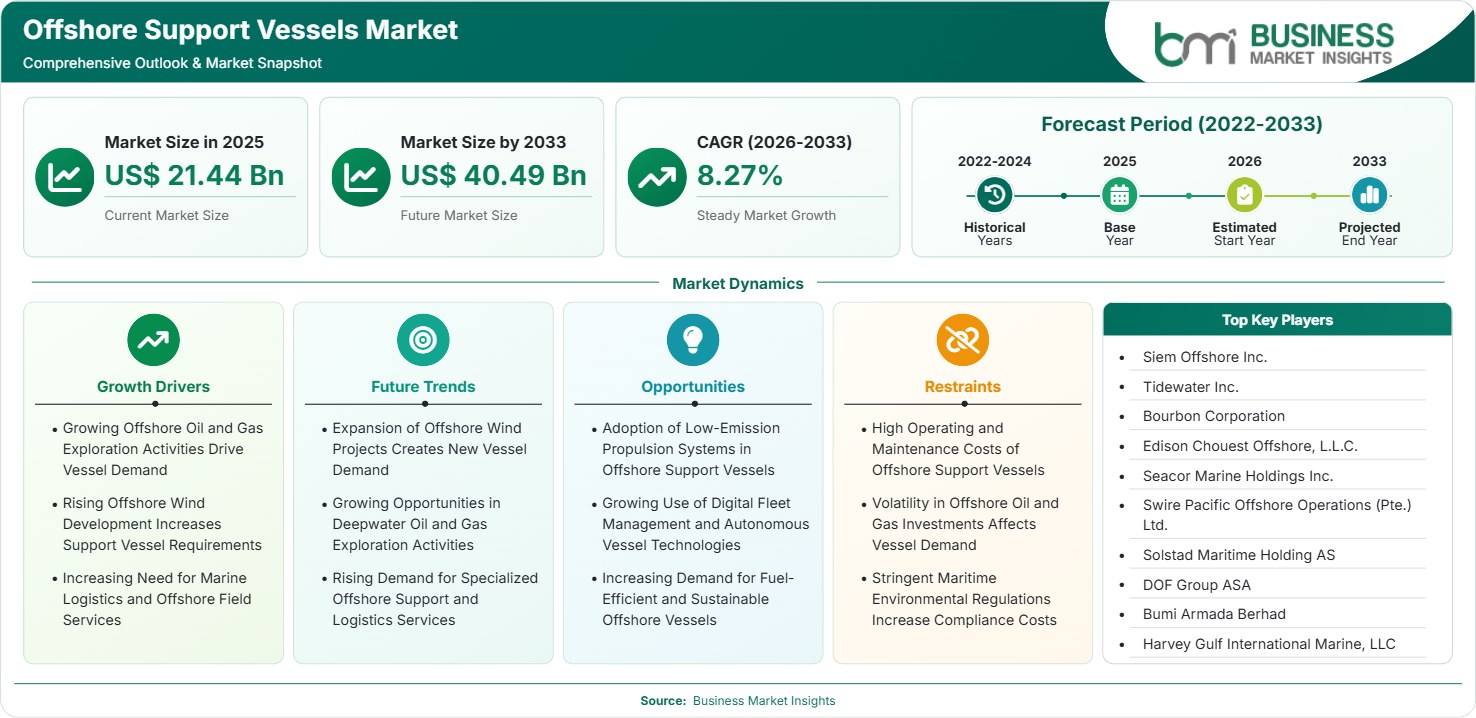
The Offshore Support Vessels Market size was valued at US$ 21.44 Billion in 2025 and is projected to reach US$ 40.49 Billion by 2033, growing at a CAGR of 8.27% during 2026–2033, driven by offshore exploration, wind farm expansion, marine logistics, vessel modernization, digitalization, and sustainable propulsion.

Report Coverage
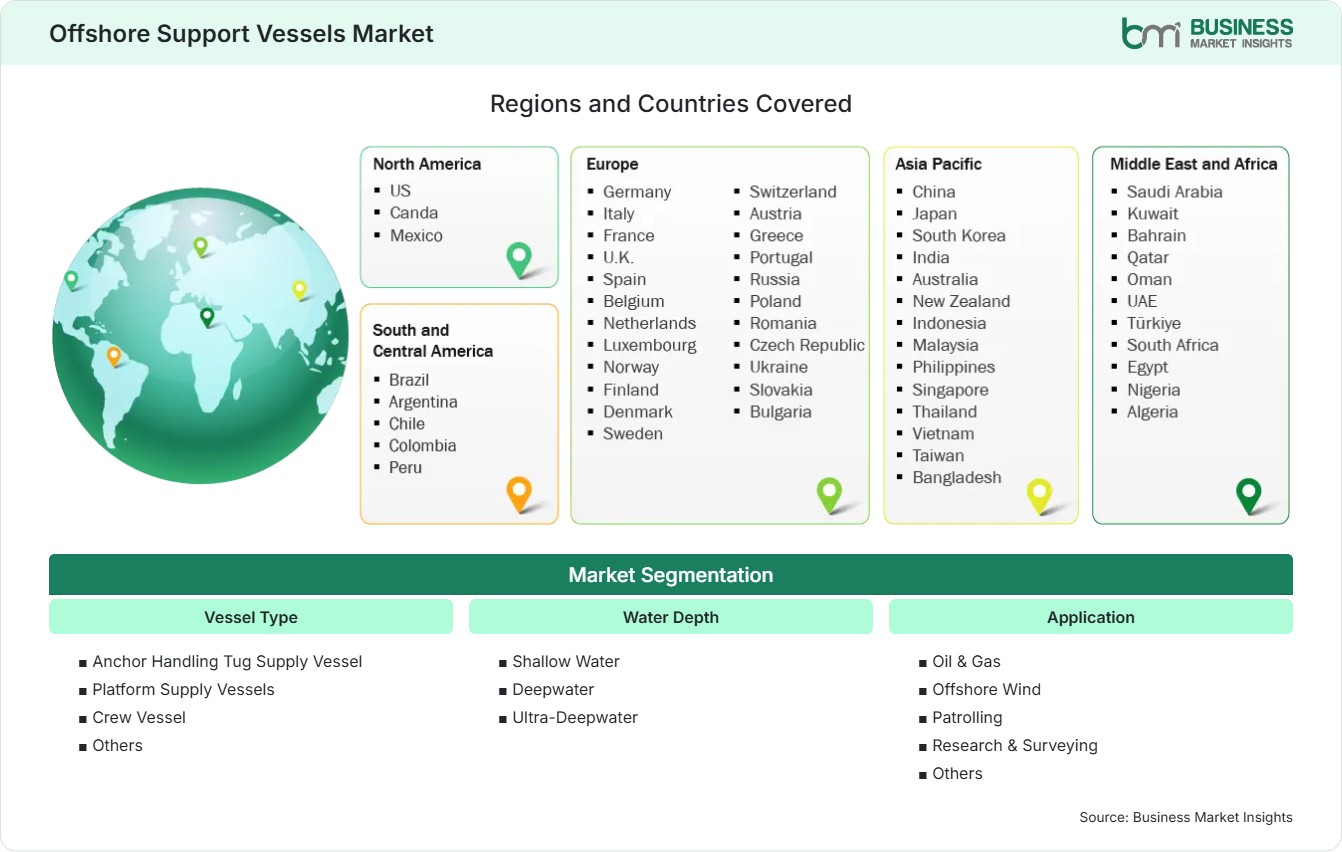
  • Vessel Type: Anchor Handling Tug Supply Vessel, Platform Supply Vessels, Crew Vessel, Others
  • Water Depth: Shallow Water, Deepwater, Ultra-Deepwater
  • Application: Oil & Gas, Offshore Wind, Patrolling, Research & Surveying, Others
US$ 21.44 Bn Market size in 2025
US$ 40.49 Bn Market Size by 2033
8.27% CAGR, 2026 - 2033
2026-2033 Forecast Period

AI Overview

Offshore Support Vessels Market Summary

  • North America Region: North America holds an estimated 28%–32% share in 2025, growing at a CAGR of 7.5%–8.0%, supported by offshore oil and gas activity, Gulf of Mexico operations, offshore wind development, vessel replacement, and specialized marine logistics. The US market is estimated to grow at a CAGR of 7.8%–8.3% during 2026–2033, supported by offshore energy projects, Gulf of Mexico field services, offshore wind leasing activity, and demand for modern support vessels with improved fuel efficiency and operational capabilities.
  • Fastest Growing Region: Asia Pacific holds an estimated 24%–28% share in 2025, growing at a CAGR of 9.0%–9.6%, supported by offshore energy investments, expanding offshore wind capacity, deepwater exploration, maritime infrastructure development, and increasing demand for modern support vessels across China, Southeast Asia, India, and Australia.
  • Leading Segment: Platform Supply Vessels account for an estimated 32%–36% share in 2025, growing at a CAGR of 7.8%–8.3%, supported by offshore drilling, and increasing demand for larger vessels serving deepwater energy projects.
  • High Growth Segment: Offshore Wind represents an estimated 14%–18% share in 2025, growing at a CAGR of 11.0%–12.5%, driven by accelerating offshore wind installations, specialized crew transfer, and growing demand for low-emission marine logistics.
  • Key Market Opportunity: Fleet owners can capture expanding demand by deploying low-emission propulsion, autonomous navigation, digital fleet monitoring, predictive maintenance, and specialized vessels designed for offshore wind and deepwater operations.
  • Major Market Players: Siem Offshore Inc., Tidewater Inc., Bourbon Corporation, Edison Chouest Offshore, L.L.C., Seacor Marine Holdings Inc., Swire Pacific Offshore Operations (Pte.) Ltd., Solstad Maritime Holding AS, DOF Group ASA, Bumi Armada Berhad, Harvey Gulf International Marine, LLC.
Strategic Insights

Offshore Support Vessels Market: Strategic Insights

Offshore Support Vessels Market Strategic Framework
FREE PDF
Request your free sample
Request free sample
Stakeholder View

Key Takeaways

  • The industry value chain is moving toward integrated offshore service capabilities, where vessel operators combine transportation, dynamic positioning, subsea support, crew logistics, maintenance, and project management to improve utilization and customer retention.
  • Offshore wind presents the strongest structural growth opportunity, particularly for service operation vessels, crew vessels, and specialized support fleets that can operate for extended periods near increasingly distant offshore installations.
  • Fleet modernization is becoming a competitive differentiator as owners replace older, less efficient vessels with hybrid propulsion, battery storage, advanced navigation, digital monitoring, and lower-emission technologies.
  • Asia Pacific offers a compelling investment case because offshore oil and gas development is occurring alongside rapidly expanding offshore wind projects, creating diversified demand across energy and marine infrastructure applications.
  • M&A and fleet consolidation remain strategically relevant because scale improves vessel utilization, financing access, geographic coverage, and the ability to invest in specialized vessels and digital operating platforms.
  • Vessel owners with diversified exposure across oil and gas, offshore wind, subsea construction, and marine logistics are better positioned to manage cyclical fluctuations in individual energy markets.
Geographic Outlook

Offshore Support Vessels Market Regional Highlights

North America Offshore Support Vessels Market

North America holds a 28%–32% offshore support vessels market share of global revenue in 2025 and is projected to expand at a 7.5%–8.0% CAGR through 2033. The region benefits from offshore oil and gas operations in the Gulf of Mexico, growing offshore wind development along the Atlantic coast, and established marine service infrastructure. The US dominates regional demand, while Canada contributes through offshore energy and marine research.

  • Gulf of Mexico activity supports platform supply and anchor handling demand, with vessel owners prioritizing efficient fleet deployment, dynamic positioning, and reliable logistics services for offshore production and drilling operations.
  • US offshore wind development creates opportunities for crew vessels, service operation vessels, and specialized support fleets required for turbine installation, inspection, maintenance, and long-duration offshore operations.
  • Fleet renewal is gaining importance as aging vessels face higher maintenance expenses and increasing regulatory pressure, encouraging operators to invest in newer tonnage with improved fuel economy.
  • Canada offers selective opportunities through offshore energy, marine research, and specialized support services, although project timing remains influenced by regulatory approvals and regional investment cycles.

US Offshore Support Vessels Market

The US offshore support vessels market represents approximately 82%–86% of North America's 2025 revenue and is projected to grow at a 7.8%–8.3% CAGR through 2033. Demand is anchored by Gulf of Mexico oil and gas operations and emerging offshore wind projects. Vessel operators increasingly require larger deck capacities, dynamic positioning, improved fuel efficiency, and specialized offshore capabilities.

  • Gulf of Mexico operations remain a core demand center, supporting platform supply vessels, anchor handling vessels, and specialized offshore logistics fleets serving production and drilling activities.
  • Offshore wind development along the US Atlantic coast is creating new requirements for crew transfer, service operation, construction, and maintenance vessels as projects progress toward commercial operation.
  • Fleet modernization is increasingly driven by fuel costs, emissions requirements, and customer preference for reliable vessels capable of supporting longer offshore missions with advanced onboard technologies.

Europe Offshore Support Vessels Market

Europe offshore support vessels market accounts for an estimated 30%–34% share in 2025 and is expected to grow at a 8.0%–8.5% CAGR through 2033. Norway remains the leading market, while the UK and Denmark benefit from offshore wind and established offshore energy ecosystems. Germany is a high-growth market at approximately 9.0%–9.6% CAGR as offshore wind capacity expands.

  • Norway remains a leading offshore support vessel hub because of its advanced maritime cluster, offshore energy expertise, sophisticated vessel designs, and strong investment in low-emission fleet technologies.
  • The UK is benefiting from offshore wind development and North Sea energy activity, creating demand for crew vessels, service operation vessels, subsea support, and maintenance logistics.
  • Germany is emerging as a high-growth market as offshore wind projects expand, supporting opportunities for specialized vessels serving turbine installation, inspection, maintenance, and marine construction.
  • Denmark combines offshore wind expertise with maritime capabilities, supporting demand for specialized vessels and creating opportunities for suppliers focused on energy-efficient propulsion and digital operating systems.

Asia Pacific Offshore Support Vessels Market

Asia Pacific offshore support vessels market represents approximately 24%–28% of 2025 revenue and is projected to grow at a 9.0%–9.6% CAGR, making it the fastest-growing region. China leads regional activity, while Australia, India, and Southeast Asia offer strong opportunities. India is a high-growth market at approximately 10.0%–10.8% CAGR, supported by offshore energy exploration and emerging renewable projects. China benefits from offshore wind and domestic energy development. Southeast Asia continues to generate demand through offshore oil and gas operations, marine infrastructure, subsea projects, and expanding regional vessel requirements.

  • China remains a leading regional market because offshore wind development, offshore energy production, and domestic maritime capabilities create broad demand for specialized support vessels.
  • India offers strong growth potential as offshore exploration, coastal infrastructure, and renewable energy ambitions increase demand for platform supply, survey, and specialized marine logistics services.
  • Australia maintains substantial demand through offshore energy, subsea activity, and marine construction, while vessel operators increasingly emphasize fuel efficiency and advanced operational capabilities.
  • Southeast Asia provides opportunities across Malaysia, Indonesia, and Vietnam, where offshore oil and gas projects and marine infrastructure development sustain demand for support and logistics fleets.

Rest of World Offshore Support Vessels Market

South and Central America offshore support vessels market represent an important portion of Rest of World demand, led by Brazil's deepwater offshore oil and gas activity. Offshore support vessels are increasingly required for deepwater logistics, platform resupply, anchor handling, and specialized field services, creating demand for modern vessels with dynamic positioning and substantial deck capacities. The Middle East and Africa provide additional opportunities through offshore energy development, maritime infrastructure, and growing subsea activity. The combined Rest of World region represents approximately 16%–20% share in 2025 and is projected to grow at a 7.0%–7.5% CAGR through 2033.

  • Brazil's deepwater oil and gas industry supports sustained demand for platform supply vessels, anchor handling vessels, and specialized subsea fleets operating across complex offshore production environments.
  • Guyana is becoming a high-growth offshore support market as expanding production creates requirements for logistics, supply, crew transportation, field services, and specialized offshore project support.
  • Saudi Arabia and the UAE provide opportunities through offshore energy investment, marine infrastructure development, and demand for modern vessels capable of operating in demanding climatic conditions.
Global Market Geography
FREE PDF
Request your free sample
Request free sample
Segment Analysis

Offshore Support Vessels Market Segmentation

Vessel Type

Platform Supply Vessels lead the segment with an estimated 32%–36% share in 2025 and a 7.8%–8.3% CAGR during 2026–2033. Their broad utility across offshore drilling, production, subsea activity, and field maintenance supports sustained utilization.

  • Anchor Handling Tug Supply Vessel: These vessels support rig positioning, anchor handling, towing, and offshore construction, with demand driven by deepwater projects requiring high bollard pull and advanced maneuverability.
  • Platform Supply Vessels: Broadly deployed for transporting fuel, equipment, water, and supplies, these vessels benefit from offshore production, drilling activity, subsea operations, and recurring platform logistics requirements.
  • Crew Vessel: Crew vessels support personnel transfer and offshore maintenance, with growing demand from offshore wind farms and energy facilities requiring frequent, safe, and efficient crew transportation.

Water Depth

Deepwater represents an estimated 42%–46% share in 2025 and is projected to grow at a 8.5%–9.0% CAGR during 2026–2033. Deepwater projects require advanced vessels with dynamic positioning, larger capacities, and greater endurance.

  • Shallow Water: Mature offshore fields and coastal energy operations sustain demand for supply, crew, and maintenance vessels, with vessel selection emphasizing cost efficiency and operational flexibility.
  • Deepwater: Growing offshore exploration and production require advanced support vessels with dynamic positioning, high deck capacity, long endurance, and specialized equipment for complex field logistics.
  • Ultra-Deepwater: Technically demanding projects require high-specification vessels supporting subsea construction, drilling logistics, and remote operations, creating opportunities for advanced propulsion and digitally enabled fleet management.

Application

Oil & Gas accounts for an estimated 58%–62% share in 2025 and is projected to grow at a 7.0%–7.5% CAGR during 2026–2033. Offshore wind is expanding faster as new projects require specialized marine logistics and maintenance fleets.

  • Oil & Gas: Offshore exploration, drilling, production, and field maintenance generate sustained requirements for supply, anchor handling, crew, and specialized support vessels across shallow and deepwater operations.
  • Offshore Wind: Expanding wind farms require crew transfer, service operation, construction, survey, and maintenance vessels, creating one of the strongest long-term opportunities for fleet diversification.
  • Patrolling: Offshore infrastructure protection, maritime security, and monitoring activities support demand for maneuverable vessels equipped for extended patrols and specialized surveillance operations.
  • Research & Surveying: Seabed mapping, environmental monitoring, geological studies, and offshore project development require specialized vessels equipped with survey systems, sensors, and advanced navigation technologies.
Market Forces

Offshore Support Vessels Market Dynamics

Key Market Drivers

Growing Offshore Oil and Gas Exploration Activities Drive Vessel Demand

Offshore oil and gas exploration remains a core demand driver as operators pursue deepwater and ultra-deepwater resources requiring specialized logistics, subsea support, and field-service fleets. Global offshore discoveries and production projects increasingly involve remote locations where platform supply vessels, anchor handling tug supply vessels, and specialized support ships are essential for continuous operations. The growth is reinforced by higher vessel requirements associated with complex project logistics and longer distances from shore.

Rising Offshore Wind Development Increases Support Vessel Requirements

Offshore wind is becoming a major source of incremental vessel demand as projects move farther offshore and require more complex installation, inspection, maintenance, and crew-transfer operations. This structural expansion supports market growth by diversifying revenue beyond oil and gas. Offshore Support Vessels Market trends also favor low-emission propulsion, hybrid systems, onboard accommodation, and advanced motion-compensation technologies that improve crew safety and operational efficiency. (gwec.net)

Increasing Need for Marine Logistics and Offshore Field Services

Offshore installations require continuous transportation of personnel, equipment, fuel, spare parts, and consumables, making marine logistics essential throughout the operating lifecycle. Increasing project complexity and greater distances from shore are raising requirements for vessels with higher endurance, larger cargo capacities, dynamic positioning, and enhanced safety systems. Offshore Support Vessels Market trends also indicate growing demand for specialized vessels serving subsea inspection, repair, maintenance, survey work, and offshore construction, expanding the addressable market for high-specification fleet operators.

Key Market Opportunities

Adoption of Low-Emission Propulsion Systems in Offshore Support Vessels

Decarbonization creates opportunities for fleet owners to differentiate through hybrid-electric propulsion, battery storage, alternative fuels, shore power, and energy-efficient vessel designs. Offshore support vessel operators can benefit by deploying technologies that reduce fuel consumption during low-load operations, port stays, and dynamic positioning. Hybrid systems are particularly attractive because they can combine conventional engines with batteries to optimize power output and reduce emissions.

Growing Use of Digital Fleet Management and Autonomous Vessel Technologies

Digital fleet management can improve vessel utilization, maintenance planning, fuel efficiency, safety, and route optimization by integrating operational data across vessels and shore-based control centers. Predictive maintenance systems can identify equipment degradation before failures cause costly downtime, while autonomous navigation technologies may reduce workload and improve operational consistency in selected applications. Offshore Support Vessels Market Forecasts increasingly incorporate digital capabilities because operators need higher utilization from expensive assets.

Increasing Demand for Fuel-Efficient and Sustainable Offshore Vessels

Customers are increasingly seeking vessels that reduce fuel consumption and emissions while maintaining operational performance, creating opportunities for hull optimization, energy-efficient propulsion, advanced power management, and lightweight equipment. The opportunity is particularly strong in offshore wind, where developers increasingly seek lower-carbon supply chains. Specialized vessels designed around long-duration maintenance missions can further improve economics through optimized accommodation, onboard equipment, and reduced transit frequency.

Market Restraints and Challenges

High Operating and Maintenance Costs of Offshore Support Vessels

Factor: Offshore support vessels require substantial spending on fuel, crew, insurance, dry-docking, equipment maintenance, regulatory compliance, and specialized onboard systems. Impact: High fixed and variable operating costs can reduce margins when vessel utilization falls or charter rates weaken. Advanced vessels equipped with dynamic positioning, hybrid propulsion, subsea systems, and specialized cranes require additional technical expertise and maintenance expenditure.

Volatility in Offshore Oil and Gas Investments Affects Vessel Demand

Factor: Offshore exploration and production spending can fluctuate with crude oil and natural gas prices, capital allocation decisions, regulatory changes, and project approval cycles. Impact: Reduced offshore investment can lower vessel utilization, depress charter rates, delay newbuild orders, and increase idle fleet capacity. Although offshore wind provides diversification, oil and gas remains a major demand source for platform supply and anchor handling vessels.

Company Analysis

Competitive Landscape

The Offshore Support Vessels Market analysis reflects competition based on fleet size, vessel specifications, geographic coverage, charter relationships, operational utilization, safety performance, and technological capabilities. Leading operators are diversifying beyond traditional oil and gas services into offshore wind, subsea operations, marine logistics, and specialized energy infrastructure support.

Company Name

Overview

Products and Services relevant to this market

Siem Offshore Inc.

Offshore vessel operator with experience serving energy and marine industries through specialized support vessels and global operational capabilities.

Platform supply vessels, offshore support vessels, subsea support, crew services, and marine logistics for offshore energy projects.

Tidewater Inc.

Global offshore energy services provider operating a diversified fleet across major offshore oil and gas regions.

Platform supply vessels, anchor handling vessels, offshore support, marine logistics, and energy-sector vessel chartering services.

Bourbon Corporation

International offshore marine services group with broad experience supporting offshore energy and specialized maritime operations.

Offshore support vessels, subsea services, crew transportation, logistics, and integrated marine services for energy projects.

Edison Chouest Offshore, L.L.C.

Major privately held offshore service company with extensive US Gulf Coast and international offshore vessel operations.

Platform supply vessels, anchor handling vessels, offshore logistics, specialized support ships, and marine transportation services.

Seacor Marine Holdings Inc.

Offshore marine transportation company serving offshore oil and gas customers through specialized vessel fleets.

Platform supply vessels, fast support vessels, crew transportation, and offshore logistics services across energy markets.

Swire Pacific Offshore Operations (Pte.) Ltd.

Offshore vessel operator with experience serving international energy projects and complex marine logistics requirements.

Platform supply vessels, anchor handling vessels, offshore support ships, and specialized marine logistics services.

Solstad Maritime Holding AS

Norwegian offshore vessel operator with strong capabilities across offshore energy, wind, and specialized marine operations.

Platform supply vessels, construction support vessels, anchor handling vessels, subsea services, and offshore wind support.

DOF Group ASA

Integrated offshore and subsea service provider operating a diversified fleet across global energy and marine markets.

Platform supply vessels, construction support vessels, subsea vessels, inspection services, engineering, and offshore logistics.

Bumi Armada Berhad

Malaysian offshore energy services company providing marine solutions and support for offshore oil and gas developments.

Offshore support vessels, floating production solutions, marine logistics, subsea services, and offshore field support.

Harvey Gulf International Marine, LLC

US-based offshore marine transportation company focused on energy-sector support and advanced vessel technologies.

Platform supply vessels, offshore support vessels, LNG-powered vessels, marine transportation, and specialized offshore logistics.

Trust & Transparency

Research Methodology

The market analysis combines proprietary research with secondary data from government agencies, company disclosures, regulatory filings, industry databases and expert interviews. Market estimates are validated through data triangulation, cross-market benchmarking and analyst review.

View Full Research Methodology

Questions Answered

Frequently Asked Questions

How can vessel operators reduce exposure to oil and gas cycles?

Operators can diversify into offshore wind, subsea services, research, surveying, and marine infrastructure support.

What is driving demand for vessel fleet modernization in offshore support vessels market report?

Rising fuel costs, emissions regulations, aging fleets, and customer requirements are encouraging operators to replace older vessels with more efficient ships.

Why is dynamic positioning important for offshore support vessels?

Dynamic positioning allows vessels to maintain precise positions without traditional anchoring, which is essential during subsea work, offshore construction.

How does offshore wind change vessel requirements?

Offshore wind increases demand for crew transfer vessels, service operation vessels, construction support vessels, survey ships, and specialized maintenance fleets.

Which vessel type offers the strongest long-term demand opportunity?

Platform supply vessels remain a core opportunity because offshore energy operations require continuous logistics.

Access the Full Offshore Support Vessels Market Report

Get segment-level forecasts, regional estimates, competitive benchmarking, company profiles and downloadable Excel datasets.

Access the full Offshore Support Vessels Market Report
350 pages PDF & Excel | 2026-08-10
Similar Research

Related Market Reports