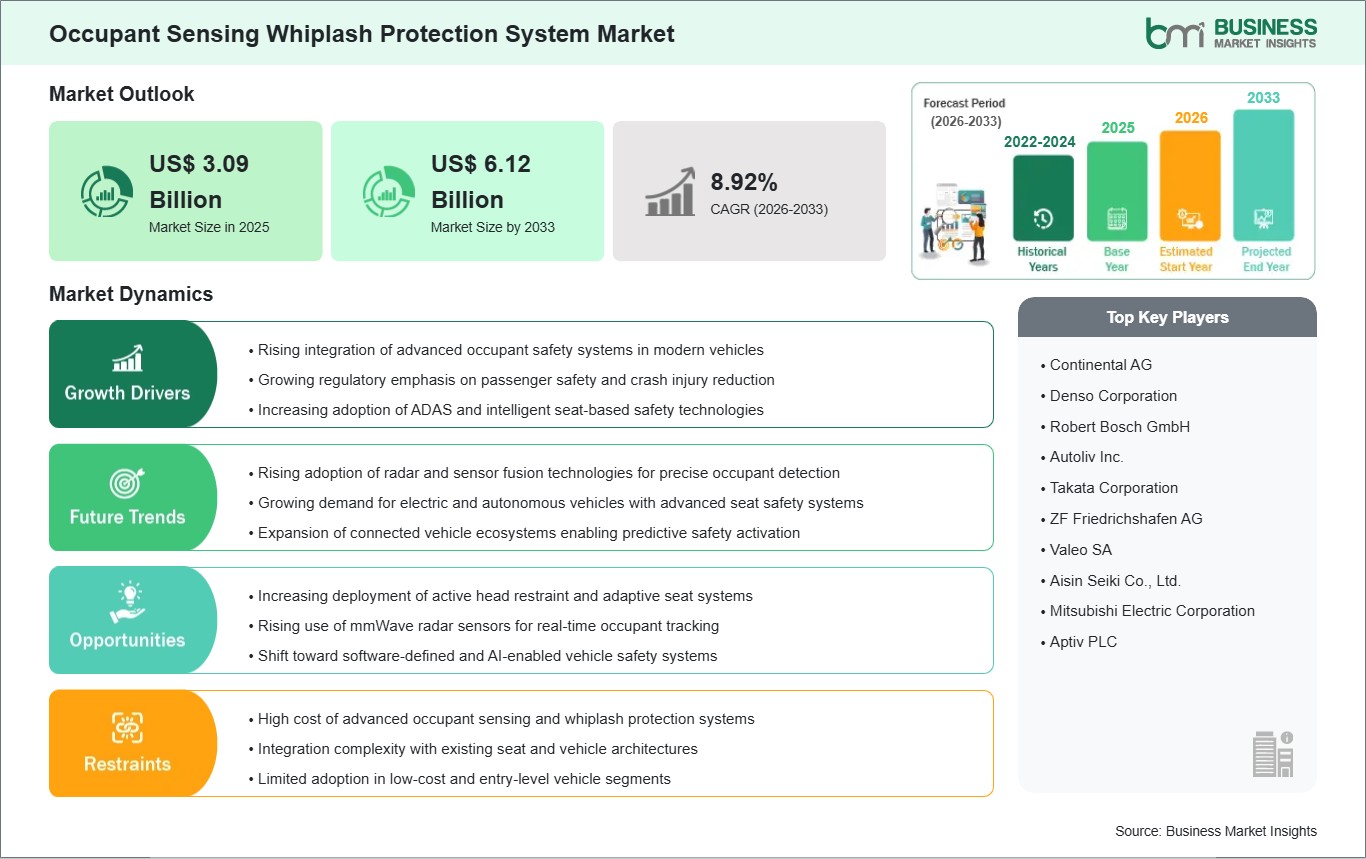
The Occupant Sensing Whiplash Protection System Market size is expected to reach US$ 6.12 Billion by 2033 from US$ 3.09 Billion in 2025.The market is estimated to record a CAGR of 8.92% from 2026 to 2033.
Occupant Sensing Whiplash Protection System refers to advanced automotive safety solutions designed to detect occupant position, seating posture, and collision conditions in order to activate adaptive head restraint and seat mechanisms during rear-end impacts. These systems integrate occupant sensing technologies such as pressure sensors, seat position sensors, accelerometers, and radar-based detection to ensure precise and timely whiplash injury mitigation. By continuously monitoring occupant seating geometry and crash dynamics, whiplash protection systems automatically adjust headrests, seatback angles, or active restraint components to reduce cervical spine stress during sudden impact events. This technology is increasingly becoming a key element of modern vehicle safety architectures, particularly within Advanced Driver Assistance Systems (ADAS), intelligent seating platforms, and next-generation passive safety systems. Market growth is being driven by rising global emphasis on occupant safety, increasing regulatory pressure for enhanced crash protection, and the growing integration of intelligent safety features in passenger and commercial vehicles.
However, several factors may restrain market progression. The high cost of integrating advanced occupant sensing modules, active head restraint mechanisms, and control electronics remains a major barrier for mass-market adoption, especially in entry-level and price-sensitive vehicle segments. The industry also faces technical challenges related to sensor calibration accuracy, response timing, and system reliability under complex crash scenarios. Integration complexity with existing seat structures and vehicle electronic architectures further increases development time and cost for OEMs. Additionally, variability in global safety standards and testing protocols creates inconsistencies in system design requirements across regions. Durability concerns related to mechanical actuators and long-term performance of sensing components also add to maintenance and lifecycle cost challenges for automakers.
Despite these challenges, the market outlook remains positive as automotive manufacturers increasingly prioritize occupant-centric safety innovation. Opportunities are emerging through the integration of AI-based predictive sensing, sensor fusion technologies, and smart seat architectures capable of anticipating collision impact conditions in real time. The expansion of electric and autonomous vehicle platforms is further accelerating demand for advanced safety systems that enhance passenger protection without compromising cabin design flexibility. Additionally, advancements in compact sensors, lightweight actuators, and software-defined vehicle safety systems are improving scalability and cost efficiency. Collectively, these developments position the occupant sensing whiplash protection system market for steady growth as a critical component of next-generation automotive safety and intelligent mobility ecosystems.

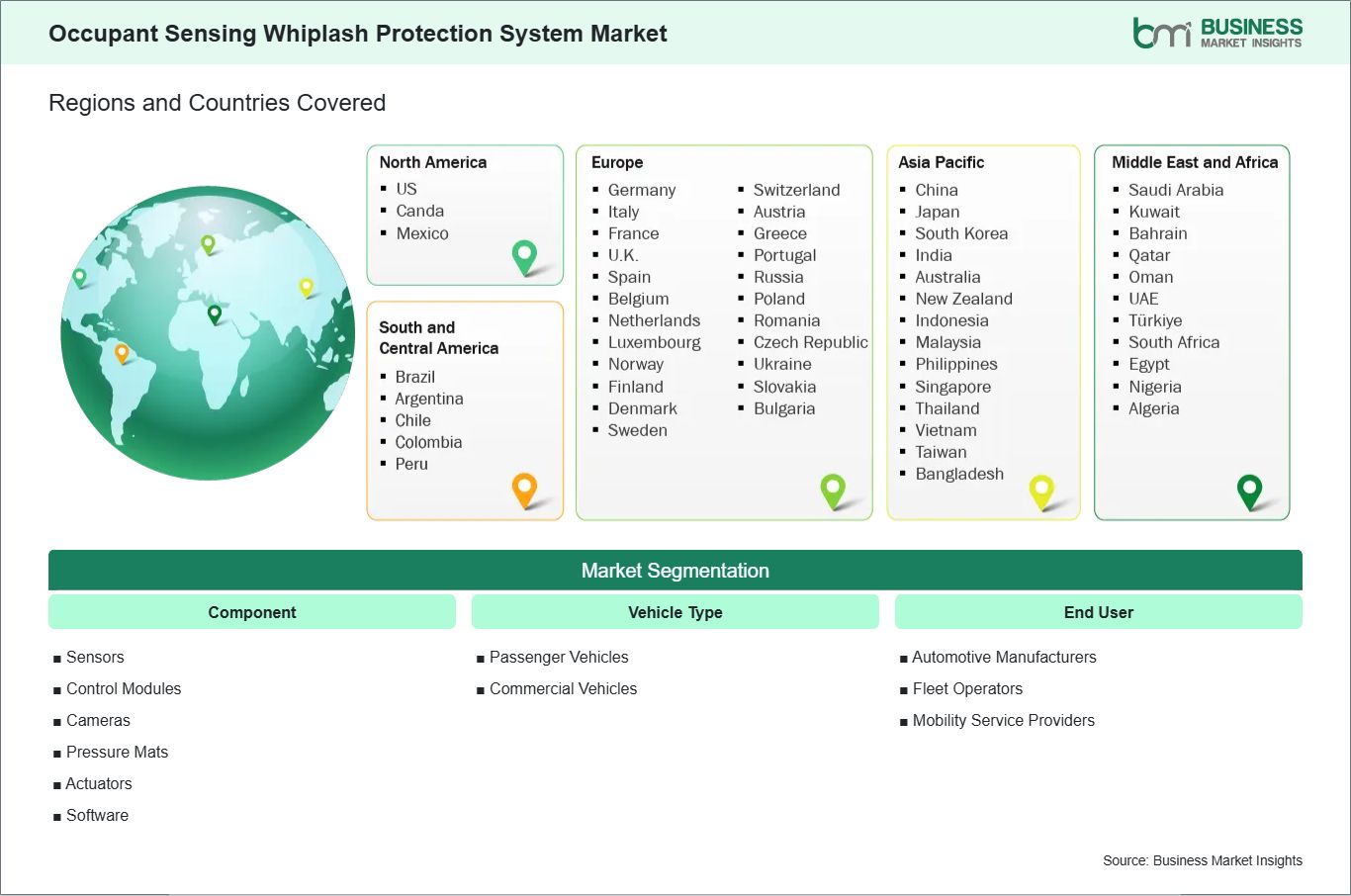
The occupant sensing whiplash protection system market is segmented based on component, vehicle type, and end user, reflecting the increasing integration of intelligent sensing, adaptive seat technologies, and AI-driven automotive safety solutions across modern vehicle architectures.
The Occupant Sensing Whiplash Protection System market is being driven by the increasing need for enhanced passenger safety, reduction of whiplash-related injuries, and compliance with stringent global automotive safety regulations. Unlike conventional passive safety systems, these solutions utilize occupant sensing technologies, seat position monitoring, and crash detection inputs to enable adaptive head restraint and seat adjustments during rear-end collisions. The rising integration of Advanced Driver Assistance Systems (ADAS) across passenger and commercial vehicles is significantly accelerating demand, as OEMs focus on minimizing cervical spine injuries and improving overall crash safety performance. Growing concerns over road accident fatalities and injury severity, along with mandatory safety rating frameworks such as NCAP, are further strengthening adoption. Additionally, the expansion of electric and semi-autonomous vehicles is increasing the need for intelligent seat-based safety systems as a critical occupant protection mechanism. In commercial fleets and long-haul transportation, these systems are gaining strong traction due to their ability to enhance driver safety, reduce injury risks, and improve regulatory compliance. Technological advancements in pressure sensors, seat position sensors, accelerometers, and radar-based occupant detection are improving accuracy and response timing, thereby driving sustained market growth supported by automotive safety innovation and intelligent seating technologies.
Opportunities in the Occupant Sensing Whiplash Protection System market are expanding through the integration of artificial intelligence, sensor fusion technologies, and next-generation smart seating platforms. AI-enabled systems are enabling predictive safety capabilities such as pre-impact occupant positioning, adaptive head restraint control, and real-time crash severity estimation, significantly improving injury mitigation effectiveness. The adoption of sensor fusion combining pressure mats, seat position sensors, cameras, and radar-based systems is enhancing system reliability across diverse seating conditions and crash scenarios. The evolution of electric and autonomous vehicles is creating strong opportunities where advanced occupant sensing becomes essential for intelligent cabin safety and human-machine interaction. Additionally, the growth of connected vehicle ecosystems and software-defined vehicle architectures is enabling continuous optimization of whiplash protection algorithms through over-the-air updates. Increasing investments in smart mobility infrastructure and fleet safety management systems are further accelerating adoption. Furthermore, advancements in compact sensors, lightweight actuators, and energy-efficient control modules are reducing system cost and complexity, positioning the market for sustained long-term growth driven by AI-enabled safety intelligence and connected automotive platforms.
The Occupant Sensing Whiplash Protection System Market is projected to grow from US$ 3.09 Billion in 2025 to US$ 6.12 Billion by 2033 , registering a CAGR of 8.92% from 2026 to 2033.
By component, sensors account for a significant share of the Occupant Sensing Whiplash Protection System market as they enable accurate detection of occupant position, seating posture, and crash impact conditions for timely activation of whiplash protection systems. Pressure sensors are widely used due to their ability to measure seat load distribution and occupant presence with high reliability. Seat position sensors continue to grow as they help determine occupant seating geometry for optimized head restraint deployment. Accelerometers are critical for detecting sudden deceleration or rear-impact forces, enabling rapid system response. Radar-based sensing technologies are also gaining traction as they provide precise occupant motion and position tracking even in complex crash scenarios. Control modules play a central role by processing sensor inputs and coordinating adaptive head restraint and seat adjustments in real time. Actuators are essential components that physically adjust headrests and seat structures to reduce whiplash injury risk during collisions. Software-based systems are expanding rapidly due to their ability to enable predictive safety logic, real-time decision-making, and integration with advanced vehicle safety platforms.
By vehicle type, passenger vehicles dominate adoption due to the increasing integration of advanced safety systems and intelligent seating technologies in sedans, hatchbacks, and SUVs, particularly in mid-range and premium segments. Electric vehicles are witnessing strong growth as they incorporate advanced electronic architectures that support smart occupant safety systems. Luxury and premium vehicles are early adopters of advanced whiplash protection technologies, driven by high safety expectations and feature differentiation. Commercial vehicles are also experiencing rising adoption as fleet operators focus on reducing driver injury risks, improving safety compliance, and enhancing long-haul transportation safety, where rear-end collision risks are comparatively higher.
| Report Attribute | Details |
|---|---|
| Market size in 2025 | US$ 3.09 Billion |
| Market Size by 2033 | US$ 6.12 Billion |
| Global CAGR (2026 - 2033) | 8.92% |
| Historical Data | 2022-2024 |
| Forecast period | 2026-2033 |
| Segments Covered | By Component
|
|
Regions and Countries Covered
| |
| North America | US, Canada, Mexico |
| Europe | Germany, Italy, France, U.K., Spain, Belgium, Netherlands, Luxembourg, Norway, Finland, Denmark, Sweden, Switzerland, Austria, Greece, Portugal, Russia, Poland, Romania, Czech Republic, Ukraine, Slovakia, Bulgaria |
| Asia-Pacific | China, Japan, South Korea, India, Australia, New Zealand, Indonesia, Malaysia, Philippines, Singapore, Thailand, Vietnam, Taiwan, Bangladesh |
| South and Central America | Brazil, Argentina, Chile, Colombia, Peru |
| Middle East and Africa | Saudi Arabia, United Arab Emirates, Kuwait, Bahrain, Qatar, Oman, Turkiye, South Africa, Egypt, Nigeria, Algeria |
| Market leaders and key company profiles |
|
The "Occupant Sensing Whiplash Protection System Market Size and Forecast (2022–2033)" report provides a detailed analysis of the market covering below areas:
The Occupant Sensing Whiplash Protection System Market shows diverse regional adoption patterns influenced by rising automotive safety regulations, increasing penetration of advanced safety systems, and growing demand for intelligent occupant protection technologies across passenger and commercial vehicles.
North America, being a highly advanced automotive and technology-driven region, holds a strong position in the market due to the presence of leading automotive OEMs, Tier-1 suppliers, and advanced vehicle safety technology providers. The United States and Canada are witnessing increasing integration of occupant sensing whiplash protection systems in passenger vehicles, electric vehicles, and fleet safety platforms. The region is heavily focused on improving road safety standards and reducing injury severity caused by rear-end collisions and whiplash-related trauma. Strong investments in advanced seat safety systems, sensor-based occupant monitoring, and intelligent restraint technologies are further supporting market expansion. Additionally, well-established regulatory frameworks and rapid adoption of electric and semi-autonomous vehicles are accelerating deployment across multiple vehicle segments, including passenger cars and commercial fleets.
Asia Pacific is experiencing significant growth, driven by rapid automotive production, expanding vehicle ownership, and increasing adoption of smart mobility and in-cabin safety technologies. Countries such as China, Japan, South Korea, and India are actively integrating occupant sensing whiplash protection systems into modern vehicles to enhance passenger safety and comply with evolving safety standards. The region’s strong automotive manufacturing base and cost-competitive electronics ecosystem are enabling large-scale deployment of pressure sensors, seat position sensors, accelerometers, and radar-based occupant detection systems. The growing demand for commercial transportation, logistics expansion, and ride-sharing services is further contributing to adoption, particularly in high-risk driving conditions such as long-distance and urban congestion environments. Additionally, rising investments in automotive safety innovation, electric mobility, and intelligent transportation infrastructure are supporting continuous market growth.
Both regions are contributing significantly to the growth of the Occupant Sensing Whiplash Protection System Market, driven by advancements in automotive safety technologies, increasing focus on occupant protection, and rising adoption of intelligent seating and sensor-based safety solutions across diverse vehicle platforms.

The occupant sensing whiplash protection system market is evaluated by gathering qualitative and quantitative data post primary and secondary research, which includes important corporate publications, association data, and databases. A few of the key developments in the occupant sensing whiplash protection system market are:
The Occupant Sensing Whiplash Protection System Market is valued at US$ 3.09 Billion in 2025, it is projected to reach US$ 6.12 Billion by 2033.
As per our report Occupant Sensing Whiplash Protection System Market, the market size is valued at US$ 3.09 Billion in 2025, projecting it to reach US$ 6.12 Billion by 2033. This translates to a CAGR of approximately 8.92% during the forecast period.
The Occupant Sensing Whiplash Protection System Market report typically cover these key segments-
The historic period, base year, and forecast period can vary slightly depending on the specific market research report. However, for the Occupant Sensing Whiplash Protection System Market report:
The Occupant Sensing Whiplash Protection System Market is populated by several key players, each contributing to its growth and innovation. Some of the major players include:
The Occupant Sensing Whiplash Protection System Market report is valuable for diverse stakeholders, including:
Essentially, anyone involved in or considering involvement in the Occupant Sensing Whiplash Protection System Market value chain can benefit from the information contained in a comprehensive market report.
Please tell us your area of interest
(Market Segments/ Regions and Countries/ Companies)