Market Summary
Executive Summary and Global Market Analysis
Occupant Classification System refers to advanced in-cabin sensing solutions designed to detect, identify, and classify vehicle occupants in real time to optimize airbag deployment, seatbelt tensioning, and overall passenger safety under various driving conditions. These systems leverage pressure sensors, capacitive sensors, ultrasonic sensing, radar technologies, seat-mounted mats, and AI-powered signal processing algorithms to ensure accurate detection of occupant presence, weight, posture, and seating position. By simulating intelligent human-like interpretation of in-cabin occupancy conditions, occupant classification technologies identify adults, children, infants, seat vacancies, and improper seating configurations in real time. This technology is becoming a core component of modern automotive safety architectures, particularly within airbag control systems, advanced restraint systems, and integrated vehicle safety platforms. Market expansion is being driven by increasingly stringent global vehicle safety regulations, rising NCAP crash safety standards, and growing integration of intelligent passive safety systems across passenger and commercial vehicles.
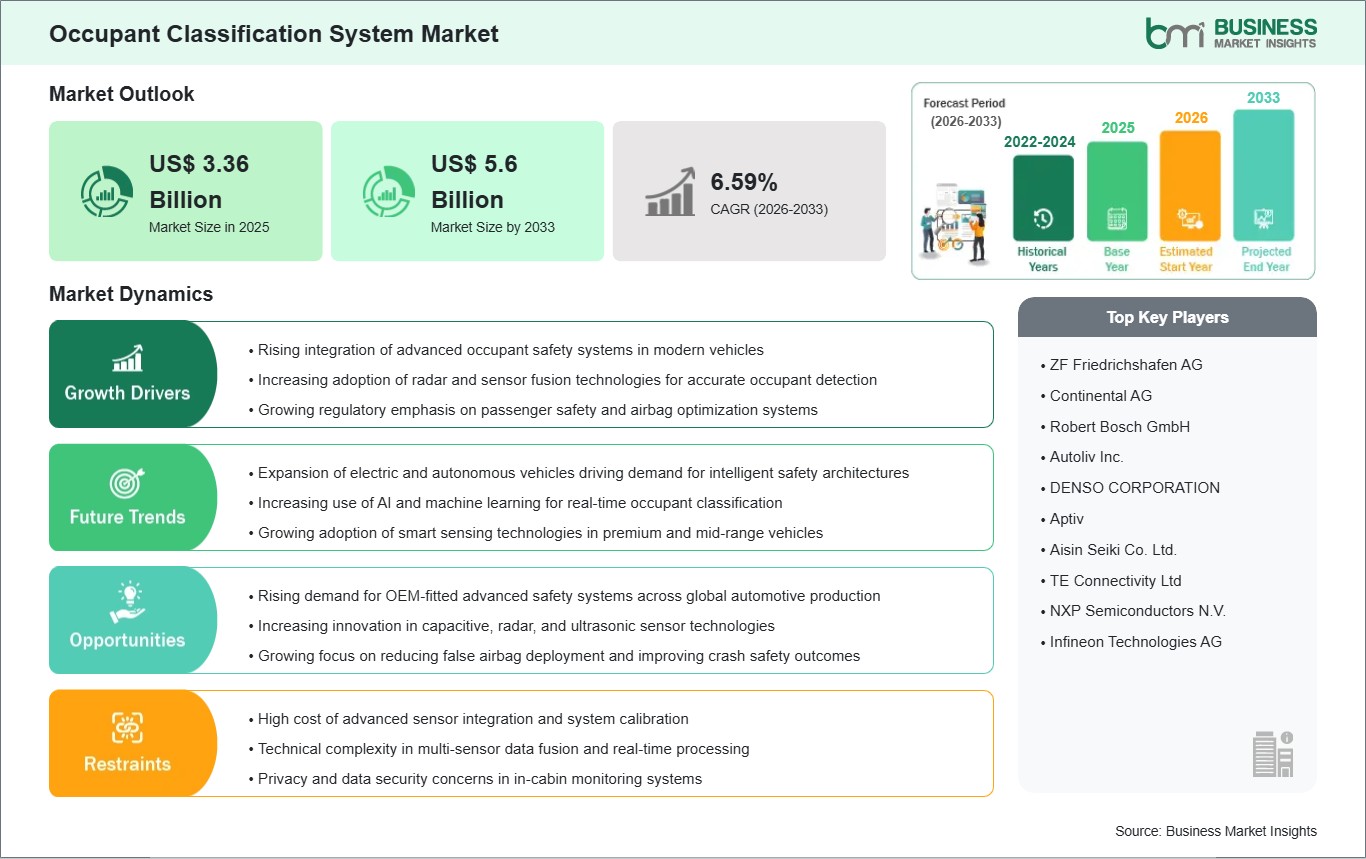
However, several factors may restrain market progression. The high cost of integrating advanced sensor arrays, including radar modules, capacitive mats, and multi-sensor fusion systems, remains a significant barrier, particularly for entry-level and cost-sensitive automotive segments. The industry also faces technical challenges related to accurate occupant classification under dynamic real-world conditions, including varied seating positions, child seats, movement during travel, and interference from seat materials or accessories. Privacy and data handling concerns surrounding in-cabin sensing systems further complicate large-scale deployment, as regulatory frameworks increasingly emphasize occupant data protection and system transparency. Additionally, computational constraints associated with real-time multi-sensor fusion and classification algorithms increase system complexity, calibration requirements, and integration challenges with existing airbag control units (ACUs) and vehicle safety architectures.
Despite these challenges, the market outlook remains highly favorable as the automotive industry transitions toward intelligent, safety-centric vehicle ecosystems. Opportunities are emerging through the convergence of sensor fusion technologies, AI-based classification algorithms, and next-generation smart restraint systems, enabling highly accurate real-time occupant detection and safety optimization. The expansion of electric and autonomous vehicles is accelerating demand for adaptive interior safety systems that dynamically adjust protection mechanisms based on occupant profiles. Furthermore, the rise of smart mobility platforms and connected vehicle ecosystems is creating new opportunities for predictive safety analytics and enhanced crash response systems. Ongoing advancements in radar-based sensing, capacitive technologies, and machine learning-based occupant recognition are also improving system precision and reliability. Collectively, these developments position the occupant classification system market for sustained growth as a critical enabler of next-generation automotive safety and intelligent passenger protection systems.
Segment Analysis
Occupant Classification System Market Segmentation
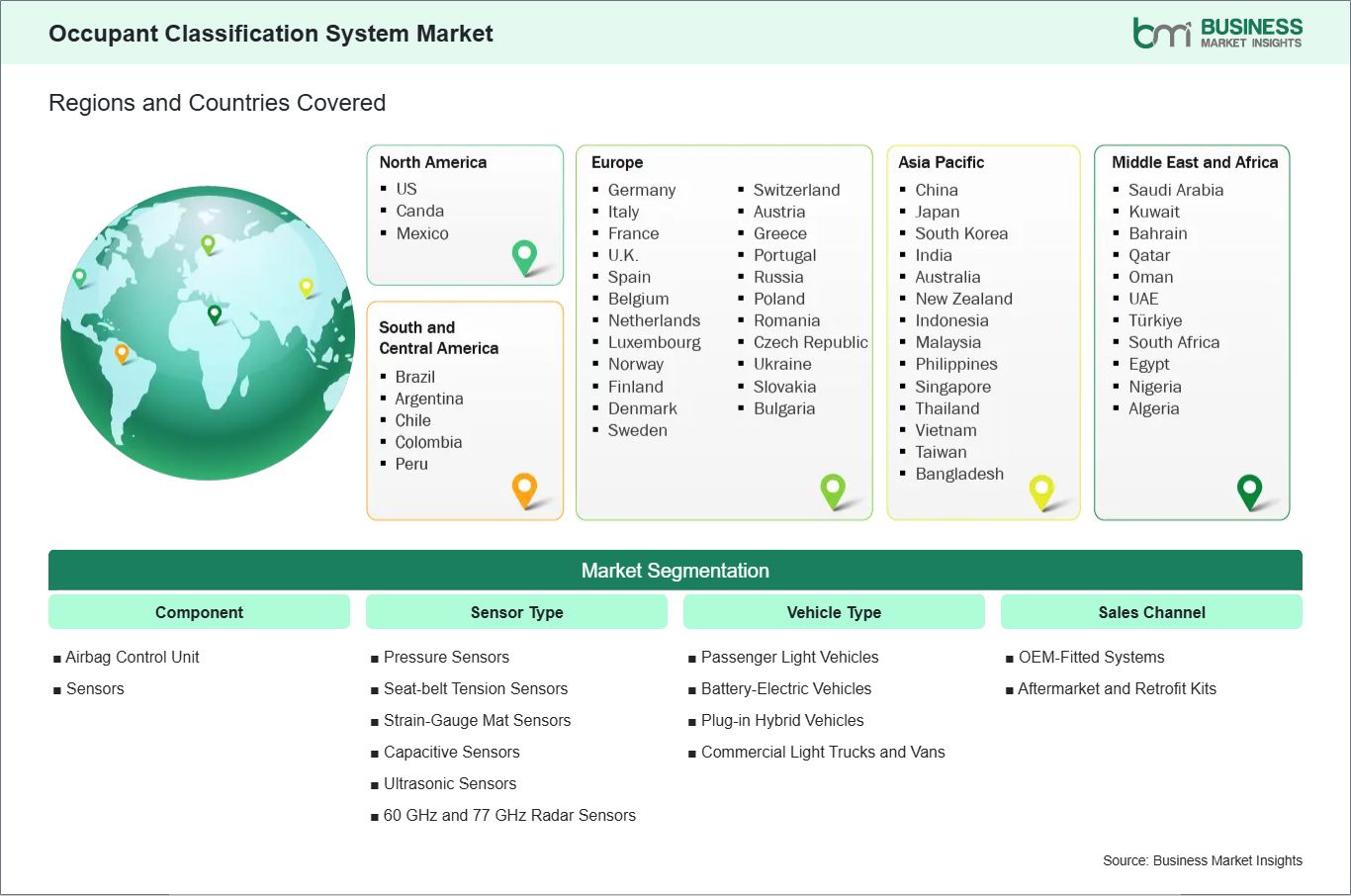
The occupant classification system market is segmented based on component, sensor type, vehicle type, and sales channel, reflecting its growing role in enhancing airbag deployment accuracy and overall passenger safety in modern vehicles.
By Component
- Airbag Control Unit (ACU): Central processing module that interprets sensor data to determine occupant presence, weight, and seating position for precise airbag deployment decisions
- Sensors: Embedded sensing elements integrated into seats and cabin structures to detect occupant characteristics such as weight, posture, and position in real time
By Sensor Type
- Pressure Sensors: Measure seat pressure distribution to identify occupant presence and approximate weight classification
- Seat-belt Tension Sensors: Detect belt load and tension changes to infer occupancy status and restraint usage
- Strain-Gauge Mat Sensors: Embedded in seat cushions to measure deformation caused by occupant weight and posture
- Capacitive Sensors: Use changes in electrical capacitance to detect human presence and seating position without direct pressure dependence
- Ultrasonic Sensors: Utilize sound wave reflection to detect occupancy and distance-related seat positioning characteristics
- 60 GHz and 77 GHz Radar Sensors: Advanced mmWave sensors capable of detecting micro-movements, breathing patterns, and precise occupant positioning even through seat materials
By Vehicle Type
- Passenger Light Vehicles: Includes sedans, hatchbacks, and SUVs where occupant safety systems are standard or increasingly advanced with ADAS integration
- Battery-Electric Vehicles (BEVs): Electric vehicles integrating advanced sensor-based safety systems to optimize energy-efficient safety deployment strategies
- Plug-in Hybrid Vehicles (PHEVs): Hybrid platforms combining combustion and electric systems with advanced occupant detection for optimized safety logic
- Commercial Light Trucks and Vans: Utility and logistics vehicles requiring robust occupant detection systems for driver and passenger safety compliance
By Sales Channel
- OEM-Fitted Systems: Factory-installed occupant classification systems integrated directly into vehicle design and airbag control architecture
- Aftermarket and Retrofit Kits: Upgradable solutions installed post-production, mainly for enhancing safety compliance in older vehicles or fleet upgrades
Market Forces
Occupant Classification System Market Drivers and Opportunities
Rising Demand for Vehicle Safety, Smart Airbag Deployment, and Regulatory Compliance
The Occupant Classification System (OCS) market is experiencing strong growth due to increasing emphasis on vehicle safety, intelligent airbag deployment, and compliance with stringent automotive safety regulations. OCS technologies help determine occupant presence, seating position, posture, and weight to optimize airbag activation and reduce injury risks during collisions. Rising adoption of Advanced Driver Assistance Systems (ADAS) and intelligent cabin safety technologies across passenger and commercial vehicles is significantly driving market demand. Automakers are integrating advanced sensing systems to comply with evolving safety standards and vehicle assessment programs such as NCAP and FMVSS. Additionally, growing consumer awareness regarding passenger safety and child occupant protection is accelerating implementation of advanced occupant monitoring solutions.
The rapid expansion of Battery-Electric Vehicles (BEVs), Plug-in Hybrid Vehicles (PHEVs), and connected vehicles is further strengthening demand for lightweight and highly accurate occupant sensing technologies. Advancements in capacitive sensors, pressure sensors, strain-gauge mats, ultrasonic systems, and radar-based occupant detection are improving real-time monitoring accuracy and system reliability. Increasing deployment of smart airbags, seatbelt pretensioning systems, and adaptive restraint technologies is also contributing to market growth. Collectively, rising regulatory pressure, technological innovation, and increasing integration of intelligent in-cabin safety systems are driving sustained expansion of the occupant classification system market.
Rising Integration of AI-Based Cabin Intelligence, Sensor Fusion, and Smart Mobility Platforms
The Occupant Classification System market is witnessing significant opportunities through the integration of artificial intelligence, sensor fusion technologies, and advanced cabin intelligence platforms. AI-enabled occupant classification systems are increasingly capable of analyzing occupant posture, movement, seating behavior, and child presence in real time, improving airbag deployment precision and enhancing overall passenger safety. The growing adoption of sensor fusion technologies combining pressure sensors, capacitive sensors, ultrasonic sensors, and 60 GHz / 77 GHz radar systems is creating opportunities for highly accurate and adaptive occupant monitoring solutions across modern vehicles.
The evolution of autonomous and semi-autonomous vehicles is generating additional growth opportunities, as advanced cabin sensing becomes essential for human-machine interaction and passenger protection. Increasing investments in connected vehicle ecosystems and software-defined vehicle architectures are enabling integration of intelligent occupant monitoring with broader ADAS and in-cabin personalization systems. Additionally, rising demand for child detection systems, rear-seat occupancy monitoring, and personalized safety configurations is expanding application areas across passenger and electric vehicles.
Size and Share Analysis
Occupant Classification System Market Size and Share Analysis
The Occupant Classification System Market is projected to grow from US$ 3.36 Billion in 2025 to US$ 5.6 Billion by 2033 , registering a CAGR of 6.59% from 2026 to 2033.
By component, sensors account for a significant share of the Occupant Classification System market as they enable accurate detection of occupant presence, seating posture, weight distribution, and position for intelligent airbag deployment and passenger safety management. Advanced sensing technologies such as capacitive sensors, pressure sensors, ultrasonic sensors, and radar-based systems are increasingly being integrated into modern vehicle cabins to improve occupant detection accuracy and real-time monitoring capabilities. Airbag Control Units (ACUs) continue to witness strong demand as they serve as the central processing system responsible for interpreting sensor data and coordinating adaptive airbag deployment decisions during collisions. Growing integration of intelligent restraint systems and connected safety architectures is further supporting adoption of advanced ACUs across passenger and electric vehicles.
By vehicle type, passenger light vehicles dominate market adoption due to increasing integration of advanced safety systems, smart airbags, and ADAS-enabled cabin monitoring technologies across sedans, hatchbacks, and SUVs. Battery-Electric Vehicles (BEVs) and Plug-in Hybrid Vehicles (PHEVs) are witnessing strong growth as automakers increasingly deploy lightweight and intelligent occupant sensing systems aligned with connected and software-defined vehicle architectures. Commercial light trucks and vans are also experiencing increasing adoption as fleet operators focus on enhancing passenger safety, regulatory compliance, and intelligent restraint system deployment in commercial transportation environments..
Report Coverage
Occupant Classification System Market Report Coverage and Deliverables
The "Occupant Classification System Market Size and Forecast (2022–2033)" report provides a detailed analysis of the market covering below areas:
- Occupant classification system market size and forecast at global, regional, and country levels for all market segments covered under the scope
- Occupant classification system market trends, as well as drivers, restraints, and opportunities
- Occupant classification system market analysis covering key trends, global and regional framework, major players, regulations, and recent developments
- Industry landscape and competition analysis covering market concentration, heat map analysis, prominent players, and recent developments for the occupant classification system market
- Detailed company profiles, including SWOT analysis
Geographic Insights
Occupant Classification System Market Geographic Insights
The Occupant Classification System Market demonstrates diverse regional adoption patterns influenced by evolving automotive safety regulations, increasing deployment of intelligent restraint systems, and growing integration of advanced in-cabin sensing technologies across passenger and commercial vehicles.
North America holds a significant position in the market due to the strong presence of leading automotive manufacturers, safety technology providers, and advanced vehicle electronics companies. The United States and Canada are witnessing increasing adoption of occupant classification systems across passenger cars, electric vehicles, and light commercial vehicles to improve airbag deployment accuracy and passenger protection. The region is highly focused on vehicle safety compliance, supported by stringent regulatory frameworks and growing integration of Advanced Driver Assistance Systems (ADAS). Rising consumer demand for premium safety features and connected vehicle technologies is accelerating deployment of capacitive sensors, radar-based occupant monitoring systems, and intelligent Airbag Control Units (ACUs). Additionally, the rapid expansion of electric and software-defined vehicles is supporting innovation in lightweight and AI-enabled occupant sensing platforms.
Asia Pacific is experiencing substantial growth driven by rapid automotive production, increasing vehicle ownership, and expanding adoption of smart mobility technologies. Countries such as China, Japan, South Korea, and India are actively integrating occupant classification systems into modern vehicles to comply with evolving safety standards and improve passenger protection. The region’s strong electronics manufacturing ecosystem and cost-efficient sensor production capabilities are enabling large-scale deployment of pressure sensors, strain-gauge mats, ultrasonic sensors, and mmWave radar technologies. Growing production of Battery-Electric Vehicles (BEVs) and Plug-in Hybrid Vehicles (PHEVs), along with increasing investments in intelligent transportation and connected vehicle infrastructure, is further accelerating market growth.
Both regions are contributing significantly to the expansion of the Occupant Classification System market through continuous advancements in automotive safety technologies, intelligent cabin sensing, and connected mobility solutions.
Industry Activity
Recent Developments
The occupant classification system market is evaluated by gathering qualitative and quantitative data post primary and secondary research, which includes important corporate publications, association data, and databases. A few of the key developments in the occupant classification system market are:
- In January 2026, Valeo, a global leader in the automotive industry, and Seeing Machines, the advanced computer vision technology company that designs AI-powered operator monitoring systems to improve transport safety, announced that their joint In-Cabin Monitoring Solutions (ICMS) for driver and occupant applications will be featured across several Valeo demonstrations at CES 2026 in Las Vegas.
- In January 2024, At CES, Yanfeng, a leading global automotive supplier, introduced a new generation of its Hover Seat, with Seat Sensing Posture ID technology that adds new levels of comfort. The seat based on zero gravity research, by detecting the occupant’s body language, such as seating position, level of fatigue, and body type actively releases fatigue for passengers throughout the ride and to improve the driving experience.
Trust & Transparency
Research Methodology
The market analysis combines proprietary research with secondary data from government agencies, company disclosures, regulatory filings, industry databases and expert interviews. Market estimates are validated through data triangulation, cross-market benchmarking and analyst
review.
View Full Research Methodology
Key Sources Referred:
World Bank – Global Trade Indicators
World Trade Organization (WTO)
(International Monetary Fund )IMF
International Trade Administration (ITA)
Company website
Company annual reports
Company investor presentations