
Next Generation Packaging Market Outlook: Size, Share, Trends, Growth Analysis, Competitive Landscape & Forecast, 2022-2033

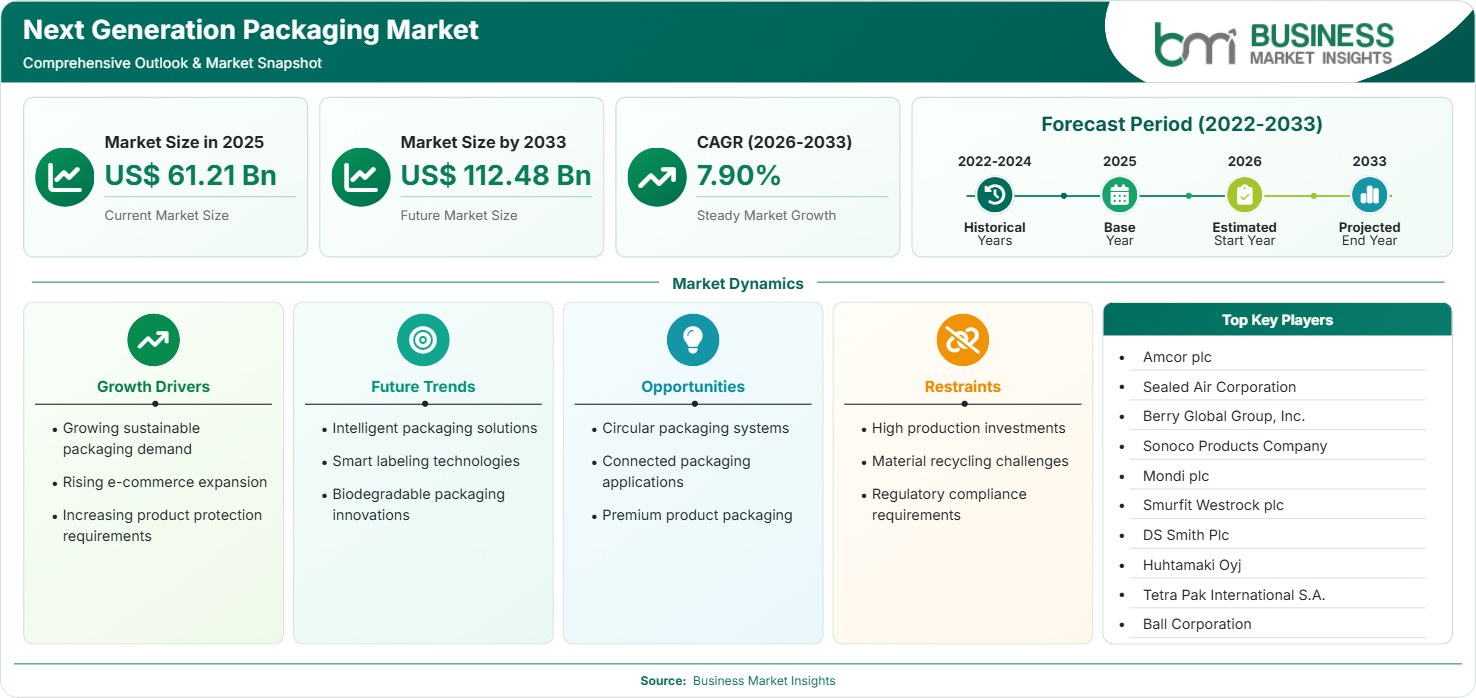
The Next Generation Packaging Market size was valued at US$ 61.21 billion in 2025 and is projected to reach US$ 112.48 billion by 2033, growing at a CAGR of 7.90% during 2026–2033. Growing demand for sustainable packaging, expanding e-commerce activities, and increasing requirements for enhanced product protection are driving market growth. In contrast, circular packaging systems, connected packaging technologies, and premium packaging solutions present significant future opportunities.

Report Coverage
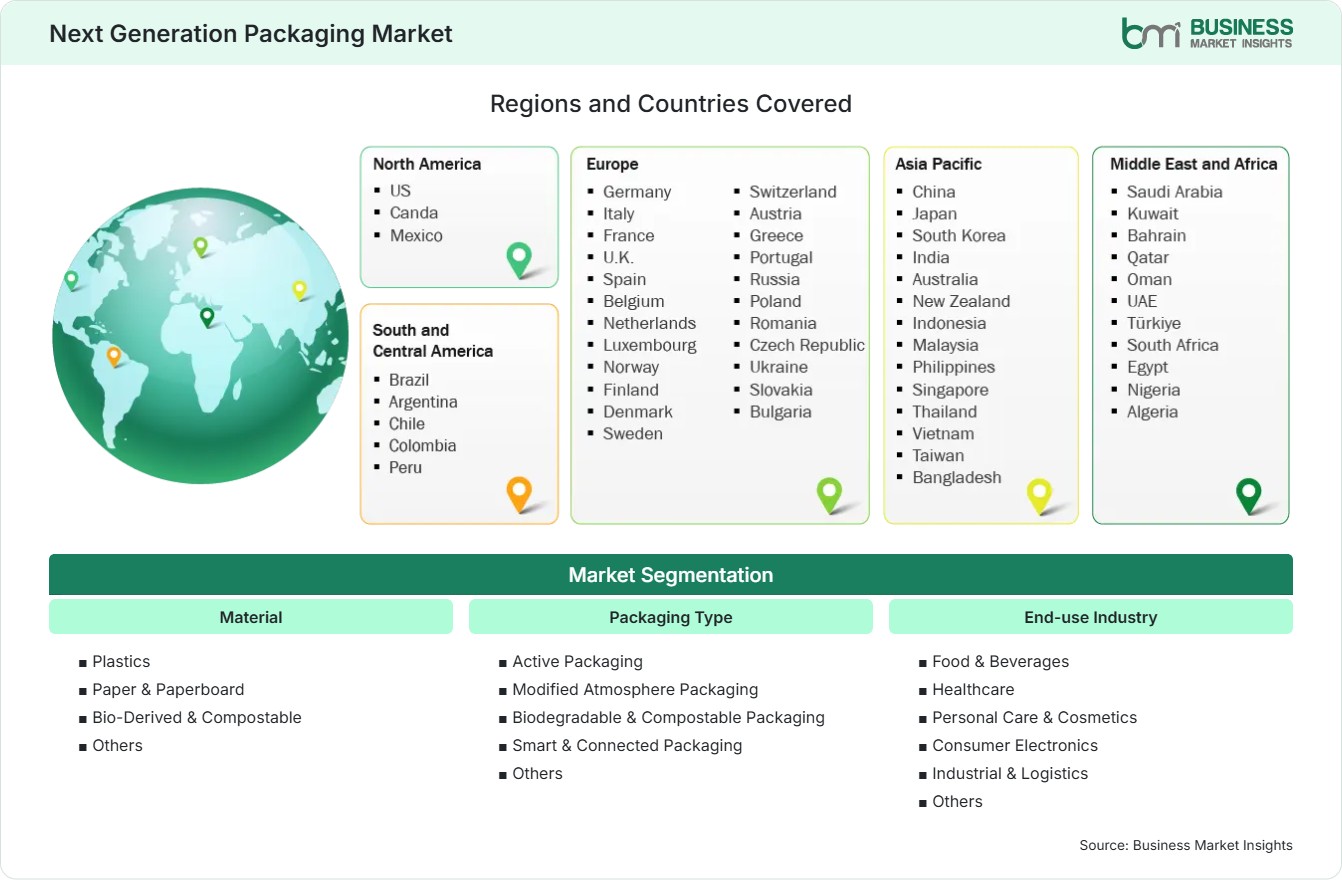
  • Material: Plastics, Paper & Paperboard, Bio-Derived & Compostable, Others
  • Packaging Type: Active Packaging, Modified Atmosphere Packaging, Biodegradable & Compostable Packaging, Smart & Connected Packaging, Others
  • End-use Industry: Food & Beverages, Healthcare, Personal Care & Cosmetics, Consumer Electronics, Industrial & Logistics, Others
US$ 61.21 Bn Market size in 2025
US$ 112.48 Bn Market Size by 2033
7.90% CAGR, 2026 - 2033
2026-2033 Forecast Period

01 AI Overview

Next Generation Packaging Market Summary

  • North America: North America holds 33%–36% market share in 2025 and is projected to grow at a CAGR of 7.4%–8.1% during 2026–2033. Strong sustainability initiatives, advanced packaging technologies, and high consumer demand for innovative packaging solutions continue driving regional growth. The U.S. market is expected to expand at a CAGR of 7.6%–8.3% through 2033.
  • Fastest Growing Region: Asia Pacific accounts for 29%–32% of the market in 2025 and is forecast to register the highest CAGR of 8.5%–9.2% during 2026–2033. Rapid industrialization, expanding e-commerce, and rising demand for food packaging continue to accelerate regional market expansion.
  • Leading Segment: Plastics represent 39%–42% market share in 2025 and are anticipated to grow at a CAGR of 7.5%–8.2% during the forecast period. Lightweight properties, design flexibility, and barrier performance continue to support widespread adoption across packaging applications.
  • High Growth Segment: Smart & Connected Packaging accounts for 12%–15% market share in 2025 and is projected to register a CAGR of 10.8%–11.6% through 2033. Rising adoption of IoT technologies, QR-enabled packaging, and real-time product tracking continues to strengthen segment growth.
  • Key Market Opportunity: Increasing investments in recyclable materials, intelligent packaging technologies, and circular economy initiatives are creating substantial opportunities for packaging manufacturers across the food, healthcare, and consumer goods industries.
  • Major Market Players: Amcor plc, Sealed Air Corporation, Berry Global Group Inc., Sonoco Products Company, Mondi plc, Smurfit Westrock plc, DS Smith Plc, Huhtamaki Oyj, Tetra Pak International S.A., Ball Corporation.
02 Strategic Insights

Next Generation Packaging Market: Strategic Insights

Next Generation Packaging Market Strategic Framework
FREE PDF
Request your free sample
Request free sample
03 Stakeholder View

Key Takeaways

  • Sustainability has become the primary strategic driver, encouraging manufacturers to transition toward recyclable, reusable, compostable, and bio-based packaging materials while improving overall supply chain efficiency.
  • Food and beverage manufacturers continue representing the largest commercial opportunity as demand increases for active, modified atmosphere, and intelligent packaging capable of improving product freshness and shelf life.
  • Smart packaging technologies incorporating sensors, RFID, QR codes, and digital traceability are transforming packaging from a protective medium into an interactive customer engagement platform.
  • Asia Pacific presents the strongest long-term investment potential due to expanding manufacturing capacity, growing packaged food consumption, rapid urbanization, and increasing e-commerce penetration.
  • Strategic acquisitions, partnerships, and investments in sustainable materials, advanced recycling technologies, and digital packaging platforms continue to reshape competitive dynamics across the global packaging industry.
04 Geographic Outlook

Next Generation Packaging Market Regional Highlights

North America Next Generation Packaging Market

North America accounts for 33%–36% of the global market in 2025 and is projected to grow at a CAGR of 7.4%–8.1% through 2033. Strong regulatory support for sustainable packaging, advanced manufacturing capabilities, and high consumer demand for environmentally responsible products continue to support regional leadership. The Next Generation Packaging Market share remains strong due to continuous investments in packaging innovation and circular economy initiatives.

  • Strong adoption of recyclable and reusable packaging materials across industries.
  • Growing investments in smart packaging and digital labeling technologies.
  • Food, healthcare, and e-commerce sectors continue driving product demand.
  • Sustainability regulations encourage innovation in bio-based packaging materials.

US Next Generation Packaging Market

The United States represents the largest regional market and is projected to register a CAGR of 7.6%–8.3% during the forecast period. Rising consumer preference for sustainable packaging, expanding online retail activities, and increasing adoption of intelligent packaging technologies continue to strengthen market growth.

  • Major consumer goods companies continue investing in sustainable packaging.
  • Smart packaging adoption increases across healthcare and food industries.
  • Packaging automation supports manufacturing productivity improvements.

Europe Next Generation Packaging Market

Europe accounts for 28%–31% of the market in 2025 and is projected to grow at a CAGR of 7.3%–8.0% during the forecast period. Germany leads regional demand, while France demonstrates strong growth driven by circular economy regulations, packaging innovation, and expanding sustainable manufacturing investments.

  • Circular economy policies accelerate recyclable packaging adoption.
  • Germany remains the largest packaging manufacturing market in Europe.
  • France records increasing investments in biodegradable packaging solutions.
  • Premium consumer packaging continues supporting product innovation.

Asia Pacific Next Generation Packaging Market

Asia Pacific represents 29%–32% of the global market in 2025 and is expected to record the fastest CAGR of 8.5%–9.2% through 2033. China dominates regional revenue, while India records the highest growth, driven by expanding packaged food consumption, manufacturing investments, and rapid e-commerce development.

  • Rapid industrialization drives demand for advanced packaging solutions.
  • Expanding e-commerce increases protective packaging requirements.
  • The food processing industry supports large-scale packaging adoption.
  • Smart manufacturing accelerates packaging technology implementation.

Rest of World Next Generation Packaging Market

The Rest of World region accounts for 7%–9% of the market in 2025 and is projected to grow at a CAGR of 7.1%–7.8% during 2026–2033. Brazil, the UAE, and South Africa continue investing in sustainable packaging production, food processing, and industrial manufacturing, supporting steady regional market expansion.

  • Food exports continue driving demand for advanced protective packaging.
  • Sustainability initiatives encourage the adoption of recyclable materials.
  • Industrial production supports packaging technology investments.
  • Growing retail industries strengthen long-term packaging demand.
Global Market Geography
FREE PDF
Request your free sample
Request free sample
05 Segment Analysis

Next Generation Packaging Market Segmentation

Material

The Material segment accounted for 39%–42% of the overall market in 2025 and is projected to grow at a CAGR of 7.8%–8.5% during 2026–2033. Emerging trends toward sustainability, new barrier technologies, and the rising need for lightweight yet durable packaging materials are among the other factors encouraging innovation in the packaging industry. Companies are increasingly using recyclable polymers, renewable fibers, and other biodegradable materials to minimize their environmental impact without compromising packaging efficiency.

  • Plastics: Plastics continue to dominate the market owing to their lightweight structure, excellent barrier performance, cost-effectiveness, and versatility across food, healthcare, industrial, and consumer product packaging applications.
  • Paper & Paperboard: Growing demand for recyclable and renewable packaging materials is accelerating the adoption of paper and paperboard across retail, food service, consumer goods, and e-commerce packaging applications.
  • Bio-Derived & Compostable: Bio-derived and compostable materials are experiencing rapid adoption as manufacturers pursue sustainable alternatives that reduce plastic waste while supporting circular economy objectives and regulatory compliance.

Packaging Type

The Packaging Type segment represented 35%–38% of the market in 2025 and is expected to register a CAGR of 8.0%–8.7% during the forecast period. Packaging technologies are evolving beyond product containment toward active protection, intelligent monitoring, and sustainability. Manufacturers are integrating advanced barrier materials, freshness indicators, digital tracking, and environmentally friendly designs to improve product quality, consumer engagement, and supply chain efficiency while reducing environmental impact.

  • Active Packaging: Active packaging extends product shelf life by controlling moisture, oxygen, antimicrobial activity, and freshness, making it widely adopted across food, pharmaceutical, and healthcare packaging applications.
  • Modified Atmosphere Packaging (MAP): MAP technology enhances product preservation by modifying internal package gas composition, reducing spoilage, and maintaining freshness throughout storage and transportation.
  • Biodegradable & Compostable Packaging: Increasing environmental awareness and regulatory support continue driving adoption of biodegradable packaging solutions across food service, retail, and consumer packaged goods industries.
  • Smart & Connected Packaging: Smart packaging technologies utilize QR codes, RFID, NFC, sensors, and digital authentication to improve product traceability, supply chain visibility, consumer engagement, and anti-counterfeiting capabilities.

End-use Industry

The End-use Industry segment accounted for 41%–44% of the market in 2025 and is anticipated to expand at a CAGR of 8.1%–8.8% through 2033. The increasing demand for sustainable, protective, and intelligent packaging solutions across multiple industries continues to drive market expansion. The Next Generation Packaging Market trends indicate growing investments in digital packaging technologies, recyclable materials, and premium product packaging to enhance operational efficiency, regulatory compliance, and consumer satisfaction.

  • Food & Beverages: Food and beverage manufacturers represent the largest end-use segment due to rising demand for sustainable packaging, improved food preservation, extended shelf life, and advanced product protection technologies.
  • Healthcare: Healthcare organizations increasingly adopt advanced packaging solutions that provide enhanced sterility, product integrity, traceability, and regulatory compliance for pharmaceutical and medical device packaging.
  • Personal Care & Cosmetics: Premium packaging designs, sustainable materials, and smart labeling technologies continue supporting brand differentiation and consumer engagement across cosmetic and personal care products.
  • Consumer Electronics: Electronics manufacturers utilize advanced packaging materials to improve shock resistance, moisture protection, anti-static performance, and secure transportation of high-value electronic products.
  • Industrial & Logistics: Industrial and logistics companies increasingly adopt durable, lightweight, and recyclable packaging solutions to improve transportation efficiency, warehouse operations, and supply chain sustainability.
06 Market Forces

Next Generation Packaging Market Dynamics

Key Market Drivers

Growing sustainable packaging demand

Consumer, business, and regulatory awareness of the environment will continue to drive demand for sustainable packaging alternatives. Recycling technology, biodegradable polymers, and packaging are among innovations that companies are exploring to decrease carbon emissions and plastic waste. The increasing number of corporations embracing sustainability and the circular economy concept is fueling more innovation in sustainable packaging technology.

Rising e-commerce expansion

The accelerated growth of e-commerce worldwide has increased the need for packaging materials that are protective, lightweight, and durable to ensure the safe transportation of products. Online retailers are in dire need of packaging materials that ensure safety, low shipping costs, and a great customer experience.

Increasing product protection requirements

Companies operating in the food, healthcare, pharmaceuticals, electronics, consumer goods, and industrial industries are increasingly demanding innovative packaging solutions to protect their products from moisture, oxygen, contamination, temperature fluctuations, light, and other forms of damage during storage and distribution. Advanced barrier materials, active packaging methods, smart sensing and tracking systems, and tamper-proof packaging are techniques that improve the safety, quality, and performance of products in globalized supply chains. Furthermore, the increasing demand for environmentally friendly packaging, traceability, compliance, and effective logistics management is prompting the adoption of innovative protective packaging solutions.

Key Market Opportunities

Circular packaging systems

The growing emphasis on waste reduction and resource efficiency is creating significant opportunities, as reflected in the Next Generation Packaging Market forecast, as companies accelerate investments in reusable, refillable, recyclable, and closed-loop packaging systems. Organizations adopting circular packaging models are improving sustainability performance, reducing material consumption, and supporting long-term environmental objectives while meeting evolving regulatory and consumer expectations. Furthermore, increasing innovation in eco-friendly packaging materials, circular economy initiatives, and resource-efficient manufacturing processes is expected to drive long-term market growth and strengthen the adoption of next-generation packaging solutions across diverse end-use industries.

Connected packaging applications

The adoption of digital technology within packaging through QR codes, radio-frequency identification (RFID), near-field communication (NFC), blockchain, and IoT provides room for better traceability, consumer engagement, supply chain transparency, and product authentication. It allows businesses to gather useful information on how consumers interact with their brands.

Premium product packaging

The need for high-end consumer goods has been rising in sectors such as food, cosmetics, beverages, and luxury items. Companies have been investing in developing creative materials, attractive finishes, unique designs, and smart packaging elements that enhance aesthetics and increase brand value.

Market Restraints and Challenges

High production investments

Factor: The development of advanced packaging technologies, sustainable materials, intelligent labeling systems, and automated production facilities requires significant capital investment in manufacturing infrastructure and research.

Impact: High upfront investment costs may delay adoption among small- and medium-sized manufacturers, limiting the commercialization of innovative packaging solutions despite rising customer demand and regulatory support.

Material recycling challenges

Factor: Multi-layer packaging structures, composite materials, and mixed-material designs often complicate recycling processes due to limited collection infrastructure and separation technologies.

Impact: Recycling complexities increase waste management costs, reduce material recovery efficiency, and create regulatory compliance challenges, thereby encouraging manufacturers to invest in simplified packaging designs and improved technologies for recyclable materials.

07 Company Analysis

Competitive Landscape

The competitive landscape is characterized by continuous innovation in sustainable materials, intelligent packaging technologies, lightweight packaging solutions, and circular economy initiatives, reflecting a key aspect of the Next Generation Packaging Market analysis. The key players in this market are focusing on recycling and biobased materials, digital packaging, automation, and acquisitions to enhance their global manufacturing capabilities. In addition, collaboration across the packaging value chain is driving the development and commercialization of intelligent, connected, and sustainable packaging solutions, enabling differentiation among products and meeting the ever-changing demands of end-user industry sectors.

Company Name

Overview

Products and Services Relevant to this Market

Amcor plc

Global packaging manufacturer specializing in flexible and rigid packaging solutions for consumer and healthcare markets.

Sustainable flexible packaging, recyclable packaging, rigid containers, barrier films, and healthcare packaging solutions.

Sealed Air Corporation

Packaging company focused on protective, food, and automated packaging technologies.

Protective packaging, food packaging, automated packaging systems, barrier materials, and sustainable packaging solutions.

Berry Global Group Inc.

Global manufacturer of plastic packaging and engineered materials serving multiple industries.

Flexible packaging, rigid packaging, recyclable plastics, healthcare packaging, and industrial packaging solutions.

Sonoco Products Company

International provider of consumer, industrial, healthcare, and protective packaging products.

Paper packaging, rigid paper containers, protective packaging, industrial packaging, and sustainable packaging products.

Mondi plc

Global packaging and paper manufacturer emphasizing sustainable packaging innovation.

Paper packaging, flexible packaging, corrugated packaging, recyclable materials, and industrial packaging solutions.

Smurfit Westrock plc

Leading producer of paper-based packaging and integrated packaging solutions.

Corrugated packaging, paper packaging, consumer packaging, sustainable packaging, and packaging automation services.

DS Smith Plc

International packaging company focused on fiber-based and circular packaging solutions.

Corrugated packaging, recyclable packaging, retail packaging, industrial packaging, circular design services.

Huhtamaki Oyj

Global manufacturer of sustainable foodservice and consumer packaging products.

Food packaging, molded fiber packaging, flexible packaging, sustainable packaging, consumer packaging solutions.

Tetra Pak International S.A.

Global provider of food-processing and carton-packaging systems.

Carton packaging, aseptic packaging, food processing equipment, and sustainable packaging technologies.

Ball Corporation

Global producer of recyclable aluminum packaging for beverage, food, and personal care industries.

Aluminum beverage cans, aerosol packaging, sustainable metal packaging, recyclable packaging solutions.

08 Industry Activity

Recent Developments

June 2026

Packsize announced the acquisition of Panotec, expanding its portfolio of automated right-sized packaging systems and strengthening its next-generation sustainable packaging solutions for e-commerce and industrial customers.

May 2026

Applied Materials announced the acquisition of ASMPT's NEXX business, expanding its advanced panel-level packaging equipment portfolio to support next-generation AI semiconductor packaging with 2.5D and 3D chiplet architectures.

March 2026

ProAmpac announced the completion of its acquisition of TC Transcontinental Packaging, expanding its global flexible packaging manufacturing footprint and accelerating the development of next-generation sustainable packaging solutions across food, healthcare, and consumer goods markets.

August 2025

ProAmpac announced the acquisition of PAC Worldwide, expanding its global footprint and vertically integrated packaging capabilities to accelerate innovation in next-generation sustainable packaging solutions for e-commerce, consumer packaged goods, and industrial applications.

10 Trust & Transparency

Research Methodology

The market analysis combines proprietary research with secondary data from government agencies, company disclosures, regulatory filings, industry databases and expert interviews. Market estimates are validated through data triangulation, cross-market benchmarking and analyst review.

View Full Research Methodology

11 Questions Answered

Frequently Asked Questions

What future opportunities are expected to shape the market?

Future opportunities include circular packaging systems, connected packaging technologies, premium product packaging, bio-based materials, digital traceability solutions, advanced recycling technologies, and intelligent packaging platforms that enhance sustainability and consumer engagement.

Who are the major companies operating in the Next Generation Packaging Market Report?

Major companies include Amcor plc, Sealed Air Corporation, Berry Global Group Inc., Sonoco Products Company, Mondi plc, Smurfit Westrock plc, DS Smith Plc, Huhtamaki Oyj, Tetra Pak International S.A., and Ball Corporation.

Which material segment holds the largest market share?

The Plastics segment dominates the market with a 39%–42% share in 2025 owing to its lightweight properties, excellent barrier performance, versatility, durability, and cost-effectiveness across multiple packaging applications.

Which region dominates the Market?

North America leads the market with a 33%–36% share in 2025, supported by strong sustainability initiatives, advanced packaging technologies, high consumer awareness, and significant investments in packaging innovation.

What factors are driving the Next Generation Packaging Market?

The market is driven by increasing demand for sustainable packaging, expanding e-commerce activities, growing product protection requirements, rising environmental regulations, and continuous innovation in smart and connected packaging technologies.

Access the Full Next Generation Packaging Market Report

Get segment-level forecasts, regional estimates, competitive benchmarking, company profiles and downloadable Excel datasets.

Access the full Next Generation Packaging Market Report
350 pages PDF & Excel | 2026-07-31