Market Summary
Executive Summary and Global Market Analysis
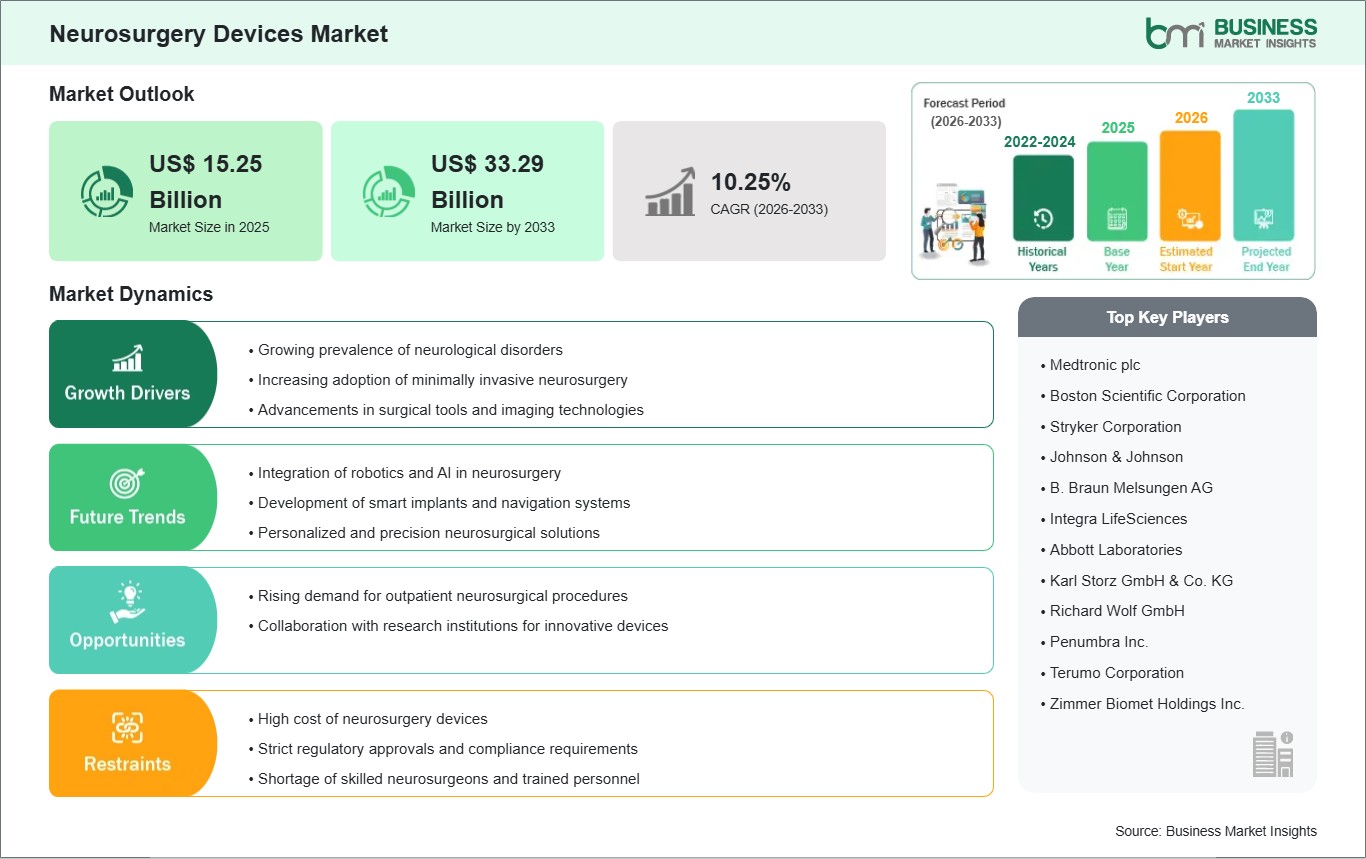
Neurosurgery devices comprise high-precision medical instruments and systems designed to diagnose, treat, and repair disorders of the brain, spinal cord, and peripheral nerves. These devices provide significant strategic value by facilitating complex procedures in hospitals, specialized neurology clinics, and ambulatory surgical centers. Market growth is primarily driven by the global increase in neurodegenerative diseases such as Alzheimer`s and Parkinson`s, the rapid adoption of robotic-assisted neurosurgery, and rising demand for minimally invasive spine and cranial interventions. In addition, the adoption of AI-powered intraoperative imaging, which enables real-time tracking of neural pathways, is markedly enhancing surgical accuracy and reducing the risk of post-operative deficits.
Several challenges may impede market growth. High procedural and device costs represent a significant barrier, especially for advanced neuromodulation therapies that may not be universally covered by insurance. The inherent risks associated with neurosurgical operations often result in cautious adoption of new and unproven technologies by surgical teams. Additionally, the industry is constrained by stringent and prolonged regulatory approval processes for Class III implantable devices, which can delay the commercialization of next-generation brain-computer interfaces (BCIs).
Despite these challenges, the market presents substantial opportunities due to the global emphasis on personalized precision neurosurgery and the rapid deployment of portable, point-of-care neuro-monitoring systems. The advancement of bio-absorbable neuro-implants and the expansion of tele-neurosurgery platforms for remote guidance are anticipated to generate significant prospects for sustained market growth.
Segment Analysis
Neurosurgery Devices Market Segmentation
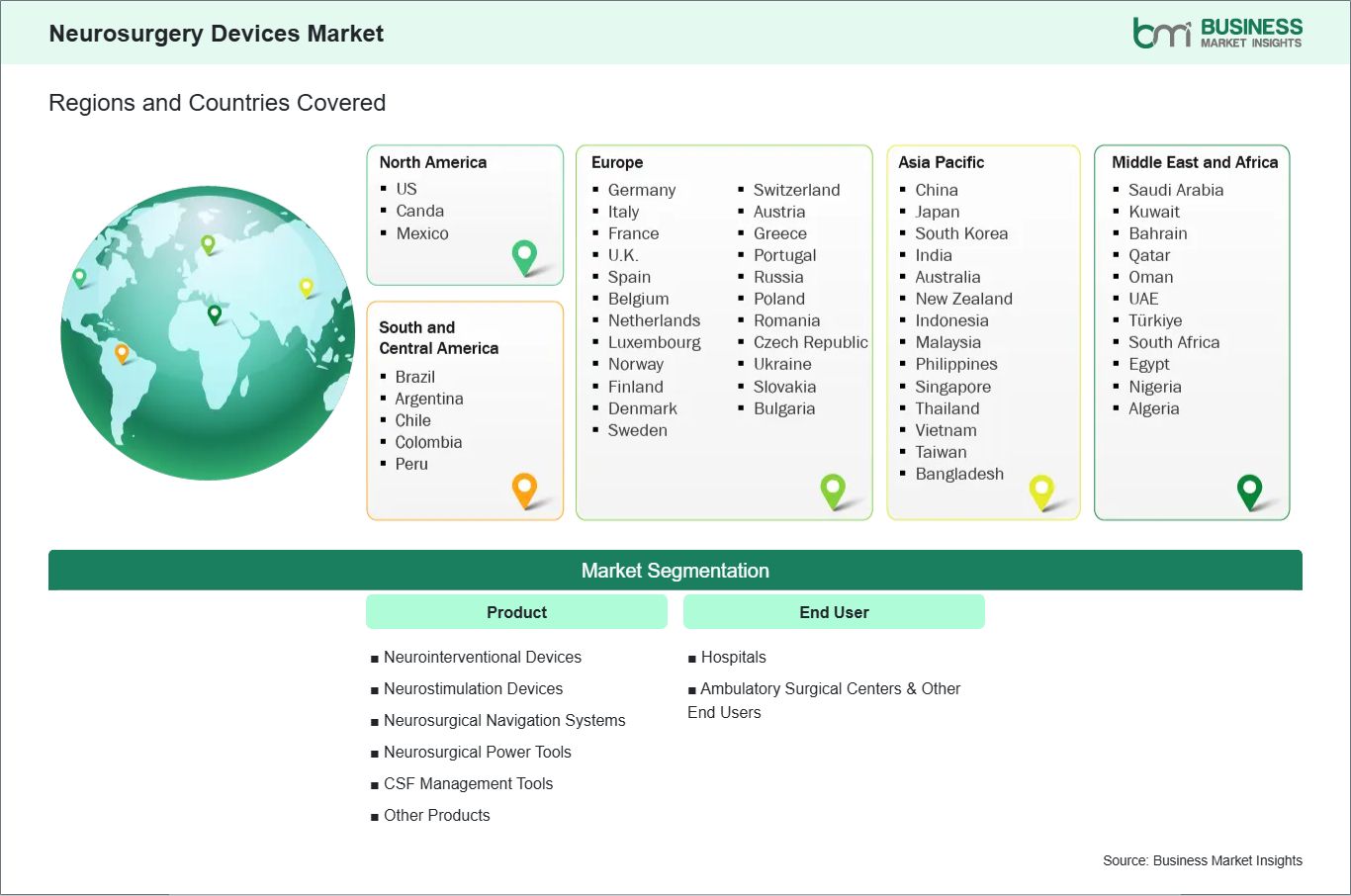
Key segments that contributed to the derivation of the Neurosurgery Devices market analysis are product and end user.
- By Product, the market is segmented into Neurointerventional Devices, Neurostimulation Devices, Neurosurgical Navigation Systems, Neurosurgical Power Tools, CSF Management Tools, and Others.
- By End User, the market is categorized into Hospitals, and Ambulatory Surgical Centers & Others.
Market Forces
Neurosurgery Devices Market Drivers and Opportunities
Advancing Clinical Safety and the Integration of Robotic Precision
The primary driver of the neurosurgery devices market is the global increase in neurological disorders, including brain tumors, epilepsy, and Parkinson's disease, combined with a demand for technologies that mitigate the high-risk nature of cranial surgery. The integration of surgical robotics and artificial intelligence-powered navigation is a significant catalyst, as these platforms offer surgeons enhanced stability and real-time anatomical mapping, which shortens learning curves and reduces intraoperative complications. Additionally, the rising prevalence of ischemic strokes has generated substantial demand for neurointerventional devices such as clot retrievers and aspiration catheters, which require rapid and precise deployment. Technological advancements, particularly the growing adoption of minimally invasive neurosurgery (MIN), further drive market growth, as both patients and payers increasingly favor procedures with smaller incisions, reduced blood loss, and faster recovery times.
Moreover, favorable government initiatives and healthcare expansion in emerging economies, particularly in the Asia-Pacific region, are increasing funding for neuro-specialty centers. Simultaneously, the rapidly aging global population maintains a high demand for neurodegenerative treatments. Collectively, these factors, including advancements in robotic precision, the urgency of stroke intervention, and the adoption of minimally invasive neurosurgery, position neurosurgery as one of the most technologically advanced and rapidly growing segments within the medical device industry.
Closed-Loop Neuromodulation and Smart Implantable Biologics
A significant opportunity exists in the integration of neurosurgery devices with closed-loop neurostimulation systems. Next-generation deep brain stimulation (DBS) and spinal cord stimulators are being developed with sensing capabilities that detect abnormal brain activity and automatically adjust electrical pulses in real time, enabling a personalized approach to the treatment of movement disorders and chronic pain. Additionally, substantial growth is anticipated in the development of 3D-printed custom implants and bio-absorbable dura substitutes. By leveraging patient-specific imaging data to produce customized cranial plates or synthetic tissues, manufacturers can enhance biocompatibility and decrease post-surgical rejection rates.
The expansion of Ambulatory Surgical Centers (ASCs) for spine and neuro-interventions creates a lucrative opportunity for the development of portable, compact navigation units and specialized instrumentation tailored to high-throughput outpatient settings. In addition to advancements in traditional hardware, the emergence of Brain-Computer Interfaces (BCIs) represents a transformative frontier, offering new possibilities for surgical devices that enable neural-to-digital communication for paralyzed patients. Manufacturers prioritizing interoperable software ecosystems and those advancing Laser Interstitial Thermal Therapy (LITT) for tumor ablation are well positioned to lead the neurosurgery devices market.
Size and Share Analysis
Neurosurgery Devices Market Size and Share Analysis
The Neurosurgery Devices market demonstrates steady growth, with size and share analysis revealing evolving trends and competitive positioning among key players. The report further examines subsegments categorized within product and end user, offering insights into their contribution to overall market performance.
Based on product, the Neurostimulation Devices and Neurosurgical Navigation Systems subsegments demonstrate a significant market presence, representing the most technologically advanced and highest-value categories. Neurostimulation Devices are essential within the Functional Neurosurgery sector, as they provide transformative treatments for chronic pain, epilepsy, and movement disorders through Deep Brain Stimulation (DBS) and Spinal Cord Stimulation (SCS). An emerging trend is the increased adoption of Neurosurgical Navigation Systems and Power Tools, which are gaining prominence as integral components of contemporary surgical suites. Navigation systems are increasingly utilized in Oncology and Spine Surgery, offering precise guidance that enables surgeons to operate within the intricate structures of the brain with sub-millimeter accuracy. Additionally, next-generation power tools are preferred for their ergonomic designs and specialized attachments that facilitate minimally invasive procedures.
Report Coverage
Neurosurgery Devices Market Report Coverage and Deliverables
The "Neurosurgery Devices Market Size and Forecast (2022–2033)" report provides a detailed analysis of the market covering below areas:
- Neurosurgery Devices market size and forecast at global, regional, and country levels for all the key market segments covered under the scope
- Neurosurgery Devices market trends, as well as market dynamics such as drivers, restraints, and key opportunities
- Neurosurgery Devices market analysis covering key market trends, global and regional framework, major players, regulations, and recent market developments
- Industry landscape and competition analysis covering market concentration, heat map analysis, prominent players, and recent developments for the Neurosurgery Devices market
- Detailed company profiles, including SWOT analysis
Geographic Insights
Neurosurgery Devices Market Geographic Insights
The geographical scope of the Neurosurgery Devices market report is divided into five regions: North America, Asia Pacific, Europe, Middle East & Africa, and South & Central America.
North America continues to lead the market, supported by a high prevalence of neurological conditions such as Parkinson`s and Alzheimer`s disease, as well as a well-established infrastructure for robotic-assisted surgery and neurostimulation. Europe serves as a significant center for innovation, characterized by specialized task forces in geriatric neurosurgery and a stringent regulatory focus on the safety of implantable neuro-interventional devices. The Asia Pacific region represents the fastest-growing market, driven by rapid healthcare modernization in China and India, an aging population in Japan, and the growth of medical tourism for complex cranial procedures.
The Asia-Pacific Neurosurgery Devices Market is segmented into China, Japan, South Korea, India, Australia, and the rest of the region. China is a primary contributor to regional growth, advancing toward high-precision domestic manufacturing of neuro-endoscopes and stereotactic systems. India is experiencing substantial growth in demand for neurovascular devices, attributed to a rising number of stroke-related interventions and the proliferation of private multispecialty hospitals. Japan is at the forefront of adopting advanced deep-brain stimulation (DBS) technologies, which are specifically designed to address the needs of its super-aging population.
Industry Activity
Recent Developments
The Neurosurgery Devices market is evaluated by gathering qualitative and quantitative data post primary and secondary research, which includes important corporate publications, association data, and databases. A few of the key developments in the Neurosurgery Devices market are:
- In November 2024, ClearPoint Neuro announced the acquisition of IRRAS, enhancing its neuro device and drug delivery portfolio, expanding commercial scale, and opening new indications in intracranial fluid management, positively impacting the neurosurgery device market.
- In Sep 2024, ZEISS launched the KINEVO 900 S, a next-generation robotic visualization system for neurosurgery, featuring 4K 3D imaging, AI-assisted cobotics, and enhanced workflow integration. This product launch directly advances the neurosurgery device market by improving surgical precision, efficiency, and clinical outcomes.
Trust & Transparency
Research Methodology
The market analysis combines proprietary research with secondary data from government agencies, company disclosures, regulatory filings, industry databases and expert interviews. Market estimates are validated through data triangulation, cross-market benchmarking and analyst
review.
View Full Research Methodology
Key Sources Referred:
World Bank – Global Trade IndicatorsWorld Trade Organization (WTO)(International Monetary Fund )IMFInternational Trade Administration (ITA)Company websiteCompany annual reportsCompany investor presentations