
Natural Sweeteners Market Outlook: Size, Share, Trends, Growth Analysis, Competitive Landscape & Forecast, 2026-2033

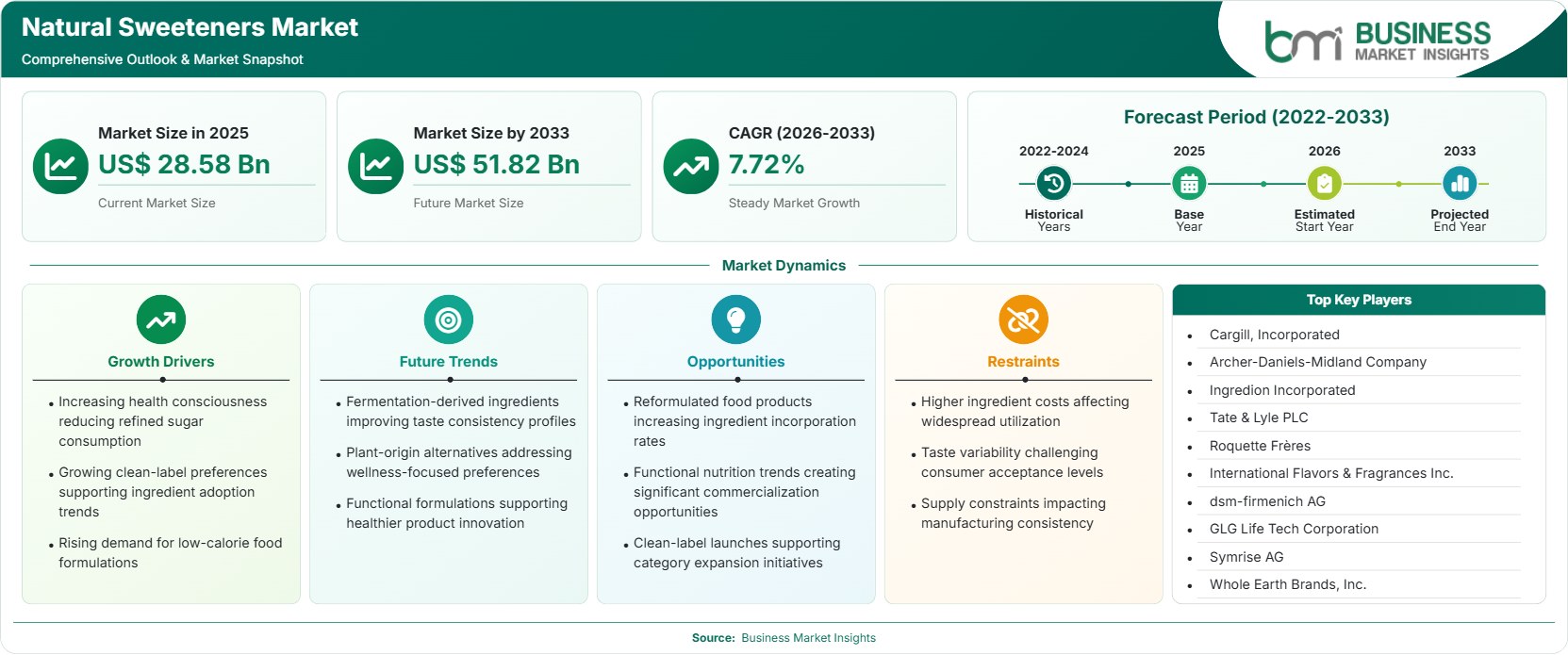
The Natural Sweeteners Market size was valued at US$ 28.58 Billion in 2025 and is projected to reach US$ 51.82 Billion by 2033, growing at a CAGR of 7.72% during 2026–2033, driven by sugar-reduction initiatives, clean-label demand, plant-based ingredients adoption, expanding functional foods, and innovation in stevia, honey, and sugar-alcohol formulations.

Report Coverage
  • Type: Honey, Molasses, Date Palm, Sugar Alcohol , Stevia, Others
  • Application: Food and Beverage , Pharmaceuticals, Personal care and Cosmetics
US$ 28.58 Bn Market size in 2025
US$ 51.82 Bn Market Size by 2033
7.72% CAGR, 2026 - 2033
2026-2033 Forecast Period

AI Overview

Natural Sweeteners Market Summary

  • North America Region: North America holds a market share of 34%–37% in 2025, growing with a CAGR of 6.8%–7.2%. Key drivers include sugar-reduction regulations, broad low-calorie sweetener adoption, food innovation investment, diabetes management focus, premium honey consumption, expanding clean-label portfolios, beverage reformulation programs, e-commerce penetration, ingredient traceability, and product differentiation opportunities. Brief US analysis: The U.S. dominates regional demand through beverage reformulation and nutraceutical innovation, advancing at 6.9%–7.3% CAGR.
  • Fastest Growing Region: Asia Pacific holds a market share of 26%–29% in 2025, growing with a CAGR of 8.8%–9.4%. Key drivers include rising disposable incomes, urban dietary shifts, expanding food processing industries, health awareness campaigns, diabetic populations, regional stevia cultivation, premiumization trends, modern retail expansion, regulatory support, and investment in natural ingredient manufacturing.
  • Leading Segment: Food and Beverage holds a Natural Sweeteners Market share of 68%–72% in 2025, growing with a CAGR of 7.6%–8.1%. Key drivers include bakery reformulations, reduced-sugar beverages, confectionery innovation, consumer demand for recognizable ingredients, clean-label product launches, taste optimization technologies, retail expansion, functional foods adoption, premium positioning, and broad manufacturing integration.
  • High Growth Segment: Stevia holds a market share of 16%–19% in 2025, growing with a CAGR of 9.5%–10.2%. Key drivers include calorie-free positioning, regulatory acceptance, improved taste profiles, fermentation-enabled production, increasing beverage applications, diabetes-oriented products, global sugar taxes, ingredient innovation, sustainability advantages, and strong multinational brand adoption.
  • Key Market Opportunity: Expansion of next-generation natural sweetener blends combining stevia, honey derivatives, and sugar alcohols enables taste optimization, cost control, reduced calories, broader application compatibility, and premium health-focused product differentiation.
  • Major Market Players: Cargill, Incorporated; Archer-Daniels-Midland Company; Ingredion Incorporated; Tate & Lyle PLC; Roquette Frères; International Flavors & Fragrances Inc.; dsm-firmenich AG; GLG Life Tech Corporation; Symrise AG; Whole Earth Brands, Inc.
Strategic Insights

Natural Sweeteners Market: Strategic Insights

Natural Sweeteners Market Strategic Framework
FREE PDF
Request your free sample
Request free sample
Stakeholder View

Key Takeaways

  • The industry value chain is shifting toward vertically integrated sourcing models that combine cultivation, extraction, refining, formulation, and distribution capabilities to enhance traceability and cost efficiency.
  • Reduced-sugar beverages, nutraceutical products, and functional bakery categories offer the highest commercial upside due to growing health-conscious consumer demographics.
  • Innovation is increasingly focused on taste improvement, fermentation-derived sweetening compounds, and hybrid formulations that replicate sugar functionality without excessive calories.
  • India, China, Indonesia, and Vietnam present compelling expansion opportunities due to favorable demographics, rising packaged-food consumption, and developing ingredient-processing infrastructure.
  • Strategic acquisitions within specialty ingredient portfolios are enhancing access to proprietary technologies, application expertise, and premium customer relationships.
  • Sustainability credentials, including responsible sourcing and lower environmental footprints, are becoming decisive procurement criteria among multinational food manufacturers.
Geographic Outlook

Natural Sweeteners Market Regional Highlights

North America Natural Sweeteners Market

North America captured 34% to 37% of the Natural Sweeteners Market shares in 2025 and is expected to expand at a CAGR of 6.8% to 7.2% until 2033. The market demand is fueled by increased development of reduced-sugar products, increased consumer awareness of metabolism, and widespread use in the food and beverage industries. Increasing regulation of sugar content drives innovation in formulation development. Premium natural sweeteners continue to be supported by mature retail sales networks, ingredient innovations, and high consumer purchasing power.

  • Food and beverage manufacturers continue accelerating sugar reformulation strategies in beverages, dairy products, and snacks, strengthening ingredient demand and supporting premium product positioning across retail channels.
  • Consumer interest in clean-label ingredients has increased adoption of honey, stevia, and plant-derived sweetening systems across mainstream packaged food applications.
  • Healthcare awareness regarding obesity and diabetes supports sustained demand for calorie-conscious products incorporating alternative sweetening ingredients.
  • Ingredient producers are investing in supply-chain transparency, sustainability certifications, and digital traceability platforms to strengthen customer trust.

US Natural Sweeteners Market

The US market accounts for about 78%-82% of regional demand and grows at a CAGR of 6.9%-7.3%. Extensive beverage formulation efforts, strong demand for nutraceuticals, and robust distribution channels bolster consumption. Food companies are increasingly using natural ingredients to meet wellness-driven consumer demand. Product launches aimed at reducing sugar content continue to add to the category's growth, while research investments support enhanced taste performance and new application development.

  • Sugar-reduction commitments among leading beverage manufacturers create consistent demand for stevia-based and blended sweetener solutions.
  • Functional nutrition products increasingly utilize natural sweeteners to support clean-label positioning and calorie management objectives.
  • Retailers continue expanding shelf space for reduced-sugar and specialty wellness products targeting health-conscious consumers.

Europe Natural Sweeteners Market

Europe will account for 27%-30% of worldwide demand by 2025 and is growing at a 7.0%-7.6% CAGR in the Natural Sweeteners Market. The focus on nutrition labeling and reducing sugar content in regulatory bodies aids commercial implementation. Germany leads in regional consumption, while the growth rate is higher in Eastern European regions. Consumer inclination toward natural products and sustainability affects ingredient-sourcing decisions.

  • Germany remains the leading national market, supported by advanced food manufacturing capabilities and innovation-focused ingredient adoption.
  • Poland emerges among higher-growth markets with rising consumption of health-oriented packaged foods and beverages.
  • Growing private-label activity encourages incorporation of natural sweetening ingredients within mainstream retail portfolios.
  • Environmental sustainability initiatives influence supplier selection, sourcing decisions, and product development priorities.

Asia Pacific Natural Sweeteners Market

Asia Pacific accounts for 26%-29% of the market share in 2025 and has the highest growth rate, with an 8.8%-9.4% CAGR. The growth drivers include higher incomes, urbanization, prevalence of diabetes, and increased consumption of processed foods. The major countries in the region include China, owing to its production capacity and ingredient availability, followed by India, which is experiencing rapid growth. Regional investments in cultivation, extraction, and downstream processing facilities improve supply availability and export competitiveness.

  • China maintains leadership through extensive stevia production capacity and established ingredient supply chains.
  • India records strong growth due to dietary shifts, health awareness, and expanding packaged-food industries.
  • Regional beverage manufacturers are increasingly utilizing low-calorie sweetening systems to satisfy health-conscious consumer demand.
  • Modern retail expansion improves market accessibility and supports premium product penetration.

Rest of World Natural Sweeteners Market

The Rest of World region accounts for 10%–13% of industry demand and advances at 7.4%–8.0% CAGR. South and Central America benefit from agricultural resource availability and growing packaged-food sectors. The Middle East and Africa are supported by changing dietary preferences and expanding retail networks. Brazil leads regional consumption, while Gulf Cooperation Council economies display attractive opportunities due to premium health-food demand and rising wellness awareness among consumers.

  • Brazil benefits from strong agricultural infrastructure and increasing functional-food product development initiatives.
  • Gulf markets exhibit growing demand for premium and reduced-sugar food offerings across urban populations.
  • Retail modernization enhances access to international and specialty nutrition products throughout developing markets.
  • Rising lifestyle-related health concerns encourage manufacturers to adopt lower-calorie formulations across product categories.
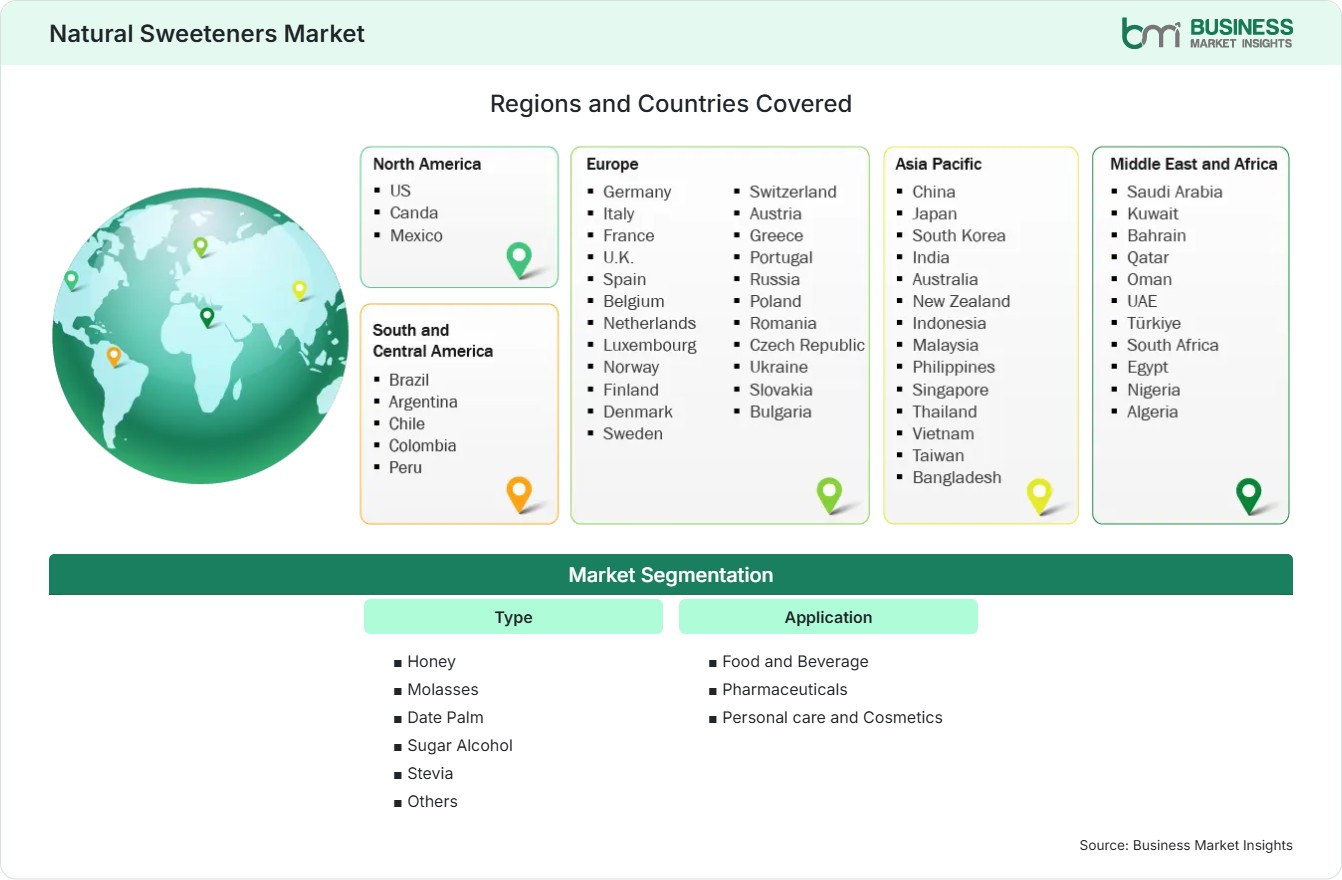
Global Market Geography
FREE PDF
Request your free sample
Request free sample
Segment Analysis

Natural Sweeteners Market Segmentation

Type

Type-based demand remains diverse, and Honey, Stevia, and Sugar Alcohol types have maintained high usage rates. This has been the overall market structure, with honey accounting for the highest share. The scope of the Natural Sweeteners Market continues to grow with new ingredient development, while the type segment sees a 7.5%-8.2% CAGR as manufacturers seek balanced sweetness, functionality, and clean-label advantages.

  • Honey: Widely adopted in bakery, beverages, and health foods because of natural positioning, flavor complexity, and consumer familiarity. Premium and organic variants continue attracting higher-value purchasing behavior globally.
  • Molasses: Utilized across bakery products, specialty foods, and nutraceutical formulations due to mineral content, distinctive flavor characteristics, and growing interest in minimally refined ingredients.
  • Date Palm: Demand benefits from clean-label preferences, ethnic food popularity, and natural nutrient profiles, making it attractive for premium food product developers.
  • Sugar Alcohol: Adoption expands through calorie-reduction strategies and diabetic-friendly formulations supported by technological improvements and broad food industry acceptance.
    • Xylitol: Commonly applied in oral care products, chewing gum, and reduced-sugar foods due to dental-health advantages and sweetness performance.
    • Mannitol: Preferred in pharmaceutical applications and specialty formulations requiring stability, low hygroscopicity, and controlled sweetness characteristics.
    • Sorbitol: Maintains broad usage across confectionery, pharmaceuticals, and personal care products because of functionality and cost-effectiveness.
    • Maltitol: Increasingly incorporated into sugar-free confectionery and bakery applications due to favorable taste characteristics and formulation flexibility.
  • Stevia: The fastest-growing category, benefiting from calorie-free positioning, regulatory approvals, and ongoing improvements in taste performance through advanced processing technologies.

Application

The application sector is dominated by Food and Beverage, holding 68%–72% market share in 2025 and anticipated to expand at a 7.6%–8.1% CAGR. Increasing preference for low-sugar, high-quality, and innovative products drives demand in the market. This paragraph captures the evolving Natural Sweeteners Market trends, driven by expanding applications that extend beyond traditional foods into the healthcare and personal wellness industries.

  • Food and Beverage: Largest revenue contributor driven by product reformulation, sugar reduction commitments, and strong consumer demand for natural ingredient declarations.
    • Bakery: Natural sweetening ingredients support flavor development, clean labels, moisture retention, and premium positioning across cakes, breads, and snacks.
    • Confectionery: Manufacturers increasingly use alternative sweeteners to reduce sugar content while maintaining consumer-expected taste and texture profiles.
    • Beverages: Strong adoption fueled by sugar-reduction targets, functional drink demand, and ongoing innovation in flavor balancing technologies.
  • Pharmaceuticals: Utilized in syrups, chewable tablets, and dietary supplements where taste enhancement and patient acceptance remain development priorities.
  • Personal care and Cosmetics: Expanding incorporation in oral care, skincare, and wellness-oriented formulations reflecting broader preference for naturally derived ingredients.
Market Forces

Natural Sweeteners Market Dynamics

Key Market Drivers

Rising Global Sugar Reduction Initiatives

Leading health institutions, such as the WHO, continue to advocate for lower sugar intake in diets, prompting food companies to develop new product formulations. The rising cases of obesity and diabetes have increased demand for natural sweeteners in all drinks, candies, and other packaged foods. Consumers’ desire for ingredients that they can easily identify has led to the use of natural ingredients such as honey, stevia, and sugar alcohols. Regulations on added sugars, together with increased labeling of sugar content in food products, are favoring sweetener substitution. Industry participants are responding by expanding production capacity, innovating ingredients, and developing application-specific formulations to support broader commercial adoption.

Advances in Extraction and Fermentation Technologies

Innovation in technology has made it possible to increase yield efficiency, improve taste quality, and scalable use of natural sweetener ingredients. Steviol glycoside production through fermentation has been made more reliable by overcoming agricultural constraints. New technologies in purification have helped reduce product bitterness and improve their sensory profile. Manufacturers benefit from increased consistency in product use, especially in beverages. There have been continued investments in research that help to develop new ingredients and hybrids. These improvements lower formulation barriers and increase customer acceptance. Enhanced production economics encourage broader implementation across mass-market products and support expansion into emerging application categories where performance requirements are increasingly sophisticated.

Expansion of Functional and Wellness Foods

Product categories focused on health remain in demand from consumers and ensure a constant requirement for ingredients. Products such as functional beverages, sports nutrition, dietary supplements, and fortified foods are using more natural sweeteners. Brand owners strive to obtain ingredients that meet their clean-label and calorie-management requirements. It is possible to say that the combination of health benefits and improved taste makes products commercially viable. The demand for such products goes beyond developed countries into developing ones. E-commerce ensures greater availability of such products. This ecosystem supports continuous product launches and creates long-term growth opportunities for ingredient suppliers serving multiple end-use industries.

Key Market Opportunities

Premium Natural Ingredient Positioning

Manufacturers can capitalize on premiumization by using premium, traceable, and sustainable raw materials. Increasingly, consumers are analyzing origin, environmental considerations, transparency, and nutritional performance. Specialty premium honey, premium stevia extracts, and other specialized natural blends can be considered for value addition. Premiumization helps food manufacturers gain pricing power and a product differentiation advantage. Supermarkets are increasing their offerings in response to consumer trends. As disposable incomes continue to rise in developing countries, consumer demand for high-quality products made with natural ingredients will grow. These dynamics create attractive margins and support long-term portfolio expansion strategies.

Emergence of Personalized Nutrition Solutions

There is a greater need for personalized nutrition platforms today, thus an increased need for sweeteners that cater to these demands. Products for diabetics, weight-management regimens, and performance nutrition all need innovative ingredient solutions. Naturally derived ingredients fit the bill for personalized products very well because of their diverse sweet profiles and functional properties. Digital health ecosystems make it easy to provide product recommendations tailored to specific needs. The ingredient companies can work with nutrition technology partners to provide customized solutions. As consumer engagement with wellness-tracking tools expands, ingredient innovation that addresses specific metabolic and nutritional requirements will gain strategic importance.

Growth in Emerging Markets and Local Manufacturing

Regional manufacturing, harvesting, and production capacity offer many developmental opportunities. Natural Sweeteners Market Forecasts indicate increased demand for such products in Asian countries, Latin American nations, and selected Middle Eastern countries, driven by urbanization and changing consumption habits. Regional production lowers transportation expenses and improves supply chain security. Government backing for the food processing sector provides another incentive to invest in it. Expanding brands domestically creates new customers. Collaboration among producers, food processors, and multinational companies would help with marketing and the creation of employment opportunities, and strengthen market access across high-growth regions.

Market Restraints and Challenges

Raw Material Supply Volatility

Factor: Increased dependence on agriculture exposes businesses to risks associated with climatic conditions, diseases, and production disruptions. Impact: Fluctuations in raw material availability may increase procurement costs, jeopardizing the manufacturing firm's profitability. Raw materials such as honey, stevia, and dates are highly vulnerable to weather conditions during harvesting. This can create price volatility and make it hard for the manufacturer or brand owner to predict prices. As a result, to mitigate these risks, the company will be forced to diversify its supply chain. However, creating a robust supply chain is capital-intensive.

Taste and Formulation Complexity

Factor: Some naturally occurring sweeteners have aftertaste or functional drawbacks compared to conventional sugar. Impact: Product formulation becomes even more complicated and may be more expensive for the manufacturer. Formulating the desired flavor profile may involve mixing in other substances or using advanced technology to modify flavor. Small or medium-scale manufacturers may not always have sufficient resources for such an approach. Technical problems associated with the application are different depending on what is being produced- beverages, baked goods, or confections. However, scientific research continues to work on solving these problems.

Company Analysis

Competitive Landscape

The competitive environment remains moderately consolidated, with leading ingredient suppliers focused on innovation, sustainability, and global distribution. This Natural Sweeteners Market analysis highlights major participants active across extraction, formulation, and specialty ingredient development.

Company Name

Overview

Products and Services relevant to this market

Cargill, Incorporated

Global food ingredient leader with extensive sourcing, processing, and formulation capabilities.

Stevia solutions, sweetener systems, food ingredients, beverage reformulation support.

Archer-Daniels-Midland Company

Diversified agricultural processor with broad specialty ingredient portfolio.

Natural sweeteners, formulation services, nutritional ingredients, supply-chain solutions.

Ingredion Incorporated

Major specialty ingredients producer emphasizing sugar reduction technologies.

PureCircle stevia portfolio, clean-label ingredients, beverage applications.

Tate & Lyle PLC

International ingredient specialist focused on healthier food solutions.

Stevia, allulose, sweetener blends, technical formulation expertise.

Roquette Frères

Plant-based ingredient company serving food and pharmaceutical sectors.

Sugar alcohols, specialty sweeteners, nutraceutical ingredients.

International Flavors & Fragrances Inc.

Global ingredients and sensory solutions company.

Taste modulation, flavor systems, sugar-reduction technologies.

dsm-firmenich AG

Nutrition and health specialist with advanced formulation capabilities.

Sweetness modulation, nutritional ingredients, product development services.

GLG Life Tech Corporation

Stevia-focused company with cultivation and extraction expertise.

Stevia extracts, specialty sweetening ingredients, agricultural sourcing.

Symrise AG

Global flavor and ingredient innovation company.

Taste enhancement systems, natural ingredient technologies.

Whole Earth Brands, Inc.

Consumer-focused sweetener company with global brand portfolio.

Natural tabletop sweeteners, stevia products, sugar alternatives.

Trust & Transparency

Research Methodology

The market analysis combines proprietary research with secondary data from government agencies, company disclosures, regulatory filings, industry databases and expert interviews. Market estimates are validated through data triangulation, cross-market benchmarking and analyst review.

View Full Research Methodology

Questions Answered

Frequently Asked Questions

What is the primary challenge affecting suppliers?

Supply volatility associated with agricultural raw materials can create cost fluctuations, sourcing uncertainty, and margin pressure, particularly for producers dependent on crop-derived sweetening ingredients.

How does this Natural Sweeteners Market Report support strategic planning?

The Market Report helps organizations evaluate competitive positioning, regional demand patterns, segment attractiveness, investment priorities, and potential risks across the industry value chain.

Which region offers the strongest future investment potential?

Asia Pacific provides the strongest long-term opportunity due to urbanization, expanding middle-class populations, rising health awareness, and investments in food-processing and ingredient-manufacturing capacity.

What makes stevia the fastest-growing type segment?

Stevia combines zero-calorie positioning, increasing regulatory acceptance, improved taste profiles, and strong compatibility with beverage reformulation strategies, supporting growth rates above the broader industry average.

Which application generates the largest revenue?

Food and beverage applications generate the highest revenue because manufacturers continuously reformulate beverages, bakery products, and confectionery items to reduce sugar while maintaining taste and label appeal.

Access the Full Natural Sweeteners Market Report

Get segment-level forecasts, regional estimates, competitive benchmarking, company profiles and downloadable Excel datasets.

Access the full Natural Sweeteners Market Report
350 pages PDF & Excel | 2026-09-20
Similar Research

Related Market Reports