
Oleoresin Market Outlook: Size, Share, Trends, Growth Analysis, Competitive Landscape & Forecast, 2026-2033

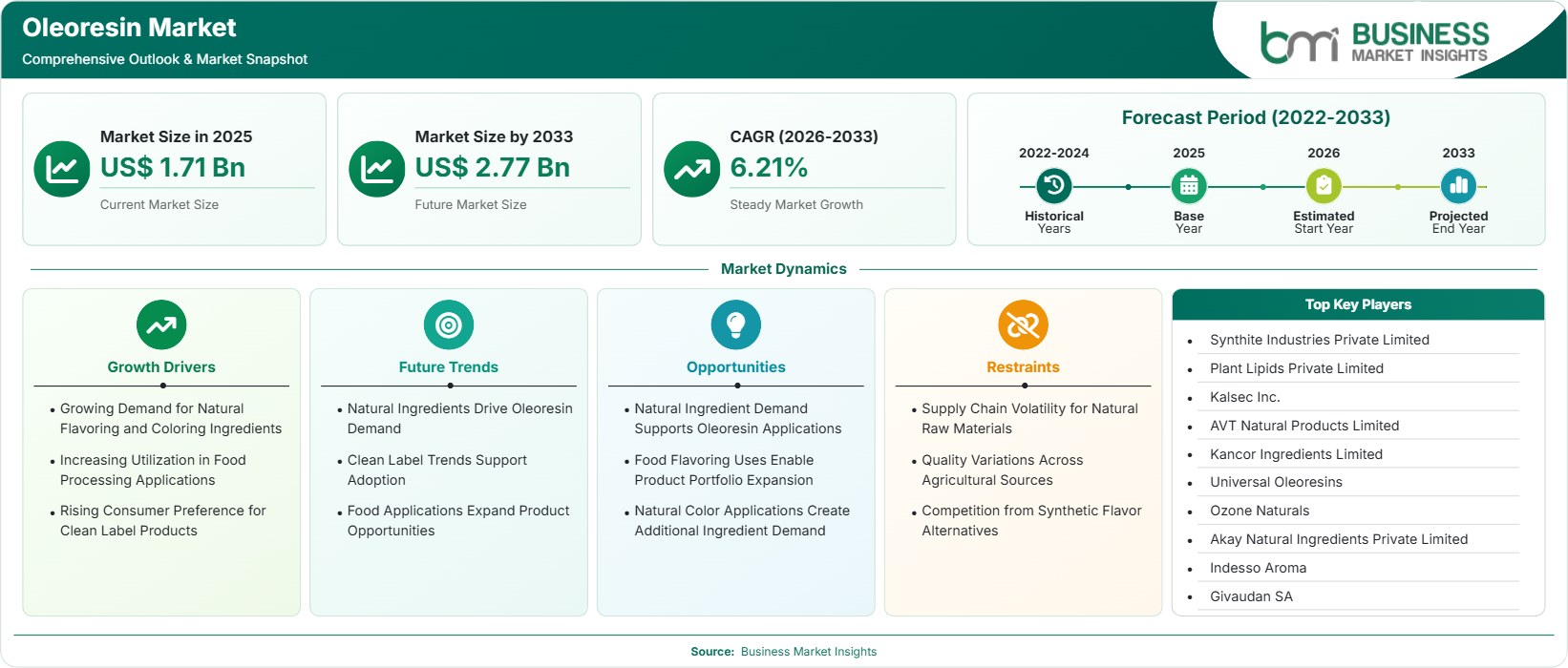
The Oleoresin Market size was valued at US$ 1.71 Billion in 2025 and is projected to reach US$ 2.77 Billion by 2033, growing at a CAGR of 6.21% during 2026–2033. Rising demand for natural food ingredients, clean-label formulations, plant-based colorants, functional extracts, and expanding pharmaceutical and cosmetic applications are creating significant growth avenues across global value chains.

Report Coverage
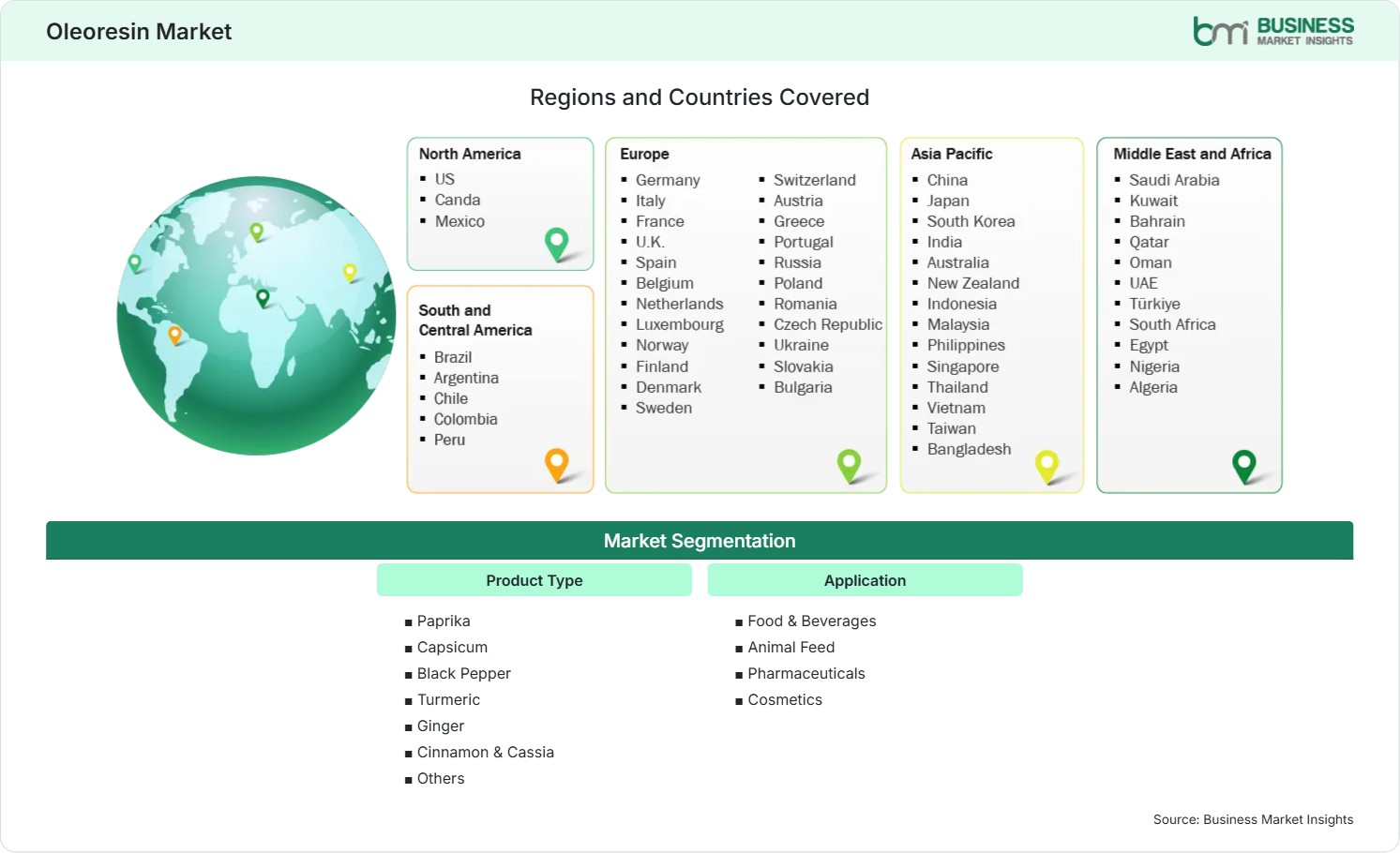
  • Product Type: Paprika, Capsicum, Black Pepper, Turmeric, Ginger, Cinnamon & Cassia, Others
  • Application: Food & Beverages, Animal Feed, Pharmaceuticals, Cosmetics
US$ 1.71 Bn Market size in 2025
US$ 2.77 Bn Market Size by 2033
6.21% CAGR, 2026 - 2033
2026-2033 Forecast Period

AI Overview

Oleoresin Market Summary

  • North America Region: North America holds an Oleoresin Market share of 32%–35% in 2025, growing with a CAGR of 5.5%–5.9% during 2026–2033. Demand is supported by clean-label foods, natural colorants, standardized spice extract usage, and premium seasoning innovations across processing industries. US market benefits from advanced food manufacturing and ingredient innovation, expanding at approximately 5.6%–6.0% CAGR through 2033.
  • Fastest Growing Region: Asia Pacific accounts for 26%–29% share in 2025 and advances at 7.3%–7.8% CAGR. Strong spice cultivation, export processing investments, growing packaged food industries, nutraceutical manufacturing expansion, and rising regional consumption accelerate development opportunities.
  • Leading Segment: Food & Beverages represents 58%–61% share in 2025 and grows at 6.0%–6.4% CAGR. Increasing replacement of synthetic additives, flavor standardization needs, convenience food demand, natural preservation requirements, and premium culinary product launches support adoption.
  • High Growth Segment: Pharmaceuticals contributes 14%–17% share in 2025 and expands at 7.0%–7.5% CAGR. Increasing utilization of bioactive compounds, herbal therapeutics development, standardized botanical ingredients, anti-inflammatory formulations, and preventive healthcare demand stimulate expansion.
  • Key Market Opportunity: Growth opportunities are emerging through high-purity extracts, sustainable extraction technologies, clean-label reformulations, nutraceutical innovation, natural cosmetic actives, and ingredient traceability platforms supporting premium global product positioning.
  • Major Market Players: Synthite Industries Private Limited, Plant Lipids Private Limited, Kalsec Inc., AVT Natural Products Limited, Kancor Ingredients Limited, Universal Oleoresins, Ozone Naturals, Akay Natural Ingredients Private Limited, Indesso Aroma, Givaudan SA.
Strategic Insights

Oleoresin Market: Strategic Insights

Oleoresin Market Strategic Framework
FREE PDF
Request your free sample
Request free sample
Stakeholder View

Key Takeaways

  • The industry value chain is increasingly integrated from spice cultivation through extraction, formulation, and ingredient distribution, enabling improved quality control, traceability, and supply reliability.
  • Pharmaceutical and nutraceutical applications present strong upside potential due to expanding demand for standardized botanical actives with documented functional properties.
  • Investments in advanced extraction technologies are delivering higher yields, improved purity levels, reduced solvent usage, and stronger sustainability credentials.
  • Asia Pacific offers the most compelling long-term expansion opportunity because of its raw material availability, processing expertise, and growing domestic consumption.
  • Strategic acquisitions and partnerships among ingredient suppliers continue to strengthen global distribution capabilities and application development expertise.
  • Sustainability certifications, transparent sourcing programs, and residue-compliance frameworks are becoming critical competitive differentiators across international procurement markets.
Geographic Outlook

Oleoresin Market Regional Highlights

North America Oleoresin Market

North America accounts for 32%–35% of the Oleoresin Market share in 2025 and is projected to expand at 5.5%–5.9% CAGR during 2026–2033. Demand is driven by natural ingredient reformulation programs across food processing, beverages, nutraceuticals, and cosmetics. Large multinational companies increasingly prefer standardized spice extracts for consistency and shelf-life advantages. Regulatory scrutiny on synthetic additives encourages adoption of botanical alternatives. Advanced manufacturing infrastructure and strong consumer spending sustain regional leadership while supporting innovation in premium seasoning blends and functional ingredient formulations.

  • Food manufacturers increasingly replace artificial colors with paprika and capsicum extracts to meet clean-label requirements and consumer transparency expectations.
  • Growth in plant-based food categories generates demand for natural flavor enhancement systems sourced from spice-derived ingredients.
  • Nutraceutical companies expand utilization of turmeric, ginger, and black pepper extracts in wellness-focused formulations.
  • Traceability requirements drive investment in supplier qualification programs and authenticated sourcing networks.
  • Corporate sustainability commitments support procurement of responsibly sourced botanical ingredients.

US Oleoresin Market

The United States represents 70%–74% share within North America and advances at 5.6%–6.0% CAGR of the Oleoresin Market through 2033. Demand stems from processed foods, dietary supplements, specialty seasonings, and personal care applications. Major ingredient distributors emphasize standardized potency and regulatory compliance. Product innovation in functional foods continues supporting adoption of spice-derived extracts across premium consumer categories.

  • Clean-label product launches increase incorporation of natural colorants and flavor concentrates.
  • Expanding supplement consumption supports demand for bioactive turmeric and ginger derivatives.
  • Foodservice innovation encourages specialized seasoning systems with consistent flavor performance.
  • High regulatory compliance standards favor established suppliers with validated quality programs.

Europe Oleoresin Market

Europe holds 28%–31% market share in 2025 and grows at 5.8%–6.2% CAGR. The region benefits from stringent food regulations, strong demand for natural ingredients, and widespread adoption of botanical formulations. Germany remains the leading market, while Poland and Eastern European economies exhibit faster expansion with 6.3%–6.8% CAGR. Ingredient transparency, sustainability expectations, and premium product positioning continue driving procurement of standardized extracts.

  • Food manufacturers prioritize natural coloring and flavoring systems to align with consumer preferences.
  • Germany leads consumption through advanced food processing and ingredient innovation capabilities.
  • Poland emerges as a high-growth country supported by expanding manufacturing investments.
  • Cosmetics producers adopt spice-derived extracts for antioxidant and botanical positioning claims.
  • Nutraceutical demand strengthens growth of turmeric- and ginger-based ingredient portfolios.

Asia Pacific Oleoresin Market

Asia Pacific holds 26%-29% market share in 2025 and leads in CAGR, at 7.3%-7.8%, through 2033. India leads in production and exports in the market owing to its large spice crop and extraction capacity. The major demand from China and Indonesia is driving the Oleoresin Market growth, with Indonesia showing a 7.8%-8.3% CAGR. An increase in packaged food manufacturing, exports, and internal consumption of nutraceuticals drives growth. The region continues to benefit from the favorable availability of raw materials and investment in processing infrastructure.

  • India dominates supply chains through large-scale extraction facilities and export capabilities.
  • China drives demand through food manufacturing, wellness products, and ingredient innovation.
  • Indonesia exhibits rapid expansion supported by agricultural resources and processing investments.
  • Regional producers increasingly adopt advanced extraction technologies to improve competitiveness.
  • Growing middle-class consumption boosts demand for natural and premium food ingredients.

Rest of World Oleoresin Market

Rest of World accounts for 10%-13% share in 2025 and experiences a CAGR of 6.1%-6.6%. The South & Central America region capitalizes on the growing food processing industry in countries like Brazil and Mexico. On the other hand, the Middle East & Africa region capitalizes on rising food imports, a growing hospitality industry, and increasing demand for natural ingredients. Brazil is the leader in this region in terms of demand, whereas the UAE is growing faster, with a CAGR of 6.7%-7.1%, supported by investments in food innovation and ingredient sourcing.

  • Brazil strengthens regional consumption through processed food and seasoning applications.
  • Mexico supports growth with snack, beverage, and convenience food manufacturing expansion.
  • Gulf countries increasingly adopt premium natural ingredients in foodservice supply chains.
  • Import dependency encourages strategic partnerships with global ingredient suppliers.
  • Rising health awareness supports botanical ingredient adoption across consumer products.
Global Market Geography
FREE PDF
Request your free sample
Request free sample
Segment Analysis

Oleoresin Market Segmentation

Product Type

The Product Type holds an important share of industry demand, with diverse applications in the food, pharma, cosmetics, and feed industries. The share of this category in the Oleoresin Market is estimated at 39%-42% in 2025, growing at a 6.0%-6.4% CAGR. The market scope continues to widen due to innovations in standard extracts and efficient extraction methods, and growing preference for natural functional ingredients across global manufacturing sectors.

  • Paprika: Widely utilized as a natural colorant in processed foods, sauces, meat products, and snacks. Adoption benefits from clean-label initiatives and increasing regulatory preference for botanical coloring alternatives.
  • Capsicum: Demand is supported by applications requiring standardized heat profiles, particularly in seasonings, processed foods, and specialty formulations emphasizing sensory consistency.
  • Black Pepper: Growing application in nutraceuticals and flavor systems reflects strong interest in piperine functionality, bioavailability enhancement, and premium food formulations.
  • Turmeric: Strong uptake is driven by curcumin-rich formulations used in wellness products, functional foods, and cosmetic products emphasizing natural positioning.
  • Ginger: Utilized extensively in beverages, supplements, and food products where flavor intensity and botanical functional properties support product differentiation.
  • Cinnamon & Cassia: Adoption increases across bakery, confectionery, beverages, and wellness applications due to recognizable flavor profiles and natural ingredient demand.

Application

Application-driven demand is led by food industry applications, even as usage in pharmaceuticals and cosmetics accelerates. The market accounts for 58% to 61% in 2025 and has a compound annual growth rate of 6.0% to 6.4%. The Evolving Oleoresin Market trends show a move towards more use of high-purity extracts in health and premium consumer products.

  • Food & Beverages: Dominates consumption through flavor standardization, natural coloring requirements, seasoning systems, and clean-label product development across multiple categories.
  • Animal Feed: Increasing usage supports feed palatability, functional ingredient incorporation, and specialized nutritional formulations targeted toward commercial livestock production.
  • Pharmaceuticals: Growth reflects expanding utilization of bioactive botanical compounds within supplements, therapeutic formulations, and preventive healthcare applications.
  • Cosmetics: Natural positioning trends encourage inclusion of spice-derived extracts in skincare, personal care, and wellness-oriented premium product ranges.
Market Forces

Oleoresin Market Dynamics

Key Market Drivers

Clean-Label Food Ingredient Adoption

Food producers all over the world keep switching synthetic additives with natural ones. The regulatory environment and shifts in consumers' attitudes toward natural food products are prompting greater use of plant-based ingredients. Oleoresins deliver concentrated flavors, coloring, and functional properties while enabling the label simplification strategy. Various processed food product lines, such as snacks, sauces, ready meals, and beverages, use paprika, turmeric, and capsicum oleoresins. Consumers become more interested in ingredient listings, which increases the importance of botanical ingredient systems. International organizations like the WHO keep stressing the need for healthy food composition, which is conducive to greater use of naturally sourced ingredients and creating long-term demand momentum across ingredient supply chains.

Expansion of Nutraceutical and Wellness Markets

Growing health awareness will further help increase the use of dietary supplements and wellness products. The use of extracts comprising curcumin, gingerols, and piperine has found commercial favor owing to their inclusion in wellness-focused formulations. Standardized extracts are preferred by the pharma and nutra industries because it makes formulation very simple. The aging population in developed countries and the health consciousness among people in developing nations will continue to affect their buying patterns. Science in botanical bioactives will continue to contribute to innovation in this domain. All these things together ensure consistent demand from wellness-oriented companies seeking differentiated ingredients with measurable functionality and consumer appeal.

Advancements in Extraction and Processing Technologies

Technological advances are helping achieve higher yields, greater purity, and improved performance on sustainability metrics. By using supercritical CO2 extraction, efficient solvent recycling, and analytical testing, suppliers can improve ingredient quality and reduce waste. Many producers have automated their operations to guarantee consistency in active compounds. These developments lower the per-unit production cost of the extract. This creates room for better standardization, which builds good relationships with multinational firms in the food, cosmetic, and health industries. As quality expectations increase globally, technological capabilities become a significant differentiator supporting market competitiveness and long-term industry development.

Key Market Opportunities

Premium Natural Colorant Development

The demand for natural coloring systems is increasing dramatically due to regulatory pressures and consumer preference for non-synthetic additives. There are various options for the food industry that are searching for natural coloring systems, such as paprika, turmeric, and capsicum extracts. It is possible to invest in developing more stable coloring systems for various products, including beverages, dairy products, and processed foods. New markets provide additional chances for suppliers due to the global clean-label trend. Long-Term Oleoresin Market Forecasts reveal commercial potential for suppliers of customized coloring systems that offer traceability, regulatory compliance, and consistent functionality across diverse end-use applications.

Expansion into Functional Personal Care Products

Botanical components are now being used in increasing amounts in cosmetic and personal care products. Customers are often convinced that products containing plant-derived ingredients have qualities such as sustainability and status. There is potential for spice extracts to be used in cosmetics, wellness, and beauty products for their antioxidant and aromatic properties. Companies can distinguish themselves through investing in clinical studies and proof of efficacy. There is continued growth in the premium cosmetics market in Asia-Pacific, North America, and Europe. Demand for naturally positioned ingredients provides suppliers with opportunities to expand beyond traditional food-industry applications and access higher-margin specialty markets.

Emerging Market Processing Investments

The growth of food manufacturing in Southeast Asia, Latin America, and certain Middle Eastern nations creates opportunities for local production and distribution. The development of extraction facilities, the supply chain management of spices, and value-added processes can help improve supply. Growing populations, urbanization, and rising incomes provide a basis for growth in packaged foodstuffs and supplements, among other products. Regional partnerships allow companies to leverage logistics, supply chain, and regulatory management. Regional production allows firms to minimize supply chain disruptions and build strong connections with customer relationships across developing consumption markets.

Market Restraints and Challenges

Raw Material Price Volatility and Supply Risk

Factor: Dependence on agricultural goods such as pepper, turmeric, paprika, and ginger puts producers at risk due to changes in weather conditions, crop diseases, and shifts in cultivation economics. Impact: Volatile raw material costs put price pressure on all links in the value chain and reduce profit margins for extract manufacturers. Variations in the climate make predicting harvests increasingly difficult for the world’s leading producers. Restrictions on exports, disruptions to transport logistics, and a shortage of the labor force can exacerbate volatility. Persistent volatility remains a significant operational challenge affecting planning accuracy and profitability.

Regulatory Complexity Across Global Markets

Factor: The procedures for obtaining ingredient approval, addressing contaminants, complying with labeling guidelines, and registering products vary across jurisdictions. Impact: The cost of compliance is higher because suppliers operate in numerous international markets with varying regulations. In most cases, manufacturers must undergo stringent testing, documentation, and certification procedures to remain in the market. It may be hard for small- to medium-sized suppliers to deal with changes in standards for contaminants, traceability, and quality control. Delays in adapting to regulations affect the introduction of new products to the market.

Company Analysis

Competitive Landscape

The competitive environment remains characterized by strong sourcing capabilities, extraction expertise, and application-focused innovation. This Oleoresin Market analysis highlights a mix of global ingredient specialists and established botanical extract manufacturers.

Company Name

Overview

Products and Services relevant to this market

Synthite Industries Private Limited

Leading spice extract producer with extensive global manufacturing and export operations.

Oleoresins, spice extracts, natural colors, seasonings, botanical ingredients.

Plant Lipids Private Limited

Global supplier serving food, flavor, and nutraceutical industries.

Pepper, paprika, turmeric, ginger oleoresins and specialty extracts.

Kalsec Inc.

Ingredient company focused on natural solutions for food applications.

Natural colorants, spice extracts, antioxidants, oleoresin ingredients.

AVT Natural Products Limited

Integrated producer specializing in natural ingredient extraction and sourcing.

Spice extracts, botanical ingredients, oleoresins, nutraceutical solutions.

Kancor Ingredients Limited

Natural extracts supplier with strong global food and wellness presence.

Oleoresins, essential oils, spice extracts, health ingredients.

Universal Oleoresins

Specialized producer focused on spice-derived extract products.

Paprika, pepper, turmeric, capsicum and customized oleoresins.

Ozone Naturals

Botanical ingredient manufacturer serving industrial customers globally.

Natural extracts, spice concentrates and oleoresin ingredients.

Akay Natural Ingredients Private Limited

Developer of value-added botanical and spice-based ingredient systems.

Curcumin, piperine, oleoresins and nutraceutical ingredients.

Indesso Aroma

Indonesian ingredient company with flavor and botanical expertise.

Oleoresins, essential oils, flavor ingredients and extracts.

Givaudan SA

Global flavor and fragrance leader with specialty botanical capabilities.

Natural extracts, flavor systems, botanical ingredients and oleoresins.

Trust & Transparency

Research Methodology

The market analysis combines proprietary research with secondary data from government agencies, company disclosures, regulatory filings, industry databases and expert interviews. Market estimates are validated through data triangulation, cross-market benchmarking and analyst review.

View Full Research Methodology

Questions Answered

Frequently Asked Questions

What does an Oleoresin Market Report typically evaluate?

It commonly assesses demand patterns, supply chains, competitive positioning, regional developments, regulatory influences, technological advances, and future business opportunities across end-use industries.

What industries beyond food use oleoresins?

Applications extend to pharmaceuticals, nutraceuticals, animal feed, cosmetics, personal care products, fragrances, and specialized wellness formulations requiring botanical ingredients.

How are extraction technologies evolving?

Advanced techniques such as supercritical extraction improve purity, yield, consistency, and sustainability while reducing solvent dependence and enhancing product quality.

What makes Asia Pacific a strategic production hub?

The region benefits from abundant spice cultivation, established extraction expertise, lower processing costs, and strong export infrastructure supporting global ingredient supply chains.

What factors are driving adoption of oleoresins in food manufacturing?

Manufacturers increasingly prefer concentrated natural ingredients that deliver stable flavor and color performance while supporting clean-label product positioning and regulatory compliance requirements.

Access the Full Oleoresin Market Report

Get segment-level forecasts, regional estimates, competitive benchmarking, company profiles and downloadable Excel datasets.

Access the full Oleoresin Market Report
350 pages PDF & Excel | 2026-09-04