
Poultry Market Outlook: Size, Share, Trends, Growth Analysis, Competitive Landscape & Forecast, 2026-2033

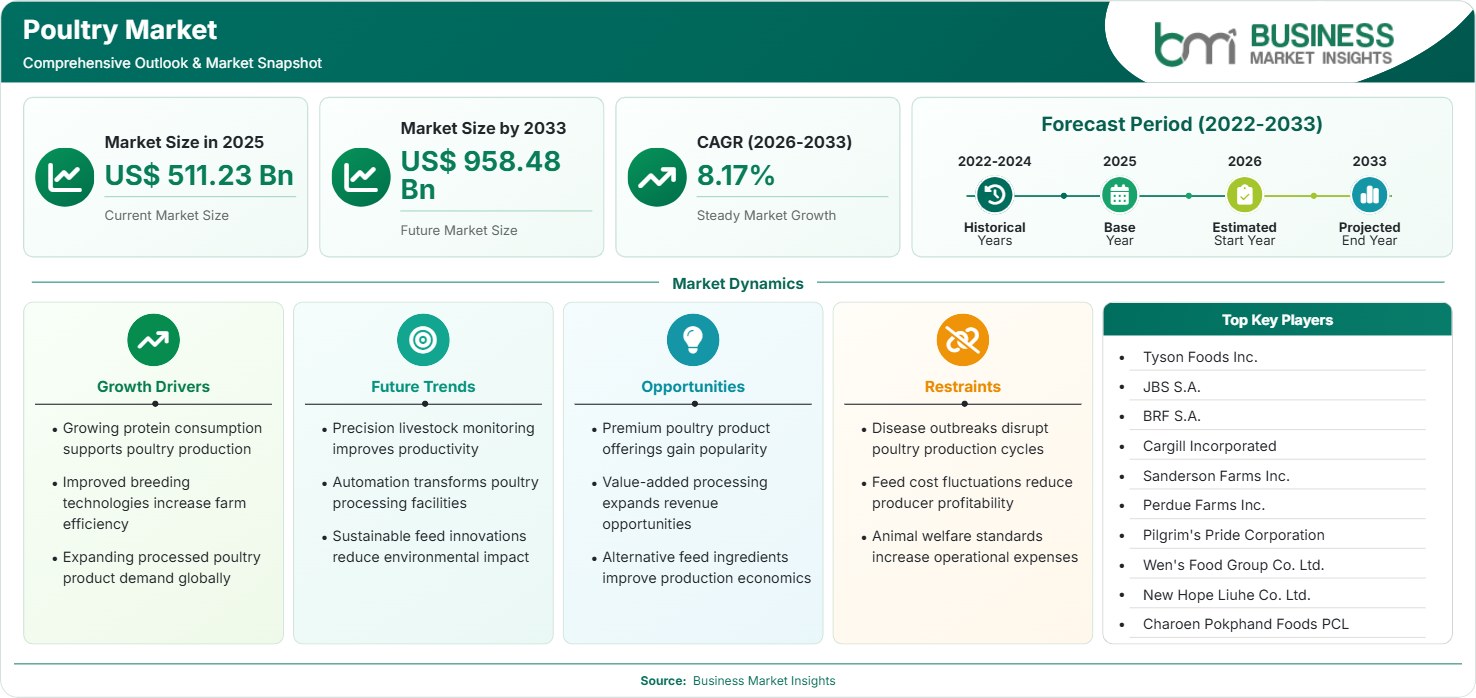
The Poultry Market size was valued at US$ 511.23 billion in 2025 and is projected to reach US$ 958.48 billion by 2033, growing at a CAGR of 8.17% during 2026–2033. Rising protein consumption, advancements in breeding technologies, and increasing demand for processed poultry products continue supporting production expansion and investment across global poultry value chains.

Report Coverage
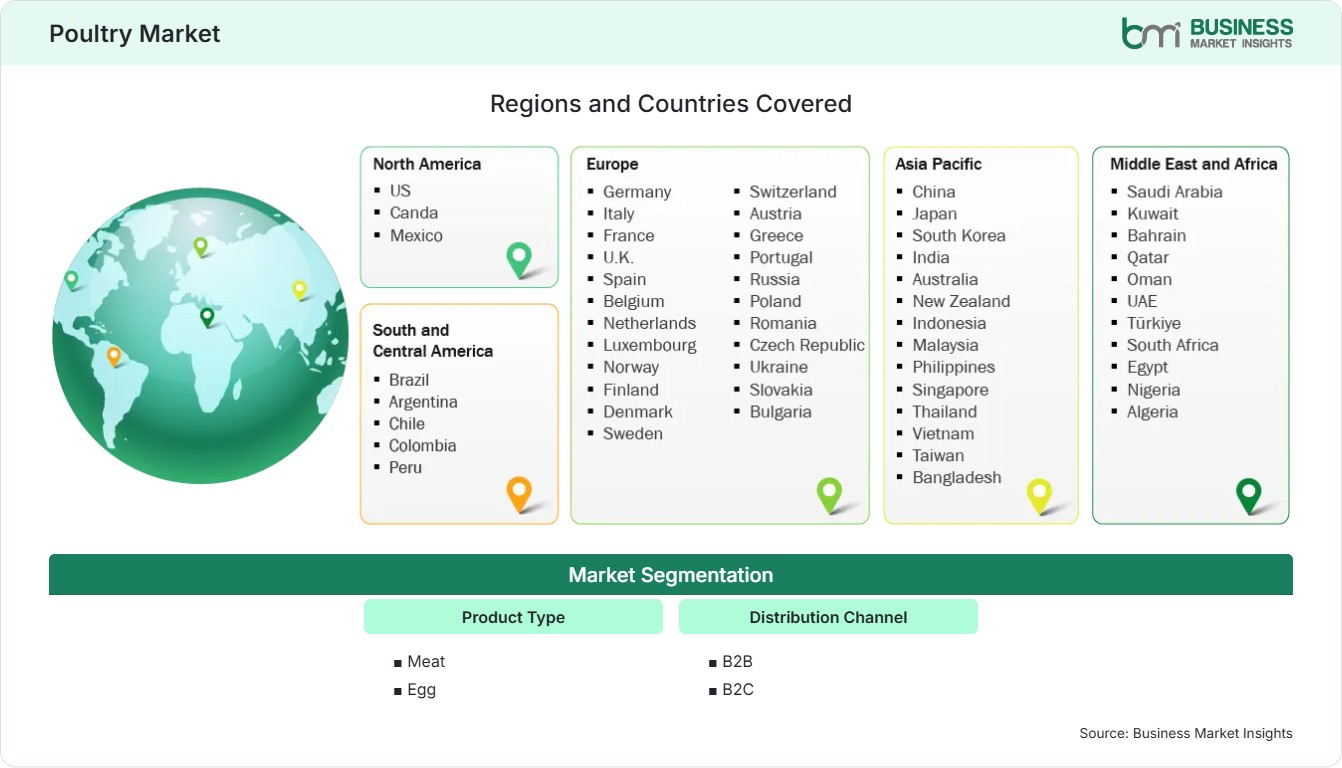
  • Product Type: Meat, Egg
  • Distribution Channel: B2B, B2C
US$ 511.23 Bn Market size in 2025
US$ 958.48 Bn Market Size by 2033
8.17% CAGR, 2026 - 2033
2026-2033 Forecast Period

AI Overview

Poultry Market Summary

  • North America Region: North America holds 26%–29% market share in 2025 and is projected to grow at a CAGR of 7.5%–8.0% during 2026–2033. Strong commercial farming, integrated processing facilities, and stable consumer demand support market expansion. The U.S. remains the dominant regional market with a CAGR of 7.6%–8.1%, driven by automation, export competitiveness, and rising demand for value-added poultry products.
  • Fastest Growing Region: Asia Pacific accounts for 39%–42% market share in 2025 and is expected to register a CAGR of 8.8%–9.4%, supported by population growth, rising disposable income, expanding poultry farming, and increasing consumption of affordable animal protein.
  • Leading Segment: Chicken represents 67%–70% market share in 2025 and is projected to expand at a CAGR of 8.2%–8.7%, supported by affordability, short production cycles, high feed conversion efficiency, and broad consumer acceptance.
  • High Growth Segment: Meat (Fresh/Chilled and Processed) accounts for 72%–75% market share in 2025 and is expected to record a CAGR of 8.4%–8.9%, driven by convenience foods, foodservice expansion, and retail distribution growth.
  • Key Market Opportunity: Premium poultry products, value-added processing, and alternative feed innovations continue creating new revenue opportunities while improving production efficiency and product differentiation across developed and emerging markets.
  • Major Market Players: Tyson Foods, Inc., JBS S.A., BRF S.A., Cargill, Incorporated, Sanderson Farms, Inc., Perdue Farms, Inc., Pilgrim's Pride Corporation, Wen's Food Group Co., Ltd., New Hope Liuhe Co., Ltd., and Charoen Pokphand Foods Public Company Limited.
Strategic Insights

Poultry Market: Strategic Insights

Poultry Market Strategic Framework
FREE PDF
Request your free sample
Request free sample
Stakeholder View

Key Takeaways

  • Integrated poultry production systems continue strengthening operational efficiency through improved breeding, feed management, processing, and distribution capabilities across global supply chains.
  • Processed poultry products offer attractive long-term growth opportunities as consumer demand shifts toward convenient, ready-to-cook, and ready-to-eat protein products.
  • Investments in automation, digital farm management, and precision livestock technologies are improving productivity while supporting sustainable poultry production practices.
  • Asia Pacific remains the strongest regional investment destination because of rising protein consumption, expanding commercial farming, and favorable demographic trends.
  • Strategic acquisitions, production capacity expansion, and investment in value-added processing continue reshaping competitive positioning among major poultry companies.
  • Sustainable feed development and biosecurity improvements are becoming increasingly important for maintaining long-term profitability and protecting production continuity.
Geographic Outlook

Poultry Market Regional Highlights

North America Poultry Market

North America accounts for 26%–29% Poultry Market share in 2025 and is projected to expand at a CAGR of 7.5%–8.0% during 2026–2033. Strong commercial production, advanced processing infrastructure, and high domestic consumption continue supporting regional growth. Leading producers are investing in automation, animal nutrition, and processing efficiency while expanding exports to strengthen global competitiveness and improve supply chain resilience.

  • Advanced breeding technologies continue improving productivity, feed efficiency, and flock management across commercial poultry farms.
  • Processed poultry demand remains strong through supermarkets, foodservice operators, and quick-service restaurant chains.
  • Investments in automated processing facilities improve product quality while reducing labor dependency.
  • Export demand supports production expansion and strengthens North America's global poultry trade position.

US Poultry Market

The United States contributes 83%–86% of North American revenue and is projected to grow at a CAGR of 7.6%–8.1% during the forecast period. Large integrated producers, efficient production systems, and strong domestic consumption continue supporting industry expansion alongside increasing exports.

  • Modern poultry farms utilize precision monitoring technologies to improve flock health and operational efficiency.
  • Consumer preference for convenient processed chicken products continues strengthening retail demand.
  • Export-oriented processing facilities support international market expansion through improved quality standards.
  • Ongoing investments in cold-chain logistics strengthen nationwide poultry distribution networks.

Europe Poultry Market

Europe represents 22%–25% market share in 2025 and is expected to register a CAGR of 7.4%–7.9% through 2026–2033. Consumer demand for quality poultry products, strict food safety standards, and efficient production systems support stable regional growth. Poland leads regional production, while Romania records the fastest growth due to increasing investments in commercial poultry farming.

  • Sustainable farming practices continue influencing production strategies across European poultry operations.
  • Demand for premium and antibiotic-free poultry products continues increasing among consumers.
  • Advanced processing facilities improve product quality and export competitiveness.
  • Retail expansion supports wider distribution of packaged poultry products throughout Europe.

Asia Pacific Poultry Market

Asia Pacific holds 39%–42% market share in 2025 and is projected to record the fastest 8.8%–9.4% CAGR through 2026–2033. Population growth, rising disposable incomes, expanding commercial poultry farming, and increasing demand for affordable protein continue driving regional expansion. China remains the largest market, while India demonstrates the fastest growth supported by increasing poultry consumption and production investments.

  • Commercial poultry production continues expanding to meet rising domestic protein demand.
  • Processing capacity investments improve food quality, safety, and export opportunities.
  • Modern retail and e-commerce channels expand consumer access to packaged poultry products.
  • Government initiatives support livestock productivity and disease prevention programs.

Rest of World Poultry Market

The Rest of World region accounts for 9%–12% market share in 2025 and is expected to grow at a CAGR of 7.8%–8.3% during 2026–2033. Rising poultry consumption, expanding food processing industries, and investment in commercial farming continue supporting market development across Latin America, the Middle East, and Africa.

  • Brazil remains the leading regional producer supported by strong export-oriented poultry processing.
  • Saudi Arabia continues investing in domestic poultry production to strengthen food security.
  • Modern breeding technologies improve production efficiency across commercial poultry farms.
  • Cold-chain infrastructure development supports wider distribution of processed poultry products.
Global Market Geography
FREE PDF
Request your free sample
Request free sample
Segment Analysis

Poultry Market Segmentation

Species

The species segment remains the foundation of global poultry production as consumer demand varies according to dietary preferences, affordability, production efficiency, and regional consumption patterns. It accounted for 67%–70% market share in 2025 and is projected to register a CAGR of 8.2%–8.7% during 2026–2033. Strong commercial farming, efficient breeding programs, and expanding international trade continue widening the Poultry Market scope across developed and emerging economies.

  • Chicken: Dominates global production because of its short production cycle, high feed conversion efficiency, competitive pricing, and extensive consumption across households, foodservice establishments, and processed food manufacturers.
  • Turkey: Maintains stable demand through retail and foodservice channels, particularly in North America and Europe, supported by seasonal consumption, processed meat applications, and increasing preference for lean protein sources.
  • Duck: Continues expanding across Asian markets where traditional culinary preferences, premium product positioning, and growing restaurant demand support commercial production and value-added processing opportunities.

Product Type

Product diversification enables poultry producers to serve both fresh consumption and processed food industries while improving profitability through value-added offerings. This segment accounted for 72%–75% market share in 2025 and is expected to grow at a CAGR of 8.4%–8.9% during 2026–2033. Current Poultry Market trends indicate rising investments in processing facilities, food safety technologies, and cold-chain logistics to meet evolving consumer preferences.

  • Meat (Fresh/Chilled and Processed): Represents the largest product category due to increasing consumption of fresh poultry, frozen products, ready-to-cook meals, processed meat products, and expanding quick-service restaurant demand.
  • Egg: Continues generating stable revenue through household consumption, bakery products, food processing industries, and growing demand for protein-rich, affordable, and nutritionally balanced food products.

Distribution Channel

Distribution channels play an essential role in ensuring consistent product availability while supporting domestic consumption and international trade. This segment accounted for 61%–64% market share in 2025 and is projected to register a CAGR of 8.0%–8.5% during 2026–2033. Investments in modern retail infrastructure, digital commerce, and efficient logistics continue improving supply chain performance and expanding market accessibility.

  • B2B: Remains the dominant distribution channel, supplying processors, wholesalers, foodservice operators, hospitality businesses, institutional buyers, and industrial food manufacturers with bulk poultry products through integrated supply agreements.
  • B2C (Supermarkets & Hypermarkets, Convenience Stores, Online Retail and Others): Continues expanding as organized retail networks, e-commerce platforms, and direct-to-consumer channels improve product availability, cold-chain efficiency, and purchasing convenience for households worldwide.
Market Forces

Poultry Market Dynamics

Key Market Drivers

Growing protein consumption supports poultry production

Rising consumer awareness regarding balanced nutrition and affordable protein sources continues driving poultry consumption worldwide. Products from chicken and other poultry sources still prevail owing to their cost competitiveness, short breeding periods, and smaller carbon footprint when compared to a number of alternative protein sources. Growing city populations, higher incomes, and changes in dietary trends are also driving the growth in both developed and developing countries. The food service industry and retailers keep expanding poultry-related product lines. These factors collectively strengthen Poultry Market growth, encouraging producers to expand commercial farming capacity, improve productivity, and enhance processing infrastructure.

Improved breeding technologies increase farm efficiency

Continuous advancements in poultry genetics, hatchery management, precision feeding, and flock monitoring technologies are improving farm productivity while reducing production costs. Breeding programs today provide better health in birds, improved feed conversion efficiency, faster growth rates, and greater disease resistance in poultry. Digital management systems also enable real-time monitoring of the health of animals, environmental conditions, and operational efficiencies. Commercial operators are now investing in automation for housing, climate controls, and nutritional management systems to ensure maximum production and product quality.

Expanding processed poultry product demand globally

The demand for value-added chicken products continues to rise with the emergence of convenience foods that cater to the busy lifestyles of consumers who need easy access to ready-to-cook or ready-to-eat items. Retailers and fast-food chains are increasingly offering a wide variety of products including marinated chicken, packaged meals, chicken nuggets, sausages, and more. These developments continue shaping Poultry Market trends, encouraging producers to invest in advanced processing facilities and product innovation.

Key Market Opportunities

Premium poultry product offerings gain popularity

Growing demand for high-quality poultry is evident because consumers are more concerned about quality, safety, and traceability of their food. More organic, antibiotic-free, free-range and speciality poultry products are accepted by retailers. Manufacturers expand their high-end product lines and invest in quality control and certification programs to add value to their brands. Poultry Market Forecasts indicate that premiumization will remain an important growth strategy for companies seeking higher margins and stronger customer loyalty in competitive retail markets.

Value-added processing expands revenue opportunities

Value-added poultry processing enables manufacturers to diversify product offerings while increasing profitability across retail and foodservice markets. The introduction of seasoned products, portioned packaging, cooked ready meals, and convenience products helps in tackling lifestyle changes. Advancements in packaging technology and the cold chain system have also played an important role in achieving wider distribution and increased shelf life for products. There is an increasing need for processed protein products in emerging markets, which also opens up avenues for investments.

Alternative feed ingredients improve production economics

Feed manufacturers and poultry producers are increasingly evaluating alternative ingredients to improve production efficiency and reduce dependence on conventional feed commodities. The use of protein concentrates, oilseed products, insect meal, enzymes, and precision nutrition technologies is helping optimize feed efficiency, resulting in cost reductions. Further research into the development of sustainable feeds will help reduce environmental impact and increase supply chain resilience. Companies developing new feed technologies will be able to boost the competitiveness of their operations.

Market Restraints and Challenges

Disease outbreaks disrupt poultry production cycles

Disease outbreaks remain one of the most significant operational challenges facing commercial poultry producers worldwide. Factor: The presence of highly pathogenic avian influenza and other diseases could mean compulsory destruction of flocks, transport bans, export restrictions, and even suspension of production. Impact: The lack of supply, higher production costs, disruptions in international trade, and unstable prices will make operations unprofitable and create uncertainty across the entire poultry industry chain.

Feed cost fluctuations reduce producer profitability

Feed accounts for the largest share of poultry production expenses, making producers highly sensitive to changes in grain and oilseed prices. Factor: Variability in the costs of corn, soybean meal, and other feed components is directly proportional to production costs and hinders future budgeting. Impact: Increased costs cut into profit margins, affect prices, and hinder expansion potential especially among small- and medium-sized poultry companies. Continued improvements in feed utilization and logistics help manage this risk better.

Company Analysis

Competitive Landscape

Competition in the global poultry industry is driven by production scale, vertical integration, breeding efficiency, feed management, processing capabilities, and export reach. Poultry Market analysis shows that leading companies are expanding processing capacity, strengthening biosecurity practices, investing in value-added poultry products, and improving cold-chain infrastructure to address growing global protein demand while complying with evolving food safety and sustainability requirements.

Company Name

Overview

Products and Services Relevant to this Market

Tyson Foods, Inc.

One of the world's largest food companies with vertically integrated poultry production, processing, and distribution operations serving retail and foodservice markets.

Fresh chicken, processed poultry products, frozen foods, prepared meals, poultry processing, and foodservice supply solutions.

JBS S.A.

Global protein producer operating integrated poultry businesses across multiple international markets with extensive processing facilities.

Fresh poultry, frozen chicken, processed meat products, export solutions, value-added poultry, and packaged food products.

BRF S.A.

Leading Brazilian food company with strong international presence in poultry production and processed food manufacturing.

Fresh poultry, processed chicken, frozen products, ready-to-eat foods, halal poultry, and export-oriented food products.

Cargill, Incorporated

Diversified agribusiness company supporting poultry production through feed, processing, risk management, and food manufacturing operations.

Poultry feed, fresh poultry, processed chicken products, nutrition solutions, supply chain management, and food ingredients.

Sanderson Farms, Inc.

Major U.S. poultry producer specializing in fresh chicken products supported by integrated farming and processing operations.

Fresh chicken products, retail poultry, foodservice poultry, poultry processing, and distribution services.

Perdue Farms, Inc.

Integrated poultry producer recognized for premium chicken products and sustainable farming initiatives.

Fresh chicken, organic poultry, processed products, ready-to-cook foods, packaged poultry, and branded retail products.

Pilgrim's Pride Corporation

International poultry producer supplying fresh and value-added poultry products across retail and foodservice sectors.

Fresh poultry, prepared chicken products, frozen poultry, processed meat, export products, and foodservice solutions.

Wen's Food Group Co., Ltd.

Chinese agricultural enterprise with integrated poultry farming, breeding, feed production, and processing operations.

Poultry breeding, fresh chicken, processed poultry, feed products, hatchery services, and integrated farming solutions.

New Hope Liuhe Co., Ltd.

Major Chinese agribusiness company engaged in feed manufacturing, poultry farming, and integrated livestock production.

Poultry feed, breeding services, fresh poultry, animal nutrition, integrated farming, and food production solutions.

Charoen Pokphand Foods Public Company Limited

International food producer operating integrated poultry production, processing, and global food distribution businesses.

Fresh poultry, processed chicken products, poultry feed, breeding operations, ready-to-eat foods, and export solutions.

Trust & Transparency

Research Methodology

The market analysis combines proprietary research with secondary data from government agencies, company disclosures, regulatory filings, industry databases and expert interviews. Market estimates are validated through data triangulation, cross-market benchmarking and analyst review.

View Full Research Methodology

Questions Answered

Frequently Asked Questions

What does the Poultry Market Report include?

The Market Report provides comprehensive insights into market dynamics, competitive landscape, regional performance, segmentation, production trends, investment opportunities, technological developments, and long-term industry outlook.

Which region offers the strongest growth opportunities?

Asia Pacific is expected to deliver the fastest growth due to population expansion, rising disposable income, increasing poultry consumption, commercial farming investments, and continuous modernization of processing facilities.

Why is processed poultry experiencing strong demand?

Consumers increasingly prefer ready-to-cook and ready-to-eat food products that offer convenience, longer shelf life, and consistent quality. This trend supports investment in advanced poultry processing and packaging technologies.

Which poultry species dominates the global market?

Chicken remains the dominant species because of its affordability, rapid production cycle, efficient feed conversion, broad consumer acceptance, and widespread use across retail, foodservice, and food processing industries.

What factors are driving the Poultry Market?

The market is supported by rising protein consumption, expanding commercial poultry farming, improved breeding technologies, increasing demand for processed poultry products, and continuous investment in modern processing and cold-chain infrastructure.

Access the Full Poultry Market Report

Get segment-level forecasts, regional estimates, competitive benchmarking, company profiles and downloadable Excel datasets.

Access the full Poultry Market Report
350 pages PDF & Excel | 2026-08-17
Similar Research

Related Market Reports