
Natural Food Preservatives Market Outlook: Size, Share, Trends, Growth Analysis, Competitive Landscape & Forecast, 2026-2033

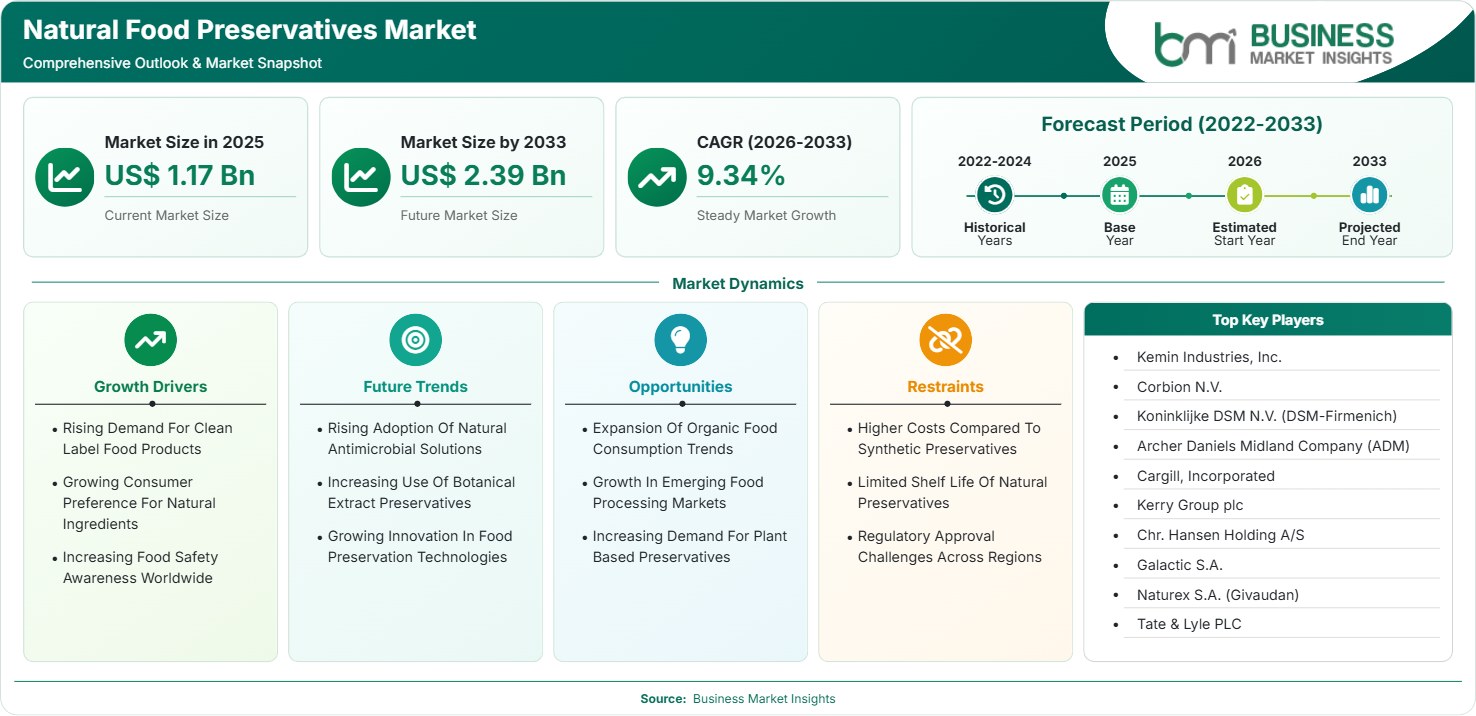
The Natural Food Preservatives Market size was valued at USD 1.17 Billion in 2025 and is projected to reach USD 2.39 Billion by 2033, growing at a CAGR of 9.34% during 2026–2033, driven by clean label demand, rising food safety requirements, organic food expansion, and innovation in plant-based preservation technologies.

Report Coverage
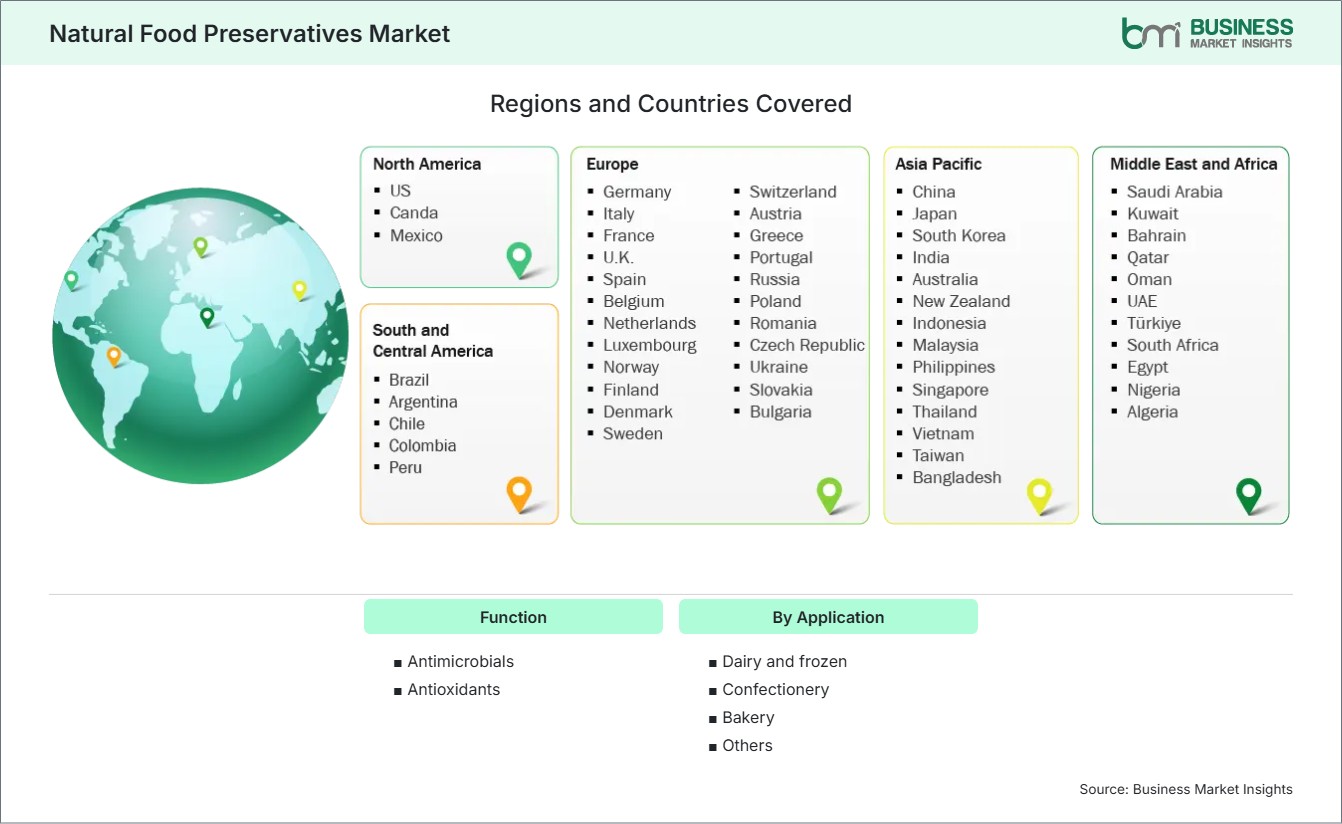
  • Function: Antimicrobials, Antioxidants
  • By Application: Dairy and frozen, Confectionery, Bakery, Others
US$ 1.17 Bn Market size in 2025
US$ 2.39 Bn Market Size by 2033
9.34% CAGR, 2026 - 2033
2026-2033 Forecast Period

01 AI Overview

Natural Food Preservatives Market Summary

  • North America Region: North America holds a 34%–37% share in 2025, growing with a CAGR of 8.70%–9.30% driven by clean label trends, food processing, regulation, and the use of natural antimicrobial solutions. Market analysis of the US shows consistent growth, with a CAGR ranging from 8.80% to 9.40%. This has been fueled by the formulation of food products with natural ingredients.
  • Fastest Growing Region: Asia Pacific occupies a market share of 27%-30% in 2025, growing at a rate of 10.20%-11.00% because of food processing development, rising disposable incomes, urbanization, consumption of packaged food products, and application of sophisticated food preservation methods in emerging countries.
  • Leading Segment: Antimicrobials hold a 55%–58% share in 2025, with an annual growth rate of 9.00%–9.60%. This is attributed to increased demand for extended shelf life, microbial activity control, acceptability among regulators, and use in dairy, bakery
  • High Growth Segment: Plant-derived antioxidants with natural preservative applications will have a market share of 42% to 45% by 2025, growing at a CAGR of 10.00% to 10.80%, owing to the need for oxidation control, natural product preferences, and food
  • Key Market Opportunity: Expanding the range of organic food categories, the growing demand for minimally processed products, and the development of multifunctional natural preservative systems present opportunities for companies that have invested in sustainable food extraction and formulation processes.
  • Major Market Players: Kemin Industries, Inc., Corbion N.V., Koninklijke DSM N.V., Archer Daniels Midland Company, Cargill, Incorporated, Kerry Group plc, Chr. Hansen Holding A/S, Galactic S.A., Naturex S.A., and Tate & Lyle PLC.
02 Strategic Insights

Natural Food Preservatives Market: Strategic Insights

Natural Food Preservatives Market Strategic Framework
FREE PDF
Request your free sample
Request free sample
03 Stakeholder View

Key Takeaways

  • The value chain is shifting from conventional ingredient sourcing to integrated ecosystems that include agriculture suppliers, extraction technique providers, food manufacturers, and formulators. Businesses with the capacity for botanical extract sourcing, fermentation ingredient sourcing, and preservation techniques will be at an advantage.
  • Applications in the dairy, bakery, confectionery, and frozen food categories are good avenues for expansion, as suppliers continue to provide preservative products that extend shelf life without interfering with clean labeling requirements. Suppliers who can create multifunctional ingredients having antimicrobial and antioxidant activities will have more formulation opportunities.
  • The trend in innovation is moving towards better extraction methods, preservation using fermentation products, and stable natural ingredients for use in various foods. The areas of research and development are focusing on improving efficacy, reducing dosages, and enhancing compatibility with processed food products.
  • Asia Pacific offers a lucrative prospect due to expansion in the food processing industry, rising demand for packaged foods, and greater consumer awareness of the ingredients used in such products. Countries like China and India are offering new prospects due to their development capabilities in the food production sector.
  • Increasing strategic investment and partnerships are evident as ingredient suppliers develop their natural preservative ranges through mergers and acquisitions, technology alliances, and local capacity building. The market players are focusing on developing their innovation pipeline in response to demands for sustainable and regulatory-compliant solutions.
04 Geographic Outlook

Natural Food Preservatives Market Regional Highlights

North America Natural Food Preservatives Market

North America accounted for a 34%–37% share in 2025, supported by strong clean label adoption and advanced food processing infrastructure. The region is projected to grow at a CAGR of 8.70%–9.30% during 2026–2033. The Natural Food Preservatives Market share is influenced by consumer preference for transparent ingredients, regulatory support, and innovation from established ingredient suppliers. The US remains the dominant contributor due to reformulation activities across packaged food categories.

  • Growing demand for clean label products is encouraging manufacturers to replace synthetic preservatives with naturally derived alternatives across processed food applications.
  • Advanced food technology infrastructure supports development of innovative preservation systems using fermentation, botanical extracts, and multifunctional natural ingredients.
  • Regulatory focus on ingredient transparency is accelerating adoption among food companies seeking compliance with evolving consumer expectations.
  • Increasing demand for organic and minimally processed foods is expanding applications for natural preservatives in premium food categories.

US Natural Food Preservatives Market

The US represented a 28%–31% share in 2025 and is expected to expand at a CAGR of 8.80%–9.40% between 2026–2033. Strong presence of food manufacturers, advanced research capabilities, and consumer demand for healthier products are supporting market expansion. The Natural Food Preservatives Market growth in the country is driven by reformulation strategies across beverages, bakery products, dairy items, and convenience foods requiring improved shelf stability.

  • Food manufacturers are investing in clean label reformulation programs to align product portfolios with changing consumer preferences.
  • Increasing demand for functional foods is creating opportunities for natural antioxidant and antimicrobial ingredient suppliers.
  • Advanced food processing capabilities enable faster adoption of innovative preservation technologies across multiple product categories.

Europe Natural Food Preservatives Market

Europe held a 25%–28% share in 2025, expanding at a CAGR of 8.90%–9.50% during 2026–2033. The region benefits from strict food quality standards, strong organic food demand, and established ingredient innovation capabilities. Germany, the United Kingdom, and France are major contributors, with Germany growing at 9.00%–9.60% CAGR due to advanced food manufacturing and sustainability initiatives. The Natural Food Preservatives Market share reflects strong consumer acceptance of naturally sourced ingredients.

  • Stringent food regulations are encouraging manufacturers to adopt safer preservation technologies and reduce reliance on synthetic additives.
  • Rising organic food consumption across Germany and France is increasing demand for botanical and fermentation-based preservatives.
  • Sustainability commitments among food companies are supporting investments in naturally derived ingredient solutions.
  • Research collaborations between ingredient producers and food manufacturers are accelerating product innovation.

Asia Pacific Natural Food Preservatives Market

Asia Pacific represented a 27%–30% share in 2025 and is projected to register the highest CAGR of 10.20%–11.00% from 2026–2033. The Natural Food Preservatives Market growth is supported by expanding processed food industries, urbanization, and increasing awareness regarding food quality. China and India are leading markets, with India achieving a CAGR of 11.00%–11.80% due to rising packaged food consumption and manufacturing investments.

  • Expanding food processing industries are creating demand for preservation solutions across dairy, bakery, and convenience food segments.
  • Rising middle-class populations are increasing consumption of packaged foods requiring extended shelf life.
  • Domestic ingredient production capabilities are improving through investments in biotechnology and natural extraction processes.
  • Growing awareness of clean label products is encouraging regional food manufacturers to adopt natural additives.

Rest of World Natural Food Preservatives Market

Rest of World accounted for an 8%–11% share in 2025, with growth expected at a CAGR of 9.50%–10.20% during 2026–2033. South America and the Middle East & Africa are experiencing increased demand due to expanding food processing sectors and changing consumer preferences. Brazil and UAE are key contributors, with Brazil growing at 9.30%–10.00% CAGR and UAE at 10.00%–10.70% CAGR.

  • Growing packaged food consumption in Brazil is encouraging manufacturers to adopt natural preservation technologies for extended product quality.
  • Middle Eastern food companies are investing in premium food categories requiring clean label preservation solutions.
  • Increasing retail modernization across developing economies is supporting demand for processed and preserved foods.
  • Regional manufacturers are partnering with global ingredient suppliers to access advanced natural preservation technologies.
Global Market Geography
FREE PDF
Request your free sample
Request free sample
05 Segment Analysis

Natural Food Preservatives Market Segmentation

Function

The function segment represents a critical category, with antimicrobials leading at a 55%–58% share in 2025 and expanding at a CAGR of 9.00%–9.60% between 2026–2034. The Natural Food Preservatives Market scope is supported by increasing demand for microbial control solutions, longer shelf life requirements, and clean label reformulation. Antioxidants are gaining adoption through oxidation prevention applications.

  • Antimicrobials: Antimicrobial preservatives maintain food safety by controlling bacterial and fungal growth. Demand is increasing across dairy, bakery, and processed foods due to extended shelf-life requirements and regulatory acceptance of natural solutions.
  • Antioxidants: Natural antioxidants prevent oxidation-related quality deterioration while preserving flavor, color, and nutritional value. Growing functional food consumption and consumer preference for plant-derived ingredients are supporting adoption across diverse food applications.

Application

Application segments demonstrate increasing adoption as food manufacturers seek natural preservation methods compatible with consumer preferences and regulatory requirements. Dairy and frozen products represent a leading category with a 36%–39% share in 2025 and a CAGR of 9.20%–9.80% during 2026–2034. The Natural Food Preservatives Market trends are influenced by demand for safer formulations, improved product stability, and sustainable ingredient solutions.

  • Dairy and frozen: Dairy and frozen food manufacturers are adopting natural preservatives to maintain freshness, improve microbial stability, and support clean label claims. Rising consumption of convenient dairy products drives formulation innovation.
  • Confectionery: Confectionery producers are incorporating natural preservatives to enhance product quality while meeting consumer expectations for healthier ingredients. Applications include chocolates, candies, and specialty products requiring improved stability.
  • Bakery: Bakery applications are expanding due to demand for extended freshness, mold control, and reduced synthetic additive usage. Natural preservation solutions help manufacturers maintain product quality while supporting premium positioning.
06 Market Forces

Natural Food Preservatives Market Dynamics

Key Market Drivers

Rising Demand For Clean Label Food Products

The increasing demand for clean label food products is reshaping formulation strategies as consumers seek products containing recognizable and naturally sourced ingredients. Food manufacturers are actively reducing synthetic preservatives and adopting alternatives derived from herbs, spices, cultured ingredients, and plant extracts. This transition is creating opportunities for ingredient suppliers to develop stable, effective, and scalable preservation solutions. Retailers and food brands are also emphasizing transparency through simplified ingredient lists and sustainability-focused product positioning. The shift toward minimally processed foods is encouraging innovation in natural preservation technologies that maintain taste, texture, and safety. As consumer expectations continue evolving, companies with advanced formulation capabilities are gaining competitive advantages in premium food categories.

Growing Consumer Preference For Natural Ingredients

Consumer preference for natural ingredients is influencing purchasing decisions across global food markets and encouraging manufacturers to prioritize naturally sourced preservation systems. Increasing awareness of artificial additives and demand for healthier food choices are driving reformulation activities across multiple product categories. Natural ingredients are becoming essential components in premium, organic, and functional food products where consumers associate transparency with quality. Ingredient suppliers are developing botanical extracts, essential oils, and fermentation-derived compounds that provide preservation benefits while supporting clean label positioning. This trend is strengthening collaboration between food producers and technology providers focused on improving ingredient performance, stability, and application flexibility.

Increasing Food Safety Awareness Worldwide

Rising food safety awareness is increasing demand for preservation technologies that protect products against microbial contamination and quality degradation. Food manufacturers are implementing advanced preservation systems to comply with safety standards and reduce product losses throughout supply chains. Natural preservatives are gaining attention as companies seek solutions that combine safety performance with consumer acceptance. Growing concerns regarding food waste are also encouraging investment in ingredients that extend shelf life while maintaining product integrity. Regulatory bodies and industry organizations continue emphasizing improved food safety practices, supporting innovation in natural antimicrobial solutions. This driver is creating opportunities for companies developing effective preservation technologies suitable for diverse food applications.

Key Market Opportunities

Expansion of Organic Food Consumption Trends

The rapid expansion of organic food consumption is creating substantial opportunities for manufacturers of natural food preservatives as consumers increasingly prefer products made with recognizable, plant-derived ingredients. According to the Food and Agriculture Organization of the United Nations and FiBL, global organic agriculture continues to expand in both cultivated land and retail sales, encouraging food manufacturers to eliminate synthetic additives from organic formulations. The Natural Food Preservatives Market Forecasts indicate sustained investment in botanical extracts, cultured dextrose, vinegar derivatives, rosemary extract, and natural antimicrobial systems that comply with organic certification standards. Food processors are increasing partnerships with ingredient suppliers to develop preservative blends that maintain shelf life without compromising clean-label positioning. Growing consumer willingness to pay premium prices for minimally processed organic foods further strengthens commercial opportunities across dairy, bakery, beverages, sauces, and packaged ready-to-eat products.

Growth in Emerging Food Processing Markets

Rapid industrialization of food processing industries across emerging economies presents a significant growth avenue for natural food preservative manufacturers. Countries including India, Brazil, Indonesia, Vietnam, Mexico, and several Middle Eastern nations are witnessing increasing investments in packaged foods, cold-chain infrastructure, and modern retail channels. Rising disposable incomes, urbanization, and changing dietary habits are accelerating demand for processed foods with longer shelf life while maintaining natural ingredient profiles. Governments are also encouraging value-added food manufacturing through investment incentives and food safety modernization programs, increasing the adoption of advanced preservation technologies. International ingredient manufacturers are expanding production facilities and regional distribution networks to serve local processors seeking regulatory-compliant natural preservation solutions. This trend creates opportunities for customized preservative formulations tailored to regional food products, climatic conditions, and evolving consumer preferences.

Increasing Demand for Plant Based Preservatives

Growing interest in plant-based ingredients across the global food industry is creating new opportunities for naturally derived preservative solutions. Manufacturers are increasingly incorporating rosemary extract, green tea polyphenols, citrus extracts, oregano oil, thyme oil, clove extract, and fermented plant compounds as alternatives to synthetic preservatives. Consumer demand for vegan, vegetarian, allergen-free, and sustainably sourced foods continues to expand the application scope of botanical preservation technologies across multiple food categories. Advances in extraction technologies, encapsulation methods, and synergistic ingredient combinations are improving antimicrobial and antioxidant performance while minimizing flavor impacts. Research collaborations between ingredient developers, universities, and food manufacturers are accelerating commercialization of novel plant-derived preservatives capable of meeting stringent food safety requirements without compromising taste, texture, nutritional quality, or clean-label product positioning.

Market Restraints and Challenges

Higher Costs Compared To Synthetic Preservatives

Factor: The higher production costs associated with natural preservatives remain a key challenge for manufacturers seeking wider adoption across price-sensitive food categories. Factor: Natural preservatives often require specialized extraction processes, advanced purification technologies, and controlled sourcing of botanical, microbial, or fermentation-based raw materials, increasing overall formulation expenses compared with conventional synthetic alternatives. Impact: These elevated costs can limit adoption among small and medium-sized food processors, particularly in developing markets where pricing remains a critical purchasing factor. Manufacturers must balance premium positioning with cost optimization through improved supply chain management, scalable production methods, and technological advancements. Although consumers increasingly support clean-label products, the price gap between natural and synthetic preservation systems continues to influence purchasing decisions and slows penetration in mass-market food applications.

Limited Shelf Life Of Natural Preservatives

Factor: The limited shelf stability and performance consistency of some natural preservation solutions create operational challenges for food manufacturers. Factor: Many plant-based and biological preservatives have lower stability under varying temperature, humidity, pH, and processing conditions compared with synthetic preservatives, requiring careful formulation and application expertise. Impact: This limitation can restrict their use in products requiring extended distribution periods, global transportation, and long storage cycles. Food companies must invest in research and development to improve efficacy through encapsulation, combination technologies, and optimized delivery systems. Variability in raw material composition from agricultural sources can further affect preservative performance and batch consistency. Addressing these technical limitations remains essential for expanding natural preservation adoption across processed foods, dairy products, bakery items, and frozen applications.

07 Company Analysis

Competitive Landscape

The Natural Food Preservatives Market analysis is characterized by intense competition among global ingredient manufacturers focused on clean-label innovation, fermentation technologies, botanical extracts, and naturally derived antimicrobial solutions. Companies are expanding research capabilities, strengthening regional production networks, and collaborating with food manufacturers to develop customized preservation systems that comply with evolving food safety regulations and consumer preferences for minimally processed products.

Company Name

Overview (20–30 words)

Products and Services Relevant to this Market (20–30 words)

Kemin Industries, Inc.

Global ingredient manufacturer specializing in food technologies, animal nutrition, and human health solutions with extensive expertise in natural preservation systems.

Natural antioxidants, antimicrobial ingredients, rosemary extracts, shelf-life extension solutions, food protection technologies, technical support, and customized preservation formulations.

Corbion N.V.

Netherlands-based biotechnology company recognized for fermentation-based food ingredients and sustainable preservation technologies serving global food manufacturers.

Lactic acid, cultured preservatives, vinegar-based preservation systems, antimicrobial ingredients, fermentation solutions, clean-label ingredients, and food safety technologies.

Koninklijke DSM N.V.

International science-based company providing nutritional, health, and bioscience solutions supporting sustainable food production and ingredient innovation.

Natural preservation ingredients, enzyme solutions, nutritional ingredients, fermentation technologies, food processing solutions, and formulation support services.

Archer Daniels Midland Company

Global agricultural processing and nutrition company supplying food ingredients through integrated sourcing, manufacturing, and innovation capabilities.

Plant-derived ingredients, natural extracts, food ingredient solutions, botanical ingredients, formulation services, and customized preservation components.

Cargill, Incorporated

Multinational food ingredient producer offering broad portfolios of agricultural, food, and specialty ingredient solutions for global food manufacturers.

Natural food ingredients, texturizers, botanical extracts, preservation solutions, formulation assistance, and ingredient supply chain services.

Kerry Group plc

Ireland-based taste and nutrition company delivering clean-label technologies and advanced ingredient solutions across diverse food and beverage applications.

Natural preservation systems, functional ingredients, taste modulation, clean-label solutions, antimicrobial technologies, and food application support.

Chr. Hansen Holding A/S

Global bioscience company specializing in microbial solutions and natural ingredients for food preservation, health, and agricultural applications.

Protective cultures, fermentation technologies, natural antimicrobial cultures, dairy preservation solutions, food cultures, and ingredient development services.

Galactic S.A.

Belgium-based producer specializing in fermentation-derived ingredients and natural preservation technologies for food safety and shelf-life improvement.

Lactic acid solutions, cultured preservatives, antimicrobial ingredients, fermentation products, clean-label preservation systems, and technical formulation support.

Naturex S.A.

Natural plant ingredient specialist with expertise in botanical extraction technologies serving food, beverage, and nutrition industries worldwide.

Botanical extracts, natural antioxidants, plant-derived preservation ingredients, fruit extracts, vegetable concentrates, and formulation support.

Tate & Lyle PLC

Global provider of specialty food ingredients focused on healthier formulations, ingredient innovation, and sustainable food manufacturing solutions.

Specialty food ingredients, ingredient formulation services, stabilization technologies, plant-based solutions, food ingredient development, and application expertise.

08 Industry Activity

Recent Developments

June 2026

Chinova Bioworks producing natural preservatives and fining agents from upcycled mushroom stalks and also expanding its capacity four-fold to fuel international expansion and meet demand in fast-growing markets such as non-alcoholic beer.

September 2025

dsm-firmenic launched its next-generation Dairy Safe all-in-one cultures, providing label-friendly bioprotection solutions that enable cheese manufacturers to reduce artificial preservatives while extending shelf life and maintaining product quality.

August 2025

dsm-firmenic announced major investments in its Kerala seasoning facility and a new Taste manufacturing plant in Gujarat, India, supporting clean-label flavor innovation and expanding production capacity for natural food ingredients.

March 2025

BASF SE launched two new Isobionics biotechnology-derived natural flavor ingredients, produced through fermentation technology, supporting the clean-label movement and broader adoption of naturally derived food ingredients.

10 Trust & Transparency

Research Methodology

The market analysis combines proprietary research with secondary data from government agencies, company disclosures, regulatory filings, industry databases and expert interviews. Market estimates are validated through data triangulation, cross-market benchmarking and analyst review.

View Full Research Methodology

11 Questions Answered

Frequently Asked Questions

What insights are covered in the Natural Food Preservatives Market Report?

The market report provides analysis of market size, competitive strategies, segmentation, regional developments, technological advancements, growth drivers, challenges, and emerging opportunities influencing the global industry landscape.

What role do regulations play in market development?

Food safety authorities and regulatory frameworks encourage transparent ingredient labeling and safer preservation practices, supporting innovation in naturally derived solutions that meet consumer expectations and compliance requirements.

How are manufacturers improving the performance of natural preservation solutions?

Companies are investing in fermentation technologies, encapsulation methods, botanical extraction, and combined preservation systems to enhance stability, antimicrobial effectiveness, and compatibility with different food formulations.

Which applications provide the strongest growth opportunities for natural preservatives?

Dairy products, bakery items, frozen foods, and processed foods offer strong opportunities due to increasing demand for extended shelf life, improved food safety, and natural ingredient positioning among consumers.

What factors are influencing the adoption of natural food preservatives?

Consumer preference for clean-label products, stricter food safety standards, demand for minimally processed foods, and increasing replacement of synthetic additives are driving adoption across dairy, bakery, confectionery, and packaged food applications.

Access the Full Natural Food Preservatives Market Report

Get segment-level forecasts, regional estimates, competitive benchmarking, company profiles and downloadable Excel datasets.

Access the full Natural Food Preservatives Market Report
350 pages PDF & Excel | 2026-07-27